
What this guide answers
- What are the main duties of a club secretary?
Five clusters cover the role: running the meeting cycle (agendas, minutes, action tracking); managing official correspondence as the club's point of contact; keeping the club's records and registers — constitution…
- Is a club secretary legally responsible for anything?
Generally yes, though what exactly falls on the secretary depends on the club's legal form.
- How many hours a week does a club secretary spend?
For a typical community club: two to four hours a week in season, spiking around registration, the AGM and grant deadlines, and much less over the off-season.
- What makes a good club secretary?
Organised beats brilliant: the great secretaries are systematic (everything filed, everything dated), communicative (minutes out fast, replies acknowledged), and appropriately stubborn about process — notice periods…
South Africa edition. This guide is written for volunteer-run clubs in South Africa. Where rules differ — grants, tax, incorporation, safeguarding — follow the South Africa-specific pointers below or check with your national body.
Ask any long-serving club person which committee role actually keeps a club running and they'll rarely say the president. The secretary is the club's engine room: the person who knows what was decided, what's due, who to contact and where everything is. When the role is done well, nobody notices. When it's vacant or drowning, everything — registrations, insurance, the AGM, the relationship with the association — starts slipping at once.
This guide lays out the whole role honestly: every duty a club secretary carries, a month-by-month calendar so nothing ambushes you, the tools that shrink the workload, and the checklist that makes handover painless. Whether you've just been talked into the job at an AGM or you're writing a role description to recruit someone, this is the complete picture.
The role in one paragraph
The secretary is the club's administrative officer and official point of contact, and in most legal forms the role carries genuine legal weight.
Where the club is a registered NPO, the secretary carries the annual reporting the Non-profit Organisations Act requires — narrative and financial reports filed with the Department of Social Development each year. Missing them puts the registration at risk, and with it most of the club's grant eligibility.
Practically, the secretary runs the information side of the club: meetings and minutes, correspondence in and out, the records, the memberships paperwork, and the compliance calendar.
What the secretary is not: the person who does everything the committee didn't assign. Protecting the role from scope creep is half the art of surviving it.
The duties, broken down
1. Meetings — before, during, after
The most visible slice of the job:
- Before: book the meeting, build the agenda with the president, circulate agenda and papers a few days out so people arrive having read them.
- During: record attendance and apologies, take minutes — decisions and action items with names and dates, not a transcript of who said what.
- After: circulate draft minutes within a week (while memory is fresh), track the action list, and bring unfinished items back to the next agenda so nothing evaporates.
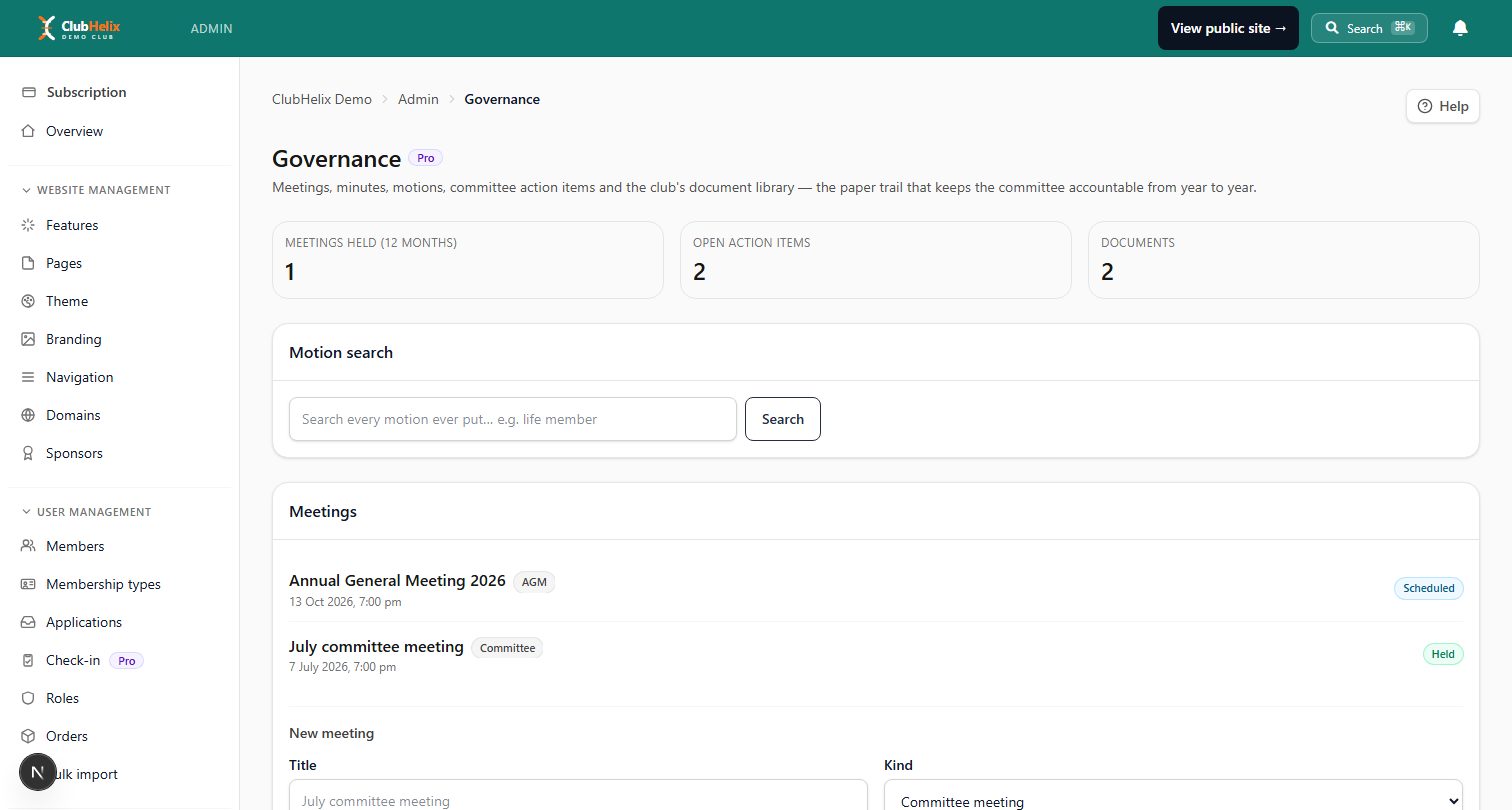
Good minutes are short. "The committee approved the purchase of new match balls, up to $400 — action: Treasurer, by 30 June" is a complete minute. Clubs that keep meeting records in a proper meetings and governance tool — agendas, minutes and resolutions stored against each meeting — save their future selves the classic archaeology of digging through personal inboxes for what was agreed in 2023.
2. Correspondence — the club's inbox
The secretary is the official channel between the club and the world: the association and governing body, the council (ground allocations, permits), insurers, grant bodies, schools, and members. The workable system has three rules:
- One address: everything flows through
secretary@yourclub.org.auon the club's own domain — never a personal inbox. The address outlives the person. - Triage, don't absorb: forward finance to the treasurer, coaching matters to the appropriate coordinator, and log anything needing a committee decision for the agenda. The secretary routes; the secretary does not personally resolve everything.
- Reply-or-acknowledge: even "received, will raise at the next meeting" keeps the club's reputation with the association and council healthy.
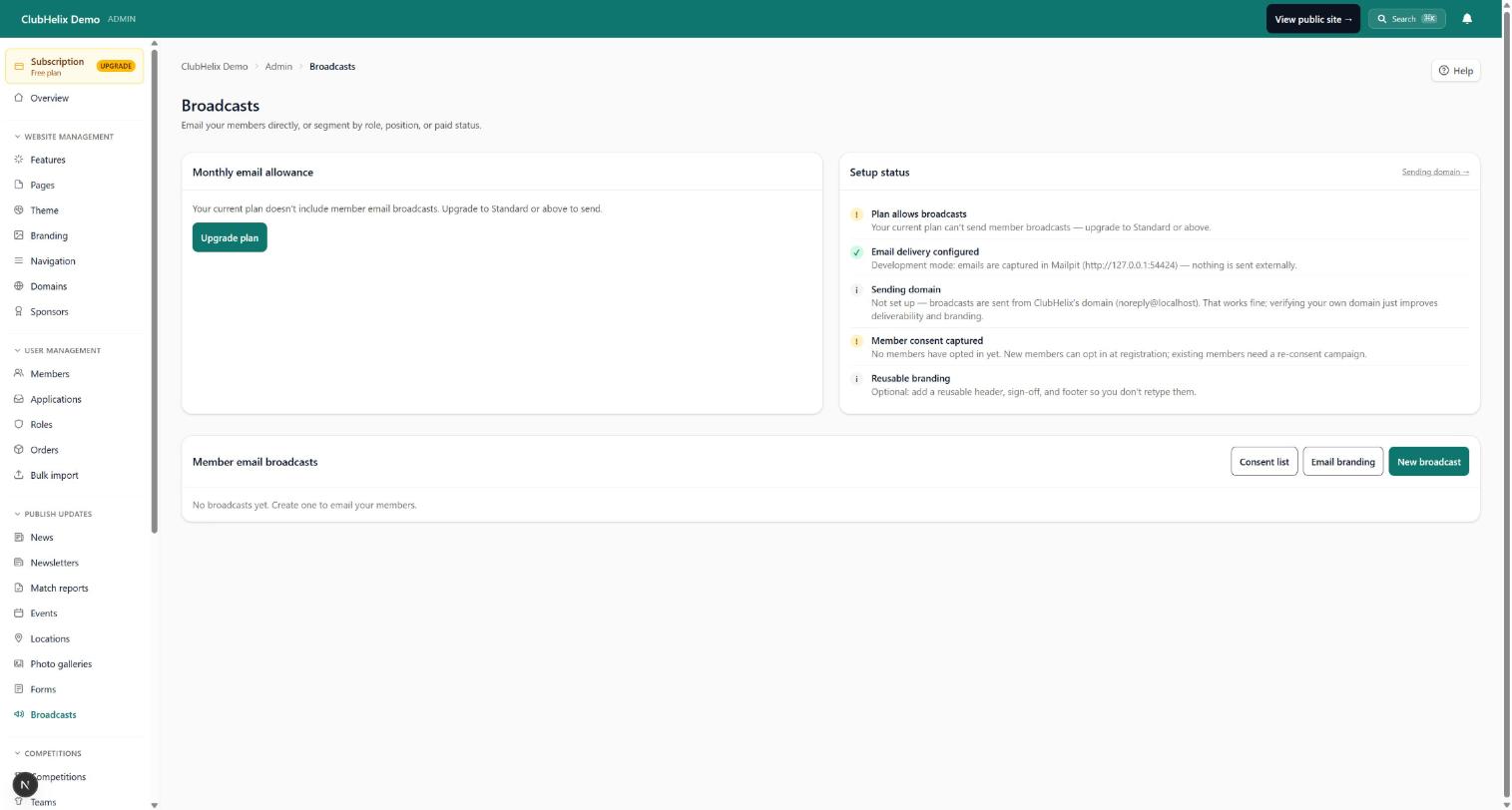
Outbound member communication is the other half. Notices of meetings, registration reminders, key-date announcements — the secretary is usually the sender. Doing this from a personal account with fifty BCC'd addresses is how clubs land in spam folders and privacy strife; a proper member broadcast tool sends from the club's address to exactly the right member list, with unsubscribes handled automatically.
3. Records and registers — the club's memory
The secretary is custodian of the documents that prove the club is what it says it is:
- The constitution/rules (current version, plus amendment history) and the certificate of incorporation.
- The register of members — a legal requirement for incorporated associations in every state, kept current as people join and leave.
- Minutes archive for committee meetings and general meetings.
- Insurance certificates, affiliation documents, council agreements and leases, policies (codes of conduct, child safety, privacy), grant paperwork and key contracts.
The standard to hold yourself to: if the whole committee changed tomorrow, could the new one find everything? That means club-owned storage (not a personal laptop), sensible folders, and the asset and login register kept current.
4. Compliance and official lodgements
The calendar-driven core of the role, and the part with real consequences when missed:
- Annual return / annual summary to your state's incorporating regulator (Fair Trading, Consumer Affairs or equivalent) after the AGM, on time.
- AGM mechanics: proper notice to members per the constitution, nominations, proxies if allowed, quorum, and lodging any resulting changes (new office holders, rule amendments).
- Affiliation renewals with your association or governing body, and the member insurance that usually rides on them.
- Registers the law or your funding requires: committee member details, conflicts of interest where applicable, working-with-children check currency for relevant roles (coordinate with whoever owns child safety).
None of this is hard; all of it is dated. Which is why the next section exists.
5. Membership administration (in many clubs)
In clubs without a separate registrar, the secretary also runs membership: registration setup each season, approving applications, keeping the register synced with reality, and chasing the unfinancial. If your club still does this on paper and spreadsheets, this is the single duty most worth automating — online registration that feeds the member register directly removes the secretary's biggest annual workload spike.
The secretary's annual calendar
Adjust months to your season; the shape is what matters.
| When | What's due |
|---|---|
| Pre-season (2–3 months out) | Affiliation renewal; insurance confirmed; registration opens; council ground allocations confirmed |
| Season start | Member register current; welcome email to members; key-dates notice out |
| Monthly, all year | Committee meeting cycle (agenda → minutes → actions); correspondence triage |
| Mid-season | Grant deadlines (many open mid-year); working-with-children check audit |
| Season end | Presentation night notices; AGM planning begins |
| AGM month | Notice per constitution; nominations; reports compiled; AGM run and minuted |
| Within weeks of AGM | Annual return lodged; office-holder changes lodged; bank signatories updated; handover to any successor |
Put every dated item in a shared club calendar with reminders — not your personal one. The calendar is a club asset that hands over with the role.
Shrinking the job: tools and delegation
The secretary role has a reputation for burnout, mostly in clubs where it's actually four roles wearing one badge. Three fixes:
-
Split what can be split. Registrar for memberships, a comms volunteer for newsletters and socials, a grants officer if you chase funding. The constitution rarely requires the secretary to do these — habit does.
-
Move from personal tools to club systems. Club email domain, shared document storage, a club platform where meetings, member records and email live in one place with role-based access. Every task that moves out of a personal inbox is one that hands over cleanly.
In ClubHelix, that looks like minutes that lock once the committee adopts them, action items with a named owner and a reminder email, and committee tasks assigned to a position rather than a person, so they pass to the next secretary at the AGM without a handover meeting. You can click through all of it in the live demo without creating an account.
-
Write the runbook as you go. A living "how I do this" document — where things are, logins (in the club's password manager), the annual calendar, contacts at the association and council. Twenty minutes a month writing it saves your successor forty hours, and it's the core of the committee handover checklist.
The club secretary checklist
The condensed version to print or pin:
Weekly: clear and triage the secretary inbox · update the action list · send any due member notices.
Monthly: agenda out ahead of the meeting · minutes out within a week after · actions chased · registers touched if anything changed.
Season: registration and affiliation done · insurance certificates filed · key dates published to members · council/grounds paperwork current.
Annually: AGM noticed, run, minuted · annual return lodged · office-holder changes lodged everywhere (regulator, bank, association, website) · document archive tidy · handover pack updated.
Frequently asked questions
What are the main duties of a club secretary?
Five clusters cover the role: running the meeting cycle (agendas, minutes, action tracking); managing official correspondence as the club's point of contact; keeping the club's records and registers — constitution, member register, minutes, insurance and policies; driving the compliance calendar, including the AGM and the annual return to the state regulator; and, in many clubs, membership administration. The common thread is information: the secretary is the person who knows what was decided, what's due and where everything is.
Is a club secretary legally responsible for anything?
Generally yes, though what exactly falls on the secretary depends on the club's legal form. Committee members also share general duties to act honestly and carefully. None of this is cause for alarm — the obligations are straightforward when the calendar is kept — but check your own regulator's guidance rather than relying on a general article like this one.
Where the club is a registered NPO, the secretary is usually the person responsible for the annual narrative and financial reports the Non-profit Organisations Act requires, and for keeping the registered particulars current.
How many hours a week does a club secretary spend?
For a typical community club: two to four hours a week in season, spiking around registration, the AGM and grant deadlines, and much less over the off-season. The honest variables are tooling and delegation — a secretary with online registration, a club email system and a shared document archive does the same job in half the hours of one running on paper, BCC emails and a personal laptop. If the role is consuming ten hours a week, it's carrying tasks that should be split off.
What makes a good club secretary?
Organised beats brilliant: the great secretaries are systematic (everything filed, everything dated), communicative (minutes out fast, replies acknowledged), and appropriately stubborn about process — notice periods, quorums and records, even when it would be quicker to skip them. The best also build for succession from day one, keeping club assets in club systems so that handing over the role takes an afternoon, not a season.
Most of a secretary's load is information logistics — and that's exactly what software should carry. ClubHelix keeps meetings, agendas and minutes, the member register and member email in one club-owned admin that hands over with the role. See pricing or start free.


