
What this guide answers
- What does a club registrar do, in one sentence?
The registrar runs registrations and owns the member database — making sure every player and member is registered, eligible, accurately recorded and paid up, and handling clearances when players change clubs.
- What's the difference between a registrar and a secretary?
The secretary handles the club's correspondence, meetings and compliance; the registrar handles memberships and player registrations specifically.
- How long does a clearance or transfer take?
It varies by sport and governing body, and it can stall if the former club has outstanding-fee or disciplinary holds.
- What member data should a club collect?
Only what it genuinely uses: identity and contact details, emergency contacts, relevant medical information and required consents.
Ireland edition. This guide is written for volunteer-run clubs in Ireland. Where rules differ — grants, tax, incorporation, safeguarding — follow the Ireland-specific pointers below or check with your national body.
Ask a committee who their registrar is and you'll often get a pause — it's the least glamorous job at the club and one of the most important. The registrar is the person who makes sure every member is actually a member: registered, eligible, recorded correctly, and (working with the treasurer) paid up. When it's done well, nobody notices. When it's done badly, the club finds out on grand final morning that its best player was never registered.
This guide covers what a club registrar (sometimes called the membership registrar or membership secretary) actually does across a season, the recurring traps, and the tools that turn the role from data entry into oversight.
What is a club registrar?
The registrar owns the membership record and the registration process end to end. That typically means:
- Running registrations. Opening the club's registration each season, getting every player, member and volunteer signed up through the club's own process and — in most sports — the governing body's registration system as well, and confirming everyone is registered before they take the field.
- Eligibility. Checking age groups, grading rules and competition eligibility, so the club never fields an unregistered or ineligible player.
- Clearances and transfers. Handling the paperwork when players arrive from, or leave for, other clubs.
- The member database. Keeping names, contact details, emergency contacts, medical flags and consents accurate and current — the record every other volunteer relies on.
- Reporting. Telling the committee how many members the club actually has, in what categories, and how that compares to last season.
The registrar works hand-in-glove with the secretary (correspondence and compliance) and the treasurer (fees) — see what a club secretary does for how the roles divide. In small clubs one person wears two of these hats; in large junior clubs, registrar is comfortably a standalone job.
Registration windows — the registrar's calendar
Most of the registrar's year is shaped by windows: the period when the governing body's system opens, the club's own early-bird period, the cut-off for round one, and the mid-season deadline after which no new registrations are accepted for that competition. A typical cycle looks like this:
| Phase | What the registrar does |
|---|---|
| Pre-season (8–10 weeks out) | Confirm fees with the committee; set up the club's registration form; check what the governing body requires this season; announce dates |
| Registration opens | Publicise the link everywhere; run a registration day for families who want help in person; answer the same six questions patiently |
| Two weeks before round one | Chase the returners who haven't re-registered — they always assume it "carries over"; reconcile club registrations against the governing body's list |
| Season proper | Register late arrivals; process clearances; keep the paid/unpaid list current with the treasurer |
| Mid-season deadline | Final eligibility sweep before finals-qualification rules kick in |
| End of season | Archive the season's data; report final numbers; note lapsed members for next year's outreach |
The single most valuable habit is the reconciliation: regularly comparing the club's own list with the governing body's registration system, because the two drift apart every season, and the drift is where ineligible-player disasters live.
Don't forget the non-players. Coaches, team managers and match-day volunteers often need their own registrations, accreditations or background checks, and those expire on their own schedules — a good registrar tracks them on the same calendar as player registrations so nothing lapses mid-season.
Clearances and transfers
When a player moves between clubs, most governing bodies require a clearance or transfer — a formal handover between the old club, the new club and the governing body, sometimes with conditions (outstanding fees, disciplinary matters) that can hold it up. The specifics differ by sport and place, so treat this generically: know your governing body's current process, start clearances early (they're never faster than you hope), keep the player informed, and never let anyone play while a clearance is still pending. Inbound clearances are a registrar's happiest paperwork; outbound ones should be processed just as promptly — clubs that sit on outgoing clearances get a reputation that follows them.
Data accuracy and privacy

The registrar is the custodian of the club's most sensitive information: children's details, medical conditions, emergency contacts, addresses. Two duties follow.
Under GDPR the club is a data controller and the registrar is, in practice, the person exercising that responsibility. Medical details are special category data needing both a lawful basis and a separate condition, there is no small-organisation exemption, and a breach involving children's data must be reported to the Data Protection Commission within 72 hours. Have a privacy notice families have actually seen, a retention rule, and a named person who knows what to do in the first hour after a laptop goes missing.
Accuracy. Bad data is operationally dangerous — an out-of-date emergency contact matters at the exact moment it's needed. Verify details at every renewal rather than copying last year's record, make the form ask only for what the club genuinely uses, and fix errors at the source (the member record) instead of in side spreadsheets that immediately go stale.
Privacy. Collect the minimum, store it in one secure place rather than in inboxes and USB sticks, share it only with the volunteers who need it, and delete what the club no longer needs. Publish a short privacy statement so families know what's collected and why — our club privacy policy template is a starting point, and your local privacy regulator's guidance is the authority. A registrar who keeps everything in a personal spreadsheet emailed around the committee is one lost laptop away from the club's worst week.
Reporting — the registrar's numbers
The registrar is also the committee's early-warning system, because membership numbers move before anything else does. A short monthly report — total members by category, new versus returning, registrations against the same point last season, and the unpaid list — tells the committee whether the club is growing, shrinking or quietly losing a whole age group. Trends matter more than totals: fifteen under-14s not returning is a coaching or culture conversation the committee needs to have now, not at the AGM. Keep the report to half a page, use the same format every month so changes stand out, and bring one recommendation with it ("open a second under-10s team", "chase the twenty lapsed seniors before the mid-season cut-off"). Registrars who report this way stop being seen as data entry and start being seen as the person who understands the club best — which is usually the truth.
The registrar's toolkit
The old-school registrar re-types paper forms into a spreadsheet and chases payments by text. The modern registrar sets up a system once and supervises it.
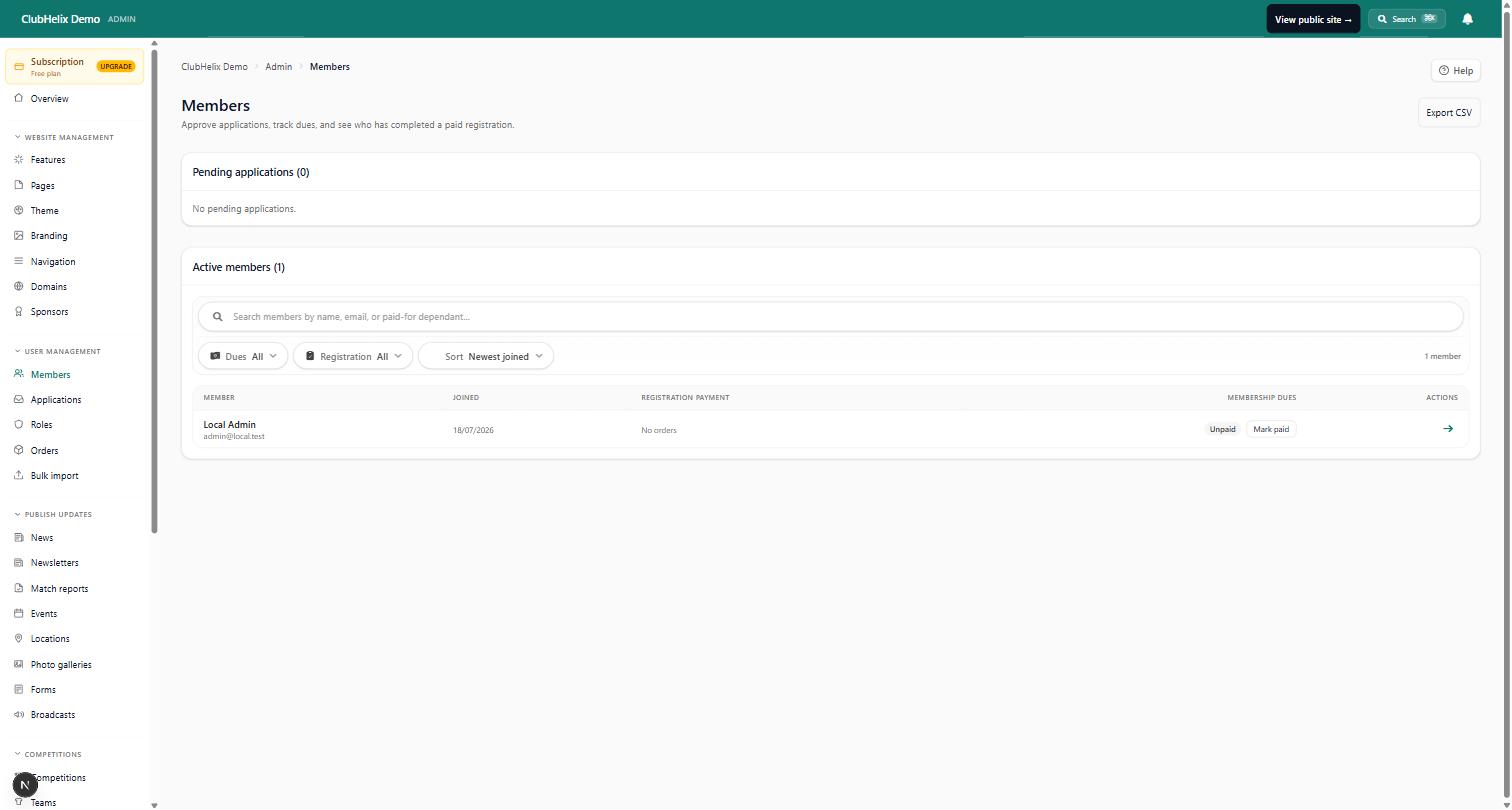
With ClubHelix, online registration means members register and pay themselves — the form feeds the member database directly, payment status updates automatically, and renewals prompt returners instead of relying on the registrar's memory. The form builder handles the club's custom questions — sizes, consents, medical flags, volunteer preferences — without a separate survey tool. And roles and permissions let the registrar see and manage member data while the canteen coordinator sees none of it, which is exactly how sensitive data should work at a club. Reports that used to take an evening (how many under-12s, who hasn't renewed, who's unpaid) become a filter on the members screen.
If your club's registration process is still paper forms and a master spreadsheet, moving it online is the single biggest workload reduction available to a volunteer committee. ClubHelix has a free tier to try it with — see what's included or get your club set up, and next season's registration window can run itself while the registrar just watches the numbers climb.
Frequently asked questions
What does a club registrar do, in one sentence?
The registrar runs registrations and owns the member database — making sure every player and member is registered, eligible, accurately recorded and paid up, and handling clearances when players change clubs.
What's the difference between a registrar and a secretary?
The secretary handles the club's correspondence, meetings and compliance; the registrar handles memberships and player registrations specifically. Small clubs often combine them, but in junior clubs with hundreds of registrations the registrar is a standalone role.
How long does a clearance or transfer take?
It varies by sport and governing body, and it can stall if the former club has outstanding-fee or disciplinary holds. Start the process as early as possible and never play someone whose clearance hasn't been confirmed.
What member data should a club collect?
Only what it genuinely uses: identity and contact details, emergency contacts, relevant medical information and required consents. Collect the minimum, keep it in one secure system with access limited by role, and delete what's no longer needed.


