
What this guide answers
- How much should we ask for?
Ask for a specific itemised amount that covers 70–80% of a costed project, with your society visibly contributing the rest.
- Can we apply for something we have already paid for?
Almost never, and trying is a good way to damage your standing.
- Our application was rejected — what do we do?
Ask for the feedback, in writing, within a week while the panel still remembers you.
- Do we have to pay tax on grant money?
For a typical student society the answer is usually no, but the reasoning depends on where your society sits legally and who holds the money, and it is worth a five-minute conversation with your student association's…
- How do we prove attendance if we do not sell tickets?
Take RSVPs for free events and mark people in at the door, even informally.
USA edition. This guide is written for volunteer-run clubs in the United States. Where rules differ — grants, tax, incorporation, safeguarding — follow the USA-specific pointers below or check with your national body.
Your society has $214 in the account, a careers night that will cost about $1,300, and a grant form that closes in nine days. Nobody currently on the committee has filled one in before. The treasurer who did it last year graduated in June and answers messages roughly never. The only record of what you spent is a folder of photographed receipts in somebody's camera roll, and you are fairly sure last year's grant was never acquitted at all.
That last detail is the one that will cost you. Funding panels are not really assessing your writing. They are answering three questions in about ninety seconds: how many students does this reach, what does it cost per head, and did this society spend last year's money on what it said it would. A society that can answer all three with real numbers gets funded ahead of a better-written application that cannot.
This guide covers where student society money actually comes from, what a panel is deciding while it reads you, the eight numbers to have ready before you open the form, a worked application with a real budget table, and the acquittal that quietly decides whether you get funded again next year. It assumes a volunteer committee with no finance background and one evening to spend on this, because that is the normal case.
Where society money actually comes from
Every viable society runs on a mix. The mix matters more than any single source, because each source fails in a different way and none of them fails on your schedule.
| Source | Typical for a mid-sized society | Reliability | Lead time | What it costs you |
|---|---|---|---|---|
| Membership fees | $600–$2,000 a year | High, but front-loaded | Immediate | Nothing but a good sign-up flow |
| Event and ticket income | $0–$3,000 a year | Medium — it can go backwards | Weeks | Real financial risk on every event |
| Association grants | $300–$2,500 a year | High if you meet the deadlines | 4–12 weeks | Forms, a budget, an acquittal |
| Faculty or department funds | $100–$1,000 per project | Medium, relationship-driven | 2–6 weeks | An email and a named academic who backs you |
| External or community grants | $500–$5,000 per project | Low hit rate, high value | 8–16 weeks | A serious application, sometimes reporting |
| Sponsorship | $200–$3,000 a year | Medium, renews or dies | 4–10 weeks | Deliverables you must actually deliver |
A useful rule: no single source should be more than about 40% of your income. A society funded almost entirely by one grant round is one panel decision away from cancelling its program. A society funded almost entirely by ticket income is one wet Thursday away from the same place.
Membership fees and event income are covered properly in the membership fees guide and the budget template. This guide is about the other four rows — the money you have to ask somebody for.
Most of your grant money comes from student activity fee allocations decided by your student government's finance or appropriations committee. There are usually two routes: an annual budget hearing, held months before the money is spent, where recognised organisations present their plans for the coming year; and rolling supplemental or co-sponsorship requests for events that come up mid-year. Both normally require your organisation to be in good standing, sometimes with an adviser's signature on the request. Read the restrictions before you build your budget, because allocations frequently cannot be spent on food, travel, gifts, prizes or anything that benefits members exclusively rather than the wider student body. Expect to supply attendance estimates, a line-item budget and evidence of how you spent last year's allocation. Miss the annual hearing and you can be left with only supplemental requests for twelve months. This is general information — your student activities office sets the actual rules.
What a funding panel is actually deciding
Picture the room. Six or seven students and one staff member, a stack of forty applications, two hours booked, and a fixed pot that is always smaller than the total asked for. That is roughly three minutes per application, and half of it is spent finding the numbers in your prose. The applications that win are the ones that hand over the numbers in the order the panel needs them.
Here is what they are scoring, and the difference between a weak and a strong answer to each.
| What they are weighing | Weak answer | Strong answer |
|---|---|---|
| Reach | "Our members would really benefit" | "120 attendees expected, around 70 of them not currently members" |
| Cost per head | Not mentioned at all | "$11.04 per attendee, of which we are asking you to fund $8.25" |
| Evidence | "We expect a great turnout" | "Our last three events drew 96, 118 and 104 — attendance report attached" |
| Skin in the game | Asks for 100% of the cost | "We contribute $335 from membership income; we are asking for the rest" |
| Track record | Silence about last year | "Last year's $600 was acquitted on 14 March; report attached" |
| Access | "Tickets $25, members only" | "Free entry, 5–7pm on campus, alcohol-free option, access contact named" |
| Legacy | Consumables that vanish | "The equipment stays with the society and is booked out to members each term" |
The panel's real fear is not that your event will be bad. It is that they will fund something that does not happen, or happens for eleven people, and they will have to explain that to the students whose fee paid for it. Everything in the strong column is you removing that fear.
Two habits are worth more than good writing. Ask for a specific, itemised amount — $990, not "around a thousand" — because a rounded number reads as a guess and a guess gets trimmed. And make the cheapest thing to say yes to be your application: the smaller and better-evidenced your ask, the more likely it survives the round of cuts at the end of the meeting when the panel is $3,000 over budget and tired.
The eight numbers to have ready before you open the form
Collect these once, keep them where the whole committee can see them, and refresh them each term. Nearly every application, sponsorship approach and acquittal draws on the same eight.
- Paid members today, and the same figure on the same date last year. Growth is persuasive; a flat number with a good reason is fine; no number at all is fatal.
- Active members — how many attended anything in the last six weeks. This is the honest number, and it is usually a third of the first one. Use it yourself even if you quote the first one to the panel.
- Attendance at your last three events, with dates. Three real numbers beat any adjective.
- Attendance mix — how many attendees were not members. Panels funded by a fee every student pays care enormously about this.
- Cost per head for the thing you are asking about: total cost divided by expected attendance.
- Your own contribution as a dollar figure and a percentage. Aim to put in at least 20–25% of any event you ask for money towards.
- Last year's award, what you spent it on, and the date you acquitted it.
- Your current balance and committed spend — what is in the account, and what is already promised to a venue or supplier.
If those numbers currently live in three people's heads, that is the actual problem to fix before the next round. A society that keeps its members, registrations and event attendance in one place can pull all eight in about a minute; a society running on a spreadsheet in someone's drive spends an evening on it and gets three of them wrong.
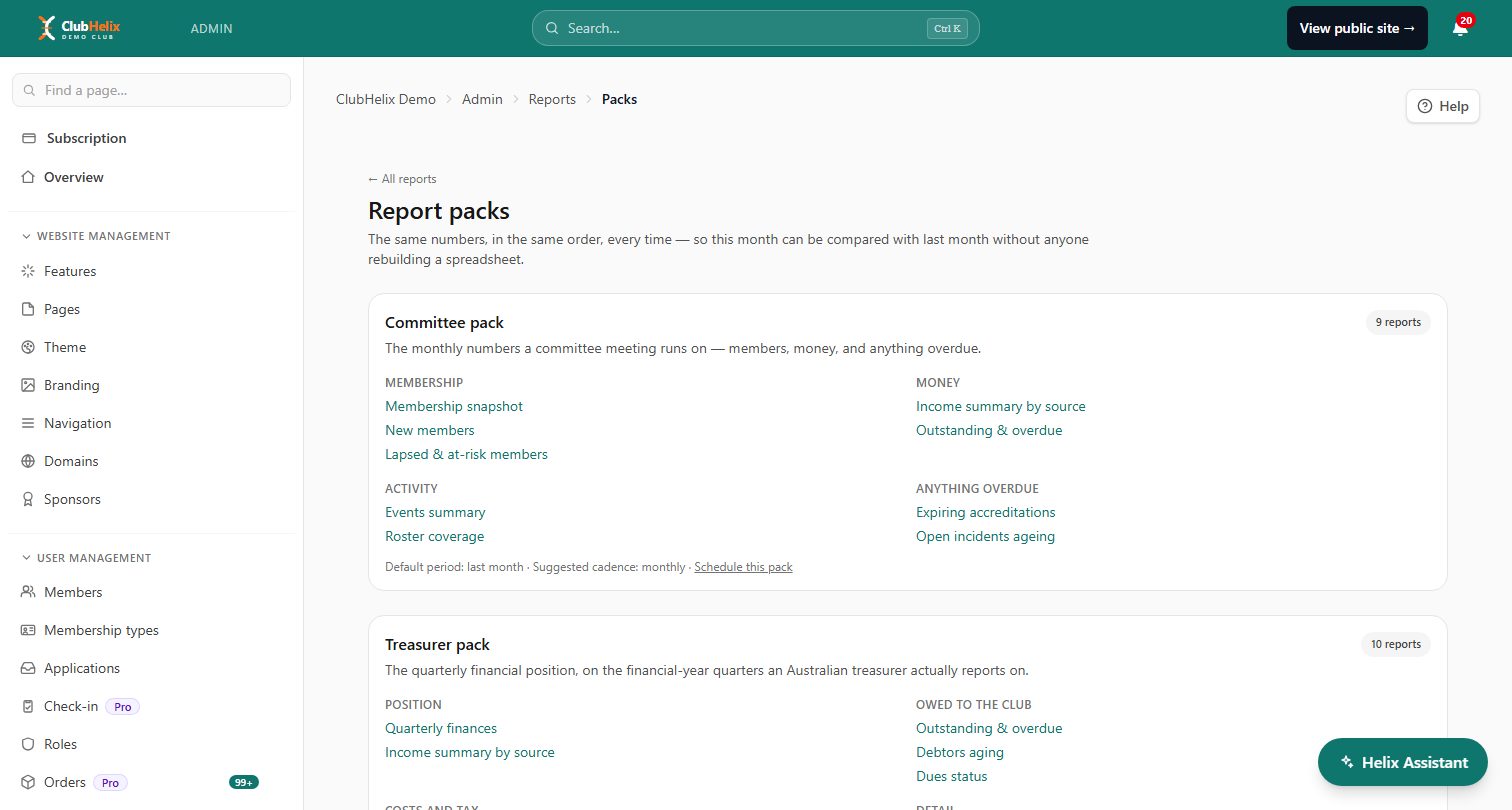
Saved report packs are genuinely useful here: build one called "Funding evidence" with membership counts, income by month and event attendance, and you can attach current figures to any application without rebuilding them. The reports feature covers how that works, and the treasurer report template is a good shape for what the panel wants to see.
A worked application you can copy
Take a 160-member course society applying for a careers night. Expected attendance 120, of whom roughly 70 are not members. Total cost $1,325. The society puts in $335 and asks for $990.
Build the budget table first, before you write a word of prose. It disciplines the ask and it is the first thing the panel looks at.
| Item | Cost | Society funds | We are asking for |
|---|---|---|---|
| Room hire (campus rate) | $0 | — | — |
| Catering, 120 × $6.50 | $780 | $180 | $600 |
| AV hire and hearing loop | $210 | $0 | $210 |
| Printing, signage and name badges | $95 | $95 | $0 |
| Speaker travel, 3 × $60 | $180 | $0 | $180 |
| Accessibility contingency | $60 | $60 | $0 |
| Total | $1,325 | $335 | $990 |
Then write six short paragraphs, in this order, because it is the order a tired panel reads in:
- What you want to do, in one sentence with a date and a number. "A careers night in week five for 120 students, with six graduate employers and three recent alumni."
- Who benefits, and how many are not already yours. Name the cohort. "Second and third-year students across the faculty; based on last year, around 70 of the 120 will not be members."
- Why it is needed. One concrete piece of evidence beats a paragraph of feeling — a survey result, a waiting list, the 40 people turned away last time. A short member survey run in week six gives you exactly this sentence.
- What it costs and what you are contributing. Paste the table. State cost per head: $11.04, of which you are asking them to fund $8.25.
- Evidence you can deliver it. Your last three attendance figures, the room already provisionally booked, the two speakers who have already said yes.
- What you will report back. Name the acquittal deadline yourself before they do. It signals you have done this before, even if you have not.
Two things to add if the form allows them. A partial-funding line — "if the full amount is not available, $600 covers catering and the event still runs at a reduced scale" — because panels routinely part-fund, and an application that tells them how to part-fund it gets part-funded rather than declined. And a one-line legacy statement if anything you are buying survives the event.
The grant application guide goes deeper on writing for external funders, where the forms get longer and the assessment is less forgiving.
Money from outside your student association
On-campus grants are the reliable base. The bigger money — the kind that funds a festival, a piece of equipment or a national trip — usually comes from outside, and it operates on longer timescales and stricter reporting. The general rules are the same everywhere: apply eight to sixteen weeks ahead, never apply retrospectively for something you have already bought, and be honest that you are a student group, because most funders are pleased about it rather than put off.
Beyond student government, four sources are worth your time. Your department or college almost always holds discretionary funds for academic organisations, and a faculty adviser's email is often all it takes. The alumni relations or advancement office funds networking events, mentoring programs and anniversary projects, and many campuses run a crowdfunding platform for student organisations with matched giving attached. If you are a chapter of a national organisation, the parent body usually has chapter grants for programming, travel and conference attendance that go unclaimed every year. And local community foundations fund projects that serve the surrounding community rather than only the campus. Read the rules on where money can be deposited before you accept anything, because outside funds often cannot go into a university agency account without approval. This is general information rather than financial advice; your student activities office can confirm what your organisation may accept.
The acquittal is what decides your next grant
An acquittal is simply the report that says: here is what we did, here is what we spent, here are the receipts. It takes about an hour if you kept records and an entire weekend if you did not. And it is the single strongest predictor of whether you get funded next time, because it is the one piece of evidence the panel trusts completely.
A complete acquittal has five parts: what actually happened and when; how many people came; what you spent, line by line against the budget you submitted; itemised receipts or invoices for every line; and an honest note on any variance, including money you did not spend. Underspending is not a crime — hiding it is. Returning $140 unspent with a clear explanation buys you more credibility than quietly absorbing it into pizza.
The failure modes are boringly consistent. Receipts photographed badly and lost when the phone dies. Cash spent with no invoice. A line item that does not match the approved budget because someone changed the venue and told nobody. An acquittal submitted after the deadline, which on many campuses freezes you out of the next round entirely. And attendance quoted from memory — "about 90, I think" — which is exactly the sentence that makes a panel discount everything else you wrote.
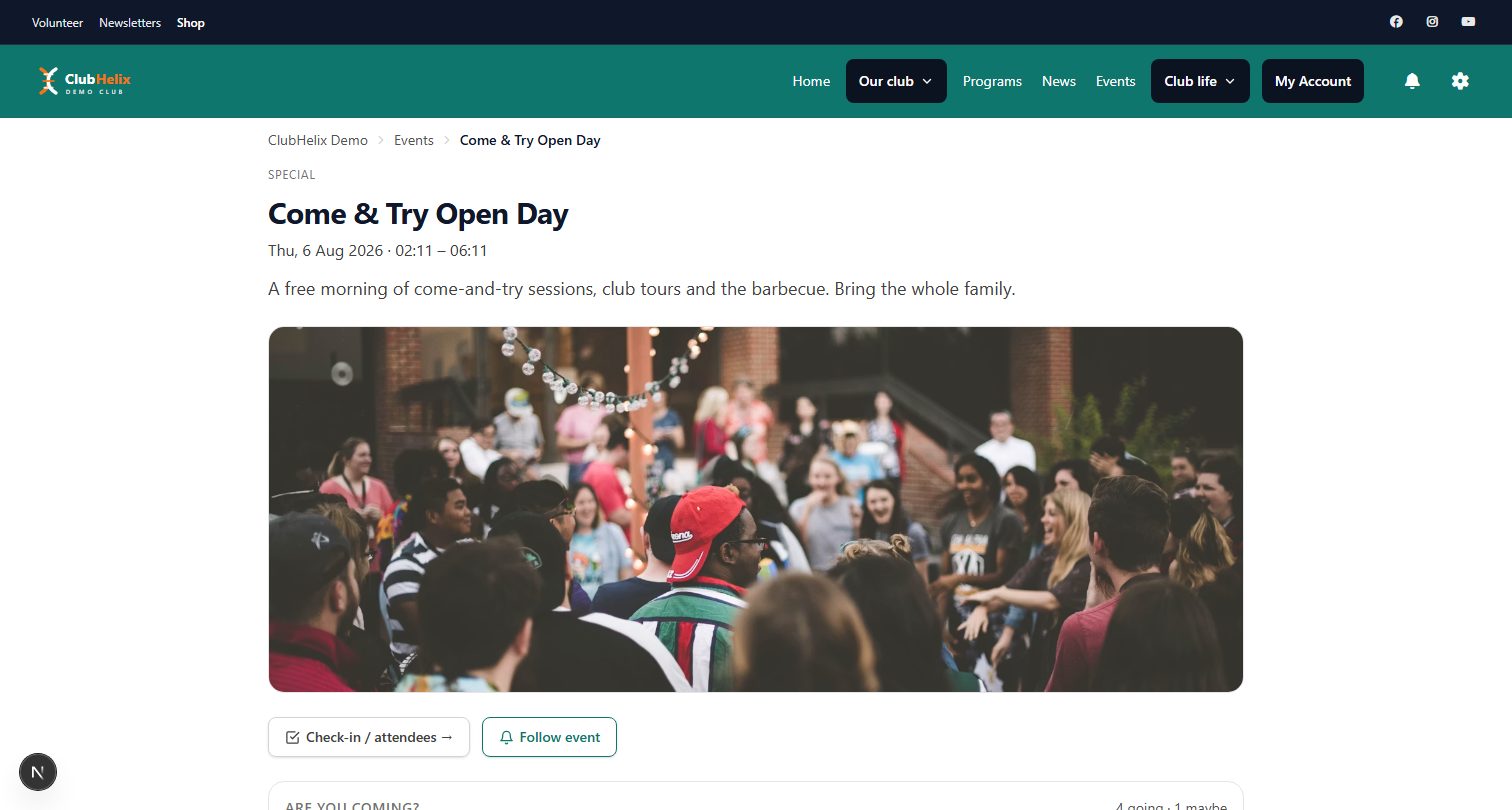
The attendance half solves itself if you take RSVPs and mark people in at the door. RSVPs and attendance tracking turn "about 90, I think" into "104 checked in against 137 RSVPs, 61 of them non-members" — which is not just better evidence, it is the number you need to plan catering next year. Keep the receipts in the same place as the event, not in a chat thread.
Allocated funds usually sit in a university agency account rather than in a bank account you control, and spending typically requires a purchase requisition and often an adviser's signature. Plan for that: a two-week internal approval cycle is normal and a supplier who wants payment in three days will not be accommodated. Read the spending restrictions again before you commit, because allocations commonly exclude food, gifts, prizes, travel or anything benefiting members exclusively, and a purchase outside the rules can be refused after you have already promised it. Unspent allocations almost always return to the pool at the end of the fiscal year rather than rolling forward, so spend on plan or hand it back early and say so. Submit your post-event report on time; a missed report commonly blocks the next supplemental request.
The funding calendar, and the mix that survives a bad round
Most societies miss money by missing dates, not by writing badly. Build one calendar the whole committee can see, and put these on it the moment you learn each date.
| When | What goes in the calendar |
|---|---|
| Before teaching starts | Affiliation renewal, the main funding round, the club fair stall deadline |
| Weeks 1–3 | Membership push — your only fully controllable income |
| Week 4 | Small-grant applications for the term's events |
| Weeks 5–6 | Member survey; the evidence for your next application |
| 8–16 weeks before any big project | External and community grant rounds |
| Within 4 weeks of each event | Acquittal, receipts and attendance figures filed |
| Mid-year | Sponsorship renewals and the second funding round |
| Before the AGM | Annual financial statement and the funding record for handover |
Then diversify deliberately. If your association's round is unusually competitive this year, the gap is filled by ticket margin, a fundraiser or a sponsor — but only if you started those in time. The sponsorship guide covers building an offer local businesses will actually pay for, and the fundraising ideas guide ranks the options by what they return per volunteer hour, which is the only ranking that matters to a committee of five.
One last discipline: write the funding record into your handover. What you applied for, what you got, who assessed it, what they asked at the time, and what you promised. A new treasurer who inherits that document applies with a year of institutional memory instead of starting from a blank form — which is the whole argument of the handover checklist in miniature.
Frequently asked questions
How much should we ask for?
Ask for a specific itemised amount that covers 70–80% of a costed project, with your society visibly contributing the rest. Panels distrust applications that ask for 100% of everything, and they distrust round numbers because a round number reads as a guess. If the pot is $20,000 and there are forty societies, an ask above about $2,000 needs a genuinely exceptional case; most successful society applications sit between $300 and $1,500. Always include a partial-funding line saying what a smaller amount would still deliver.
Can we apply for something we have already paid for?
Almost never, and trying is a good way to damage your standing. Nearly every funder — on campus and off — funds future activity, and many explicitly refuse retrospective claims because they cannot influence a decision that has already been made. The exception is reimbursement-based schemes where you were told to spend first against an approved budget, which is a different thing entirely: the approval came before the spend. If you have already committed money and now need help, be straight about it and ask whether any hardship or emergency fund exists.
Our application was rejected — what do we do?
Ask for the feedback, in writing, within a week while the panel still remembers you. Most rejections come down to three fixable things: no attendance evidence, no contribution from the society, or an unacquitted grant sitting in your file. Fix the specific one they name, then reapply in the next round rather than arguing this one — appeals rarely succeed and they cost you goodwill with the same people who will read your next application. In the meantime, scale the event down to what your own income covers and run it anyway, because a delivered small event is better evidence than a cancelled large one.
Do we have to pay tax on grant money?
For a typical student society the answer is usually no, but the reasoning depends on where your society sits legally and who holds the money, and it is worth a five-minute conversation with your student association's finance staff rather than a guess. The general shape is that grant income to a non-profit member society, spent on its stated purposes, is not treated as trading income — and that tax on ticket and merchandise sales only becomes your problem at turnover levels most societies never approach. If you are running a large ball or festival, ask before you set ticket prices rather than after. This is general information, not tax advice.
Where allocations sit in a university agency account, tax questions are generally handled by the institution. Sales tax on tickets and merchandise is the one to check, because whether the university's exemption extends to a recognised student organisation varies by state and by campus. Ask the student activities office before you price anything.
How do we prove attendance if we do not sell tickets?
Take RSVPs for free events and mark people in at the door, even informally. A named RSVP list plus a check-in count gives you two defensible numbers — how many said they would come and how many did — and the gap between them is genuinely useful planning data, because free RSVPs typically convert at 55–70% while paid tickets convert above 90%. A door count on a scrap of paper is better than nothing, but it disappears the moment the person holding it graduates. Record it against the event itself so next year's committee inherits it.
Where ClubHelix fits
Most of the pain in society funding is evidence, not writing. The numbers a panel wants — paid members, growth, attendance at the last three events, how many attendees were not members, income by month — either exist as a byproduct of how you run the society or they do not exist at all. ClubHelix produces them as a byproduct: paid sign-ups through your own site build the member register, events with RSVPs and check-in build the attendance history, and saved report packs turn both into something you can attach to an application or an acquittal in a minute.
It also survives the handover, which is the other half of the problem — the funding record, the receipts and the member list stay with the society rather than with whoever set them up. See how it fits a campus society on the university clubs page, or start with the complete guide to running a student society. Pricing, including a free tier for building the site and trying it out, with taking payments online and being found in search on the paid plans, is on the pricing page.
ClubHelix gives your society the evidence a funding panel asks for: membership and income reports, RSVPs and attendance for every event, and forms and surveys for the member feedback that makes the case. Start free before the next funding round closes.


