
What this guide answers
- What is the difference between Squadi and PlayHQ?
Both are registration and competition platforms distributed to clubs through governing-body arrangements rather than sold directly.
- Can a club choose between them?
Usually not. Both arrive with your affiliation, and the decision sits with the governing body that signed the contract.
- What do these platforms cost a club?
In the arrangements we can verify, neither charges clubs a platform subscription — PlayHQ is funded by national body contracts, and Football Queensland states there are no platform costs to clubs under its Squadi…
- Does either give our club a website?
Not as part of the competition rails. PlayHQ sells PlayHQ Websites as a separate yearly subscription with no published price (checked October 2026); the site is built from your PlayHQ data and is archived if you cancel.
- We already have a platform for competitions — is a second system just duplication?
Only if you duplicate the same job. The overlap risk is registrations and results, which should stay on the mandated rails.
Most software a club uses is bought. This pair is issued. Somewhere above your committee, a governing body signed a contract, and one Tuesday in the pre-season an email arrives explaining that registrations open on the new platform in a fortnight and here is a webinar link. Nobody at your club voted. Nobody at your club was asked. The volunteers who will spend the next six months inside the thing find out at the same time as the parents.
That is the honest context for comparing Squadi and PlayHQ. They are both Australian, both distributed through governing bodies rather than sold to clubs, and in most cases you will end up on whichever one your sport picked. Plenty of committees run volunteers across two codes and end up in both — a netball club whose juniors register through one, whose members also help at a touch football program running on the other, and who spend the season translating between them.
So this is not a shopping comparison. It is a briefing on two pieces of inherited infrastructure — what each is funded by and therefore what your participants pay, how each handles the weekly grind of fixtures, results and officials, and, most usefully, what each one leaves entirely on the club's plate. We are ClubHelix, an all-in-one club platform, and we should be clear about our angle up front — we do not bid for governing-body competition contracts, so we are not trying to displace either as your competition platform. We build the club-facing layer, which now overlaps with PlayHQ's own website product, so weigh our views on websites with that in mind. Facts below are from public sources current as at July 2026, with PlayHQ's pricing and websites re-checked in October 2026, and where something is not published we say so instead of estimating.
Two platforms you did not choose
PlayHQ is the national competition platform for four of the country's biggest participation sports — Australian rules football, cricket, basketball and netball — through contracts with their national bodies. Based in Melbourne, it runs fixtures, ladders, results and registrations at national scale, and it has extended further into payments by acquiring the payments product TeamPay. The platform your association runs on is competition rails, built to carry an entire sport. When we re-read its pages in October 2026, PlayHQ also sold PlayHQ Websites, a club site built from your PlayHQ data with a drag-and-drop editor, fixtures, ladders and results that sync in real time, and your own domain (for a separate fee) or a free subdomain, on a yearly subscription with no published price. It also listed shop and merchandise, program management and communications modules. We haven't used them, so treat that as what PlayHQ says it does.
Squadi is the newer Australian entrant, distributed the same way — through governing-body deals rather than direct club sales. Its known footprint includes Football Queensland, Touch Football Australia and netball programs. Its scope is registration and competition management, and it carries some capabilities that matter a great deal at ground level: referee appointment and payments, team sheets, match-day tools and instalment payment options for participants. Its club-facing administration and website surface, by contrast, is thin.
The useful distinction is not "which is better software". It is that both are competition and registration engines that arrive attached to your affiliation, and the club's job is to work out what has been covered and what has not.
Side by side
| Area | Squadi | PlayHQ |
|---|---|---|
| What it is | Registration and competition management, distributed via governing bodies | National competition platform — fixtures, ladders, results, registrations |
| Known distribution | Football Queensland, Touch Football Australia, netball programs | National bodies for Australian rules football, cricket, basketball and netball |
| Base | Australian | Melbourne |
| How clubs get it | Through a governing-body arrangement | Through a national governing-body arrangement |
| Club subscription | Football Queensland states no FQ or Squadi platform costs to clubs under its arrangement | Published per-registration pricing, A$4 to A$10 by product and volume (October 2026) |
| Participant fees | Not published as a general schedule | Participant-side transaction fees, varying by sport |
| Payment options | Instalment payments for participants | Payments extended via the TeamPay acquisition |
| Officials | Referee appointment and payments | Not a capability we can verify from public sources |
| Match-day tools | Team sheets and match-day tooling | Fixtures, ladders and results at national scale |
| Public data layer | Not a notable public search presence | Very strong — fixture, ladder and result pages are where people look things up |
| Club website | Thin | PlayHQ Websites, a separate yearly subscription; price not published (October 2026) |
| Club admin beyond competitions | Thin | Lists shop, program management and communications modules (October 2026); not assessed |
Where a cell says "not published" or "not something we can verify", that is deliberate. PlayHQ's per-registration prices come from its own pricing page. Other per-registration and per-user figures floating around in third-party listings contradict each other and don't stand up to a check against a primary source, so we don't repeat them.
How each is funded, and what your participants actually pay
This is the row that changes committee decisions, so it is worth slowing down.
Neither platform is sold the way ordinary club software is sold. PlayHQ reaches clubs through contracts with the national bodies of the sports it serves. It now publishes a per-registration price list (October 2026): A$10, A$8 or A$6 per registration for registration and competition management depending on volume, or A$7, A$5 or A$4 for registration only. Who pays that, and how it reaches families, is set sport by sport, and processing fees can sit on top. The one documented example we can point to is cricket, where Cricket Australia's own support material describes a 1.49% processing fee added to the participant and 1.80% deducted before funds are disbursed. That is one sport's arrangement — do not assume it is yours. Get your own governing body's fee schedule in writing.
Squadi is distributed the same way, through governing-body deals. Football Queensland states that there are no Football Queensland or Squadi platform costs to clubs under its arrangement. Again, read that precisely: it is a statement about one state body's deal, not a general price list. How Squadi is funded beyond those contracts is not published, and we are not going to guess at it.
The practical lesson for a treasurer is that "free to the club" describes a single line in the budget — the subscription — and says nothing about what a family pays at the checkout. Total participation cost is a stack, and most of it is invisible to the person paying:
| Layer | Who sets it | Typically visible to the family? |
|---|---|---|
| National body levy | National governing body | Bundled into the total |
| State or regional levy | State body or association | Bundled into the total |
| Association or league fee | Local competition | Bundled into the total |
| Club fee | Your committee | The bit they blame you for |
| Insurance component | Usually the governing body | Rarely itemised |
| Payment processing | The platform arrangement | Sometimes charged to the payer |
When a parent complains that registration has gone up, they complain to the club, because the club is the only party in that stack they can actually find. Being able to break the stack down — ideally on your own website, in plain language — is one of the more valuable half-hours a registrar spends all year.

Instalments deserve a specific mention because they change who can play. Squadi supports instalment payments for participants, and for a family registering three children in one week, splitting that bill is the difference between joining now and joining maybe. If your platform offers it, use it and say so loudly in your registration comms. If it does not, that is a genuine question to put to your association.
Six questions worth asking your governing body before the season, whichever platform you inherit:
- What is the exact fee stack for a junior, a senior and a family, itemised?
- Which portion of that lands in the club's account, and when?
- Is there a participant-facing processing fee, and at what rate — and is it charged however the family pays, or only for using a card?
- Are instalments available, and who carries the risk if a plan defaults?
- What is the refund process, and who decides — the club, the association or the platform?
- What happens to registration data at the end of the season, and can the club export its own?
Question three has a deadline on it now. From 1 October 2026 a card payment in Australia cannot be surcharged — the Reserve Bank of Australia removed the rule that had stopped the card networks banning surcharges, so eftpos, Mastercard and Visa each enforce a no-surcharge rule of their own, and American Express has decided to do the same without being formally regulated by the RBA. There is no not-for-profit exemption. A payment provider's own charges for its services are not treated as surcharges, so a participant-side fee charged however the family pays sits differently from an amount added for using a card — which is why the question is worth asking in those words. The Reserve Bank publishes surcharging FAQs. General information, not financial advice.
Question six is the one clubs forget. Our guide to refunds for club registrations covers the money side of the same conversation.
Fixtures, ladders, results and the people who run the game
Both platforms exist to turn a competition into a schedule and a schedule into a ladder. Where they differ is what happens around the edges of match day.
PlayHQ's strength is scale and the public data layer that comes with it. Fixture, ladder and result pages for its sports are where players, parents and grandparents simply look things up, and because every competition sits on the same rails, that lookup works the same way across the country. That consistency is a real gift to a volunteer who would otherwise be answering "what time are we on Saturday" by text message forty times a week.
Squadi's distinguishing strength at ground level is officials. Referee appointment and payment is a weekly job somebody currently does with a spreadsheet, a group chat and a shoebox of cash, and a platform that handles appointment and payment together removes a genuinely thankless task. Add team sheets and match-day tooling and you have a product designed by people who have stood next to a court with a clipboard.
Whichever you are on, the club-side chain looks the same, and only part of it is automated:
| Step | Who does it | Does the platform help? |
|---|---|---|
| Draw published | Association or governing body | Yes — this is the core job |
| Translate the draw into club language | Club fixtures volunteer | Rarely |
| Confirm team lists and availability | Team managers | Partly |
| Roster officials and duty | Association or club | Squadi covers appointment and payment |
| Tell families where and when to be | Club | No |
| Record the result | Scorer or team manager | Yes |
| Ladder updates | Platform | Yes |
| Wet weather or venue change | Club and association | Not to the family, not fast enough |
The three "no" rows are exactly where clubs lose their weekends, and they are all communications rather than competition problems. If you want the mechanics of the draw itself, we have written how to make a fixture draw for clubs that run their own internal competitions alongside the mandated one.
The gap both leave — your website and your comms
Here is the thing neither competition platform is, and it is not a criticism of either: neither one is your club.
PlayHQ will now sell you a website built from its competition data, as a separate subscription, and Squadi's club-facing surface is thin. Even with PlayHQ Websites, the following jobs stay with the club:
- A public website that is actually yours, on your own domain, that a sponsor or a grant assessor can be sent to.
- News, match reports, photos and the season's story.
- Sponsors — logos, packages, acquittal reporting, renewals.
- Merchandise, uniforms and the second-hand kit table.
- Events beyond fixtures — presentation night, quiz night, the season launch.
- Canteen and duty rosters, and the volunteer chase that goes with them.
- Governance — AGM notices, minutes, the register of members, policies.
- Wet weather notices that reach a phone in ten minutes rather than an hour.
- Newsletters, welcome packs and the whole membership relationship between rounds.
There is also a search consequence that committees rarely notice. Because competition platforms publish so many public fixture and ladder pages, searching your club's name can return a page you neither wrote nor control — accurate, useful, and completely silent about your coaching program, your sponsors and your open days. Owning a real site on your own domain is how you decide what a stranger sees first. Our netball club rundown walks through the rest of the operating year, and if you are also feeding numbers upwards, reporting to your governing body covers that chore.
A first-month checklist for any platform you inherit
Do these once, at the start of the season, and the rest of the year gets quieter.
- Write down who holds club administrator access — two people, never one, and never only an outgoing committee member.
- Confirm the email address on the account is a club address, not a personal one.
- Get the fee stack in writing and publish a plain-language version on your own site.
- Find the escalation path — who at the association you contact when something breaks on a Saturday morning.
- Test the participant checkout yourself, on a phone, as a parent would see it.
- Confirm what data you can export, in what format, and download a copy at season's end.
- Decide where your source of truth lives for member contact details, because it will not be the competition platform once someone changes phone numbers.
- Agree the wet weather chain — who decides, who posts, and on which channel families are actually watching.
- Note the season rollover date and what happens to last year's teams.
- Record all of the above in your handover file so next year's committee inherits knowledge, not archaeology.
Running the club half, whichever rails you are on
If your competition data is handled and your headache is everything else — the website, the sponsors, the presentation night, the wet weather text at 7am — that is the layer we build. ClubHelix gives your club a real site on your own domain through a canvas page editor, plus broadcasts that reach members by email and push rather than hoping they check a feed. For the competitions you run yourselves — internal ladders, social comps, carnivals, club championships — there are full competitions with fixtures, ladders and finals, and a live match centre for scores as they happen.
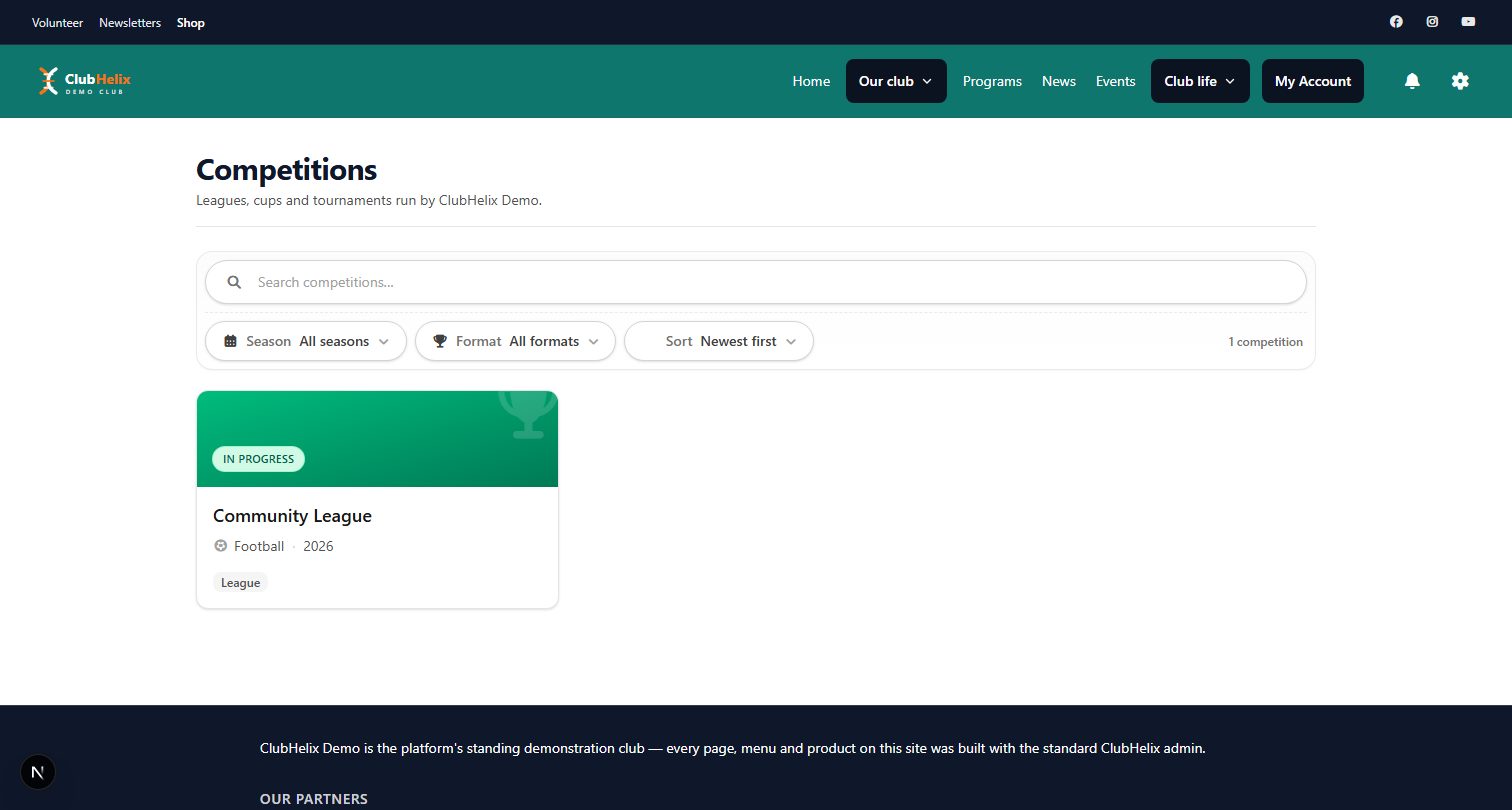
The free tier is enough to run a whole season alongside your mandated platform and judge whether the two sit comfortably together. Nobody has to ask what it costs — the plans are on the pricing page — and the platform is built in Australia and hosted here too. Most committees can start a club site in the gap between the draw landing and round one. Our fuller take on running a club website beside national competition rails is at /compare/playhq-club-website.
The boundary, stated plainly: we have no governing-body distribution deals, so we will never be the platform your sport mandates, and we would not advise any club to move its official registrations off the pipeline that carries its insurance, clearances and competition eligibility. For your sport's official competition data, the inherited platform stays the system of record. We are the half of the job it was never built to do.
Frequently asked questions
What is the difference between Squadi and PlayHQ?
Both are registration and competition platforms distributed to clubs through governing-body arrangements rather than sold directly. PlayHQ runs national competition rails for four very large participation sports and carries an enormous public fixture, ladder and result layer. Squadi is a newer entrant with a footprint including Football Queensland, Touch Football Australia and netball programs, and it carries ground-level capabilities such as referee appointment and payments, team sheets and instalment payments.
Can a club choose between them?
Usually not. Both arrive with your affiliation, and the decision sits with the governing body that signed the contract. The productive question for a committee is not which to pick but what your platform covers, what your participants pay, and what remains the club's responsibility.
What do these platforms cost a club?
In the arrangements we can verify, neither charges clubs a platform subscription — PlayHQ is funded by national body contracts, and Football Queensland states there are no platform costs to clubs under its Squadi arrangement. Costs surface elsewhere, mainly as participant-side transaction fees that vary by sport, so ask your own governing body for its itemised fee schedule rather than relying on any general figure.
Does either give our club a website?
Not as part of the competition rails. PlayHQ sells PlayHQ Websites as a separate yearly subscription with no published price (checked October 2026); the site is built from your PlayHQ data and is archived if you cancel. Squadi's club-facing surface is thin. Public competition pages are useful for looking up a fixture, but they are the competition's pages rather than yours — no news, sponsors, shop, events or membership story. Clubs on either platform still need their own web presence.
We already have a platform for competitions — is a second system just duplication?
Only if you duplicate the same job. The overlap risk is registrations and results, which should stay on the mandated rails. The gap is everything between rounds — communications, sponsors, events, commerce, governance — which the competition platform was never built for. Keep one source of truth per job and the two sit together comfortably.
Our committee is unhappy with the platform we were given. What can we realistically do?
Raise it through the association or state body, in writing and with specifics, because platform arrangements do get reviewed and club feedback feeds those reviews. In the meantime, focus your energy on the parts you genuinely control — your website, your communications, your events and your own commerce — none of which depend on the governing body's choice.
Keep reading — gameday vs playhq covers the other inherited-platform match-up, and how to make a fixture draw is for the competitions your club runs itself.

