
What this guide answers
- What grants are available for sports clubs in WA?
The main streams are the state sport and recreation department's community sport programs (facilities, equipment and participation), local council community grants, funding passed down through state sporting…
- Does our club need to be incorporated to get a grant in WA?
Almost always, yes — government funders generally require an incorporated association, or an auspicing arrangement where an incorporated body holds the funds for you.
- How much money can a small club realistically get?
It varies widely by program and year, so be wary of any figure you read that isn't on the funder's own site.
- Who should write the grant application?
Whoever knows the project best, with the secretary or treasurer supplying the governance documents and financials.
Every season, Western Australian clubs fund new goalposts, junior programs, first-aid kits, lighting upgrades and coach accreditation with grant money — and every season, plenty of eligible clubs miss out simply because nobody on the committee knew where to look, or the round closed before the paperwork was ready. Sports club grants in WA are genuinely accessible to small volunteer-run clubs; the trick is knowing the handful of places funding reliably comes from, and having your club's documents in order before a round opens.
This guide walks through the main sources of community sport funding in WA, what "grant-ready" actually means, and how to give an application its best chance. It's written for volunteer committees — no grant-writing background assumed.
Where sports club grants in WA come from
Grant funding for Western Australian clubs flows through a few long-running channels. Program names, amounts and closing dates change from year to year, so treat this as a map of where to look rather than a list of live rounds — always confirm the current details on the official site.
The state sport and recreation department
The WA state government's department responsible for sport and recreation — the Department of Local Government, Sport and Cultural Industries — runs the state's flagship community sport funding. Its long-running streams typically cover facility development and upgrades (often co-funded with your local council), equipment and participation programs, and support for getting more people active. Check the current programs, eligibility rules and closing dates at dlgsc.wa.gov.au, which lists what's open now and what's coming up.
Your local council
Almost every WA local government runs a community grants program, and sporting clubs are usually squarely inside the eligibility criteria. Council grants tend to be smaller but far less competitive than state rounds, and councils often fund the practical things state programs don't — a new barbecue for the clubrooms, line-marking equipment, a defibrillator, or a contribution towards a come-and-try day. Search your council's website for "community grants", and if you can't find anything, ring the community development officer — part of their job is helping groups like yours apply.
Your state sporting association
Many state-level governing bodies pass funding down to affiliated clubs, or run their own small grants for junior development, female participation, inclusion programs and volunteer training. They also often know about rounds before they're widely advertised. If your club is affiliated, get on your association's mailing list and ask directly what club funding they administer or recommend.
Community and corporate funding
Beyond government, look at community foundations, major retailers' local community programs, and businesses with a WA footprint that fund grassroots sport. These rounds are usually small and fast to apply for, and they're a good fit for a single concrete item — a set of junior uniforms, storage shelving, umpiring equipment.
This is general information, not legal or financial advice — check the current requirements with the official body linked above.
Get grant-ready before the round opens
Most grant rounds in WA are open for four to six weeks. That is not enough time to incorporate your club, open a bank account and write a constitution — so the clubs that win grants are the ones that were ready before the round was announced. Grant-readiness means having these on hand:
- Incorporation. Nearly every government grant requires your club to be an incorporated association (or auspiced by one). If you're not incorporated yet, start now — our guide to how to incorporate a club walks through the process.
- A club bank account in the club's name, with two signatories.
- An ABN, which is free to register and required by most funders.
- Your constitution and last AGM minutes, because funders want evidence the club is properly governed.
- A simple budget for the project you want funded, with real quotes attached. A club budget that shows your income and costs makes the project budget much easier to defend.
- Insurance details, since many rounds ask for evidence of public liability cover.
- Membership numbers, broken down by juniors, seniors and volunteers if you can — more on this below.
Keep all of this in one place the whole committee can reach, not in the outgoing treasurer's email. Clubs that store their governance documents digitally — constitution, minutes, insurance certificates, quotes — can turn an application around in an evening instead of a fortnight of phone tag.

Writing the application
Once a round opens, the application itself is usually a web form: what you want, what it costs, who benefits, and how it aligns with the funder's goals. A few principles carry almost every application:
- Answer the question they asked. If the criteria say "increase participation", your answer should say — in plain numbers — how many more people will play because of this funding.
- Be specific and costed. "New training equipment" is weak; a quoted list of items with a supplier and a delivery date is strong.
- Show community benefit beyond your members. School use of your facility, come-and-try days, shared equipment with a neighbouring club — funders love reach.
- Match the size of the ask to the size of the fund. Ring the grants officer if you're unsure; they would far rather steer you right before you apply.
- Get quotes early. Chasing a lighting quote two days before close is the classic way applications die.
We've written a full walkthrough — including a reusable answer structure — in our guide to how to write a grant application. And if you want the national picture beyond WA, see grants for sports clubs in Australia.
Why tidy membership records win grants
Almost every application asks the same questions: how many members do you have? How many are juniors? How many are female? How has membership changed over three years? Clubs that keep their roster on paper or in a spreadsheet someone maintains "when they get a chance" end up guessing — and assessors can tell.
A live membership system answers those questions in seconds. When your registrations flow into one roster with statuses and paid-up dates, your member counts are real numbers you can stand behind, and you can pull juniors, seniors and volunteers apart without a working bee. With ClubHelix, committee members who handle grants can be given exactly the access they need to member data — no more, no less — through roles and permissions, so the secretary can pull numbers for an application without sharing the treasurer's login.
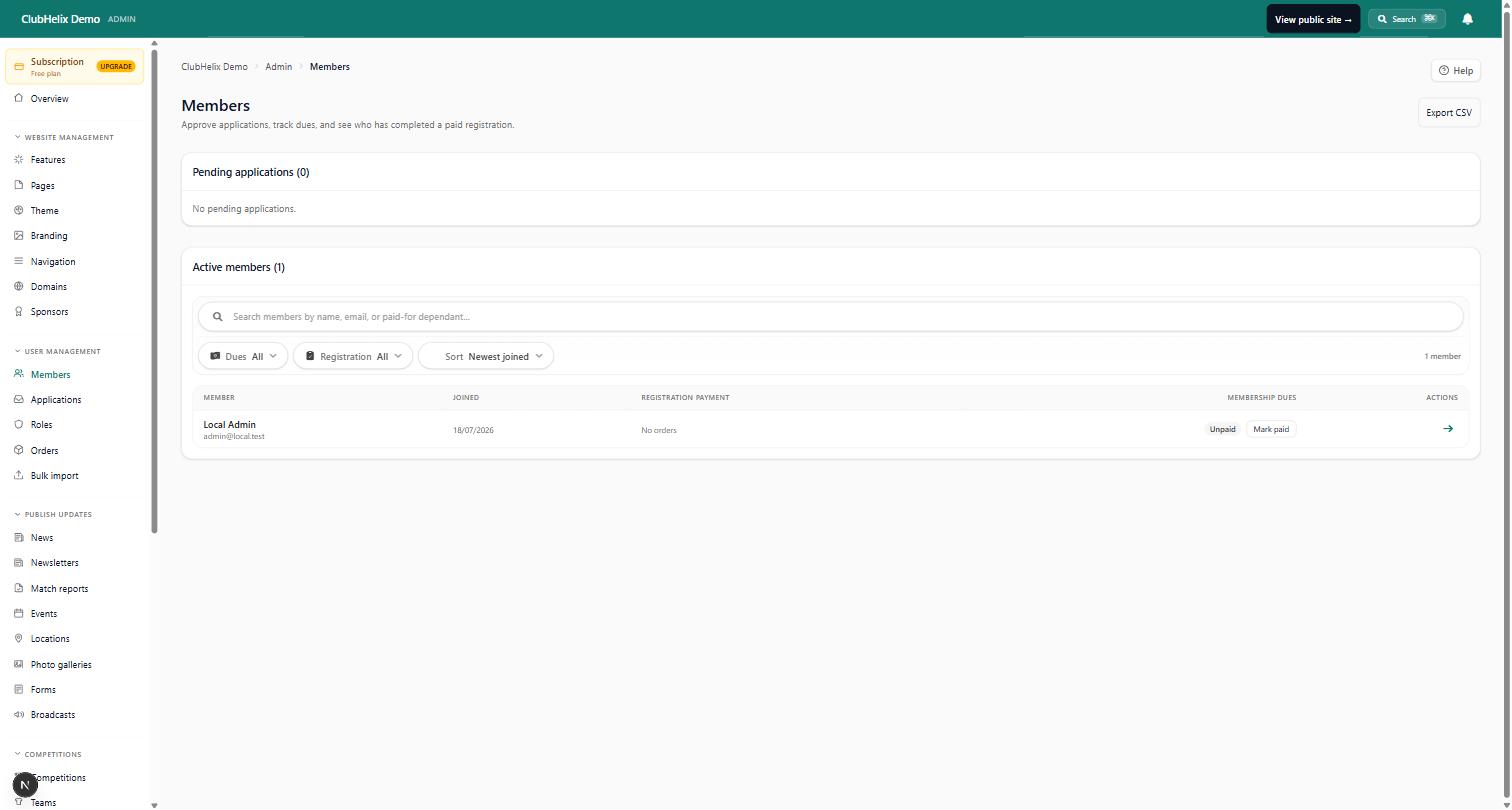
The same applies after you win: acquittal reports ask what you delivered and who benefited, and attendance or registration numbers from your own system are far more convincing than estimates.
After you apply
- If you win: read the funding agreement before you spend anything. Note the acquittal deadline in the club calendar, keep every receipt, and take photos of the funded project in use — future applications get easier when you can show past grants delivered well.
- If you miss out: ask for feedback. Grants officers will usually tell you exactly why, and "reapply next round with quotes attached" is one of the most common paths to a successful grant.
- Either way: keep a grants register — what you applied for, when, the outcome, and the contact person. Committees change; the register means next year's secretary isn't starting from zero.
A club that runs its membership, documents and communication through one platform is simply easier to fund — the numbers are real, the governance evidence is on hand, and the acquittal writes itself. If your club is still juggling spreadsheets, ClubHelix gives you a club website, registrations, membership records and document storage in one place, with a free tier to start on.
Frequently asked questions
What grants are available for sports clubs in WA?
The main streams are the state sport and recreation department's community sport programs (facilities, equipment and participation), local council community grants, funding passed down through state sporting associations, and small community or corporate grants. Check dlgsc.wa.gov.au and your local council's website for what's currently open.
Does our club need to be incorporated to get a grant in WA?
Almost always, yes — government funders generally require an incorporated association, or an auspicing arrangement where an incorporated body holds the funds for you. If you're not incorporated, start that process before chasing grants.
How much money can a small club realistically get?
It varies widely by program and year, so be wary of any figure you read that isn't on the funder's own site. Council grants are typically modest and suit single equipment purchases; state facility funding can be substantial but usually requires co-contribution. Check the current round's guidelines for real numbers.
Who should write the grant application?
Whoever knows the project best, with the secretary or treasurer supplying the governance documents and financials. Small committees often share it — one person drafts, one checks numbers, one proofreads against the criteria before submitting.

