
What this guide answers
- How long should an annual report be?
Twelve to twenty pages for most community clubs. Long enough to cover the sections above properly; short enough that a member reads it on the train.
- Is an annual report legally required?
Something is, for most formally constituted clubs — usually financial statements presented to members at an annual general meeting, with the detail set by your legal structure and your constitution.
- Who signs it off?
The committee, at a properly minuted meeting, before it goes to members.
- Should we include the detailed financials or a summary?
Both. A one-page summary in the body for the general reader, and the full statements as an annexure for those who want them.
- How is this different from an end-of-season report?
The end-of-season report is internal and operational — what worked, what to change, handover notes.
UK edition. This guide is written for volunteer-run clubs in the UK. Where rules differ — grants, tax, incorporation, safeguarding — follow the UK-specific pointers below or check with your national body.
The annual report is the one document a club produces that outlives everyone who wrote it. It goes to members, to sponsors, to funders, to the council, and — three years later — to a new committee trying to work out what happened.
Most clubs treat it as a chore to be survived. The ones that treat it as an asset find it does an extraordinary amount of work: it recruits sponsors, it satisfies grant assessors, it settles arguments, and it makes handover survivable.
Here is a structure that works, and a way to produce it that does not consume the secretary's summer.
What the annual report is for
Four audiences, in descending order of how often they are forgotten:
- Members, who want to see the season they were part of reflected accurately, including the bits that went wrong.
- The next committee, who will read it as a handover document whether you intended that or not.
- Sponsors and funders, who are assessing whether the club is a safe place for their money.
- The formal record, because your constitution and your legal structure require certain things to be presented to members annually.
A report written only for the fourth audience is a compliance document nobody reads. A report written for all four is a genuinely useful thing.
The structure
Ten sections. Most clubs can do this in 12 to 20 pages, and shorter is usually better.
1. Cover and contents
The club name, the year, and one strong photograph. A contents page if the report runs past ten pages.
2. President's report (2 pages)
The narrative. Three movements: what the season was like, what the club achieved off the field, and the honest challenges. The honesty matters more than the achievements — members can tell when a report is managing them, and the credibility you spend there is the credibility you need in the finance section.
Close with thanks that are specific. "Thanks to all our volunteers" is a formality; naming the four people who ran the canteen every Saturday is a retention strategy.
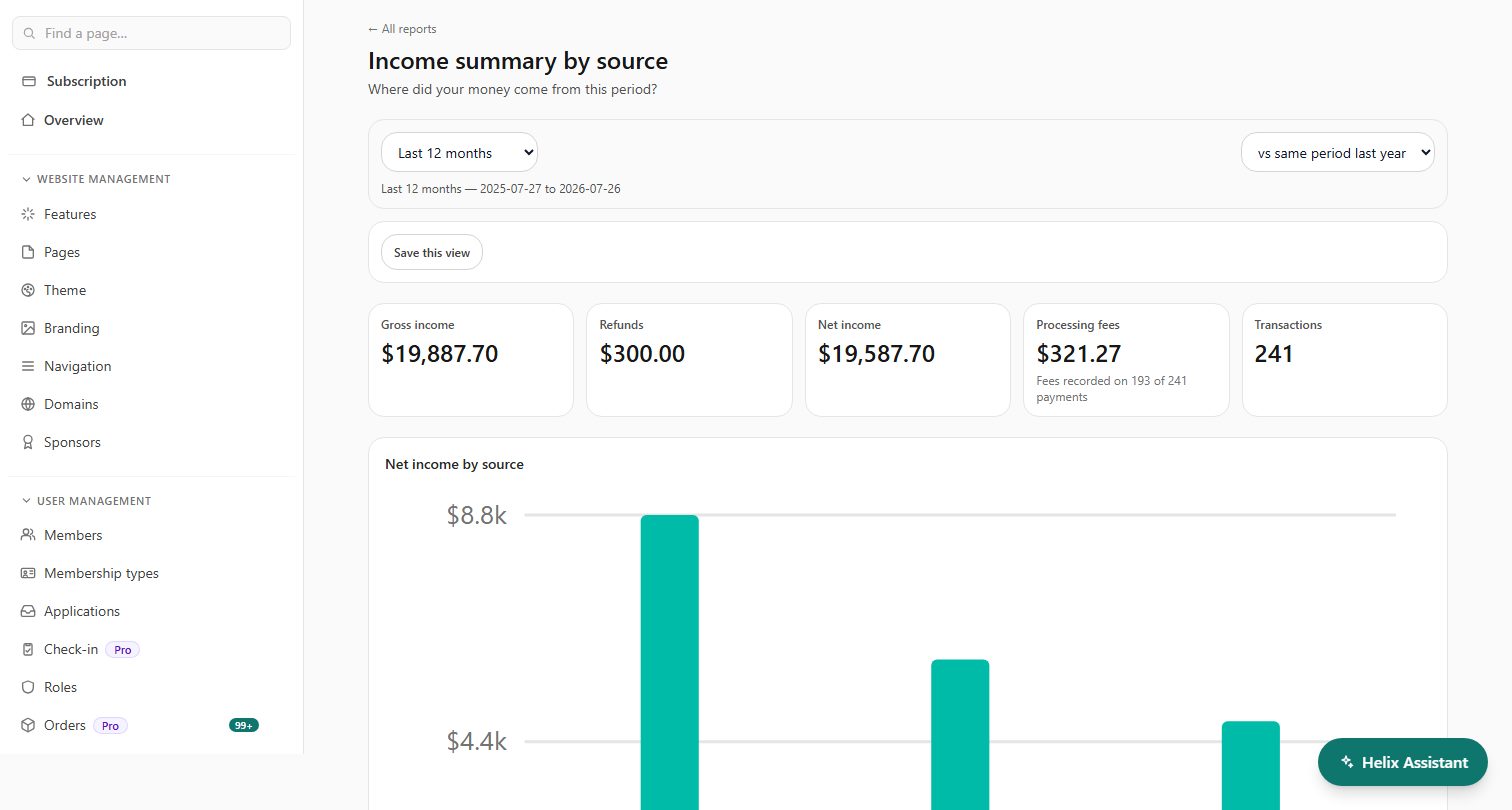
3. The year in numbers (1 page)
A single page of figures, presented plainly:
- Members, by category, with last year's figure alongside
- Teams or squads fielded
- Fixtures, sessions or events delivered
- Volunteers, and volunteer hours if you track them
- Total income and total expenditure
- Net result and closing funds
This page is the one sponsors photograph and funders quote. It is worth getting the definitions right, and worth using the same definitions as last year so the comparison means something.
4. Treasurer's report and financial statements (3–4 pages)
The written commentary first, the statements after. The commentary should explain what the numbers mean — why the surplus is smaller, what the equipment purchase was, whether the club can afford next season — in language a member without an accounting background can follow.
The statements themselves are whatever your structure requires: at minimum an income and expenditure statement and a balance sheet, plus any audit or review report that applies to your club. Your constitution and your registration status decide the requirement between them, and they do not always agree — check both.
5. Membership and registration report (1 page)
From the registrar. Numbers by category, growth or decline against last year, retention if you calculate it, and a short comment on what drove the movement. If the juniors grew 20 per cent because of a new schools program, say so — that is the sentence a grant assessor is looking for.
6. On-field reports (3–5 pages)
One page per grade, squad or team, written by the coach or manager to a fixed outline: results summary, standout performances, development highlights, thanks. A fixed outline is what makes these arrive; an open brief is what makes them late.
7. Off-field and community (1–2 pages)
Facility work, community programs, partnerships, the things the club did that were not a fixture. This is the section that distinguishes a club from a competition entrant, and it is the one funders read most closely.
8. Awards and honours (1 page)
Life members, club champions, milestone games, volunteer of the year. Also the page most likely to be photographed and shared, so get the names right.
9. Sponsors and partners (1 page)
Logos, and a genuine thank-you. Send this page to every sponsor separately when the report is published — it is the cheapest renewal conversation you will ever have.
10. Looking ahead (1 page)
Three to five priorities for next year, each with an owner. This is what turns the report from a record into a plan, and it gives the incoming committee a starting agenda.
Producing it without losing a month
The report fails when one person tries to write it in October. The pattern that works is compile-not-compose, on a schedule agreed before the season ends.
Six weeks out. The secretary sends each contributor their outline and the deadline. One page each, to a template — a form to fill, not an essay to dread.
Four weeks out. The numbers page is produced. This is the part that should take minutes rather than days: if membership, money and activity all live in one system, the year's figures are reports for a fixed period rather than a reconstruction from four sources.
Three weeks out. Contributions due. Chase in person, not by email.
Two weeks out. Secretary compiles and drafts the front matter. Committee reviews.
One week out. Final version approved at a properly minuted committee meeting, then distributed to members with the notice of the annual general meeting.
Two habits make next year's version dramatically easier. First, keep the same structure — the report becomes a fill-in rather than a design exercise. Second, keep the same figure definitions, so the comparison column is honest.

Design and distribution
You do not need a designer. You need consistency: one typeface, one accent colour, generous white space, and photographs that are actually in focus.
A few practical points:
- Publish it as a page on the club website, not only as a PDF. A web page is searchable, linkable, findable by a sponsor two years later, and reads properly on a phone. Offer the PDF as well for printing.
- Photographs need consent. Check your club's photo consent records before publishing images of juniors — annual reports circulate further than anyone expects.
- Keep every past year online. A club that can produce five years of annual reports on request looks like an institution. One that cannot find last year's looks like a risk.
The numbers section, in detail
Since this is the part most clubs find hardest, here is what belongs in it and where each figure comes from:
| Figure | Source | Watch for |
|---|---|---|
| Members by category | Membership snapshot at a fixed date | Use the same date as last year |
| New members | Joining dates in the period | Distinguish new from returning |
| Retention | Cohort comparison | State the definition |
| Participants | Attendance records | Not the same as registrations |
| Fixtures and sessions | Competition and program records | Include cancelled separately |
| Volunteer hours | Rosters plus committee estimates | Label estimates as estimates |
| Income by source | Cash received, dated by payment | Note the basis |
| Expenditure by category | Same categories as last year | Do not re-group |
Every one of those is a number the club either recorded during the year or cannot honestly produce now. That is the real lesson of annual reporting: the report is easy or impossible depending on decisions made twelve months earlier.
Frequently asked questions
How long should an annual report be?
Twelve to twenty pages for most community clubs. Long enough to cover the sections above properly; short enough that a member reads it on the train. If team reports are pushing it past thirty, tighten the outline rather than adding pages.
Is an annual report legally required?
Something is, for most formally constituted clubs — usually financial statements presented to members at an annual general meeting, with the detail set by your legal structure and your constitution. The full narrative report is generally a good-practice addition rather than a requirement. Read your own governing document.
Who signs it off?
The committee, at a properly minuted meeting, before it goes to members. The minutes recording that approval are part of the governance trail.
Should we include the detailed financials or a summary?
Both. A one-page summary in the body for the general reader, and the full statements as an annexure for those who want them. Hiding the detail is the fastest way to make members suspicious of numbers that are perfectly fine.
How is this different from an end-of-season report?
The end-of-season report is internal and operational — what worked, what to change, handover notes. The annual report is external and formal. Most of the raw material is shared, which is why clubs that do the first one well find the second nearly written already.


