
What this guide answers
- How should a club price a season pass?
Divide the pass price by the single admission price to get break-even attendances, then aim for that number to sit at about sixty to seventy per cent of your home fixtures.
- Do season passes actually make a club more money?
Usually yes, but through attendance rather than admission. Pass-holders attend more often, and each extra visit brings canteen, bar and merchandise spend that dwarfs the gate discount.
- What perks should a season pass include?
Access, recognition and priority rather than discounts — early team news, a supporters page listing, first refusal on limited seats, reserved parking or seating, and a vote in a supporters' award.
- Can a club sell season passes and single tickets at the same event?
Yes, and most do. Run two lanes at the entrance, publish the full ladder of prices on one page before the season, keep a single source of truth for the pass list, and produce any complimentary entries as a written list…
- What happens if fixtures are cancelled after passes are sold?
Say what happens before you sell, in the terms published beside the price — whether abandoned or moved fixtures are refunded, whether the pass transfers to another person, and what applies if a venue changes.
New Zealand edition. This guide is written for volunteer-run clubs in New Zealand. Where rules differ — grants, tax, incorporation, safeguarding — follow the New Zealand-specific pointers below or check with your national body.
Two volunteers stand at a folding table at the entrance to your ground. One has a float tin and a roll of tickets, the other has a clipboard and a list of names. It is cold, the first game has already started, and there is a queue of eleven people because someone is arguing about whether a fourteen-year-old counts as a child. Meanwhile a woman walks past both of them with a nod, because she paid before the season started and has not thought about admission since.
That nod is the whole argument for a season pass, and the queue is the whole argument against giving up on single tickets. Most committees debate the two as though one has to win. They do not: almost every club that runs a gate ends up selling both, and the interesting decisions are how to price the pass, when the money arrives, and how to make the entrance work when two products meet at one folding table.
This guide is for the committee setting admission for next season. It covers the break-even attendance number that should set your pass price, how the cash lands across the year and why that matters more than the total, the perks that make a pass feel worth having without costing the club anything, and the practical business of running both at one gate without a queue or an argument.
A pass is a financing product wearing a ticket's clothes
Start here, because it reframes everything that follows. When you sell a season pass, you are not selling admission. You are borrowing next season's gate income from your most committed supporters, and paying them back in a discount. The discount is your interest rate.
That reframe makes the trade-offs obvious:
| Season pass | Single-event tickets | |
|---|---|---|
| When the money arrives | Before you have spent anything | After you have already paid for the day |
| What you give up | Margin — every pass is sold at a discount | Certainty — a wet Saturday earns nothing |
| Weather risk | Carried by the buyer | Carried by the club |
| Who it suits | Regulars, families, people who like belonging | Occasionals, visitors, one-off crowds |
| Effect at the entrance | Fast — a name or a code, then through | Slow — cash, change, categories, arguments |
| What it tells you | How many committed supporters you actually have | How each individual fixture performed |
| Risk of getting it wrong | You discount the people who were coming anyway | You leave money sitting in a shoebox all season |
The last row on each side is the real tension. A pass rewards loyalty and smooths the cash, but if it is bought almost entirely by the thirty people who never miss a game, you have handed a discount to your most devoted supporters and changed nothing else. That can still be worth doing — for the cash timing alone — but call it what it is rather than pretending it grew your crowd.
Break-even attendance — the number that sets the price
There is exactly one number that decides whether a pass is priced sensibly, and it takes ten seconds to calculate:
Break-even attendances = pass price ÷ single admission price
Compare that to the number of home fixtures you actually expect to stage. Numbers below are illustrative and deliberately currency-free — substitute your own and the shape holds. Take a club with eleven home fixtures and a single adult admission of 10.
| Pass price | Break-even attendances | Share of home fixtures | How the buyer reads it |
|---|---|---|---|
| 55 | 5.5 | 50 per cent | Obvious value, easy sell |
| 70 | 7 | 64 per cent | Good value if you go regularly |
| 90 | 9 | 82 per cent | Only for the never-miss crowd |
| 110 | 11 | 100 per cent | No saving at all — do not |
Aim for break-even at sixty to seventy per cent of your home fixtures. Above eighty per cent, the pass reads as a donation with a lanyard and only your most devoted supporters buy it, which is precisely the group you gain least from converting. Below fifty per cent, you are giving the gate away to people who were always coming.
The number that matters more — total yield per supporter
Gate revenue is rarely the biggest number on a match day. Here is the same club, comparing a typical walk-up supporter with a typical pass-holder, remembering that people who have prepaid turn up more often:
| Walk-up supporter | Pass-holder | |
|---|---|---|
| Fixtures attended | 4 | 8 |
| Admission paid | 40 | 70 |
| Canteen and bar, per visit | 12 | 12 |
| Ancillary spend | 48 | 96 |
| Merchandise across a season | 5 | 20 |
| Total to the club | 93 | 186 |
The pass-holder pays less per visit and is worth roughly twice as much across a season, because prepaying is what makes someone show up in the rain. This is the argument that wins the debate in most committee rooms — and it is also why pass pricing should never be judged on gate income alone.
The counter is real, though. Work out honestly what proportion of your pass buyers are converted occasionals and what proportion are your existing regulars. If it is mostly the latter, the pass is a cash-timing tool and a loyalty gesture, not a growth strategy, and you should size it accordingly.

Where the cash lands, month by month
Pass income arrives before your costs and single-ticket income arrives after them, and for a volunteer club running on a thin bank balance, that timing is often worth more than the revenue difference.
| Period | Costs going out | Pass income | Single-ticket income |
|---|---|---|---|
| Three months out | Affiliation, insurance, equipment deposits | Early-bird sales | Nothing |
| One month out | Ground fees, uniforms, pre-season expenses | Main sales wave | Nothing |
| Opening fixtures | Match-day costs, officials, canteen stock | Late stragglers | Starts, weather-dependent |
| Mid-season | Ongoing match-day costs | Half-season passes | Steady, uneven |
| Season's end and finals | Presentation night, awards | Nothing | A late spike |
Two disciplines keep this honest:
- Treat pass income as money you owe, not money you have. It has been paid for fixtures you have not staged yet. If your accounts recognise it all in the month it lands, your mid-season position will look far better than it is, and the committee will make a decision on a number that is not real. Divide it by the number of fixtures and recognise it as you play them. Your club budget should show it that way too.
- Never spend the pass money on something that does not survive the season. Equipment, a resurface, an insurance premium — fine. Covering an operating shortfall from last year with next year's passes is the beginning of a hole that gets deeper every season.
Perks that cost you nothing
The best pass perks are not discounts. They are access, recognition and priority — things you already control and can give away without touching the budget.
Genuinely free:
- The team announcement emailed to pass-holders an hour before it goes public.
- Names listed on a supporters page on the club website, updated each season.
- Priority window to book presentation-night seats before general release.
- A vote in the supporters' player-of-the-year award.
- Walk-in entry with no queue — worth more on a cold night than any discount.
- Recognition at five, ten and twenty consecutive seasons, read out at the presentation.
- A pass-holders' question segment at the coach's pre-season night.
Costs a space, not money:
- Reserved seating or a marked standing area, held until fifteen minutes before the start.
- Reserved parking bays, if you control the car park.
- First refusal on limited finals allocations before general sale.
- A place in the ballot for capped events — an away trip, a sportsman's lunch, a training-ground visit.
Costs a volunteer twenty minutes:
- Guest entry for one nominated fixture, so a pass-holder can bring a friend into the habit.
- An open training session or squad meet-and-greet before the season starts.
- Early access to a new kit or merchandise release through the club shop.
Two perks to avoid. Do not promise anything that depends on results, and do not offer a discount at the canteen or bar — it trains your best-spending supporters to spend less at the exact counter where your margin lives.
Selling both without confusing the gate
Everything above is theory until two products meet at one folding table. This is where clubs lose money, goodwill and volunteers.
The pricing ladder
Publish the whole ladder at once, on one page, before the season starts — full-season pass, half-season pass with a fixed start date, single adult, single concession, junior, family, and any fixture that is priced differently. If a supporter has to ask what something costs, your gate is already slow.
Two rules keep the ladder coherent. Never let a walk-up price make the pass look foolish, and close pass sales at a published fixture — once the remaining games are worth less than the pass, selling one is a bad deal you talked someone into.
The gate run sheet
- Two lanes, always. One for passes, one for payment. A single queue means everyone waits behind the person counting coins.
- One list, one source. Whatever you check against, there is exactly one of it. Two half-updated lists at one entrance is how arguments start.
- Under five seconds per person. Whatever verification you choose, time it. If it takes longer, simplify it before the season, not during it.
- Comps in writing, in advance. Officials, sponsors, life members, opposition committee — a named list produced before the day. No entry approved verbally at the gate, ever. This single rule removes the confrontation volunteers hate most.
- A cashless path and a cash fallback. Take card or phone payment, and still carry a float. Coverage fails, and so do card readers.
- Count everything, including free entry. Record attendance by category even when nobody pays. Those counts are what you take to sponsors, to funders and into next year's pricing decision.
- Brief the volunteers on the two questions they will actually get. "Is my child free?" and "I bought a pass, it is in my other bag." Give them a scripted answer to each, including who may authorise an exception, and they will never have to guess.
Mid-season sales
Publish a half-season pass with a fixed start date rather than a sliding pro-rata price. Price it at break-even against the remaining fixtures, and let the published date do the arithmetic so no volunteer ever has to.
Decide up front whether the pass covers the finals series, and write the answer on the pass page before you sell one. Most community clubs exclude finals and sell them separately — the crowd is bigger, the costs are higher, and the host venue often sets the admission. Excluding them is fine as long as it was published; discovering it at the gate on a semi-final afternoon is not.
When the season does not go to plan
A pass is a promise about a season you have not played yet, so say in writing what happens when the season changes shape. Cover, at minimum, what a supporter is entitled to if fixtures are abandoned or moved, if the venue changes, if a fixture is closed to spectators, and whether the pass is transferable to another person. Publish it beside the price, not in an email afterwards.
This is general information rather than legal advice — consumer protection rules covering prepaid tickets differ by jurisdiction and can apply to community clubs as much as to commercial venues. If your pass carries meaningful money, have someone check your terms against your consumer-protection regulator's guidance before you sell.
Practical mitigation costs nothing: state that a washed-out fixture is not refunded but does not count towards any guarantee you have offered, keep a small contingency out of pass income for the season you have to reschedule half of, and communicate cancellations quickly through the channel supporters actually watch.
Weather is the main thing that turns a good pass into a complaint. Summer heat policies, storms rolling in mid-afternoon and grounds closed by the council after heavy rain all remove fixtures from a season people prepaid for. Two habits help — build a wet-weather clause into the pass terms from the start, and get cancellations out early on the day rather than waiting for certainty, because a supporter who did not drive across town forgives an abandoned fixture much more readily.
What the numbers look like locally
In New Zealand dollars, community club admission typically sits in single figures for an adult, with juniors often admitted free. A season pass at a club with a dozen home fixtures usually lands between a modest round figure and something approaching a junior subscription. Many clubs bundle the pass into a social membership rather than selling it as a standalone ticket, which is worth considering — it converts a ticket buyer into a member you can count, contact and invite to everything else.
One list, one gate, no shoebox
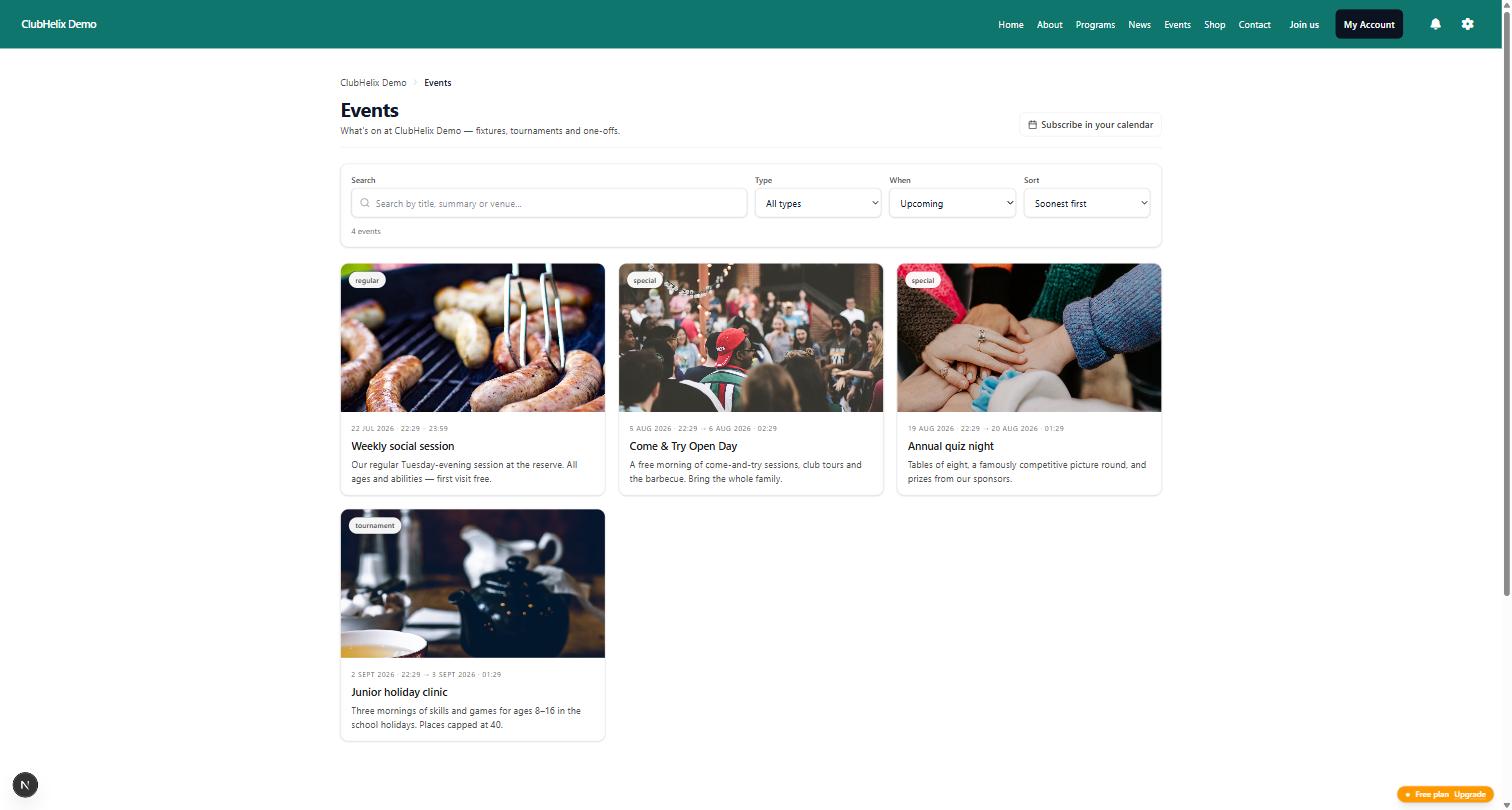
The reason gates run badly is almost never the pricing — it is that the pass list lives in a spreadsheet on someone's laptop and the ticket money lives in a tin. ClubHelix puts both on your own club site: events and ticketing sells single admissions and season passes online with the categories you have published, discount codes handle family rates and early-bird pricing without new ticket types, and the installable club app means a supporter's pass is on the phone already in their hand at the gate rather than in a drawer at home.
It costs nothing to try — there is a genuinely free tier, and pricing is published openly. Create your club site, put next season's ladder of prices on one page, and let the folding table go back to being a folding table.
Frequently asked questions
How should a club price a season pass?
Divide the pass price by the single admission price to get break-even attendances, then aim for that number to sit at about sixty to seventy per cent of your home fixtures. Price it higher and only the never-miss supporters buy; price it lower and you are discounting people who were always going to attend.
Do season passes actually make a club more money?
Usually yes, but through attendance rather than admission. Pass-holders attend more often, and each extra visit brings canteen, bar and merchandise spend that dwarfs the gate discount. The cash also arrives before your costs, which for a club with a thin balance is often worth more than the revenue itself.
What perks should a season pass include?
Access, recognition and priority rather than discounts — early team news, a supporters page listing, first refusal on limited seats, reserved parking or seating, and a vote in a supporters' award. Avoid discounts at the canteen or bar, which reduce spending at the counter where your margin lives.
Can a club sell season passes and single tickets at the same event?
Yes, and most do. Run two lanes at the entrance, publish the full ladder of prices on one page before the season, keep a single source of truth for the pass list, and produce any complimentary entries as a written list in advance so no volunteer has to make a judgement call at the gate.
What happens if fixtures are cancelled after passes are sold?
Say what happens before you sell, in the terms published beside the price — whether abandoned or moved fixtures are refunded, whether the pass transfers to another person, and what applies if a venue changes. Rules on prepaid tickets vary by jurisdiction, so treat this as general information and check your terms against your consumer-protection regulator's guidance.
Keep reading — how to promote a club event covers filling the ground in the first place, and printed membership cards vs digital passes tackles what the supporter actually holds at the gate.

