
What this guide answers
- Does the agent need to stay connected all the time?
No. The token sits in your assistant's settings and does nothing until you ask a question — there is no background process, no nightly run, no agent watching your club.
- Can we let it read but never change anything?
Yes, and that is the default. Both checkboxes are off when you mint a token, which produces a read-only key — the Monday, Wednesday and handover days above all work on one.
- What happens if somebody types a bad instruction?
Several things have to fail at once for it to matter. Every write and publish tool dry-runs first and waits to be told to proceed.
- Do we need a technical volunteer for this?
You need somebody comfortable copying a line of text into an application's settings once, which is genuinely the whole setup and is covered step by step in connecting an AI assistant to your club data.
Ireland edition. This guide is written for volunteer-run clubs in Ireland. Where rules differ — grants, tax, incorporation, safeguarding — follow the Ireland-specific pointers below or check with your national body.
Nobody joins a club committee because they want to reconcile a shop report. They join because their kid plays, or because they played, or because somebody rang them and nobody else said yes. Then the year happens: the unpaid fees spreadsheet, the four screens you open to answer one question at a meeting, the news post that never gets written because Sunday evening ran out.
Clubs rarely lose volunteers to the sport. They lose them to the admin around it — and the admin is mostly not hard, it is just repetitive, scattered across screens, and always due.
This guide is about what changes when an AI agent can read your club platform directly. Not the technology (there is a separate guide on connecting one), and not whether clubs should use AI at all (that one too). Just the week — the prompts a real person would type, and what comes back.
The setup, briefly
An admin mints a token from System → API & webhooks in the club admin and hands it to their assistant. The token acts as that person, so it can never see or do more than they can, and it stops working the moment they stop being an admin. Two checkboxes decide the rest: leave both off and the agent can only read; tick "Allow changes" and it can draft and edit; tick "Allow publishing" and it can make things visible to the public.
Most of the week below runs on a read-only token — only Thursday and Friday need the first checkbox, and neither needs the second. For the reasoning behind that split before you hand anything over, read /guides/ai-agent-permissions-for-clubs.
Monday — the money check
The treasurer's Monday usually starts with four tabs. It can start with one question instead.
You type:
How does the money look this week? Unpaid member invoices, anything unfulfilled in the shop, and anything that bounced or complained from last week's email.
What comes back is short, numeric and a little dull.
Members — 214 active, 11 with an invoice past due, 6 more due inside a fortnight. Shop — 37 orders in the last 30 days, 3 of them still not marked fulfilled. Email — last broadcast delivered to 198 addresses, 4 hard bounces, 2 complaints.
That is the whole Monday job: not "who owes us", but "is there anything I need to look at". Nine weeks out of ten the answer is no, and you have spent ninety seconds instead of twenty minutes confirming it.
Understand one thing before you rely on this. The member-data tools return aggregates — counts by status and payment standing — not names, emails or medical details. The agent will tell you eleven members are past due; it will not hand you the eleven names. That is deliberate. The register with real people in it lives behind a human login, and when you actually need to chase somebody you open the admin and see them there. So the agent is a poor place to build a debtors list, and a good place to notice you have one.
Wednesday — the committee pack
This is the one that surprises people, because it replaces an evening.
Every club has somebody who spends the night before a meeting copying numbers out of four screens into a document nobody reads twice. Membership against the same point last season. Registrations by status. What is on in the next fortnight. Anything that changed that the committee ought to know about.
You type:
Committee meeting tomorrow night. Give me a one-page pack: membership by status, registrations by status with how many are incomplete, everything on in the next three weeks with numbers booked, and anything notable in the club's audit log since the last meeting.
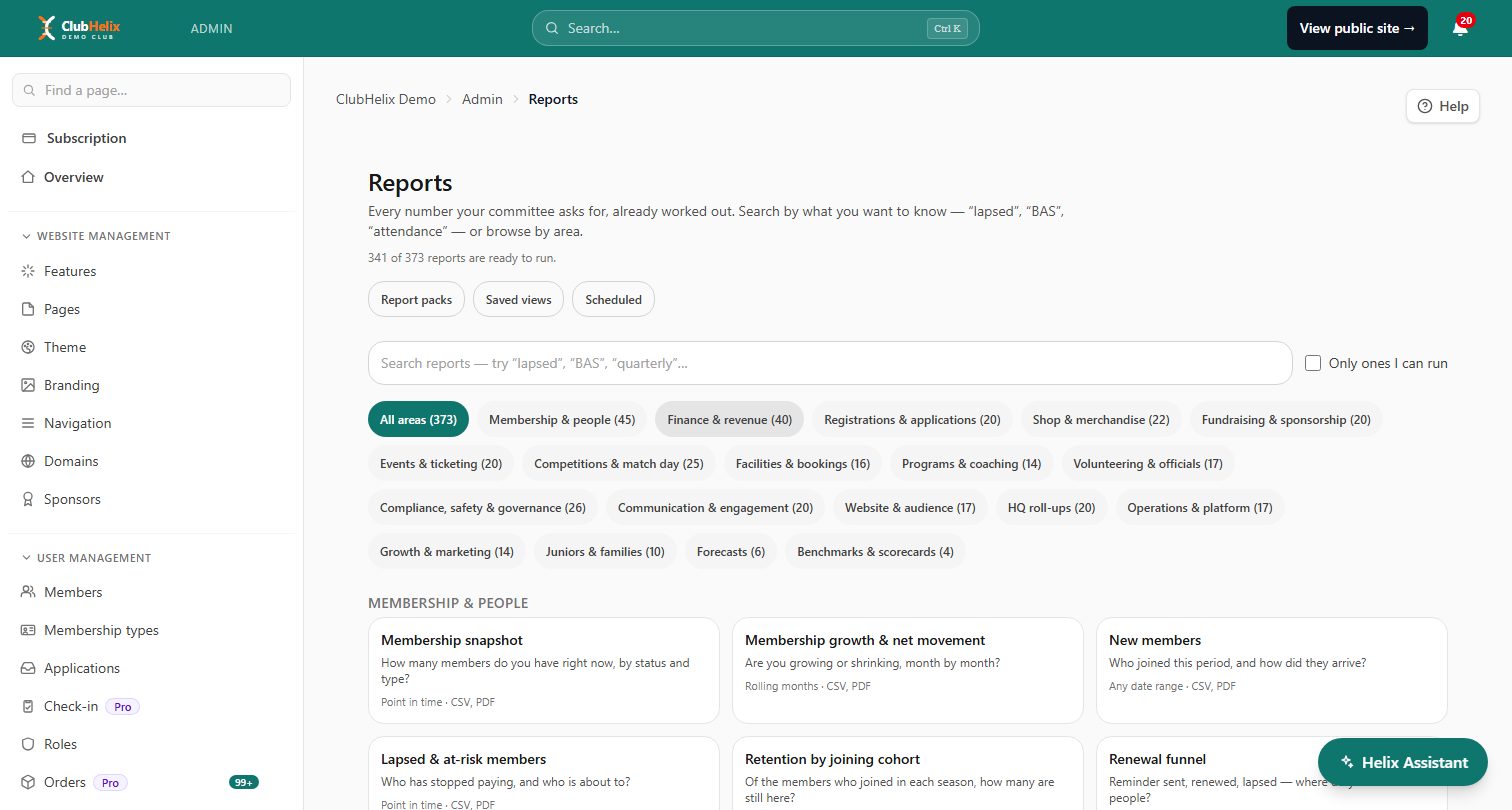
What comes back is the pack, assembled from the same tables the admin screens read — including one section most committees have never had at all: the club's own audit log. Who changed the fee settings, who deleted a page, who granted an admin role to whom. It has always been there; almost nobody scrolls it, because scrolling it is a chore and summarising it is a bigger one.
Two practical notes. Ask for the shape you want — "one page, plain sentences" or "a table per section" — because the pack is worth more when it matches how your committee already reads. And check the figures against a screen the first two or three times, so you know what each one means before you put it in front of eight people. Anything you look at every meeting belongs on a reporting page anyone can open, not in a prompt only you know how to type.
The agent's reads land in the audit log too, under the name of the person whose token it is. Nothing about this is anonymous.
Thursday — the drafting pass
Thursday needs the first checkbox, Allow changes, and this is where people get nervous — so let us be precise about what it does and does not unlock.
You type:
Draft a news post about the weekend: firsts won by six, reserves lost narrowly, and thank the three people who ran the canteen in awful weather. Club voice, about 250 words, leave it as a draft.
The agent writes the post and saves it as a draft. Before it writes anything it shows you what it is about to do and waits: every write tool dry-runs unless it is explicitly told to proceed, so the normal experience is "here is the post I would save, shall I?" rather than discovering it afterwards.
Then:
Draft a renewal reminder into the broadcasts composer for members whose fees are past due. Friendly, one clear link, no guilt.
Same pattern, with one extra line drawn deliberately: the agent writes the words and saves the draft into the broadcasts composer, and an admin picks the audience and sends. Choosing who receives something is not a thing the agent can do, so what you get is four seconds of drafting instead of forty minutes of it, and the two decisions that matter — who, and whether — still belong to a person who reads it first.
Here is the sentence worth reading twice, because it is what makes the rest of this safe. There are more than 200 tools on the ClubHelix MCP endpoint, and not one of them sends an email or an SMS, takes a payment, or issues a refund. The email and SMS tools are delivery reports, suppression lists and configuration checks. The broadcast tool drafts. So the precise version is: a publish-scoped agent can put a page live, and still cannot send a single email to a member.
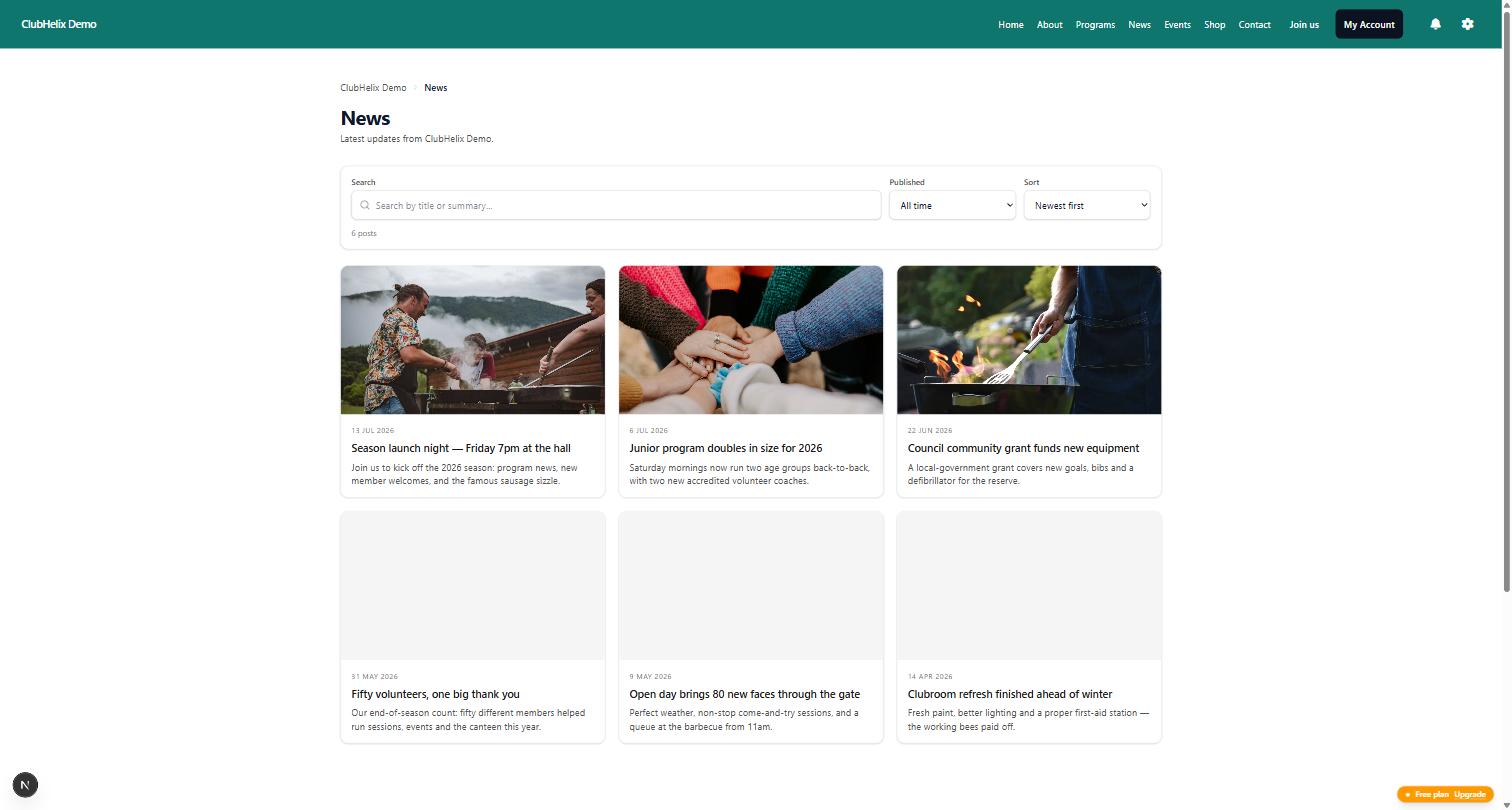
Sending is not a permission somebody forgot to switch off — it is not there at all. If your worry about AI in a club is "what if it emails 400 families by itself", that worry does not apply: the send button never leaves human hands. You get the tedious 80% done and keep the judgement call. There is more on holding the club's voice through this in AI-drafted newsletters and news.
Friday — site hygiene
Every club website rots quietly. Last season's training venue on the juniors page, a fee that changed two seasons ago, a committee contact who moved away. Nobody is neglecting it; no one person reads all forty pages, and the ones that rot are never the ones you visit.
You type:
List our pages with when each was last updated, and flag anything that still names the old training venue, an out-of-date fee, or a committee member who has left.
What comes back is a list — forty-one pages, last-updated dates, five flagged with the line that triggered the flag and why. It is a proofread of the whole site by somebody with the patience to read all of it.
Then the useful half:
Fix the two worst as drafts. Don't publish anything.
With changes allowed and publishing off, the agent updates the page drafts and stops. You open them, read what changed, and publish yourself — and even if you did grant publishing, it still shows you the plan and waits for a yes before touching a live page. Ten minutes on a Friday, and the pages that embarrass you in front of a prospective family quietly stop doing it. That surface has a feature page of its own: AI agent access.
The changeover — asking instead of excavating
The best argument for any of this is not a weekday at all. It is the handover.
Everyone has lived through the usual version: an incoming secretary inherits a shared drive, three spreadsheets with overlapping names, a login that belongs to somebody's old work email, and a predecessor who has earned the right to stop answering messages. The first six weeks are archaeology.
The version with an agent is that the new secretary mints their own token and asks:
I've just taken over as secretary. What state is the club in? Membership by status, what is owed, what is booked over the next two months, which registrations are half-finished, and what changed in the admin in the last three months.
No spreadsheet to find, no predecessor to bother. The platform is the record, and the record answers questions.
The mechanics are simple. A token acts as the person who created it and dies the moment that person stops being an admin at the club, so the outgoing secretary's token stops working when their role is removed, whether or not anybody remembers to revoke it. Tokens also expire by default after 90 days. There is no transfer step because there should not be one: the old token ends, the new person mints their own, and the audit log keeps saying who did what.
Where it is still the wrong tool
A guide that only sells is a guide nobody trusts, so here is where we would talk you out of it.
- A nightly sync is not a job for an agent. If you want member data flowing into another system every night at the same time, that is what webhooks and the API are for — scheduled, silent, nothing to interpret. An agent is for the question you ask, not the pipe you leave running.
- An agent is not a reporting dashboard. A number you look at every week should sit on a page anyone on the committee can open without knowing how to phrase anything. Use the agent to work out which numbers matter, then put those on a report and stop asking.
- Anything with a legal or money consequence wants a person reading the screen. Refunds, disputes, a complaint, a child-safety matter, a decision that ends up in minutes — not because the agent would get it wrong, but because "I read it myself" is the answer a committee needs to be able to give.
- A token skips the browser's extra sign-in step, as any API token does. That is exactly why it expires, why it is revocable in one click, and why every request it makes is audited. Treat it like a key to the clubhouse, not a browser tab.
- It cannot touch your subscription. Whatever you allow it, an agent acting for your club cannot change your plan, your billing or your payment settings — those are platform-staff tools, out of reach of any organisation's token. Agent access itself is on every plan, including the free one.
If none of those rule you out, the honest summary of the benefit is narrow and real: it removes the copying-out. Not the judgement, not the relationships, not the hard conversations about fees — just the part of the week where a volunteer is acting as a very slow spreadsheet.
What a week like this actually buys you
Add it up and a committee gets perhaps three to five hours back: Monday's twenty minutes, Wednesday's evening, Thursday's two drafts, Friday's proofread. That is not a transformation. It is roughly one volunteer's worth of goodwill per season, which happens to be the exact quantity most clubs run out of.
The other half is harder to measure and probably matters more. When the numbers are one question away, people ask more questions. When the committee pack is free, it gets read. When the news post takes four minutes, it gets written in the week people still care about the result. Admin that is cheap gets done, and a club where the admin gets done is a club where the people doing it stay.
Frequently asked questions
Does the agent need to stay connected all the time?
No. The token sits in your assistant's settings and does nothing until you ask a question — there is no background process, no nightly run, no agent watching your club. Requests are capped at 120 a minute per token, far more than a conversation uses and a deliberate ceiling on anything odd.
Can we let it read but never change anything?
Yes, and that is the default. Both checkboxes are off when you mint a token, which produces a read-only key — the Monday, Wednesday and handover days above all work on one. Drafting needs "Allow changes"; making something public needs "Allow publishing" on top of it. Grant the smallest one that does the job and mint a second token later if you need more.
What happens if somebody types a bad instruction?
Several things have to fail at once for it to matter. Every write and publish tool dry-runs first and waits to be told to proceed. Every write is checked against the live permissions of the person the token belongs to, so an agent cannot do what its owner could not do by hand, and the database refuses writes its own rules do not admit. Nothing in the tool set can send or charge anything at all. The realistic worst case is a badly worded draft that somebody deletes.
Do we need a technical volunteer for this?
You need somebody comfortable copying a line of text into an application's settings once, which is genuinely the whole setup and is covered step by step in connecting an AI assistant to your club data. If nobody on your committee wants to, the Helix Assistant built into the admin answers the same sorts of questions with no connecting at all — the same idea with a smaller blast radius.


