
What this guide answers
- Which raises more money, a raffle or an auction?
An auction usually raises more in one night, but only if the room fills.
- What is the best fundraiser for a small club?
For a small club with a modest volunteer base, a well-run raffle is hard to beat — it scales down without losing money, it does not need an event, and everyone can help.
- Do we need a permit for a club raffle or an auction?
Raffles are a regulated form of gaming in most jurisdictions and often need a permit, licence or registration above a certain prize value.
- How many auction lots should a club run?
Six to eight live lots and fifteen to twenty-five silent items suits a typical dinner.
- Can we run a raffle and an auction at the same event?
Yes, and most clubs eventually do. Run the raffle for weeks beforehand across the whole membership and simply draw it on the night, keep obviously priceable goods away from the live stage, and stagger the closing of…
USA edition. This guide is written for volunteer-run clubs in the United States. Where rules differ — grants, tax, incorporation, safeguarding — follow the USA-specific pointers below or check with your national body.
There is a moment in most fundraising discussions where two proposals end up on the table at once. Someone wants to run the raffle again, because the raffle always works and nobody has to organise anything. Someone else went to a fundraising dinner at a club across town, watched a signed jersey go for four figures in ninety seconds, and would like some of that energy here.
Both people are right, and they are describing completely different machines. A raffle sells to a crowd you never have to gather. Tickets travel — down a team list, across the bar, through a group chat, out to a grandparent who has not been to a game in years and buys a book anyway. An auction sells to a room. It needs bodies in seats, a reason to be there, food on tables, and a handful of people who arrived prepared to spend more than they planned. The raffle converts breadth. The auction converts depth.
This guide is for a committee choosing between them, or working out how to run both without one eating the other. It covers what each really earns per volunteer hour once you count the hours honestly, how prize and lot sourcing differ and what each does to your standing with local businesses, the compliance questions to settle before you sell anything, and the hybrid format most clubs land on after they have run both.
Choose by the audience you can actually assemble
Before the money, answer one question: can you reliably put ninety to a hundred and fifty people in a room on a Saturday night, with enough of them in a spending mood? If the honest answer is no, the auction question is already settled, because an auction with forty guests is a dinner party that loses money.
| Raffle | Auction | |
|---|---|---|
| Who it reaches | Anyone a member can hand a ticket to | People who bought a seat and turned up |
| Number of buyers | Hundreds, mostly small | Dozens, a few of them large |
| Average spend | The price of a ticket or a book | Wildly uneven — two bidders can carry the night |
| Where the money is won | In distribution — how many sellers you mobilise | In the room — atmosphere, competition, the right two lots |
| Downside case | You sell fewer tickets and make less | The room is half full and you lose the catering deposit |
| Skill it demands | Nagging, gently, for six weeks | One person who can hold a room and read a bid |
| Best used for | A recurring, dependable income line | A one-off target — a resurface, a bus, a defibrillator |
That last row is the practical split most committees miss. A raffle is a good annual habit. An auction is a good campaign. Trying to make the auction annual is how clubs exhaust their donor list in three years.
There is also a difference in what failure looks like, and it is the single most important line in this article: a raffle that goes badly returns a smaller number, and an auction that goes badly returns a negative one. The raffle has almost no fixed costs, so it scales down gracefully. The auction commits you to a venue, a caterer and a print run before a single guest confirms.
Revenue per volunteer hour, counted honestly
Most fundraising decisions are made on gross revenue, which is the wrong number. The scarce resource in a volunteer-run club is not money, it is the hours of about eight people. Divide the net result by the hours it consumed and the comparison changes character.
The worked examples below are illustrative and deliberately currency-free — substitute your own prices and the ratios still hold. Count hours the way you would count paid staff time, including the phone calls that went nowhere.
A 500-ticket club raffle
| Task | Hours |
|---|---|
| Committee sign-off, permit or registration paperwork | 3 |
| Sourcing five prizes — calls, visits, collection | 8 |
| Ticket design, printing or online setup | 2 |
| Distribution to teams and sellers | 3 |
| Selling, spread across twenty people over six weeks | 20 |
| Chasing unsold books and unbanked money | 5 |
| Draw, notifying winners, prize handover | 3 |
| Reconciliation and reporting | 2 |
| Total | 46 |
Sell all 500 tickets at 5 and you gross 2,500. Take off 80 for printing, 50 for the permit and 100 topping up a prize nobody donated, and you net about 2,270 — roughly 49 per volunteer hour. Sell only 300 and you net about 1,270 over maybe 38 hours, which is 33 per hour. Worse, not fatal.
A 120-seat dinner with eight live lots
| Task | Hours |
|---|---|
| Venue, date, catering contract | 10 |
| Seat sales, table plan, dietary requirements | 12 |
| Sourcing eight live lots and twenty silent lots | 30 |
| Lot descriptions, photos, display, bid sheets | 12 |
| Run sheet, briefing the auctioneer, audio and screens | 8 |
| On the night — setup, registration, bidding, pack-down | 40 |
| Settlement, invoicing, handing over lots | 10 |
| Thank-yous, reporting, donor follow-up | 6 |
| Total | 128 |
Fill the room and the arithmetic is handsome. 120 seats at 60 grosses 7,200 against catering and venue of 4,800, so the dinner itself contributes 2,400. Eight live lots averaging 450 add 3,600, twenty silent lots averaging 90 add 1,800, and the raffle you run during dessert adds 600. Net about 8,400, or 66 per volunteer hour — comfortably ahead of the raffle.
Now run it at three-quarters full:
| Guests sold | Dinner contribution | Live and silent lots | Net | Per volunteer hour |
|---|---|---|---|---|
| 120 | 2,400 | 5,400 | 7,800 | 61 |
| 100 | 1,200 | 4,600 | 5,800 | 46 |
| 80 | 0 | 3,600 | 3,600 | 29 |
| 60 | −1,200 | 2,400 | 1,200 | 10 |
Two things fall out of that table. The auction only beats the raffle when the room is close to full, and the fixed catering cost — not the bidding — is what destroys the result. So sell seats first and hard, set a go/no-go date four weeks out, and negotiate a catering minimum you can actually hit rather than one that flatters the plan.

Prizes and lots — two different asks, one finite goodwill
Both fundraisers run on donated goods, and both draw from the same well: the businesses within a few kilometres of your ground, plus whatever your own members can make or give. That well is shallower than committees assume, and it does not refill on demand.
The asks are not the same shape
A raffle wants many, modest, obvious prizes. A hamper, a voucher, a case of something, a service. The ask is easy because the cost to the donor is small and the exposure is broad — their name goes on every ticket and every poster.
An auction wants few, remarkable, hard to price lots. This is a genuinely harder ask, and the useful rule is that a live lot must be something money cannot otherwise buy. A voucher for a local restaurant is a silent-auction item, not a live one, because everyone in the room can price it and nobody will bid past its face value.
| Lot type | Where it comes from | Cost to the donor | Why it bids well |
|---|---|---|---|
| Access money cannot buy | Your own club | Nothing | Scarcity, one-off, a story to tell |
| Signed memorabilia | Players, association, sponsor | Low | Provenance, and a good tale behind it |
| Trade or professional service | A member's own business | Their time | Easy to value, easy to describe |
| A weekend away | A member with a holiday place | One weekend | Photos and dates that actually work |
| Group hospitality | A local venue | Wholesale cost | Sized for a table, so friends bid as one |
The best live lots are almost always the ones you manufacture yourself, cost nothing, and cannot be bought anywhere else: the coach runs your team's warm-up for a week, a junior leads the side out at the biggest home game, your name on a training drill for the season, first pick of the club car park for a year, a squad member mows the winner's lawn, the president's blazer worn for one match.
Protect the donor relationship, because it is the real asset
- One ask per business per year. Keep a donor register so three volunteers do not walk into the same bakery in a fortnight. Columns worth keeping: business, contact, what they gave, its value, who asked, when, whether they were thanked, and what they said about next year.
- Never let a donated lot go embarrassingly cheap in public. If a business gives you something worth real money and it sells for a quarter of that in front of a room, you have cost them face. Put anything with a public price on the silent table, where a low result is quiet.
- Close the loop within a fortnight. A photo of the winner, the named result, a written note, and whatever documentation the donor needs for their own books. This habit is why some clubs get a yes every year and others get a polite decline.
- Tell them what the money did. "Your hamper paid for a third of the new junior goals" beats "thanks for supporting the club" by a distance. Our guide on how to keep club sponsors happy goes further on the follow-through.
The compliance questions to settle before you sell anything
This is general information, not legal advice, and the rules genuinely differ by jurisdiction and change over time. The safe approach is identical everywhere: work out who your regulator is, ask these questions in writing before you commit, and keep the answer on file for the next committee.
A raffle is a form of gaming almost everywhere — you are selling chances at a prize, and that is regulated whether or not you are a charity. An auction is usually a straightforward sale of goods and lighter-touch, but not automatically free of obligations, particularly around alcohol and who may hold the gavel.
Questions to put to your regulator or governing body before either:
- At what total prize value or ticket revenue does a permit, licence or registration become necessary?
- Which kinds of organisation may run one — must we be incorporated, registered or endorsed to qualify?
- Can we sell tickets online, and are there limits on who may buy — by age, by location, by payment method?
- What must appear on a ticket, and what records must we keep of sales, buyers and the draw?
- How must the draw be conducted and supervised, and how must the results be published?
- How long must records be retained, and does anyone need to see a return or an audit afterwards?
- May alcohol be a prize or a lot, and does that need separate approval or a licence?
- Does whoever holds the gavel need to be a licensed auctioneer, or may a volunteer run the bidding?
- What are we allowed to say about tax treatment for buyers — and what must we not imply?
- Do our insurance policy and our venue agreement actually cover an event of this kind?
In the United States, charitable gaming is regulated state by state and the differences are dramatic — some states require registration for any raffle, some restrict which nonprofits may run one, and a few prohibit them outright. Start with your state's attorney general, gaming commission or charitable-solicitation registry, and check whether your city or county adds its own layer. Auctions are generally treated as sales rather than gaming, but the rules on what you may tell a buyer about deductibility are precise, so take advice before printing bid sheets.
When the money actually arrives
Fundraisers are cash-flow events as much as revenue events, and the two options behave very differently on a bank statement.
| Week | Raffle | Auction |
|---|---|---|
| Minus 12 | Nothing | Venue deposit paid — money out |
| Minus 8 | Prize sourcing, no cash yet | Seat sales open, deposits trickle in |
| Minus 6 to 1 | Steady ticket income, week by week | Seat income arrives late and in a rush |
| Event week | Final surge | Catering balance due, often before the event |
| Plus 1 to 3 | Reconciliation, all money banked | Chasing settlement on unpaid lots |
The practical rule: never fund an auction deposit out of money you need for something else in three months. A club with a tight winter should run the dependable raffle in the tight months and hold the auction for a period when a shortfall would not hurt.
Time it to your season. The dependable draw suits the depths of the winter fixture list, when people are at the ground every weekend and a ticket book moves without effort. Save the dinner for the shoulder — the awards night at the end of the campaign, or the lighter evenings before the season restarts, when a night out is appealing and the venue is not competing with the festive rush.
Two run sheets you can copy
Raffle, six weeks out
- Week minus 6. Committee approves the target, the prize list and the ticket price. Lodge the permit or registration if one is needed. Appoint one accountable person — not a subcommittee.
- Week minus 5. Secure prizes and confirm each in writing. Photograph them. Build the online ticket page and the seller list.
- Week minus 4. Launch. Announce to the whole club at once with a clear deadline and a picture of the top prize. Hand out books at training.
- Weeks minus 3 to minus 1. Weekly nudge with a running total and a leaderboard of sellers. Nothing lifts sales like visible progress.
- Draw week. Final call for money and unsold books. Draw in public, publish every winning number, notify winners individually.
- Week plus 1. Bank everything, reconcile, report the net figure to the committee, thank donors and the top sellers by name.
Auction, sixteen weeks out
- Week minus 16. Set the target and the room size. Book the venue and read the cancellation terms before signing anything.
- Week minus 14. Appoint an auctioneer and a compere, and confirm the licensing position and your insurance.
- Weeks minus 12 to minus 6. Source lots — six to eight live and fifteen to twenty-five silent, then stop chasing.
- Week minus 8. Seats on sale. Publish the lot list as it grows — the lots sell the seats, not the other way round.
- Week minus 4. Go or no-go against seat sales. Under sixty per cent, cut the catering or move the date now.
- Week minus 2. Run sheet locked, bid sheets printed, table plan set, payment method tested with a live transaction.
- On the night. Registration desk open early, every guest recorded against a bidder number, silent tables closed in staggered waves so people stay.
- Week plus 1. Settle every unpaid lot, hand over the goods, and write to every donor with a photo and the result.
The hybrid most clubs end up with
Once a club has run both, it usually stops treating them as alternatives. The format that works is a raffle running for six to eight weeks across the whole membership, drawn on the night of a dinner that carries six to eight live lots and a silent table. Three rules stop it crowding itself:
- Sell the raffle tickets before the night. If the raffle only sells in the room, you have converted a broad fundraiser into a narrow one and lost the point of running it.
- Do not let the two compete for the same goods. Anything with an obvious retail price goes to the raffle or the silent table. The live stage gets only what cannot be priced.
- Cap the live lots at eight. A room's appetite for bidding is finite and it runs out around the ninth item, which is exactly when your best lot should have already sold.
If you would rather not sit anyone down at all, club fundraising ideas has the wider menu, and a trivia night is the cheapest way to test whether your club can actually fill a room before you commit to catering.
Getting the money in without the shoebox
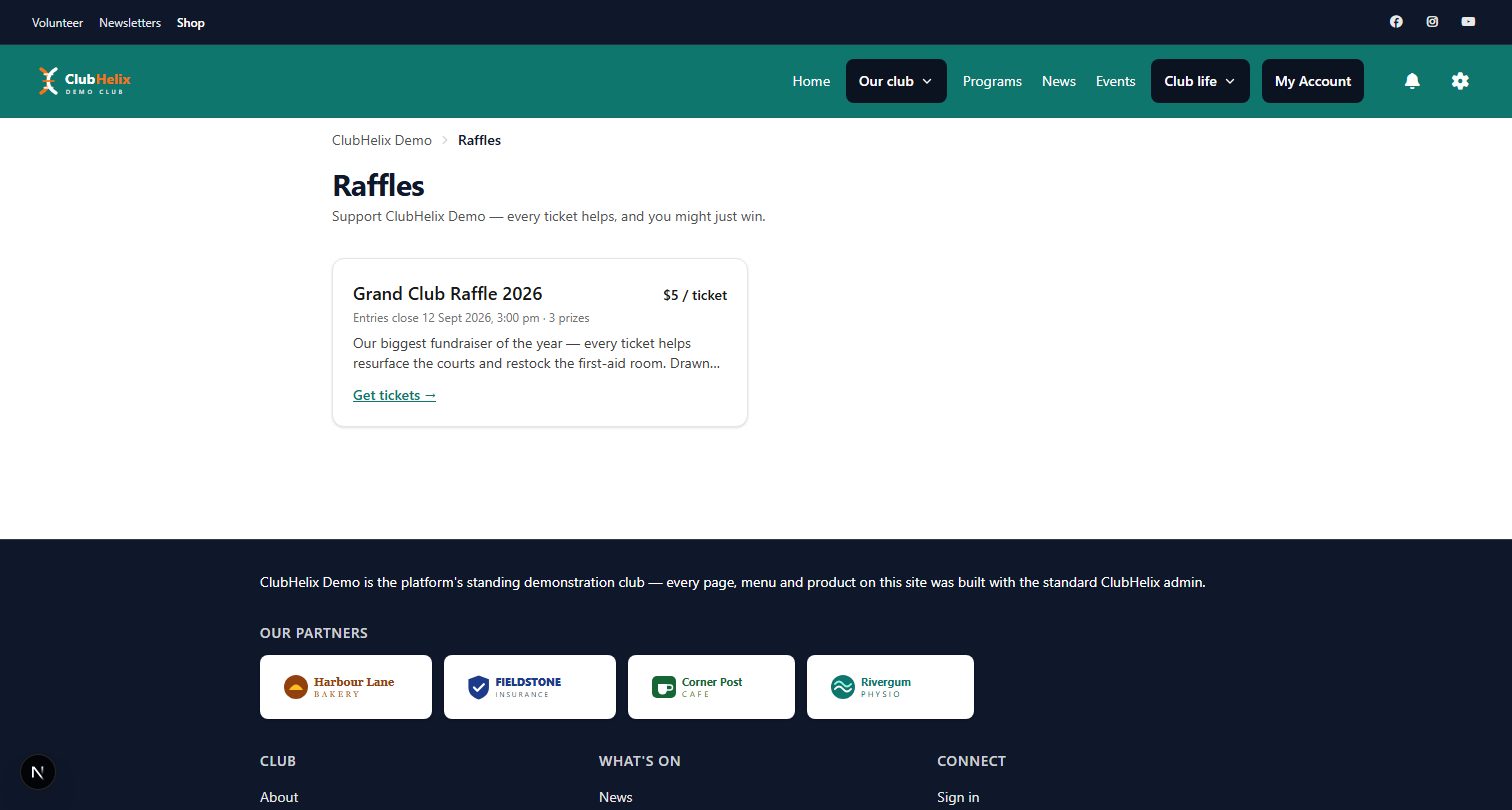
The tedious part of either fundraiser is not the asking, it is the tracking — who has a ticket book, who has paid, which lot went to which bidder, and how any of it reconciles on Monday. ClubHelix handles that side directly on your club site — online raffles with tickets sold and numbers allocated automatically, donations for supporters who would rather just give, a club shop for seats and merchandise, and email broadcasts from your own domain so the weekly nudge goes out in two minutes rather than an evening.
You can try the whole thing without spending anything — the free tier is a real product, not a demo, the pricing is published rather than quoted, and a committee can have a site live and a raffle open before the next meeting. Create your club site and put the ticket book away.
Frequently asked questions
Which raises more money, a raffle or an auction?
An auction usually raises more in one night, but only if the room fills. A raffle raises less per hour of effort at the top end and far more reliably at the bottom, because it has almost no fixed costs. If you cannot confidently fill a room, the raffle will out-earn the auction on the result that actually lands in the bank.
What is the best fundraiser for a small club?
For a small club with a modest volunteer base, a well-run raffle is hard to beat — it scales down without losing money, it does not need an event, and everyone can help. Build the auction ambition later, once you have a mailing list, a donor register and evidence you can sell a hundred seats.
Do we need a permit for a club raffle or an auction?
Raffles are a regulated form of gaming in most jurisdictions and often need a permit, licence or registration above a certain prize value. Auctions are usually treated as sales and are lighter-touch, though alcohol lots and who may act as auctioneer can still be regulated. Treat this article as general information and confirm your position with your own regulator before you sell anything.
How many auction lots should a club run?
Six to eight live lots and fifteen to twenty-five silent items suits a typical dinner. Beyond that, bidding fatigue sets in, the night runs long and your later lots sell for less than they are worth — which is worse than not offering them, because it embarrasses the donor.
Can we run a raffle and an auction at the same event?
Yes, and most clubs eventually do. Run the raffle for weeks beforehand across the whole membership and simply draw it on the night, keep obviously priceable goods away from the live stage, and stagger the closing of the silent tables so people stay for the main event.
How do we ask a local business for a prize?
Ask in person, ask specifically, and make it easy to say yes — name the item or the value you are hoping for, say exactly where their name will appear, and leave a one-page letter behind. Then thank them properly afterwards with a photo and the result. Our guide on how to get sponsors for a sports club covers the longer relationship this turns into.
Keep reading — club fundraising ideas lays out the full menu, and how to keep club sponsors happy covers the relationships that make every ask easier next year.

