
What this guide answers
- What is the main difference between Pitchero and TeamSnap?
Structure. Pitchero is built around a club — a hosted public website, a club-wide membership database and club payments, with teams as sections inside it.
- How much do Pitchero and TeamSnap cost?
67% + 15p on Pro. TeamSnap's pricing page (October 2026) says single teams are "$0 to start" and shows no figures, while its club and league product, TeamSnap ONE, is quoted rather than published — ask for that quote…
- Does TeamSnap give my club a website?
It varies by plan, and TeamSnap's pricing page (October 2026) doesn't spell it out.
- Can a club run both a website platform and a team app?
Plenty do, and it is a legitimate answer. The cost is two member lists and the re-keying between them, which lands on whichever volunteer is least able to say no.
- Our teams already use different apps. Where do we start?
Not with a product decision. Start with the access audit — who owns each account, who else can get in, where money has landed, and what breaks if that person leaves.
The comparison that leads people here usually starts with an audit nobody enjoyed. A new registrar sits down to build one list of everyone in the club and finds there isn't one. There are eleven — a chat group per team, three of them on paid plans charged to a coach's personal card, two belonging to coaches who left last winter and whose accounts nobody can get into. Meanwhile the club's actual website still lists a president who resigned two seasons ago.
Pitchero and TeamSnap both get shortlisted at that exact moment, and it is worth saying plainly that they are not the same shape of product. The difference that decides everything downstream is the unit of account. Pitchero is built around a club — one hosted website, one membership database, one set of finances, with teams as sections inside it. TeamSnap grew up around a team — one squad, one schedule, one group of parents — and later added a club and league layer above it. That single structural difference explains almost every other difference on this page, including who ends up holding your money and your member list.
Full disclosure before we referee. We are ClubHelix, an all-in-one club platform, so we compete with both and we will say exactly where near the end. Everything factual below is from public sources, current as at July 2026. Verify anything decision-critical on their own sites, and if we have something wrong, tell us.
Two products, two units of account
Pitchero is a Leeds-based club platform built around a hosted club website, with membership, online payments, branded mobile apps and deep team-statistics tooling hanging off it. It has league and fixture feed integration inherited from its football and rugby heritage, and it hosts the public web presence for roughly ten thousand grassroots clubs — which is why, if you have ever looked up a village rugby side, you have probably landed on one. It is priced in pounds and also sells in Australian, New Zealand and US currencies. It is a club-level product; there is no association or governing-body layer sitting above the club in the way there is for platforms sold to national bodies.
TeamSnap is a Boulder, Colorado product and the team-app market leader in the United States and Canada. Its core loop is scheduling, availability, communication, payments and registration, delivered through native mobile apps with an enormous consumer brand behind them. Its pricing page (checked October 2026) shows no dollar figures: single teams are "$0 to start", and the club and league product, TeamSnap ONE, is on customised pricing. What web presence each plan includes varies, so ask. In the US market it also plugs into the background-screening ecosystem that many youth leagues require, and it operates a sponsor advertising network.
The practical consequence: Pitchero is bought by a committee, TeamSnap is usually adopted by a coach. That is not a criticism of either. It is the reason clubs end up comparing them at all — one arrived from the top, the other arrived from the bottom, and now they meet in the middle at a committee meeting.
One club site versus eleven team accounts
The cover version of this problem is "we should probably consolidate". The real version is four separate fractures, and it helps to name them, because different fractures justify different urgency.
The front door fractures. A prospective family googles your club and finds the sport's fixture listing, a social page with a 2023 cover photo, and nothing that says what juniors cost or when sign-on is. Team apps are closed by design — the content inside them is invisible to anyone who has not been invited. A club website platform exists to solve exactly this; a team scheduler does not attempt it below TeamSnap ONE.
The member list fractures. Every team keeps its own roster in its own account. There is no reliable answer to "how many financial members do we have", because the answer lives in eleven places and none of them knows who has paid the club as opposed to who turns up. Grant applications, insurance declarations and end-of-season reporting all quietly depend on that number.
The money fractures. This is the one that ends up on a committee agenda. Team-level fee collection means funds landing somewhere that is not the club's bank account, reconciled by a volunteer who is not the treasurer. Nobody is doing anything dishonest — the audit trail your auditor or grant assessor wants simply does not exist.
The memory fractures. When a coach steps down, the account, the history, the parent contacts and the photos go with them. Committees rediscover this every January.
Before you shortlist any product, run this audit. It takes about an hour and it changes what you buy.
- List every app, group and page currently used by any team, including the ones nobody admits to.
- For each one, write down whose email address owns it and who else has admin access.
- Note which ones hold contact details for children, and who can see them.
- Note which ones have ever collected money, and where that money landed.
- Count how many separate places a change of address would have to be typed.
- Find out which accounts are on paid plans and who is paying for them.
- Ask what happens to each account if that person leaves tomorrow.
Almost every club that runs this audit finds at least one account that only one person can access. That single finding is usually worth more than the software comparison that prompted it.

Side by side
Public information, current as at July 2026. Where a figure is not published, we say so rather than repeating an internet estimate.
| Area | Pitchero | TeamSnap |
|---|---|---|
| Unit of account | The club | The team, with a club and league layer above it |
| Public club website | Yes — the centre of the product | With the business (club and league) tier |
| Mobile apps | Native branded club apps | Native apps — the primary interface |
| Scheduling and RSVPs | Team tools included | The core loop, and the reason most coaches adopt it |
| Membership database | Yes, club-wide | Rosters per team; club-wide records at TeamSnap ONE |
| Registration and payments | Yes, on paid plans | Yes, including registration |
| Fixture and league feeds | Yes — governing-body feeds from its football and rugby heritage | Not a league-feed product in the same sense |
| Team statistics | Deep — a long-standing strength | Present, but not the product's centre of gravity |
| Published subscription | Free, Standard £38 a month, Pro £99 a month | Single teams "$0 to start"; TeamSnap ONE by quote; no figures (Oct 2026) |
| Payment fees | From 2.42% + 17p (Standard) to 1.67% + 15p (Pro); no payments on Free | Published team pricing; club-tier commercial terms come with the quote |
| Home market | Leeds, UK; sells in several currencies | Boulder, USA; strongest in the United States and Canada |
The money question — subscriptions, fees and who holds the float
What each publishes
Pitchero publishes its subscription ladder: a Free plan, Standard at £38 a month and Pro at £99 a month, with 30-day trials and a discount for annual billing. Online payments are not available on the Free plan. On paid plans the processing rate is tier-linked — 2.42% + 17p on Standard, improving to 1.67% + 15p on Pro. So the higher tier is partly a subscription and partly a bulk-rate purchase.
TeamSnap publishes no prices: single teams are "$0 to start" and the club and league product, TeamSnap ONE, is custom-quoted (checked October 2026). You will find third-party directories quoting monthly figures for it; those are estimates rather than published prices, so we will not repeat them. Ask for the quote, and ask what the payment processing terms are in the same conversation, because at club scale that is the number that moves.
An illustrative sum, clearly labelled as one
Here is the arithmetic committees rarely do, worked on Pitchero's published rates purely because they are published. Say a club collects £8,400 in subscriptions across 140 payments of £60.
- Standard: £456 a year in subscription, plus 2.42% (£203.28) and 17p × 140 (£23.80) in fees — about £683 a year all in.
- Pro: £1,188 a year in subscription, plus 1.67% (£140.28) and 15p × 140 (£21.00) — about £1,349 a year.
The better rate saves about £66 in fees and costs £732 more in subscription. At the same average payment size, a club needs to be pushing somewhere near £90,000 a year through the platform before the cheaper processing rate pays for the dearer plan — worth knowing before a committee upgrades "because the fees are lower". This is illustrative arithmetic on published rates, not a quote; put your own volumes in.
The float question nobody asks
Whichever product you choose, ask where the money sits between the member paying and the club being paid, and whose name is on that account. A team-adopted scheduler with a coach's payout details attached is a governance issue before it is a software issue — our guide to collecting membership fees online covers the controls worth putting around it.
Where each is genuinely strong
Pitchero is strong when the club's public face and club-wide money are the priority. It is a real website platform with membership and payments built into it, not a profile page. Long-established team-statistics tooling makes appearance records and scoring tables a first-class feature rather than a spreadsheet, and its governing-body fixture and league feeds remove a weekly re-typing job for clubs in the sports it grew up serving. The whole thing is bought once, by the club — precisely the structure a committee is trying to restore.
TeamSnap is strong when the weekly organising loop is the priority. Availability, schedule changes, "who is coming Saturday", reminders that actually reach parents — this is what it was built for and it shows. Its consumer brand means many families already have it installed from another child's team, which makes adoption close to frictionless, and in the US market its connection to the background-screening ecosystem many leagues mandate is hard to replace. If your problem is genuinely that a coach cannot get a straight answer out of eleven families by Thursday, it solves that faster than anything a committee can procure.
Getting scattered teams back under one roof
Consolidation fails when it is announced as a correction. Coaches adopted their own tools because the club did not give them one that worked, and they will hear "we are moving everyone" as a criticism unless you frame it otherwise. Try an amnesty instead — nobody is in trouble, we are taking the admin off you, here is what you get back.
A sequence that works over about six weeks:
- Week one — audit and amnesty. Run the seven-point audit above at a coaches' meeting, in the room, with laptops open. Collect the list of accounts, and make it explicit that nothing anyone did was wrong.
- Week two — decide what stays decentralised. Match-day banter, car-pooling and last-minute "bring bibs" messages can stay wherever the team already talks. What must come back to the club is the member record, the money and the public face.
- Week three — one member list. Export what exists, merge it, de-duplicate. Expect this to be the slowest part; three spellings of the same surname is normal. Decide which field is authoritative for contact details.
- Week four — one front door. Publish the club site with the pages that answer buying questions — what it costs, when training is, who to contact, how to join. A stale page is worse than a short one.
- Week five — one payment path. Move fee collection to the club account, with the treasurer as an approver rather than the sole operator. Tell members once, clearly, and switch the old method off on a stated date.
- Week six — access and succession. Every team gets at least two club-owned admin logins, and no club account is owned by a personal email address. Add the handover to your committee handover checklist so this never has to be done twice.
The governance guardrails matter more than the tool. Two admins minimum for every area, club-owned email addresses on every account, and a written note of who can reset what.
Where ClubHelix fits, and where it does not
Here is our declared interest, stated as a lane rather than a pitch. ClubHelix is built around the club as the unit of account, with teams inside it — one member list, one bill, one public site. You get a real website with a drag-and-drop canvas page editor on your own domain, team management with squads, coaches and fixtures under the club rather than beside it, and member registration and payments that land in the club's account with the treasurer in control. The weekly organising loop lives in the same system through RSVPs, attendance and member chat, so a coach chasing availability and a registrar chasing a renewal are looking at the same person, not two records.
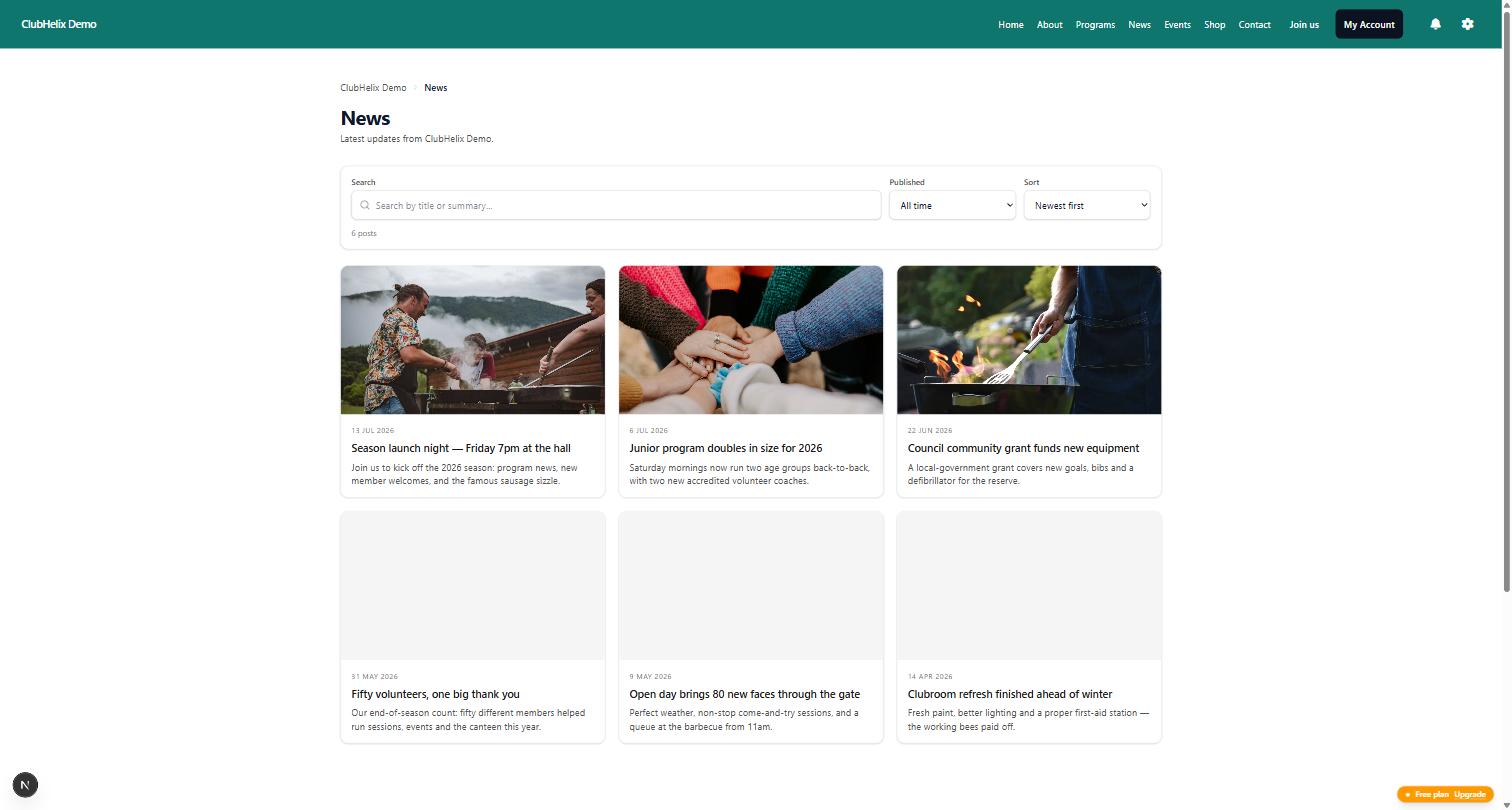
If your club is currently paying for a website it cannot edit and a handful of team apps it cannot see into, the invitation is simple — there is a free tier to build on, the platform is Australian-built and hosted, pricing is published rather than quoted, and most committees have a working club site up in an afternoon. Create your club site and move one team across before you move eleven.
Now the fair limits. ClubHelix ships an installable web app rather than native app-store apps, so if a store listing is non-negotiable, both products here beat us. We have no US background-screening integration, which is decisive for many youth clubs in that market, we do not carry Pitchero's governing-body league feeds, and our admin, club websites and member accounts are English-only. If TeamSnap's scheduling is already loved by every coach and the website problem is solved elsewhere, keep it. Fuller head-to-heads live at /compare — Pitchero and TeamSnap.
Frequently asked questions
What is the main difference between Pitchero and TeamSnap?
Structure. Pitchero is built around a club — a hosted public website, a club-wide membership database and club payments, with teams as sections inside it. TeamSnap is built around a team — scheduling, availability and messaging for one squad — with a club and league layer added above it, and a website that arrives with that business tier. Which one fits depends on whether your unsolved problem is the club's front door or the coach's Thursday night.
How much do Pitchero and TeamSnap cost?
As at July 2026, Pitchero publishes Free, Standard at £38 a month and Pro at £99 a month, with 30-day trials, annual-billing discounts, no payments on the Free plan, and processing fees from 2.42% + 17p on Standard to 1.67% + 15p on Pro. TeamSnap's pricing page (October 2026) says single teams are "$0 to start" and shows no figures, while its club and league product, TeamSnap ONE, is quoted rather than published — ask for that quote in writing, with the payment terms included.
Does TeamSnap give my club a website?
It varies by plan, and TeamSnap's pricing page (October 2026) doesn't spell it out. Don't assume the version already in use across your teams includes a public site, and ask what TeamSnap ONE, the club and league product, includes. If a public web presence is the gap you are closing, confirm which tier includes it before you decide.
Can a club run both a website platform and a team app?
Plenty do, and it is a legitimate answer. The cost is two member lists and the re-keying between them, which lands on whichever volunteer is least able to say no. Decide deliberately which system is authoritative for contact details and which is authoritative for money, and write it down. When the duplication starts eating the registrar's week, that is the signal to consolidate.
Our teams already use different apps. Where do we start?
Not with a product decision. Start with the access audit — who owns each account, who else can get in, where money has landed, and what breaks if that person leaves. Then agree what must be central (member record, money, public face) and what can stay with the teams. Only then shortlist, because that audit usually rewrites the requirements list you thought you had.
Still mapping the landscape? Our comparison of Pitchero and Spond covers the website-versus-free-app version of this question, Spond versus TeamSnap covers the two team apps head to head, and club app versus club website is the category-level version if you have not narrowed the field yet. Corrections welcome via contact.


