
What this guide answers
- What is the difference between an honorarium and a fee?
An honorarium is a token payment recognising voluntary service — not calculated against hours or a rate, and not expected as a condition of the person helping.
- Do we have to withhold tax or pay superannuation for our umpires?
That depends on the arrangement, the amounts and the rules where your club is, and it is exactly the question to put to an accountant rather than to a committee meeting.
- Can we pay a committee member?
Sometimes, and your own rules are the first place to look — many sets of rules restrict or prohibit payments to committee members, or require a members' resolution.
- Is a fuel payment a reimbursement or a fee?
It is a reimbursement if it pays back real travel, supported by a claim that names the trip and applies an agreed rate.
- How should we record payments to officials?
Against the appointment that generated them: the fixture, the role, the rate, the classification, the date paid, and the method.
UK edition. This guide is written for volunteer-run clubs in the UK. Where rules differ — grants, tax, incorporation, safeguarding — follow the UK-specific pointers below or check with your national body.
Saturday finishes, the umpires come off, and somebody hands over three envelopes from the canteen float. It has worked for decades and it is the most common way community clubs pay the people who make their sport possible.
It is also the point where a club's paperwork usually stops. The bank statement says "cash withdrawal". The minutes say nothing. And when somebody eventually asks what those payments were — an auditor, a new treasurer, a governing body, or the official themselves at tax time — the honest answer is that nobody wrote it down.
The fix is small and it starts with a question the club should answer before the money moves: what kind of payment is this?
General information only. This article is general information for community clubs, not legal, financial or tax advice, and it does not make your club compliant with anything. Paying someone can create obligations for your club, and which ones depend on the arrangement, the amounts and where you are. Talk to your accountant, and check with the revenue authority that applies to your club before you set a payment structure in place.
Three payments that look identical and are not
Reimbursement. The club pays back money the person actually spent — petrol to an away fixture, a box of match balls they bought, a parking fee. The defining feature is that the person is no better off than before. A reimbursement is supported by evidence of the spending: a receipt, a log, a rate applied to a real trip.
Honorarium. A token payment recognising voluntary service, usually to someone who was never going to invoice you — the club's long-serving scorer, a committee member who gave up a summer. It is not calculated against hours worked or a rate card. It is a thank-you with money attached, and its size should look like a thank-you.
Fee for service. Payment for work done: a match fee for a qualified referee, a session rate for a coach, an appointment rate for a scorer. It is priced against the work, expected by the person doing it, and it is the one people most often disguise as one of the other two.
A club may legitimately make all three kinds of payment in the same season. What it cannot do is make one and call it another because that sounds simpler.
Why the distinction reaches your club
Two reasons, and the second surprises committees more than the first.
It can create obligations. Paying someone for services may bring tax and compulsory retirement-contribution considerations into play for the club, depending on the arrangement. "They're a volunteer" is not a classification that settles this — the label the club uses does not decide the substance, the arrangement does. This is the point at which to involve an accountant rather than a confident committee member.
Your own revenue authority will have equivalent guidance on payments to volunteers and on when a payment for services carries withholding or pension obligations. Read it before you set the rates rather than after your first pay run, and take local advice — the answer depends on the arrangement, not on what the club calls it.
It is a governance record. A reimbursement, an honorarium and a fee sit differently in the accounts, and they sit differently at an annual meeting. "We paid our umpires match fees totalling this much" is a normal line item. "We paid the treasurer's brother-in-law an honorarium" is a question, and the club wants a good answer ready — approved by whom, at what rate, minuted when. Your own rules may also restrict what committee members can be paid, which is exactly the kind of thing nobody checks until it is awkward.
The rate card is the cheapest control you will ever build
Most of the mess comes from rates being invented per appointment. Somebody rings around, agrees a number, and the desk guesses next week.
Instead, publish a rate card once a season:
| Role | Grade | Rate | Approved |
|---|---|---|---|
| Referee | Senior | Set by committee | Minuted date |
| Referee | Junior | Set by committee | Minuted date |
| Assistant / touch official | Any | Set by committee | Minuted date |
| Scorer / timekeeper | Any | Set by committee | Minuted date |
| Travel | Per trip or per distance | Set by committee | Minuted date |
A published card does four jobs at once: it stops negotiation at the ground, it removes the appearance of favouritism, it makes the budget forecastable, and it gives the treasurer something to check a claim against. Add the classification to the card too — travel is a reimbursement, a match rate is a fee — and the awkward decision gets made once, at a meeting, rather than weekly at a canteen window.
Move the money the boring way
Cash is the enemy of a defensible record. It leaves no trace of who received what, it interacts badly with a canteen float, and it puts a volunteer in the position of carrying other people's money around.
The sequence that survives scrutiny:
- Appoint the official to the fixture before the day, with the role and the rate attached.
- Have them confirm the appointment, so an unconfirmed slot is visible while there is still time to fill it.
- Mark the appointment complete after the match — the payment exists because a fixture happened, not because somebody remembered.
- Classify the payment as a reimbursement, an honorarium or a fee.
- Pay by bank transfer in a run, not by envelope.
- Mark it paid, so the same appointment cannot be paid twice.
- Report it to the committee as a total by category, each month or each quarter.
For reimbursements, add the evidence step: a receipt, or a claim form that names the trip and the rate. A reimbursement with no substantiation is not a reimbursement — it is an unexplained payment with a friendly name.
How ClubHelix handles official payments
The match officials module follows that sequence deliberately.
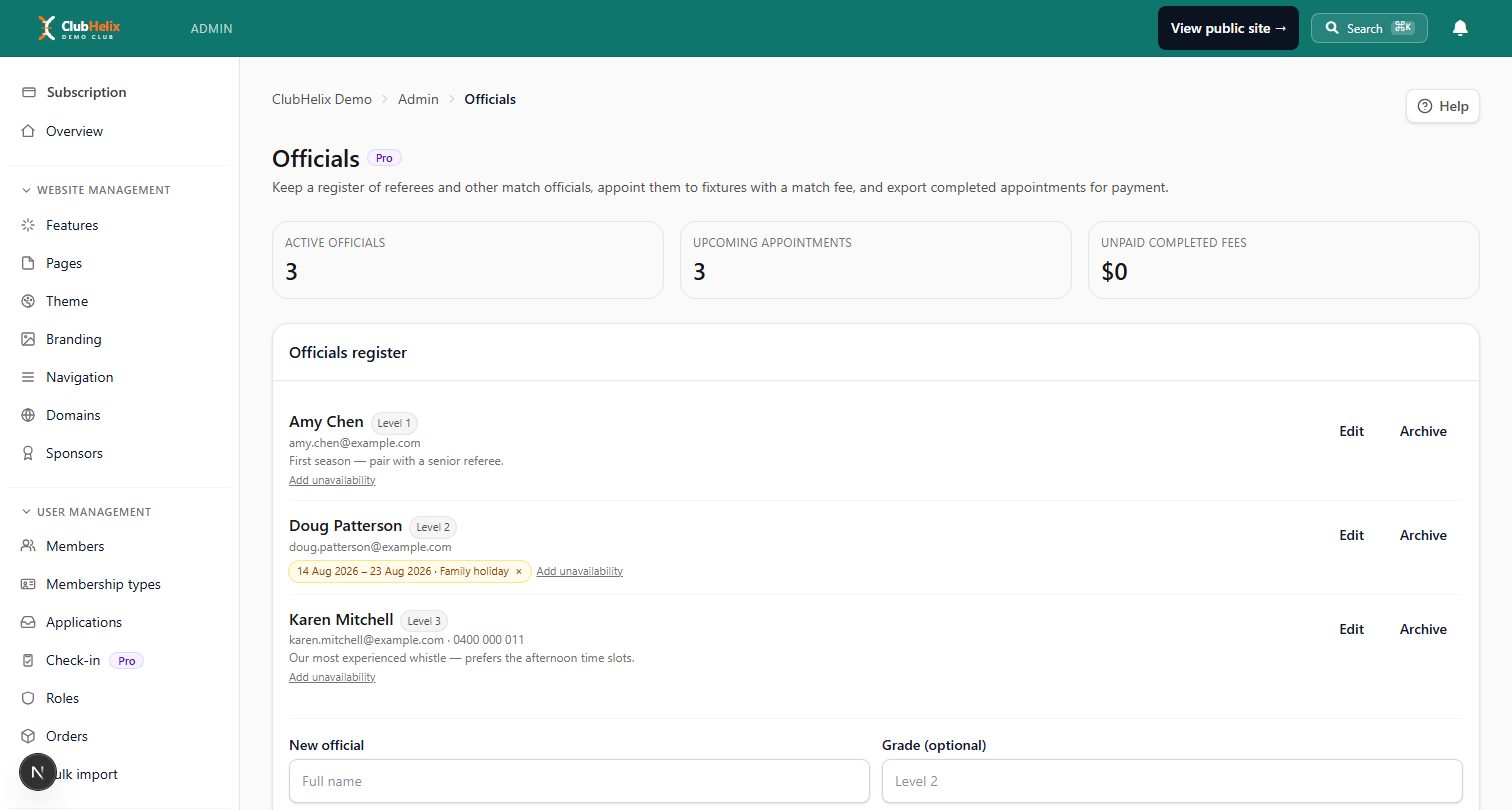
Officials sit in a register with their availability, and appointments carry the role and the fee, with a confirmation flow so the desk knows who is actually coming. Fees come from rate cards set by grade and role, so an association can decide once what a senior referee and an assistant are paid, and the person doing the appointments stops guessing.
Then the part that matters for this guide: every fee-bearing appointment records what the payment is — reimbursement, honorarium or fee. It starts empty rather than defaulted, because a classification nobody looked at is worse than none: it reads like an answer. The export refuses to produce a payment file containing a fee-bearing payment that nobody has classified, naming the rows, so the question gets answered before the money moves rather than a year later.
Payment runs export as a CSV a treasurer can reconcile.
What the software deliberately does not do is decide the classification for you, or tell you what your obligations are. It records the treasurer's own answer and keeps it attached to the payment. The judgement stays with the club and its accountant, which is where it belongs — and the reports side gives you the totals by category that the committee and the annual meeting actually ask for.
Common situations, and the sensible reading
"Our umpires are volunteers but we give them a set amount a game." A per-game amount set against the work is behaving like a fee, whatever the club calls it. Decide honestly, record it as what it is, and take advice if the amounts are meaningful.
"We pay a coach's travel." If it reimburses real travel, supported by a log or receipts, it is a reimbursement. If it is a round number paid regardless of distance, it is drifting toward a fee.
"The committee voted an honorarium for the secretary." Common and often entirely reasonable. Check your own rules first, because some sets of rules restrict payments to committee members; minute the decision, the amount and the reason; and have the person concerned absent from the vote — the conflict of interest point is covered in our conflict of interest policy guide.
"We pay juniors to run the scoreboard." Paying minors brings its own considerations — parental consent, what the club records about them, and the same classification question. Keep the amounts modest, pay to a parent's account if the family prefers, and write down what you agreed.
"One official does a lot of work for us." Volume changes how an arrangement looks. A person officiating most weekends at published rates starts to look less like a volunteer receiving thanks and more like someone providing services. That is the situation to take to an accountant early rather than after a season of payments.

What to put in front of the committee
Once a year, ideally when setting the budget:
- the rate card for the coming season, with the classification against each line;
- the total paid to officials last season by category;
- a note of anyone who received a materially larger total than the rest, and why;
- confirmation that payments were made by transfer against completed appointments;
- the accountant's view, if the club's payments are growing.
Five lines in a meeting pack, and the club never has to reconstruct a year of envelopes.
Frequently asked questions
What is the difference between an honorarium and a fee?
An honorarium is a token payment recognising voluntary service — not calculated against hours or a rate, and not expected as a condition of the person helping. A fee is payment for work done, priced against that work and usually expected. The test is not the size of the payment or what the club calls it; it is whether the payment is consideration for services. If you are choosing the word because it sounds less complicated, that is a sign you have a fee.
Do we have to withhold tax or pay superannuation for our umpires?
That depends on the arrangement, the amounts and the rules where your club is, and it is exactly the question to put to an accountant rather than to a committee meeting. What the club can do without advice is get the record right: appoint, classify, pay by transfer, keep the evidence. A club that can show what each payment was has a far easier conversation than one holding a stack of cash withdrawals.
Can we pay a committee member?
Sometimes, and your own rules are the first place to look — many sets of rules restrict or prohibit payments to committee members, or require a members' resolution. Beyond the rules, treat it as a conflict of interest: the person concerned does not participate in the decision, the amount and reason are minuted, and the payment appears in the accounts like any other.
Is a fuel payment a reimbursement or a fee?
It is a reimbursement if it pays back real travel, supported by a claim that names the trip and applies an agreed rate. If it is a flat amount paid regardless of whether anyone travelled, it is not reimbursing anything. Set the travel rate as part of the rate card, ask for the trip detail on the claim, and the distinction takes care of itself.
How should we record payments to officials?
Against the appointment that generated them: the fixture, the role, the rate, the classification, the date paid, and the method. Pay by bank transfer rather than cash, mark each appointment paid so nothing is paid twice, and report totals by category to the committee. That record is what turns three envelopes into a line item anyone can explain.
Appoint officials, set rates by grade, classify every payment and export a pay run with ClubHelix. Next: what does a club treasurer do and the treasurer's report template.


