
What this guide answers
- How many membership types should a club have?
Three playing tiers plus one non-playing tier covers most clubs — full adult, reduced adult, junior and social.
- Is a flat membership fee ever the right answer?
Yes, for small clubs, new clubs and clubs with a narrow membership.
- Do membership tiers actually increase revenue?
Usually, but the gain concentrates in the first two or three categories.
- Should a family discount be its own membership category?
No. Treat it as a cap or a discount applied on top of an existing tier.
- How do we change our fee structure without upsetting members?
Restructure at roughly neutral revenue first and increase prices in a later season, publish the cost-per-member working before the new prices, grandfather anyone worse off for one season, and close old categories to…
Canada edition. This guide is written for volunteer-run clubs in Canada. Where rules differ — grants, tax, incorporation, safeguarding — follow the Canada-specific pointers below or check with your national body.
Pull up your club's fee schedule and count the rows. If there are more than five, they did not arrive by design. They arrived one at a time, each with a good reason attached at the moment it was proposed — a rate for the midweek crowd, something for the players who only turn out after Christmas, a cheaper option for the couple who complained, a category invented for one particular family and never removed.
Nobody sets out to build a fourteen-row fee schedule. It accumulates, because adding a category always feels generous and removing one always feels like taking something away. Meanwhile the registrar is manually re-categorising thirty people a season, the treasurer cannot explain the membership line in the accounts, and a prospective member reading the join page cannot work out which row is theirs and quietly closes the tab.
This guide is for the committee sitting between the two poles — a single honest price for everyone, or a structure that charges people according to how they use the club. It models both on the same member base so you can see the money, prices out what each additional category costs in volunteer hours, and sets out a three-tier default that covers most clubs without any of the drift.
What each structure is actually buying
A flat fee and a tiered schedule are not just two prices. They optimise for different things, and it helps to name them before the debate starts.
| One flat fee | Tiered categories | |
|---|---|---|
| Optimises for | Clarity, speed, fairness that anyone can see | Revenue, access, matching price to use |
| Join-page experience | One number, one button | A decision the member has to get right |
| Who it favours | Heavy users — they pay the same as light ones | Light and low-income users, who get a price they can meet |
| Who it loses | People who cannot justify the full price | Nobody, in theory — in practice, people who pick wrong |
| Registrar's workload | Near zero | Eligibility checks, re-categorisation, disputes |
| Treasurer's forecast | Members × price. Done. | A weighted average that moves whenever the mix moves |
| Failure mode | You price to the weakest payer and undercharge everyone else | The schedule grows, nobody understands it, and enforcement quietly stops |
That last cell is the honest risk of tiers, and it is not hypothetical. Once a schedule is too complicated to police, the concession rate becomes an honour system, and an honour system is a flat fee with extra paperwork.
Modelling both on the same member base
Numbers below are illustrative and deliberately currency-free — put your own prices in and the shape holds. Take a club with 240 members whose natural composition is 90 regular adult players, 45 adults who would qualify for a reduced rate, 70 juniors and 35 social or non-playing members.
Option A — one flat fee
The trap in flat-fee pricing is that you must set the number at what your least able payer can manage, or you lose them. Set it at 150 and the arithmetic looks like this: 240 × 150 = 36,000. Except it will not be 240, because at 150 a meaningful number of juniors and social members simply do not renew. Assume you lose a dozen juniors and eight social members and the honest figure is 220 × 150 = 33,000.
Set the flat fee at 180 instead, to cover the budget, and you lose more of the same people. Flat-fee pricing pushes you towards a smaller, wealthier club — which is a legitimate choice, but make it deliberately.
Option B — four categories
| Category | Members | Fee | Revenue |
|---|---|---|---|
| Full adult playing | 90 | 260 | 23,400 |
| Concession adult playing | 45 | 150 | 6,750 |
| Junior | 70 | 110 | 7,700 |
| Social, non-playing | 35 | 45 | 1,575 |
| Total | 240 | 39,425 |
That is about 6,400 more than the flat fee, on the same club, with twenty more people in it. Tiers win — but not evenly, and that is the part committees miss. Build the structure up one row at a time and watch where the money actually comes from:
| Structure | Revenue | Gain on the previous row | Extra admin hours per year |
|---|---|---|---|
| 1 category — flat fee | 33,000 | — | 0 |
| 2 — adult and junior | 37,200 | +4,200 | 6 |
| 3 — plus concession | 39,000 | +1,800 | 8 |
| 4 — plus social non-playing | 39,425 | +425 | 8 |
| 7 — plus midweek, family, second-club | 40,100 | +675 | 34 |
Read that table twice. The second and third categories earn nearly all the money. Categories five, six and seven earn rounding errors and cost you a working week. Splitting the junior tier into three age bands, or adding a midweek category for eleven people, feels like refinement. It is mostly cost.
The same logic applies at the top. If a genuinely different group would pay meaningfully more for something meaningfully different — a premium tier with a guaranteed spot, a bundled kit, priority booking — that can be worth a row. A row that exists to save nine people a small amount is not.

What every extra category really costs
The revenue side of a new category is easy to model. The cost side never appears in the motion, so here it is. Every category you add has to be reflected in all of these places, and stay reflected as people come and go:
- The registration form — a branch, an eligibility question, and validation so someone cannot pick the cheap option by accident or otherwise.
- Proof of eligibility — who checks the card, the enrolment letter or the date of birth, and what happens when the evidence is missing on the day.
- Every published price — the join page, the printed form, the newsletter, the poster at the ground, and possibly a schedule referenced in your rules.
- Renewal communications — a different price in a different message to a different list, every single year.
- Pro-rata and mid-season joining — each category needs its own half-season answer, or an explicit rule that there is not one.
- Refunds and transfers — a member who upgrades or downgrades mid-season creates a calculation somebody has to do by hand.
- The treasurer's accounts — a line in the budget, a line in the actuals, and a variance to explain at every meeting.
- Reports and returns — internal counts, and whatever your governing body wants by category and age group.
- Rights and eligibility — who may vote, who may be selected, who may stand for the committee. Categories quietly encode governance.
- The awkward conversation — every category creates a boundary, and every boundary creates someone standing just outside it who feels hard done by.
Categories also multiply rather than add. Five playing categories crossed with two payment options and a family variant is not eight things to maintain, it is thirty states the form must handle correctly. That is why schedules collapse under their own weight around year four.
A useful discipline: before adding a row, write the answer to all ten points above on one page. If nobody will do that work, the category does not exist — it is a discount somebody is asking for.
The five tests a tier must pass
Adopt these as a standing rule and the schedule stops drifting.
- Different use, not just different price. A tier is for people who use the club differently. If the only difference is what you would like them to pay, that is a discount.
- Twenty members or five per cent. If fewer people than that will sit in the category, handle it as an exception rather than a row.
- Self-evident. A stranger reading your join page should know which one is theirs in five seconds, without asking anyone.
- Provable in under a minute. Eligibility must be checkable from something the member already has. If it needs judgement, it will not be enforced consistently.
- Removable. Could you retire this row next year without a constitutional amendment or a public argument? If not, be very sure before you create it.
The most useful of those is the first, because it separates two things clubs constantly conflate. A family rate is a discount, not a tier. So is the ten per cent off for early renewal, the free membership for the life member, and the reduction for the volunteer who runs the canteen. Keep those as rules applied on top of a tier, not as extra rows on the fee schedule. A discount can be given, changed, capped or withdrawn without restructuring anything.
The three-tier default
If you want a structure you can defend at a general meeting and still explain in one breath, this is it: three playing tiers plus one non-playing tier.
| Tier | Who it is for | Typical share of the full fee | How you verify it |
|---|---|---|---|
| Full adult playing | Adults playing or training regularly | 1.0 | Nothing to check |
| Reduced adult playing | Adults on a genuinely lower income | 0.55 to 0.65 | A concession card or enrolment |
| Junior | Members under the age your sport treats as adult | 0.40 to 0.50 | Date of birth, already on file |
| Social, non-playing | Supporters, past players, parents | 0.15 to 0.25 | Nothing — they simply cannot play |
Four rows. Everyone can find themselves. The registrar checks one document type. The treasurer can forecast with a weighted average.
If you add a fifth row, add exactly one, and make it the one your club genuinely has: a midweek or daytime tier if you run a real daytime program; a second-club rate if your sport commonly has players registered elsewhere; or a premium tier if there is something worth paying more for. Do not add all three because other clubs have them.
Two rows almost everyone should keep off the schedule:
- Life members. Make them full members with a full waiver applied. They keep every right, appear in every count and every governing-body return, and you never lose track of how many there are.
- Hardship. Never publish a hardship price. Publish a quiet line — "if cost is a barrier, contact the treasurer in confidence" — and handle it case by case. A published hardship rate is claimed by the wrong people and avoided by the right ones.
The awkward cases every structure has to answer
- Mid-season joiners. Do not build twelve monthly pro-rata figures. Publish two prices per tier — full season, and a half-season rate that starts on a fixed date. Simple, defensible, and it costs about eight minutes a year.
- Upgrades. Someone joins social and starts playing. Charge the difference, not a fresh membership, and write the rule down before the first person asks.
- Volunteer discounts. Tempting and risky — the moment a discount depends on effort, someone has to judge the effort. Pay a rebate after the season instead, on a decision the committee minutes.
- Households. Cap what one household pays, rather than inventing a family tier. A cap is easy to explain, scales to any number of children, and does not need its own row.
- Second-claim players. If your sport lets people register at more than one club, decide whether they get a vote. This is a governance question wearing a pricing costume.
For the underlying question of what the numbers should be in the first place, read how much should club membership cost, which works from your cost floor upwards rather than from your neighbours' prices sideways.
For a grounded sense of scale in dollars, fees range from a modest house-league season to a substantial competitive or rep program, and that gap usually dwarfs any tier structure you design. Two local points matter. Jump-start style assistance programs and municipal subsidies are the usual route to affordability rather than a published reduced rate. And if you issue receipts that families use for a children's activity credit, get the wording right with your adviser before the season.
Whatever the number, the levy sitting underneath it is not yours to keep, and it should be visible in your modelling before you set a single price.
Clubs in Canada typically pay per-participant registration through a provincial association up to the national body, frequently bundled with insurance cover. Model that per-head cost inside each tier before setting prices, because it does not scale down with your discounted rates. Where the provincial body sets a maximum fee or requires published pricing, check the current rules before you restructure rather than after the notices go out.
Season shape drives the pro-rata question. With the main season running across the autumn, winter and early spring, most clubs open registrations in late summer and see a second, smaller wave of joiners after the turn of the year. Two prices — full season and a fixed half-season rate beginning on a published date — handle that pattern cleanly, and they save the registrar from monthly calculations that nobody can reproduce a year later.
Changing structure without a revolt
Restructuring fees is a trust exercise, not a spreadsheet exercise. Four rules make it survivable:
- Never restructure and raise in the same year. Do the structure this season at broadly neutral revenue, and the increase next season. Combine them and every conversation becomes about the money.
- Show the arithmetic. Publish what a member costs the club — levy, insurance, ground, equipment, competition entry — before you publish the new prices. People accept numbers they can see the working for.
- Grandfather for one season. Anyone who is worse off pays their old price for one more year. It costs little and removes the only genuinely angry group.
- Retire rows quietly. Close a category to new members rather than abolishing it. It empties in two or three seasons without a single argument.
And announce it in one message to everyone at once, not in dribs to the people who ask. Our guide on how to retain club members covers the wider communication rhythm that makes a renewal season go smoothly.
Letting the form do the sorting
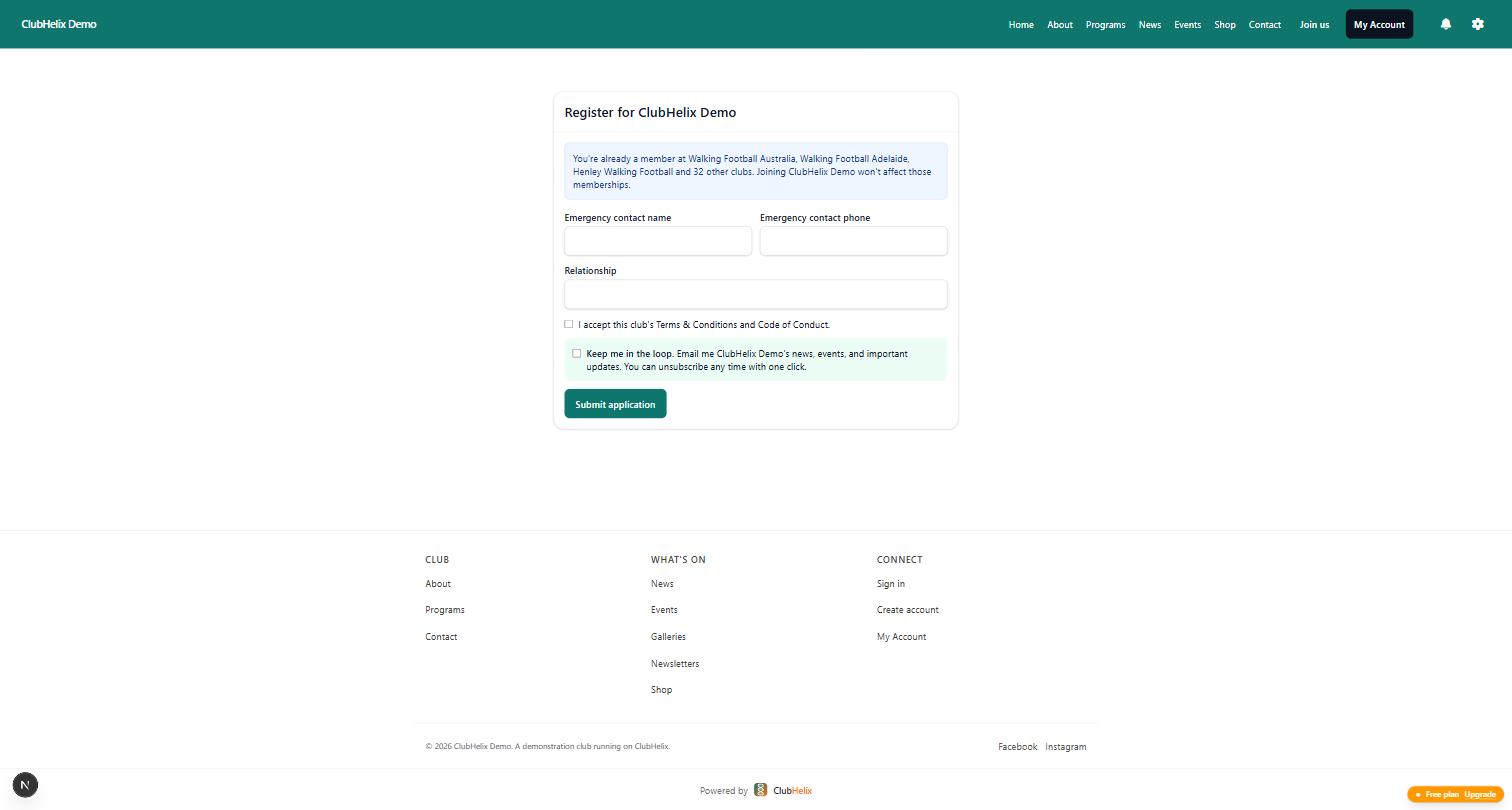
Whatever you land on, the structure only works if a member can pick the right option unaided and you can see the result without a spreadsheet. That is exactly the job ClubHelix does: self-registration puts your tiers on the join page with the eligibility questions attached and takes payment on the spot, discount codes handle household caps, early-bird rates and waivers without adding rows to the schedule, and reports show you the live mix by category so the treasurer's forecast stops being a guess. Add forms and surveys when you want to ask members what they would actually pay before you change anything.
There is a free tier to start on, and the pricing is on the page rather than behind a sales call. Create your club site, load your fee schedule in an evening, and see how much simpler it looks when the form does the sorting for you.
Frequently asked questions
How many membership types should a club have?
Three playing tiers plus one non-playing tier covers most clubs — full adult, reduced adult, junior and social. The second and third categories capture nearly all the extra revenue that tiering can win; anything beyond four rows tends to earn very little and cost real volunteer hours to maintain.
Is a flat membership fee ever the right answer?
Yes, for small clubs, new clubs and clubs with a narrow membership. One price is faster to sell, impossible to misunderstand and takes zero enforcement. The cost is that you must set it at what your least able payer can manage, which means undercharging your heaviest users and drifting towards a smaller club.
Do membership tiers actually increase revenue?
Usually, but the gain concentrates in the first two or three categories. Splitting a member base into four sensible tiers can lift income noticeably on the same number of people, because you keep members a single price would have lost. Splitting it into eight rarely adds anything you can measure.
Should a family discount be its own membership category?
No. Treat it as a cap or a discount applied on top of an existing tier. A cap scales to any number of children, can be adjusted or withdrawn without restructuring, and keeps every member counted in the tier that describes how they actually use the club.
How do we change our fee structure without upsetting members?
Restructure at roughly neutral revenue first and increase prices in a later season, publish the cost-per-member working before the new prices, grandfather anyone worse off for one season, and close old categories to new members rather than abolishing them outright.
Keep reading — how much should club membership cost sets the numbers, and how to collect club membership fees online covers getting them banked without chasing.


