
What this guide answers
- Which is cheaper for a small club?
At small sizes, the minimal tool wins on subscription without much argument — membermojo publishes a free tier up to 50 members, while LoveAdmin starts from £20 a month plus usage and transaction fees.
- Is there a member count where you should switch?
Member count is the wrong trigger. Switch when money starts arriving in instalments, when chasing arrears has become a named person's recurring job, when a large share of club income sits outside the membership system…
- Do these tools charge a fee on every payment?
They differ. 5% + 20p on their published arrangement.
- What happens to our data if we leave?
Ask before you join, not after. You want a full export of members, contact details, payment history and any consents, in a format you can open without the vendor's help.
- Can we run a membership tool alongside a separate website?
Yes, and many clubs do it well. The discipline is to nominate one system as the single source of truth for membership, push from it to the website rather than maintaining both, and never let the join button on the…
There is a particular moment in a club's life when someone finally says the quiet part out loud. Usually it is the treasurer, four weeks into renewals, holding a spreadsheet with a column called PAID? that has three values in it — Y, y and bank transfer 12/4 check with Dave. The club is not broke. The club is not badly run. The club just has no system, and everybody has stopped pretending the spreadsheet is one.
What happens next is where membermojo and LoveAdmin part company. One says: you have a records problem, so here is a clean member list that always knows who has paid, for almost nothing. The other says: you have a collection problem, so here is an engine that takes the money automatically, chases what fails, and handles instalments. Both diagnoses are sometimes right. Picking the wrong one costs you either a year of unnecessary subscription, or a year of continuing to do the work by hand while paying for software.
This guide is the sizing exercise. We compare what each publishes as pricing at three club sizes, spell out exactly which jobs stay manual on the simpler tool, and give you five concrete triggers that mean the heavier tool has become worth it.
Declare the bias early. ClubHelix is our product, it sits at the heavier end of this market, and a club that decides simple is enough is a club we did not win — read us accordingly. Everything factual below comes from what these two companies publish, current as at July 2026. Where a figure is not published, we say so instead of guessing, including in one place where the number you probably came here for does not exist.
Two different diagnoses
membermojo is deliberately small. It is a UK membership management tool for small clubs, built around one very clear promise: at any moment, you know who is a member and who has paid. Sign-up forms, a member record, renewals, a basic site. It does not try to be your website platform, your competition manager or your comms suite, and its pricing reflects that restraint — it is free up to 50 members, and the paid bands scale by member count rather than by feature unlock.
LoveAdmin is the opposite instinct. It is a UK membership and payments administration platform for clubs, class and activity providers, schools and associations, and its depth is in the money — Direct Debit through GoCardless, payment plans and instalments, and the automation that fires when a payment fails. It publishes from £20 a month on its sports clubs plan and from £35 a month for activity providers, with usage and transaction fees on top, and it states plainly that the product is not viable below £20,000 a year of processing volume.
That last sentence is the most useful thing in this article, so it gets its own paragraph. LoveAdmin has told you its own sizing rule. A club collecting less than twenty thousand pounds a year is being told, by the vendor, that this is not the tool for it. Very few companies in this category are that direct, and it saves you a demo call.
What each costs at 50, 200 and 500 members
Published information as at July 2026, with a genuine gap flagged rather than filled.
| Club size | membermojo | LoveAdmin |
|---|---|---|
| 50 members | Free — the published free tier covers up to 50 | From £20/mo (£240/yr) plus usage and transaction fees |
| 200 members | A paid band between free and the 500-member price — read it off their current table | From £20/mo (£240/yr) plus usage and transaction fees |
| 500 members | About £75/yr per their published pricing | From £20/mo (£240/yr) plus usage and transaction fees |
| 10,000 members | £550/yr per their published pricing | Quoted — enterprise conversation |
| Platform transaction fee | None — Stripe's 1.5% + 20p applies to card payments | Usage and transaction fees on top of subscription, quoted per club |
| Stated volume floor | None | States it is not viable below £20,000/yr processing |
About that 200-member row. membermojo's own pricing page is the authority here, and its published reference points are the free tier at 50 members, roughly £75 a year at 500 and £550 a year at 10,000. Figures quoted for intermediate sizes on third-party sites do not match their page, so we are not repeating them — go and read the current table for your exact member count. What you can safely take from the published points is the shape: even at 500 members, the platform fee is smaller than most clubs' annual ball hire.
The number that actually dominates
Here is the arithmetic clubs skip. Take an illustrative 500-member club charging £60 a year, all collected by card. These are example figures to show the method.
| Cost line | Amount |
|---|---|
| Subs processed (500 × £60) | £30,000 |
| membermojo platform fee | ~£75 |
| Stripe percentage (1.5%) | £450 |
| Stripe per-transaction (20p × 500) | £100 |
| Total cost of collection | ~£625 |
The platform fee is 12% of what collection costs you. The processing is the rest. This changes the comparison completely, because it means "which platform is cheaper" is mostly a question about processing arrangements and volume, not about subscription price. It also means that at £30,000 processed, this club has crossed LoveAdmin's stated £20,000 viability line and the conversation is now genuinely open — which it was not at 50 members.

What simple leaves you doing by hand
A minimal membership tool is not worse software. It is a smaller promise, honestly kept. The trap is not noticing which jobs fall outside the promise and land back on a volunteer. Work down this list and mark each row H for handled or V for volunteer — that single exercise settles most of these debates.
| The job | A membership-only tool | What stays with a volunteer |
|---|---|---|
| Who is a member, who has paid | Handled — this is the product | Nothing |
| Renewal reminders | Usually handled | Nothing |
| A failed or bounced payment | You are told it failed | Classifying it, retrying, chasing, recording the outcome |
| Instalments and payment plans | Generally not offered | A manual schedule and a diary reminder |
| Event tickets and dinners | Not the product | A separate ticketing tool or an envelope of cash |
| Merchandise and uniform sales | Not the product | A spreadsheet, a size list and a pickup table |
| Consent forms, waivers and medical notes | Sometimes a form field | Filing, expiry checking, retrieval when something happens |
| Coach and volunteer screening expiry | Not tracked | A calendar reminder someone hopes still exists |
| Fixtures, teams and results | Not the product | Another system entirely |
| Segmented communication | Basic list email at best | Copy-pasting groups into a mail tool |
| Sponsor invoicing and renewal | Not the product | The treasurer, every year, from memory |
| Committee minutes and governance records | Not the product | A shared drive with four versions of the constitution |
If your V column has two entries, simple is the correct answer and you should stop reading comparison articles and go and set it up. If your V column has nine entries, you do not have a membership software question — you have an operations question, and you are about to buy the wrong category of product.
Five triggers that mean you have outgrown simple
None of these is about member count, which is the wrong metric almost every time. They are about the shape of the work.
- Money arrives in pieces. Termly fees, monthly training subs, instalment plans, a family paying in three parts because that is what makes it affordable. Piecewise money is where a payments engine earns its subscription, and where a spreadsheet-plus-simple-tool combination fails hardest.
- Chasing has become somebody's job. If a named person spends recognisable hours each season on arrears, price that time. Even at a token rate, twenty hours of a treasurer's season is a real number to set against a subscription.
- You are processing more than the vendor's own floor. LoveAdmin's stated £20,000 a year is a published line. Under it, the maths rarely works. Over it, the fee is a smaller share of a bigger flow.
- You have income streams the membership tool cannot see. Canteen, ball tickets, uniform, raffle, sponsorship, court hire. The moment more than about a third of club income sits outside the membership system, your treasurer is doing consolidation by hand every month and your treasurer's report is only as good as their patience.
- Someone has to be told something urgently. A ground closure, a cancelled session, a safeguarding notice. A membership list is not a communications system, and finding that out on a wet Saturday is expensive.
Notice that none of those triggers is "we hit 200 members". Plenty of 400-member clubs with one annual fee and no ancillary income are perfectly served by something minimal. Plenty of 90-member coaching operations with weekly payments are not.
Where each is genuinely strong
membermojo is strong when the requirement is clarity at low cost. It ranks well in searches for simple and free membership software for a reason — small clubs try it, it does what it says, and the free tier at 50 members means a village club or a small society can run properly without a budget line at all. Restraint is a feature. It is also a low-risk first step out of a spreadsheet, which is worth more than most committees realise.
LoveAdmin is strong when money is the problem: Direct Debit depth, instalments and payment plans, and reminder automation designed by people who evidently sat with treasurers. For class and coaching providers with recurring termly billing, that depth is difficult to replicate in a general tool, and it is the honest reason to pay more.
Who should pick which
- Under 50 members, one annual fee, no ancillary income. The free simple tool. Anything else is a subscription in search of a problem.
- A coaching or class operation billing termly or monthly, above the volume floor. The payments engine, and expect to run a website elsewhere.
- A club with a real presence problem as well as a money problem. Neither, on its own. That is two subscriptions and one member list that will drift apart, which is the situation the next section is about.
When one system beats two
The pattern we see most often is a club that starts with a cheap membership tool, adds a ticketing site for the presentation night, a separate mail tool for newsletters, a form builder for consents and a spreadsheet to reconcile the lot. Nothing there was a bad decision on its own. Together they produce four member lists that disagree and a handover document nobody can write.
ClubHelix is the argument for consolidating: self-registration with payments so joining and renewing is a checkout, membership billing with automated reminders so arrears escalate without a human diary, forms and surveys so consents and medical notes attach to the member record rather than an inbox, and reports so the treasurer's numbers come out of the same system the money went into.
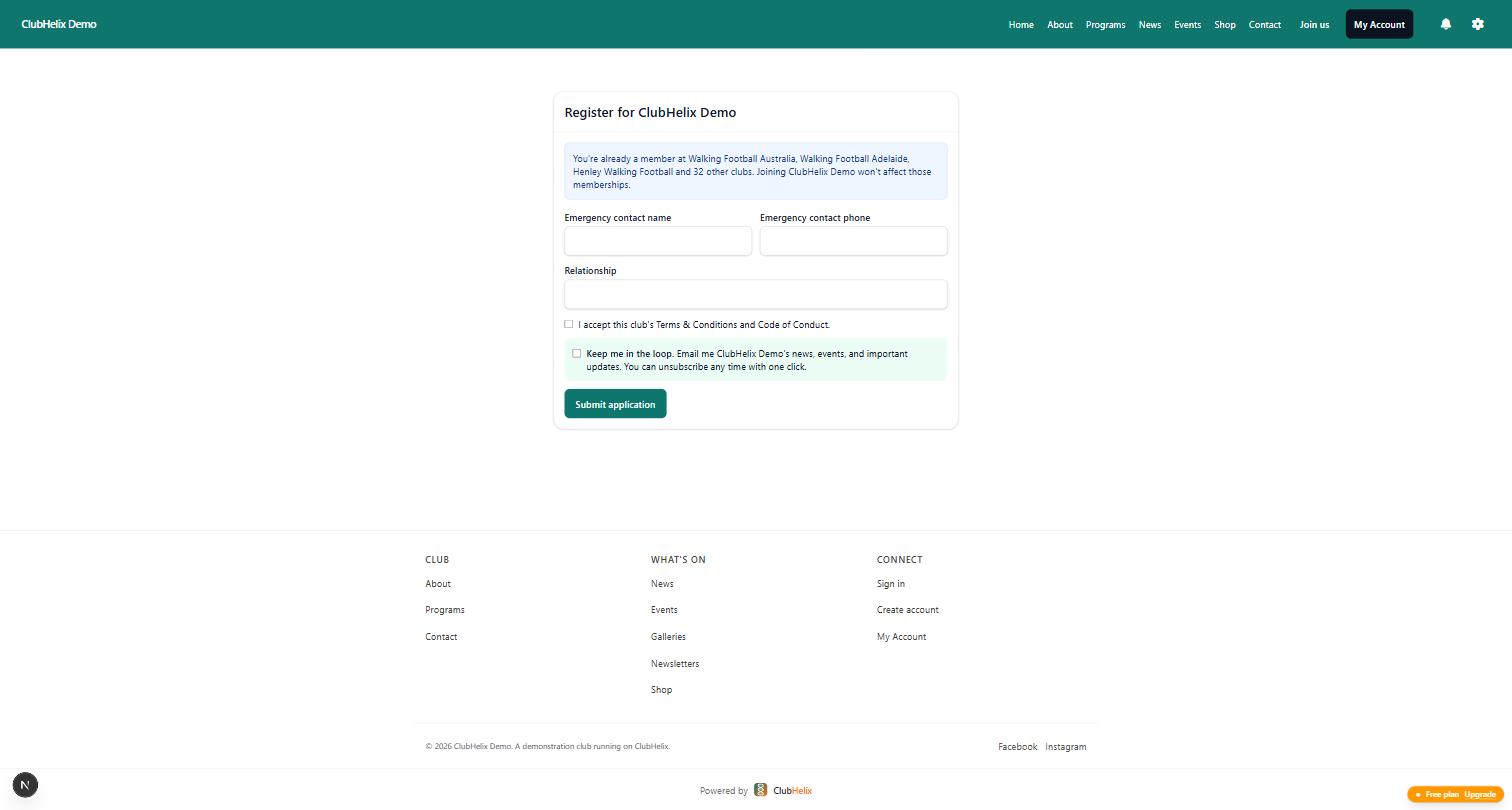
If that volunteer column of yours is getting long, it costs an evening to find out. Our pricing is a flat band per club — the bill does not climb every time you sign a new member — and the platform is built and hosted in Australia. Bring a fee table and next season's renewal list, create your club, and see whether one system genuinely absorbs the jobs that four were doing.
Two fair limits, both relevant to this particular decision. We collect through Stripe and Square, so there is no GoCardless Direct Debit, and instalment plans are not our deepest feature — a club whose entire requirement is sophisticated payment plans on Direct Debit will be better served by a payments-first specialist. And we will not pretend to beat a free tier aimed at 50-member clubs; ours is a build-and-try sandbox rather than a permanent home for a village club, so if you are genuinely small and genuinely simple, take the free option and spend the money on gear.
Frequently asked questions
Which is cheaper for a small club?
At small sizes, the minimal tool wins on subscription without much argument — membermojo publishes a free tier up to 50 members, while LoveAdmin starts from £20 a month plus usage and transaction fees. The comparison narrows as clubs grow, because processing costs dominate the total. Model your own club with real subs and real member counts before deciding, and remember card processing is charged whichever platform you pick.
Is there a member count where you should switch?
Member count is the wrong trigger. Switch when money starts arriving in instalments, when chasing arrears has become a named person's recurring job, when a large share of club income sits outside the membership system, or when you pass the processing volume a vendor states it needs. A 400-member club with one annual fee can run happily on something minimal.
Do these tools charge a fee on every payment?
They differ. membermojo publishes no platform transaction fee, with the card processor's own charge applying instead — Stripe's 1.5% + 20p on their published arrangement. LoveAdmin charges usage and transaction fees on top of the monthly subscription, quoted per club. Since processing usually outweighs the subscription, get every component of the pricing on paper before you compare anything.
What happens to our data if we leave?
Ask before you join, not after. You want a full export of members, contact details, payment history and any consents, in a format you can open without the vendor's help. A tool that makes leaving easy is usually confident about you staying. Also check who is named as data controller and where records are stored, because that answer belongs in your privacy documentation.
Can we run a membership tool alongside a separate website?
Yes, and many clubs do it well. The discipline is to nominate one system as the single source of truth for membership, push from it to the website rather than maintaining both, and never let the join button on the website lead anywhere except the membership system's own form. Two member lists edited by two people is the failure mode to design out.
Keep reading — how to collect club membership fees online covers the mechanics whichever tool you choose, and how much club membership should cost helps you rebuild a fee table simple enough to automate.


