
What this guide answers
- Is LoveAdmin or Pitchero better for collecting membership fees?
They approach it differently. LoveAdmin is a payments-first platform built around Direct Debit, payment plans and arrears automation, and that depth is its main selling point.
- What does Pitchero cost in 2026?
As at July 2026 Pitchero publishes a free tier, Standard at £38 a month and Pro at £99 a month, with 30-day trials and annual discounts advertised.
- Is there a minimum size for LoveAdmin?
The company states its product is not viable below £20,000 a year of processing volume, which is a useful sizing signal rather than a hard door.
- Can we use one for payments and the other for the website?
Technically yes, and some clubs do. The cost is that your member list now lives in two places, and reconciling who has paid against who appears on the website becomes somebody's recurring job.
- What should we ask on a demo call?
Ask for the complete fee schedule in writing, including any per-transaction and usage components.
Sit through enough committee meetings and you will hear the same two complaints, usually from different people, usually within the same hour. The treasurer says a version of "I am still chasing fourteen families for subs and I have sent three emails." The publicity officer says a version of "half the new parents could not find the fixtures again, so they asked on Facebook."
Those are not the same problem, and LoveAdmin and Pitchero are not really the same product. One is a membership and payments administration engine built around the promise of never chasing subs again. The other is a club website and app platform that also happens to take payments. Committees end up comparing the two because both surface when you search for club software with money in the query, and because the budget has room for one software line, not two.
This guide puts them side by side properly — what each is, what each publishes as pricing, how they differ on the two jobs that actually matter (getting the money in, and being findable) — and then hands you the arithmetic to work out what each will really cost your club in a year.
Our bias, stated before we referee anything: we are ClubHelix, and we build an all-in-one club platform that competes with both of these. We have tried to be scrupulous. Every factual claim below comes from what the two companies publish, we say plainly when a figure is not published rather than repeating an internet guess, and there is a section near the end on where we do not compete at all. Facts are current as at July 2026; pricing pages move, so verify anything you are about to sign.
What each one actually is
LoveAdmin is a UK membership and payments administration platform sold to sports clubs, activity and class providers, schools and associations. Its centre of gravity is recurring collection — Direct Debit through GoCardless, payment plans and instalments, and the automation that surrounds a missed or failed payment. If your description of the problem is "we get the money eventually, but it costs forty volunteer hours and three awkward conversations", that is the sentence LoveAdmin was built for. What it is not is a publishing platform. Payments and member admin are the deep part; everything else is comparatively thin.
Pitchero is a Leeds-based grassroots club platform: a club website, a branded club app, membership and payments, team pages and player stats, plus governing-body fixture and league feed integration with roots in football and rugby union. It is UK-first, though it sells in Australian, New Zealand and US currencies, and it sits behind a very large network of hosted club sites — which matters more than it sounds, because it means a new family searching your club's name is quite likely to land on a Pitchero-built page.
The short taxonomy, then: LoveAdmin is a money engine wearing a club-shaped wrapper. Pitchero is a club's public face with a payments module inside it. Almost every real difference below flows from that one distinction.
Side by side
Published information as at July 2026. Where a figure is not published, we say so rather than estimating.
| Area | LoveAdmin | Pitchero |
|---|---|---|
| Shape | Membership and payments administration | Club website, app, membership and payments |
| Home market | UK — clubs, classes, schools, associations | Leeds, UK; sells in AU, NZ and US currencies |
| Entry price | From £20/mo on the sports clubs plan | Free tier; Standard £38/mo; Pro £99/mo |
| Other plans | Activity Providers from £35/mo | Annual discounts advertised; 30-day trials |
| Transaction cost | Usage and transaction fees on top — no flat rate we can quote | From 2.42% + 17p (Standard) to 1.67% + 15p (Pro); no payments on Free |
| Direct Debit | Yes — GoCardless Direct Debit is core to the product | Membership payments on paid tiers; Direct Debit not published |
| Instalments/plans | Yes — payment plans and instalment handling are a strength | Membership payment options within the platform |
| Club website | Not the product's strength | Yes — the core of the platform |
| Branded app | No native club app | Yes — native branded club apps |
| Fixtures and stats | Not a competition product | Yes — governing-body league feeds and team stats depth |
| Volume expectation | States the product is not viable below £20,000/yr processing volume | None published |
Two honesty notes on that table. First, LoveAdmin's transaction and usage fees sit on top of the subscription, and we do not have a published flat rate to quote you — so ask for the full fee schedule in writing before you compare anything, and treat any specific percentage you read on a forum as unverified. Second, Pitchero's headline percentages differ by tier, which sounds like a reason to buy the expensive tier; the worked example further down shows why that logic usually fails at grassroots volumes.
Chasing subs — what arrears handling actually means
"Automated reminders" is on every product page in this category, which makes it useless as a comparison point. What separates a real collection engine from a mail-merge is what happens on days three, ten and thirty after a payment does not arrive.
Here is the ladder a well-run club uses. Copy it, then ask each vendor to show you which steps their software performs without a human clicking anything.
- Day 0 — collection attempt. Mandate or stored card is charged on the scheduled date. The member has already agreed to the date at sign-up.
- Day 1 — failure classified. A bounced Direct Debit, an expired card and a cancelled mandate are three different problems with three different fixes. If the software lumps them into one "failed" bucket, your registrar sorts them by hand.
- Day 3 — automatic retry. Cheap to attempt, and it clears a good share of genuine bank-timing failures without anyone being told off.
- Day 5 — first reminder. Friendly, one click to fix, addressed to the person who holds the payment method rather than the player.
- Day 12 — second reminder, different channel. Email then SMS, or the reverse. Same wording, different inbox.
- Day 20 — human contact. A named committee member, by phone. This is the step software cannot do and should not pretend to.
- Day 30 — decision. Payment plan, hardship arrangement, or suspension of eligibility under whatever your rules actually say. Write down the rule before the season, not during it.
- End of season — reconciliation. Every unpaid record either collected, formally waived or written off with a minute number attached.
LoveAdmin's product is deliberately shaped around steps two to seven, and its instalment and payment-plan handling is the part clubs most often say they cannot replicate elsewhere. Pitchero collects membership payments on its paid tiers as one module of a much wider platform; if collection is where your entire pain lives, that difference is real and you should test it with your own scenarios rather than take anyone's word for it.

One thing neither product can fix: a fee structure nobody understands. If your subs have four categories, three concessions and a family cap invented in 2014, automation just industrialises the confusion. Sort the pricing first — our guide on how much club membership should cost walks through rebuilding a fee table — then automate what is left.
The public-face half — website, news and fixtures
The second complaint in that committee meeting is a different beast entirely. A club's public face has to carry a specific and unglamorous list:
- A page that ranks when someone searches your club's name plus your suburb.
- Fixtures and results that a parent can read on a phone in a car park.
- A "how to join" path with a price on it, not an invitation to email the secretary.
- News that proves the club is alive this season, not in 2022.
- Sponsors visible enough that they renew.
- Contact details, ground address and a map that works.
Pitchero is built for exactly this list, and its governing-body fixture and league feeds mean results appear without a volunteer re-keying them on a Sunday night — genuinely one of the least appreciated features in club software. Team pages and player stats give the members a reason to return between match days. Our honest, biased assessment as a company that builds club websites for a living is that the aesthetic of a stock Pitchero site is a generation behind what a modern club site can look like; weigh that view knowing exactly who is offering it.
LoveAdmin is not competing for this job. If you buy it, plan to keep or build a website separately, and budget for that. Our guide to building a sports club website covers what the second system needs to do, and club website content ideas covers keeping it from going stale by round four.
Reading the fee print before you sign
Three numbers determine what you actually pay, and clubs routinely compare only the first one.
The subscription. Pitchero publishes £38/mo for Standard and £99/mo for Pro, with a free tier that has no payments, plus 30-day trials and annual discounts. LoveAdmin publishes from £20/mo on its sports clubs plan and from £35/mo for activity providers.
The transaction rate. Pitchero publishes from 2.42% + 17p on Standard down to 1.67% + 15p on Pro. LoveAdmin charges usage and transaction fees on top of the subscription; we have no published flat rate to quote, so get it in writing.
The volume expectation. This is the one that catches small clubs. LoveAdmin states its product is not viable below £20,000 a year of processing volume. If your club collects £12,000 in subs, you are below the line the vendor itself draws — that is not a criticism of the product, it is a sizing signal you should take seriously.
Now the arithmetic. Take an illustrative club: 180 members paying £70 a year, so £12,600 processed in 180 transactions. These are example figures to show the method, not a benchmark.
| Cost line | Pitchero Standard | Pitchero Pro |
|---|---|---|
| Subscription | £456 | £1,188 |
| Percentage fee | £304.92 | £210.42 |
| Per-transaction fee | £30.60 | £27.00 |
| Total for the year | £791.52 | £1,425.42 |
The interesting result is not the totals, it is the shape. Moving up a tier costs £732 more in subscription and saves roughly £98 in fees at this volume. Run the break-even and the fee saving alone does not repay the tier upgrade until you are processing in the region of ninety thousand pounds a year. The conclusion for a grassroots club is clean: buy the higher tier for features you will use, never for the lower percentage. Ask the same question of any vendor whose pricing page nudges you upward.
Do the same table for LoveAdmin with the fee schedule they quote you, add your website cost if the platform does not provide one, and compare total annual cost of ownership rather than headline monthly price. The how to collect club membership fees online guide has a fuller version of this exercise.
Where each is strong
LoveAdmin is strong when collection is the whole problem: Direct Debit depth, instalments and payment plans, and a product built by people who clearly listened to treasurers. Clubs with weekly or termly fee structures, class and coaching providers, and any organisation whose money arrives in many small pieces rather than one annual hit will feel the difference.
Pitchero is strong when presence is the whole problem: a real website plus a branded app plus league feeds, from a company that has been doing grassroots clubs for well over a decade with a very large hosted network behind it. If your fixtures currently live in a WhatsApp group and your website was last edited by a member who has since moved cities, this is a large step forward on day one.
Who should pick which
- A coaching or class-based operation with instalment plans, above the volume line. LoveAdmin, and budget separately for a website.
- A traditional club whose biggest deficit is public presence. Pitchero, particularly if governing-body fixture feeds cover your league.
- A small club under the volume line with both problems. Neither will feel proportionate. Look for a platform that does both jobs at a small-club price, which is the honest reason articles like this get written.
Doing both halves in one place
The reason this comparison is awkward is that most clubs genuinely have both problems, and buying two systems means two logins, two exports and one member list that quietly disagrees with itself. ClubHelix exists to close that gap: a real branded website built in a canvas page editor on your own domain, self-registration with payments so joining is a checkout rather than a form and a bank transfer, membership billing with automated reminders so the arrears ladder above runs itself, and email broadcasts from your own sending domain for everything in between.
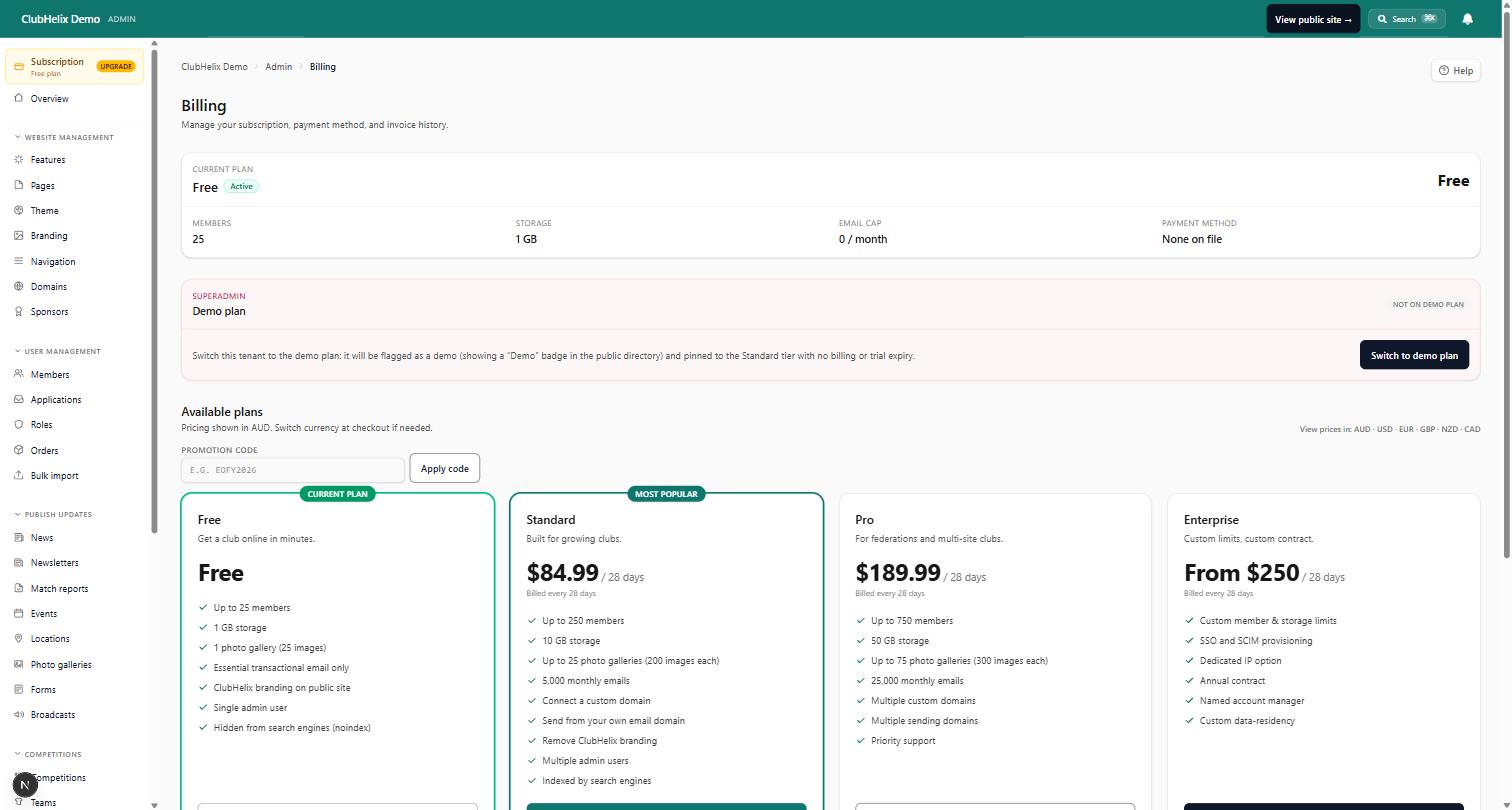
If that sounds like the shape of your problem, there is a free tier to build on, transparent pricing with no per-member or per-registration levy, and Australian hosting behind it. Most committees get a working site, a fee table and a join flow up in an afternoon — start your club site and see whether it survives contact with your registrar.
Now the limits, because a comparison that only lists strengths is an advertisement. ClubHelix collects through Stripe and Square, so we have no GoCardless Direct Debit, and instalment plans are not our deepest feature — if UK Direct Debit with sophisticated payment plans is your requirement, LoveAdmin is genuinely better at that specific job. We ship an installable web app with push notifications rather than a native app-store app. We have no governing-body league feed deals, so competitions your club runs itself are fully supported while your league's official data stays wherever your governing body puts it. And our admin, club websites and member accounts are English-only. Our fuller write-up of the website side sits at /compare/pitchero-alternative.
Frequently asked questions
Is LoveAdmin or Pitchero better for collecting membership fees?
They approach it differently. LoveAdmin is a payments-first platform built around Direct Debit, payment plans and arrears automation, and that depth is its main selling point. Pitchero collects membership payments on its paid tiers as part of a wider website-and-app platform, at published rates from 2.42% + 17p down to 1.67% + 15p depending on tier. If collection is your only problem, the payments-first tool will feel more purpose-built.
What does Pitchero cost in 2026?
As at July 2026 Pitchero publishes a free tier, Standard at £38 a month and Pro at £99 a month, with 30-day trials and annual discounts advertised. Payments are not available on the free tier, and transaction fees run from 2.42% + 17p on Standard to 1.67% + 15p on Pro. Check the current pricing page before budgeting, since these move.
Is there a minimum size for LoveAdmin?
The company states its product is not viable below £20,000 a year of processing volume, which is a useful sizing signal rather than a hard door. Below that, the subscription plus usage fees will be a large share of what you collect. Ask directly where your club sits before you invest committee time in a migration.
Can we use one for payments and the other for the website?
Technically yes, and some clubs do. The cost is that your member list now lives in two places, and reconciling who has paid against who appears on the website becomes somebody's recurring job. If you go this route, decide in advance which system is the single source of truth for membership, and export from it rather than editing both.
What should we ask on a demo call?
Ask for the complete fee schedule in writing, including any per-transaction and usage components. Ask what happens automatically at each step of a failed payment. Ask how you get your full member list and payment history out if you leave, and in what format. Ask what the renewal price will be in year two. The answers to those four questions predict the next three seasons better than any feature list.
Keep reading — how to collect club membership fees online covers the collection mechanics platform-agnostically, and membership renewal reminder templates gives you the wording for every rung of the arrears ladder above.

