
What this guide answers
- Should a missed class be refunded or credited?
Credited, in nearly every case. Your costs for that session were incurred whether the child attended or not, and a refund concedes that a term fee is really a bundle of single-class purchases — which makes your term…
- How many make-up classes should we allow per term?
Work it out from spare capacity rather than copying a number.
- Should class credits expire?
Yes, and short is kinder than vague. An unexpiring credit is an open obligation on your books against a timetable you have already sold to other families, and it surfaces two terms later as a place you do not have.
- What if we cancel the class ourselves?
Treat it as a different category entirely: every enrolled child gets a credit automatically, no notice period and no request required, and if the session cannot be rescheduled within the term then money going back is…
- Who should book the make-up class?
The family. Staff-booked make-ups cost roughly six minutes of back-and-forth each, which is a couple of hours a week once the requests arrive in volume, and the class you pick is rarely the one that suits them.
New Zealand edition. This guide is written for volunteer-run clubs in New Zealand. Where rules differ — grants, tax, incorporation, safeguarding — follow the New Zealand-specific pointers below or check with your national body.
By Tuesday lunchtime there is a message on your phone. Ella had a chest infection, she missed Saturday's lesson, and can she come to another class this week instead? You are standing in a car park with a bag of kickboards. You type back something generous, because they are a good family and it is one lesson, and then you forget you typed it. Three weeks later her mother reminds you what you said. By then you have said four slightly different things to four different families, and not one of them is written down anywhere.
That is the whole problem, and it is not a problem of generosity. The make-up request is the single most common message a swim school, gymnastics club, dance school, tennis coaching business or martial arts club receives, and it is almost always answered by the busiest person in the organisation, from memory, at speed, on a phone. The policy is not missing because nobody has thought about it — it is missing because it lives in a text thread. This guide is that policy: why a credit is the right answer, the four models you can actually run, the capacity numbers that tell you which one your timetable can afford, and the sentences to put in your terms so the answer holds when somebody pushes back.
Why a credit beats both of the alternatives
There are three honest answers to a missed class, and they are not equivalent.
| Response | What it costs you | What it teaches the family |
|---|---|---|
| Refund | Real money for a place you already staffed and heated | A term fee is really ten separate class purchases |
| Free extra class | An unbudgeted body in a class that was sized for its own enrolments | Turning up unannounced is normal |
| Credit | An admin record, and one spare place somewhere in the timetable | The place is owed, under a rule that was written in advance |
A refund sends money out of the organisation for a place that was coached, lit and supervised whether or not the child arrived. Your costs landed on the day. Worse, the moment you refund one absence you have conceded the principle that a term fee is ten single-class purchases in a bundle, and next term's revenue becomes something you cannot forecast.
A free extra class sounds like the cheap option and is usually the dearest. It adds a child to a class sized for its own enrolments, which moves the instructor ratio, slows the teaching for the children who turned up every week, and — because nobody recorded the arrangement — leaves the family reasonably assuming it is standing practice.
A credit does three things neither of the others manages. It keeps the money inside the term. It converts an absence into an attendance in a class that has a genuinely spare place. And it is countable: you can look at a number and know what is outstanding. A credit also draws the line the other two blur. The family is not owed cash. They are owed a place, under a rule you set. Where money genuinely should go back — an injury that ends a term, a program you cancelled outright — that is a different decision, and our guide to refunds for club registrations deals with it properly.
The four models that actually work
Almost every workable make-up class policy is one of four shapes. Pick one deliberately and name it in your terms.
| Model | How it works | Suits | Fails when |
|---|---|---|---|
| 1. No make-ups | Fees buy a place in a class, not ten attendances | Full timetables, squad and troupe programs | You are not full, and families shop on flexibility |
| 2. Credit within the term | Report an absence, earn a credit, book it into any spare same-level place before term ends | Most learn-to-swim, gym and dance schools | Absences cluster in the last fortnight and nothing is spare |
| 3. Fixed number per term | Two or three make-ups per enrolment per term, then the door closes | Busy timetables with thin spare capacity | The cap looks arbitrary unless you explain the capacity behind it |
| 4. Open make-up register | Spare places published weekly; anyone with a credit claims one | Multi-venue schools with many classes at each level | Small schools — the register is mostly empty and looks stingy |
Model 1 is more defensible than owners expect, provided the fee is honestly described as buying a place rather than a stack of attendances, and provided you are genuinely at capacity. Model 2 is the default for a reason: it is fair, easy to say in one sentence, and self-limiting because the term ends. Model 3 is Model 2 with the arithmetic made explicit — and the next section is how you work out whether your number is two or five. Model 4 is the most generous and the most administratively honest, because it never promises a place that does not exist; it only ever offers the ones that do.
How many make-ups can a term actually absorb?
This is the number nobody calculates, and it is why so many policies collapse in week nine. Work it out for one class and multiply.
Take a class capped at 8 children with 2 spare places most weeks, running a 10-week term.
| Figure | Working | Result |
|---|---|---|
| Attendances the term should deliver | 8 children × 10 weeks | 80 |
| Spare places across the term | 2 places × 10 weeks | 20 |
| Absences at a 10% rate | 80 × 0.10 | 8 |
| Absences at a 20% rate | 80 × 0.20 | 16 |
Twenty spare places against eight to sixteen absences looks comfortable. It is not, and three things eat the margin.
Level matching. A credit is only spendable in a class the child can actually be taught in. A spare place in a class two levels up is not capacity — it is a place you cannot offer. If your timetable has one class per level per venue, most of those 20 spare places are unreachable for most credits.
Clustering. Absences are not spread evenly across ten weeks. A winter bug takes six children out of one Saturday, and every one of those families asks in the same 48 hours. Make-up demand also piles into the final fortnight as families realise the credit is about to lapse, which is precisely when the timetable is fullest.
Family availability. A credit can only be spent at a time the family can drive to. Offer a Wednesday 4pm place to a family whose only free slot is Saturday morning and the credit stays unspent — and, fairly or not, feels like a refusal.
Netted out, a class like that absorbs perhaps eight to twelve make-ups a term rather than twenty. That is the honest basis for Model 3: two make-ups per enrolment per term across a school of 200 enrolments is a promise of up to 400 places, which almost no timetable can keep. Two per enrolment with a same-level condition and a term expiry usually can.

Notice, and what counts as notice
A cancellation policy for classes needs two things: a deadline, and one channel that records itself.
The deadline that works for most providers is before the class starts. Earlier is nicer for you, but a notice period of 24 hours punishes exactly the case the policy exists to cover — a child who wakes up unwell on the morning. Some providers run a two-tier rule: notice before the class earns a credit, notice afterwards earns one at the organisation's discretion, no notice earns nothing.
What counts as notice matters more than how long it is. A message to your personal phone at 9:04 for a 9:00 class is not notice, it is an apology, and you cannot administer a policy from four inboxes. Pick one route — a form on your website, an absence button in the family's account — and say in your terms that it is the only one. That gives every report a timestamp nobody has to remember, which is the same reason attendance itself belongs in a system rather than a clipboard (club attendance tracking covers the register side).
Do not ask for medical certificates. The administrative cost of chasing and filing them exceeds the value of one class, and it signals distrust to families who are, overwhelmingly, telling you the truth.
Expiry, and why an unexpiring credit is a liability
A missed class credit with no expiry date is an obligation on your books with no end. It is not a goodwill gesture; it is a debt you have written in invisible ink.
Picture a school with 200 enrolments and a 10% absence rate: roughly 200 credits issued across a year. If a third go unspent and never lapse, you are carrying about 65 open promises into next year, each one a place in a class you have not built yet. Multiply by your per-class rate and it is real money against a timetable that has already been sold to somebody else. Two terms later a family produces a credit from a class their child has outgrown, and you are choosing between a place you do not have and an argument you cannot win.
The expiry rules that work are short, clearly stated, and set at the moment the credit is issued:
- Within the term. Cleanest to administer and easiest to explain. A term credit earned in week three is spent by week ten or it is gone.
- End of the following term. More generous, and sensible where your levels are stable, but it doubles the open balance you carry.
- A fixed window — six or eight weeks from the missed class. Good for rolling enrolments with no hard term boundary.
Whichever you choose, put the expiry date in the confirmation the family receives, not only in your class credit policy. An expiry nobody was told about is the one that generates the complaint.
The family books the make-up, not the front desk
This is the operational hinge of the whole policy. If your staff book make-ups, the cost scales with generosity: 20 requests a term at six minutes of back-and-forth each — find a class, check the ratio, message the family, wait, rebook — is two hours of your best person's week spent on scheduling. Scale that to a school with three venues and it is a part-time role you never advertised.
If the family books it, the cost is fixed. You publish the rule and the places; they choose the time that suits them, which is the only time that was ever going to work. Your staff see the booking, not the negotiation. The same logic applies to joining in the first place — self-registration exists because the person with the information should be the person typing it in.
When you cancel the class, the obligation is different
Nothing corrodes trust faster than treating your cancellation and theirs the same way. A family's absence is their circumstance. A class you cancelled — wet weather, a sick instructor, a pool closure, a hall double-booked by the venue — is yours, and the policy has to say so plainly:
- You cancel: every enrolled child gets a credit automatically, without asking, notice period irrelevant. If the class cannot be rescheduled at all within the window, that is the case for money going back.
- The family cancels: the credit follows your make-up rule, subject to notice and expiry.
Write both halves into your terms and announce cancellations through one channel everybody has already been told to watch. A wet weather communication plan is worth having before the first storm, not during it. The unforgivable version is the silent cancellation: families in the car park, a locked gate, and a policy that technically gave them nothing.
Stopping a credit being spent twice
Every provider who administers make-ups on paper eventually issues one credit twice. The mechanics are always the same: the credit lives in one place (a note, a spreadsheet row, your memory) and is spent in another (a class list, a text message). Nobody crosses it off.
Three rules close the gap, whatever you run this on:
- One record per credit, holding the missed session it came from, the expiry date, and the session it was spent on. If those three facts are not in one row, you cannot answer the question.
- Spending marks the credit used in the same step as it books the place. Two separate actions become one action plus one forgotten action.
- A make-up place still obeys the class cap. A credit is permission to take a spare place, never permission to exceed the instructor ratio you set — that ratio is a safety commitment to every other family in the room.
How this works in ClubHelix
ClubHelix runs terms as programs and term enrolment — clinics and term programs with capacity, waitlists and session attendance — and the make-up policy sits directly on top of that.
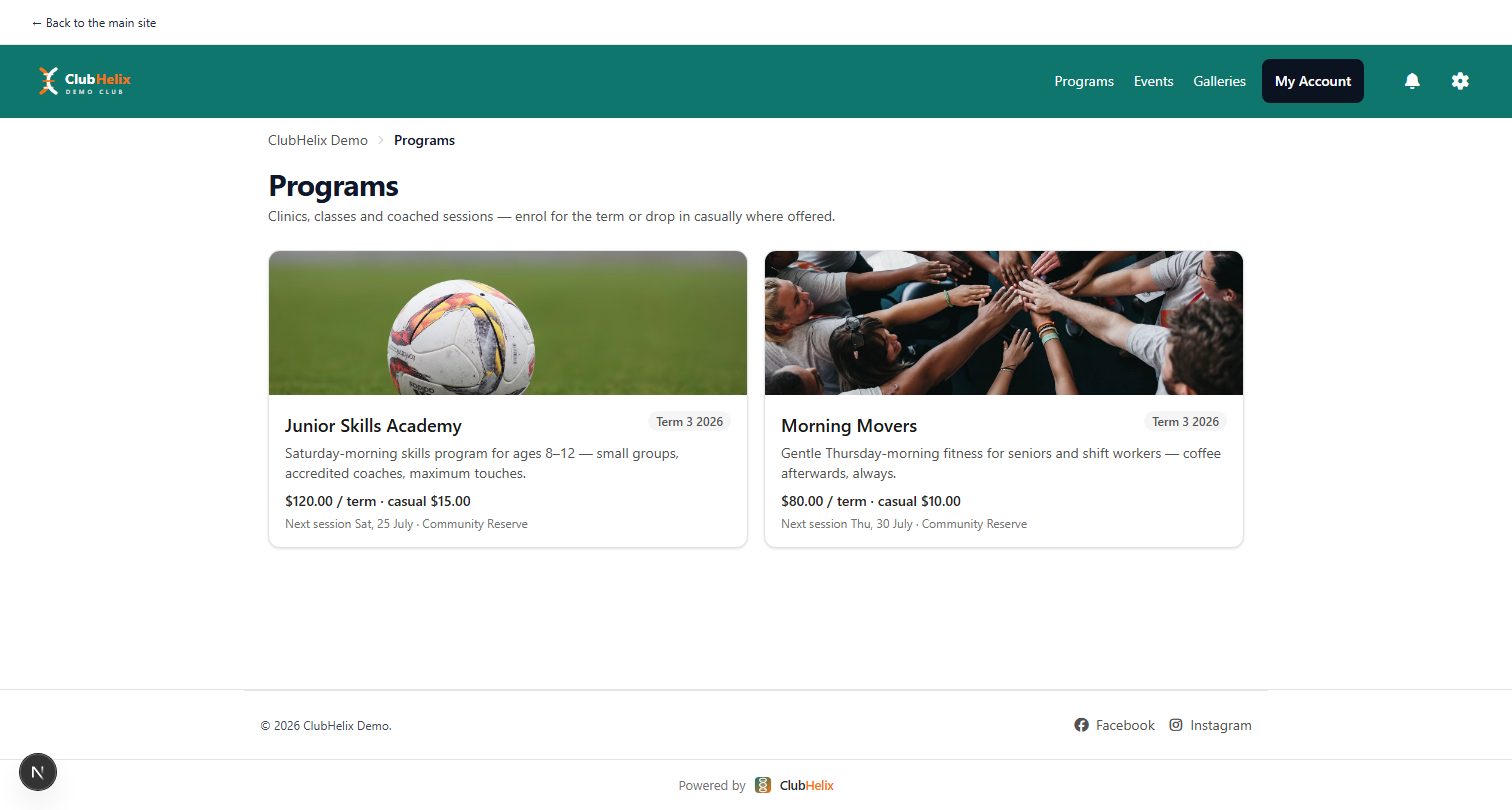
- The family reports the absence, from your website. A family reports a missed class and earns a credit they book into another class time. The report is theirs to make and the booking is theirs to make, so neither lands in your messages.
- A credit is granted deliberately, under your rule. The report earns a credit because the rule you configured says it does. It is not cash the organisation owes back — it is a place, on your terms.
- It cannot be spent twice. The credit is issued once, has an expiry cycle you set, and cannot be double-spent. A class that would break the instructor ratio you set refuses the booking, so a make-up can never quietly overfill a room.
- Levels sit on the enrolment, not the child. A level belongs to the enrolment, so the same child can sit at different levels in two programs, and families see the level on the program page.
- Session attendance stays the record of who was there. The register is part of the program, not a separate clipboard — see attendance.
There is also a trial class, which is the other half of this cohort's front desk: offer a free or paid trial class to people who have not enrolled, one per child — no account needed.
For the wider picture, see reports and the pricing page, or start an organisation. If you are building a junior intake around this, how to start a junior program is the companion piece.
The sentences to put in your terms
Short, specific, and in the terms families accept at enrolment — not buried in a newsletter. Adapt the wording, keep the structure:
- What the fee buys. Term fees purchase a place in a class for the term. Fees are not a purchase of individual sessions and are not adjusted for absences.
- What an absence earns. Where an absence is reported before the class begins, the enrolment earns one make-up credit, to a maximum of two credits per enrolment per term.
- How notice is given. Absences must be reported through your account on our website. Messages to staff phones are not a report of absence.
- How a credit is spent. Credits are booked by the family into any advertised spare place in a class at the same level, subject to class capacity, and are available while places remain.
- When it expires. Credits expire at the end of the term in which the absence occurred and have no cash value.
- What happens when you cancel. Where we cancel a session, every enrolled child receives a credit automatically. Where a session cannot be rescheduled within the term, we will contact you about a refund of that session.
- The discretion clause. We may vary this policy in individual circumstances, including extended illness or injury, without setting a precedent.
Two notes on enforceability. Terms have to be presented before payment and accepted, not published afterwards — a rule nobody agreed to is not a rule. And consumer law where you are will generally look badly on a term that is one-sided, so the clause that matters most is the one covering your cancellations. A policy that is strict about the family and silent about the provider is the one that gets picked apart, by a regulator or on a local parents' page.
The rollout, in one evening
- Pick a model from the four above and write down the number, if it has one.
- Do the capacity arithmetic for your two busiest levels, not your quietest.
- Set the expiry and decide the single channel that counts as notice.
- Write the clauses, put them in front of families at enrolment, and keep a copy with the date.
- Announce it once, warmly, at the start of a term rather than in the middle of one.
- Read the numbers after a term — credits issued, credits spent, credits lapsed — and adjust the cap rather than improvising case by case.
The goal is not to be stingy. It is to say the same true thing to every family, without checking what you told somebody else in a car park in March.
Frequently asked questions
Should a missed class be refunded or credited?
Credited, in nearly every case. Your costs for that session were incurred whether the child attended or not, and a refund concedes that a term fee is really a bundle of single-class purchases — which makes your term revenue unforecastable. Keep refunds for the cases you caused or cannot fix, such as a program you cancelled outright or a season-ending injury.
How many make-up classes should we allow per term?
Work it out from spare capacity rather than copying a number. A class of 8 with 2 spare places across a 10-week term has 20 spare places on paper but nearer eight to twelve usable ones once you allow for level matching, clustering after a sick week, and the times families can actually attend. For most schools that lands on two, sometimes three, per enrolment per term.
Should class credits expire?
Yes, and short is kinder than vague. An unexpiring credit is an open obligation on your books against a timetable you have already sold to other families, and it surfaces two terms later as a place you do not have. Expiry at the end of the term the absence fell in is the easiest rule to administer and the easiest to explain.
What if we cancel the class ourselves?
Treat it as a different category entirely: every enrolled child gets a credit automatically, no notice period and no request required, and if the session cannot be rescheduled within the term then money going back is the fair outcome. A policy that is strict about family absences and quiet about your own cancellations is the one families dispute.
Who should book the make-up class?
The family. Staff-booked make-ups cost roughly six minutes of back-and-forth each, which is a couple of hours a week once the requests arrive in volume, and the class you pick is rarely the one that suits them. Publish the spare places and the rule, and let the person with the calendar do the choosing.

