
What this guide answers
- Is Jersey Watch or TeamSnap cheaper for a club?
It depends on your shape, because the meters differ. Jersey Watch publishes a club-wide price from US$29 per month banded by athlete volume, with a US$19 first month and no contract.
- Does TeamSnap include a club website?
It varies by plan, and TeamSnap's pricing page (October 2026) doesn't spell it out: single teams are "$0 to start" and TeamSnap ONE, the club and league offering, is priced by quote.
- Are template websites good enough for a club?
For a club with nothing, absolutely — a simple template that is current beats a beautiful site that never launched.
- Which is better for a club with many teams?
The one where the club, not the coach, holds the account. Per-team subscriptions fragment cost, ownership and history across a dozen volunteers, and every departure costs you something; a single club-level subscription…
- What do neither of these cover?
Uniform and merchandise sales, canteen shifts and volunteer rosters, sponsor deliverables, AGM and committee paperwork, incident reports, digital waivers, and any competition your club runs itself.
The person choosing this software has about two hours a week, no budget approval beyond a few hundred dollars, and a folder of logins inherited from someone who left in 2023. That constraint decides more than any feature list. Jersey Watch and TeamSnap are both built for exactly that person — volunteer-run clubs, no IT staff, no procurement process — but they answer the constraint from opposite ends. Jersey Watch starts with the club's public website and adds the operational bits. TeamSnap starts with a team's schedule on a phone and works up toward the club.
That single difference determines what your first week looks like. With one, you spend it writing pages and pointing a domain, and your coaches notice nothing. With the other, you spend it getting coaches onto an app, and the public still finds you through a Facebook page from four seasons ago. This guide covers what each actually includes at its entry price, what the sign-up and payment path feels like for a parent on a phone, and which of the two holds together once your club has fourteen teams instead of four.
Our bias, stated before anything else. We build ClubHelix, an all-in-one club platform, so we are not a neutral observer — we are a third party who has to be accurate to be worth reading. Everything factual here is drawn from what the vendors publish, current as at July 2026, dollar figures are quoted only where the vendor publishes them, and anything we could not verify is described as unverified rather than dressed up as a number. Check the vendor's own pricing page before you commit, and tell us if we have something wrong.
What each one leads with
Jersey Watch (Columbus, Ohio) sells itself on being the easiest way for a volunteer to run an organisation. The product is a club website plus registration and communications, priced from US$29 per month by athlete volume across three bands — 50 to 200, 200 to 500, and 500 or more — with a first month at US$19, monthly or annual payment, and no contract. Background checks for coaches and volunteers, of the kind used in the United States, are included in the plan rather than sold separately. The websites are simple templates rather than a design tool, which is precisely the point when the alternative is no website at all.
TeamSnap (Boulder, Colorado) sells itself on the weekly organising loop. Schedules, availability, messaging and payments live inside native mobile apps, and one team can get going without asking anyone's permission — single teams are "$0 to start". Its club and league offering, TeamSnap ONE, is the tier that carries organisation-level registration, and it is on customised pricing rather than published; when we re-checked its pricing page in October 2026 there were no dollar figures on it at all. What web presence each plan includes varies, so ask. Its brand recognition in its home market is enormous, which lowers adoption friction to almost nothing there.
So the comparison is not really feature-for-feature. It is what you want to exist by the end of the month — a public front door that recruits, or a private operating rhythm that stops the Saturday morning phone calls.
The comparison table
Everything here is public information, checked as at July 2026; anything the vendor does not publish is labelled rather than estimated.
| Area | Jersey Watch | TeamSnap |
|---|---|---|
| Leads with | The club's public website | The team's schedule and messaging |
| Published entry price | From US$29/month, US$19 first month | "$0 to start" for single teams; no figures published (Oct 2026) |
| Priced by | Athlete volume — 50–200, 200–500, 500+ | Team subscriptions; club product by custom quote |
| Contract | Monthly or annual, no contract | Team plans monthly or annual; TeamSnap ONE quoted |
| Club website | Included — simple templates | Varies by plan; ask TeamSnap |
| Registration | Included | Built in; the organisation-scale version is on TeamSnap ONE |
| Payments | Included with registration | Built in |
| Background checks | Included in the plan — United States checks | Integration with the United States screening ecosystem |
| Native mobile apps | Not the product's centre of gravity | Yes — the primary interface |
| Sponsorship | Not a headline capability | A sponsorship advertising network |
| Shop and merchandise | No | No |
| Competitions and ladders | No | League and club administration sits on TeamSnap ONE |
| Committee governance | No | No |
| Home market | Columbus, Ohio — United States volunteer clubs | Boulder, Colorado — United States and Canada |
What you actually get at the entry price
The published entry prices look close. They are not comparable, because the meters are measuring different things.
Jersey Watch's meter is athletes. One subscription covers the club, and the band you sit in depends on how many athletes you have — under 200, under 500, or above. A club of 180 juniors pays the entry price once, and every team, coach and parent is inside that. The number you need to know to get a quote is a number your registrar already knows.
TeamSnap publishes no prices. Its pricing page (October 2026) says single teams are "$0 to start" and puts clubs and leagues on TeamSnap ONE with customised pricing. Starting free is why the product spreads through clubs one coach at a time, and it is also how a club ends up with a dozen separate team accounts, some of them paid on coaches' personal cards, that nobody voted on. TeamSnap ONE exists to consolidate that. What it costs, you find out by asking; the figures circulating in software directories, including the per-team figure we used to quote, are third-party estimates and we no longer repeat them.
The other half of "what you get" is what is bundled versus what you are still going to pay for elsewhere. Run this checklist against any quote:
- Domain name. Whose is it, who renews it, and can you take it with you? This one detail has stranded more clubs than any feature gap.
- Email addresses at your own domain. Almost never included by a club platform. Budget separately.
- Screening and clearances. Bundled background checks are worth real money to a club in the United States and nothing at all to a club outside it, because they will not cover the clearances your own jurisdiction requires.
- Payment processing. The subscription is not the whole cost. Ask for the processing rate, who pays it — club or parent — and how quickly funds land.
- Text messages. Usually metered separately if offered at all.
- The website's ceiling. Template-based sites are fast to launch and hard to differentiate. If you have a designer volunteer, ask what they are allowed to change.
Committees consistently compare the subscription and ignore the processing rate, which on a club turning over tens of thousands of dollars in registrations is usually the larger number. Our guide to what a club website costs breaks down the full picture including the parts nobody quotes.

The sign-up path, tested end to end
Both products register members and take payment. The only meaningful way to compare them is to walk the path a parent walks, on a phone, in the ten minutes between dinner and bedtime. Ask each vendor to demonstrate this exact sequence, and time it.
- Find the club. Search the club's name. Does a page you control come up, or a governing-body listing and an old social profile?
- Find the register button. From the home page, how many taps to the form? If it is more than two, half your parents will message the coach instead.
- Register two children in one go. Watch whether the second child requires re-entering the parent's details. This is where most volunteer support requests are born.
- Pay. Card entry on a phone, with the club's name on the payment screen rather than a processor's. Ask what the parent sees on their statement.
- Apply a concession. Multi-child discounts, hardship rates, life members. Ask whether these are codes, rules or a manual refund afterwards.
- Get the receipt. Then ask the registrar to find that same payment three months later, when the parent says they never registered.
- Reconcile. Show the treasurer a week of registrations and the matching bank deposit, and count the manual steps between them.
Step seven is the one to weight most heavily. Registration software is easy to demo and hard to reconcile, and the difference between a good and a bad implementation is entirely about whether the money that lands in the account can be traced back to individual registrations without a spreadsheet. If a vendor cannot show you that in a demo, assume your treasurer will be doing it by hand every month.
The other question is who chases. In a volunteer club, unpaid registrations are chased by a human being who feels awkward about it, unless the system does it. Ask each product to show the reminder schedule, whether it can be turned off for hardship cases, and what a parent sees. Then read our registration day guide, because the busiest fortnight of your year is not the time to discover the answer.
A club with fourteen teams
Scale does not break these products in the way people expect. Nothing falls over. What happens instead is that the administration stops being one person's job and starts being fourteen people's habits, and the software either supports that or quietly punishes you for it.
| What changes at scale | Under a club-wide subscription | Under per-team subscriptions |
|---|---|---|
| Who pays | The club, once, on one invoice | Coaches, individually, on personal cards |
| Who owns the data | The club | Whoever set up the team |
| A coach leaves | Reassign the role | Chase the login, sometimes lose the history |
| Club-wide announcement | One send | Fourteen coaches asked to forward it |
| Consistent branding | Automatic | Depends on fourteen people |
| Knowing who has actually paid | One report | Fourteen answers, none authoritative |
| New season setup | Roll teams forward centrally | Each coach rebuilds their own |
The practical advice is unglamorous. Decide who the account holder is before you buy anything, and make it a role rather than a person — registrar, secretary, whoever — with at least two people holding credentials. Clubs lose more data to a departing volunteer's forgotten password than to any technical failure, which is why the team manager's role should be defined as "operates the club's system" rather than "runs their own".
The second consideration at fourteen teams is communication. A club-wide platform lets you message everyone, one grade, or one team, from one place. A team-first tool is excellent within a team and requires a chain of forwarding between teams, and the message that reaches everyone is the one that reaches nobody in time. If your club's information currently travels by asking coaches to pass things on, our communication plan guide is worth an hour of the committee's time before you choose anything.
Which one fits your club
- Jersey Watch fits the club whose public face is the problem — no website, or one nobody has edited in years — that wants one club-level subscription, an athlete-count price it can budget, and screening included if it is in the market that screening covers. Simple templates are a feature when your alternative is nothing.
- TeamSnap fits the club whose weekly rhythm is the problem, especially where coaches already have the app and parents already recognise the brand. Its free single-team tier makes it trivially easy to test, and it is genuinely good at the job it was designed for.
- Watch the seam. Choosing the app-first option usually means you still need a website; choosing the website-first option usually means coaches keep using whatever app they already had. Whichever you pick, decide deliberately what fills the other half rather than letting it happen by accident.
- Neither covers uniform sales, canteen shifts, sponsor deliverables, AGM paperwork or a competition you run yourselves. If those are the jobs eating your volunteer hours, this is the wrong shortlist, and our round-up of the wider landscape is a better starting point.
When the site and the squad list are the same system
Here is our own answer to the seam, offered as an option rather than a verdict. ClubHelix does not make you choose which half to solve first — the public site and the club's operating system are one product. The canvas page editor and themes build a site you would happily send a sponsor, on your own domain; team management keeps squads, coaches and match-day roles in the same database as registration and payments, so signing up one new player puts them on a squad list, into the treasurer's numbers and onto the right mailing list in a single action.
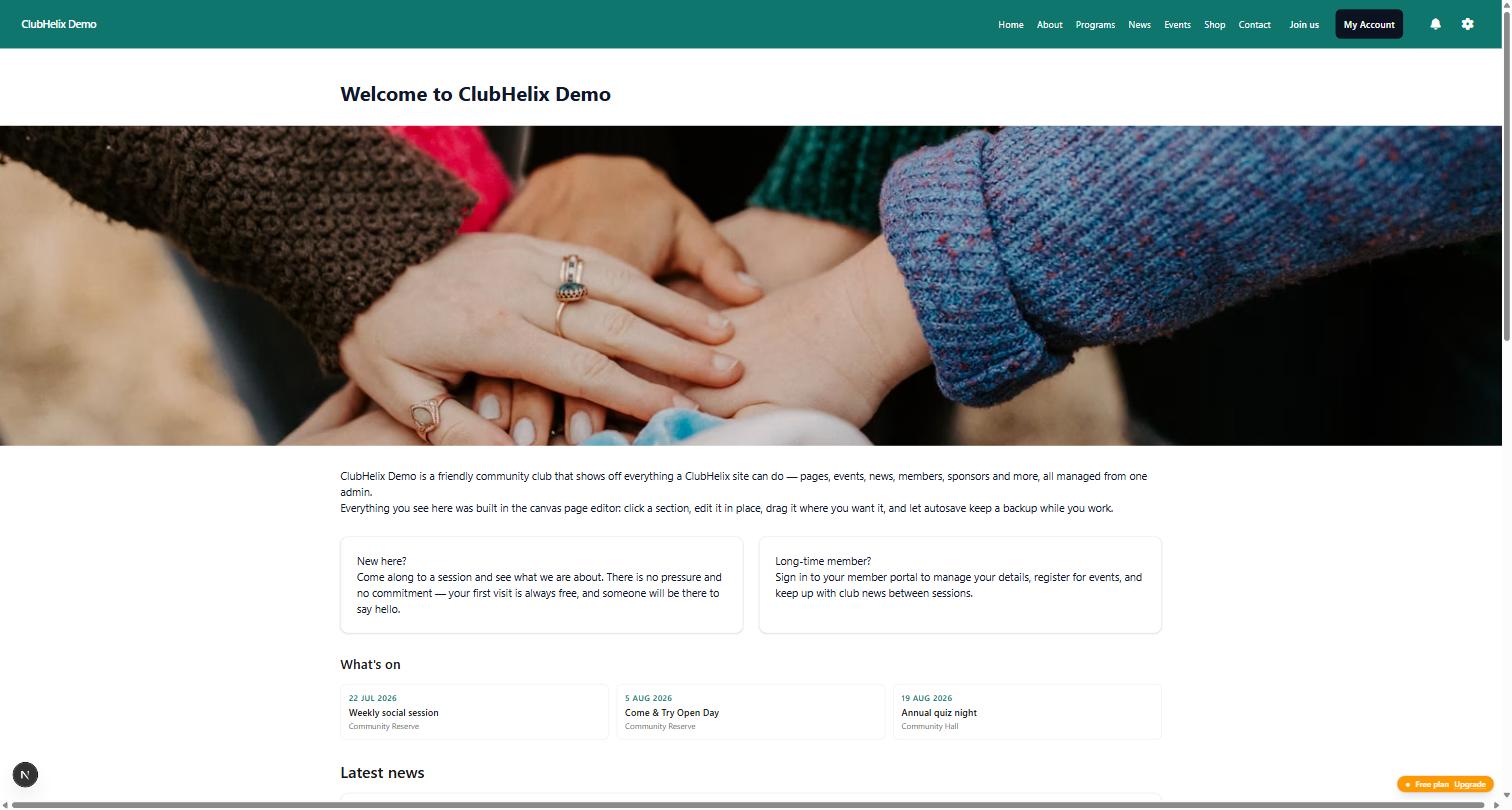
Start free, read the pricing on the page without a discovery call, and expect a working site with open registrations in an afternoon rather than a term — built and hosted in Australia, with support for the way clubs here actually talk about seasons, grades and canteens. Create your club when you are ready. Being straight about the limits — members install our app from the browser rather than from an app store, there is no screening ecosystem or advertising network of the kind a home-market product bundles, and a club that is genuinely one team will be happier with a free team app than with a whole platform. The head-to-head detail sits at /compare. For US youth leagues weighing the two biggest names, see TeamSnap vs SportsEngine compared, or the SportsEngine alternative write-up.
Frequently asked questions
Is Jersey Watch or TeamSnap cheaper for a club?
It depends on your shape, because the meters differ. Jersey Watch publishes a club-wide price from US$29 per month banded by athlete volume, with a US$19 first month and no contract. TeamSnap publishes no figures: single teams are "$0 to start" and its club product, TeamSnap ONE, is quoted individually (checked October 2026) — so get the quote, and check what any team-level accounts your coaches already pay for add up to. Compare total cost across every team, not the headline price of one.
Does TeamSnap include a club website?
It varies by plan, and TeamSnap's pricing page (October 2026) doesn't spell it out: single teams are "$0 to start" and TeamSnap ONE, the club and league offering, is priced by quote. Ask exactly what web presence comes with the plan you are quoted. If a public site that recruits members is your priority, treat the website as a separate decision and read how to build a sports club website before you commit to either product on this page.
Are template websites good enough for a club?
For a club with nothing, absolutely — a simple template that is current beats a beautiful site that never launched. The limits show up later, when you want a sponsor page that looks like the sponsorship you sold, or a landing page for a junior program that does not look like every other club on the same template. Ask what you are allowed to change before you assume you can change it.
Which is better for a club with many teams?
The one where the club, not the coach, holds the account. Per-team subscriptions fragment cost, ownership and history across a dozen volunteers, and every departure costs you something; a single club-level subscription keeps the member data, the branding and the billing in one place. Whatever you choose, make the account holder a committee role with at least two people holding access.
What do neither of these cover?
Uniform and merchandise sales, canteen shifts and volunteer rosters, sponsor deliverables, AGM and committee paperwork, incident reports, digital waivers, and any competition your club runs itself. Those jobs do not disappear; they land in spreadsheets and group chats. If consolidating them is the real reason you are shopping, compare all-in-one club platforms as well as the two products here.
Worth reading next — club app vs club website unpacks the same either-or in more depth, and TeamSnap vs SportsEngine covers the step up to organisation-scale software. If a fact here has aged badly, tell us and we will fix it.


