
What this guide answers
- What is the main difference between TeamSnap and SportsEngine?
Their starting unit. TeamSnap is built around a team — schedules, availability, messaging and payments in an app a coach can adopt alone — with club and league features on TeamSnap ONE.
- How much do TeamSnap and SportsEngine cost?
As at October 2026, TeamSnap's pricing page shows no dollar figures: single teams are "$0 to start" and TeamSnap ONE is quoted individually.
- Can a whole club run on TeamSnap?
Yes, on TeamSnap ONE, which adds organisation-level registration to the team apps your coaches already use; ask what web presence comes with it.
- Is SportsEngine worth it for a small club?
It depends almost entirely on whether you need the parts that make it heavy.
- What do these platforms not do for a club?
They do not run the organisation around match day. Merchandise, canteen and volunteer rosters, sponsor entitlements, committee minutes and motions, incident reports, social events and grant reporting all sit outside…
Fourteen teams, eleven group chats, and a registrar who keeps the only complete list of who has actually paid in a spreadsheet she updates on Sunday nights. That is the situation most committees are in when TeamSnap and SportsEngine first appear on a meeting agenda, and it explains why this comparison is harder than a feature grid makes it look. The two products do not really disagree about features. They disagree about what the system is for. TeamSnap begins with a team and works outwards. SportsEngine begins with an organisation and works inwards. Nearly every difference below is downstream of that one decision.
This guide is written for the person who has to bring a recommendation back to the committee — a president, a registrar, a treasurer, or the unlucky volunteer who said "I'll look into it". We cover what each product is, how the two pricing models behave when you actually run the numbers, how registration and payments differ once real money moves, and the significant list of club jobs that neither one finishes. If you are choosing for a single team rather than a club, the calculus is much simpler and you can stop reading after the pricing section.
Our interest, declared up front so you can weight everything that follows. We are ClubHelix, an all-in-one club platform, which makes us a third party with a stake in the same general market. We have tried to be accurate rather than flattering. Every factual claim about either product comes from public information current as at July 2026, both companies change their packaging regularly, and where we could not verify a number we say so instead of guessing. Verify anything decision-critical against the vendor before you sign, and if something here is wrong, tell us.
Two products, two starting units
TeamSnap (Boulder, Colorado) is the team-management category leader in its home market and dominant across the United States and Canada. Its core product is a team's operating system — schedules, availability, messaging, payments and registration — delivered through native mobile apps that a coach can be running by the end of a training session. Above that sits TeamSnap ONE, the product for clubs and leagues, which is where organisation-level registration lives; what web presence each plan includes varies, so ask. Around the whole thing sits an ecosystem built for its own market — screening integration for the people who work with juniors, plus an advertising network that sells sponsorship.
SportsEngine (Minneapolis, part of NBC Sports Next) approaches from the organisation end. It is an all-in-one youth-sports platform — registration, websites, league management and background screening — with deep governing-body relationships in its home market and a large network of hosted organisation sites. It also offers video streaming, which nothing else in this comparison does. Where TeamSnap earned its position by being the app a coach installs, SportsEngine earned its position by being the platform an association adopts and hands down to its clubs.
That difference shows up in the first ten minutes of a demo. TeamSnap will show you a team. SportsEngine will show you an organisation with teams inside it. Neither is wrong — but a club with fourteen teams and a committee is an organisation with a team problem, not a team with an organisation problem, and it is worth being honest about which one you are.
Side by side
Public information, current as at July 2026. Where pricing is not published or we could not verify it, the cell says exactly that.
| Area | TeamSnap | SportsEngine |
|---|---|---|
| Starting unit | The team | The organisation |
| Who typically buys | Coaches and team managers, then clubs on TeamSnap ONE | Clubs, leagues and governing bodies |
| Entry pricing | "$0 to start" for single teams; no figures published (Oct 2026) | Not verified — see the pricing section below |
| Club pricing | TeamSnap ONE — customised pricing | Not published in a form we could verify — quote-based in practice |
| Club website | Varies by plan; ask TeamSnap | Yes — a core part of the offer, with a large hosted-site network |
| Registration | Built in, strongest at club and league level | A core strength, including household-style family registration |
| Payments | Built in, alongside registration | Built in, alongside registration |
| League/competition | Club and league administration on TeamSnap ONE | League management is a headline capability |
| Background screening | Integration with its home-market screening ecosystem | Screening and home-market safeguarding compliance built in |
| Video streaming | No | Yes |
| Mobile apps | Native apps — the primary interface | Native apps alongside the web platform |
| Home market | Boulder, Colorado — US and Canada dominant | Minneapolis — United States youth sport |
Per-team pricing versus organisation plans
This is the section most comparison articles skip, because it requires admitting what is not published.
TeamSnap publishes no prices. When we re-checked its pricing page in October 2026, single teams were "$0 to start" and TeamSnap ONE, the club and league product, was on customised pricing, with no dollar figures anywhere. Starting free is why TeamSnap spreads through a club one coach at a time: nobody needs committee approval. You will find monthly figures in software directories, including the per-team figure we used to quote; those are third-party estimates rather than published prices, so we no longer repeat them.
SportsEngine's plan pricing is the awkward one. Tier figures circulate widely in directory listings and round-up articles, but we could not verify them against SportsEngine's own pricing page, so they do not appear here. Treat any number you find in a listicle as unconfirmed and get a written quote for your actual organisation size.
Here is the pattern that matters. A club of fourteen teams, each set up separately by its coach, can end up with fourteen accounts and, wherever a coach has upgraded, fourteen bills that never appear on a single invoice. Nobody approved that number. Nobody sees it. It leaves the club as fourteen separate coach reimbursements or fourteen personal credit cards, and when a coach leaves, their team's history often leaves with them. That distributed cost is the strongest single argument for moving to an organisation plan of any kind — including the one you are already on the edge of paying for by accident.
Three things to pin down in writing before you sign either quote:
- What the meter counts. Teams, athletes, registrations, or admins. This determines whether a growth season is a good news story or a budget problem.
- What happens at renewal. Ask for the renewal uplift policy and whether the first-year price is promotional. A quote without a renewal clause is a quote for one year only.
- What leaves with you. Ask specifically whether you can export members, registration history, payment records and documents in a usable format, and what happens to your website if you stop paying.
Committees routinely negotiate the first number and forget the other two. A club that has done a proper budget knows that the second and third questions are worth more than a discount.

Registration and payment handling compared
Both products register members and take money. The difference is what the money and the member record are attached to afterwards.
SportsEngine treats registration as an organisational event — a season opens, families register, and the registrations become the organisation's roster, its screening obligations and its financial picture. Household-style registration, where one parent enrols two or three children in a single sitting, is part of that model. TeamSnap does registration well too, and it is one of the stronger reasons to move up to TeamSnap ONE, but the consumer team product is built around a team's roster rather than a club's member database.
For a committee, the questions that actually decide this are not "does it have registration". Take this list into both demos and make them show you, not tell you:
- One person, one record. If a family has a junior in under-12s, a teenager in under-16s and a parent who plays socials, how many records exist, and who can see the whole picture?
- Mid-season joins. Can you pro-rata a fee, or does everyone pay the same amount regardless of when they arrive?
- Refunds and credits. Show me a refund end to end, including what the parent sees and what the treasurer's report shows afterwards.
- Unpaid chasing. Who gets reminded, on what schedule, and can the committee see who is outstanding without exporting anything?
- Concessions and multi-child discounts. Are these codes, rules, or manual adjustments?
- Payouts and reconciliation. How does a week of registrations appear in the bank account, and can the treasurer match a payout to individual registrations without a spreadsheet?
- Custom questions. Can you collect the things your own club needs — dietary requirements, medical notes, uniform sizes, consent to photos — and report on the answers?
- Screening records. Where do coach and volunteer clearances live, who is reminded before they expire, and does the system understand the checks your jurisdiction actually requires?
That last one deserves care. Both products carry screening built for the United States — SportsEngine with background screening and safeguarding compliance in the product, TeamSnap through integration with the same ecosystem. Neither maps automatically onto the clearances a club elsewhere has to hold. If your club is outside that market, budget for tracking clearances yourself and treat the built-in screening as a bonus you cannot use rather than a feature you are buying. Our guide to club registration days covers the manual side of that in more detail.
What a whole-club committee still has to solve
Assume you have chosen one of them and it has gone in well. Here is what is still on the agenda at the next meeting.
| Club job | Covered by a team/registration platform | Where it usually ends up |
|---|---|---|
| Public website that recruits | SportsEngine yes, TeamSnap varies by plan | Varies |
| Merchandise and uniform sales | No | A separate shop or an order form |
| Canteen and volunteer rosters | No | Spreadsheets, group chats |
| Sponsors and their entitlements | No | The president's inbox |
| Committee minutes and motions | No | Shared documents |
| Waivers and consent forms | Partly, via registration questions | Paper, or a separate waiver tool |
| Incident and injury reports | No | A form in a filing cabinet |
| Internal comps, socials, carnivals | Partly | A whiteboard and a draw by hand |
| Grant and governing-body reporting | Partly | Manual counts at the worst time |
None of that is a criticism of either product. A team app is not supposed to run your AGM. But it is the reason clubs end up with five subscriptions and one exhausted secretary, and it is the honest answer to "will this fix everything". It will not. It will fix the half that touches match day and money, and leave the half that touches the club as an organisation — which is the half that eats volunteer hours between seasons. If that pattern sounds familiar, the category-by-category tour in best apps for sports clubs is the wider shortlist worth having in front of you.
Who should pick which
- Pick TeamSnap if the unit of the problem genuinely is the team — a handful of squads, coaches who want an app they already know, and a club that is not ready to centralise. The free single-team tier means you can prove it before you commit anything.
- Pick SportsEngine if you are an organisation first — multiple teams, a real registration season, screening obligations in its home market, and a preference for the website and the roster living under one roof. Its natural buyer is a club or league inside the youth-sport system it was designed for, especially one whose governing body already uses it.
- Do not pick either on brand. Both are mature and both are competent. The question is which starting unit matches yours, and whether the parts they leave out are parts you can live without.
- If you are outside their home market, discount the screening ecosystem to zero in your scoring, budget for a different clearance process, and check the vernacular your members will see before you commit — season structures, "rosters" and "dues" all read as slightly foreign in some markets, and members notice.
One club, one member record
Now our own position, kept as honest as the rest. The reason clubs churn through these tools is rarely the tool. It is that the member record lives in one place, the website in another, the money in a third and the volunteer roster in a group chat, and every committee handover has to re-explain the map. ClubHelix takes the club as the starting unit and puts team management, member registration and payments, roles and permissions and your public website in the same system, so a new registration updates the roster, the finance report and the mailing list at once. Clubs that run their own competitions get fixtures, ladders and finals in the same place rather than in a separate draw.
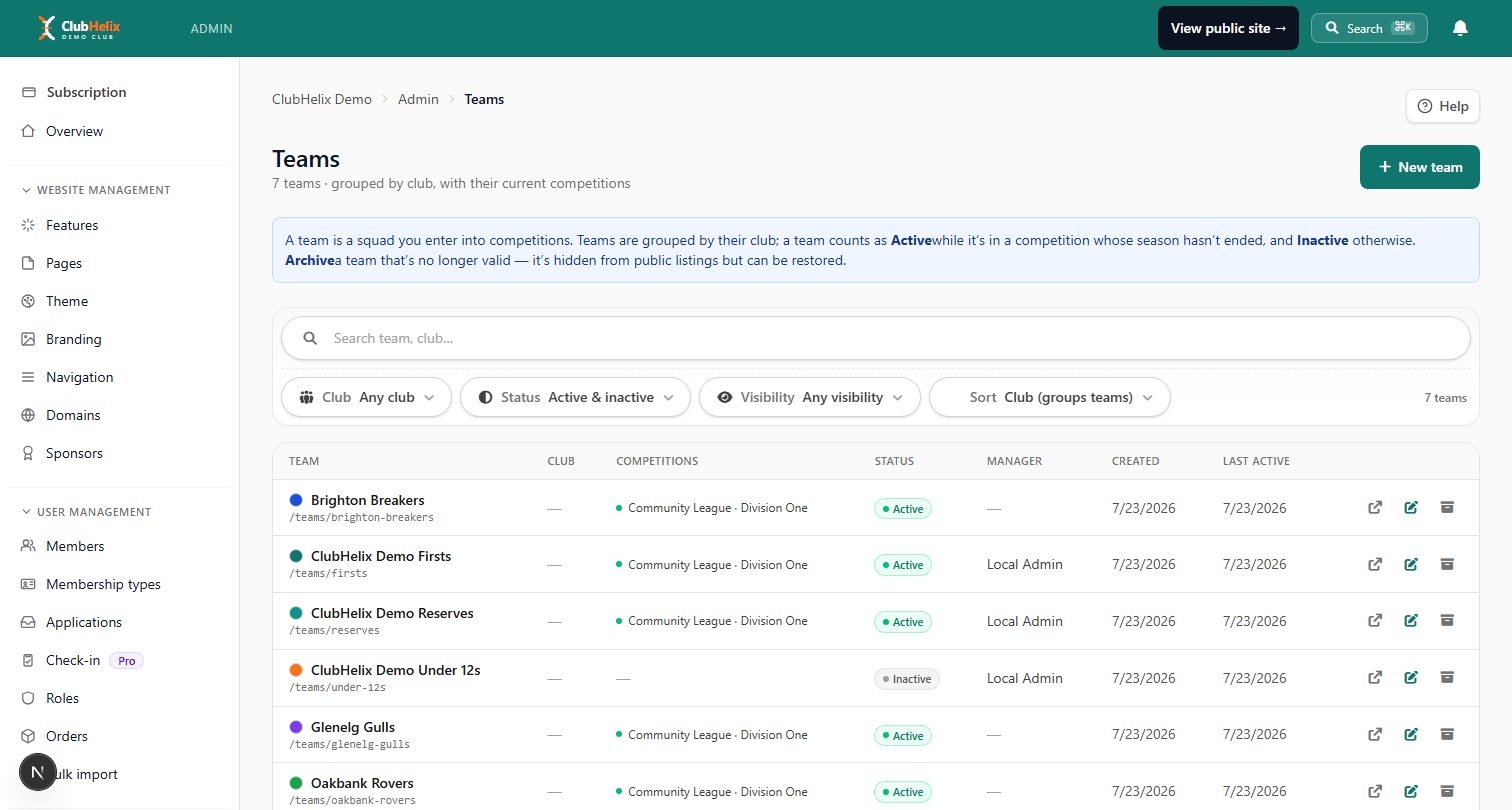
If that shape fits, there is a free tier to start on, pricing you can read without a sales call, and hosting on Australian infrastructure with a real page editor rather than a template. You can create your club site and have registration open in an afternoon. The fair statement of limits, though — we ship an installable web app rather than a native app-store download, we have no equivalent of a home-market background-screening ecosystem or a video streaming product, and if your governing body has already mandated one of these platforms for competition data, you keep using it. Our fuller write-ups sit at /compare for TeamSnap and SportsEngine.
Frequently asked questions
What is the main difference between TeamSnap and SportsEngine?
Their starting unit. TeamSnap is built around a team — schedules, availability, messaging and payments in an app a coach can adopt alone — with club and league features on TeamSnap ONE. SportsEngine is built around an organisation, with registration, websites, league management and background screening designed for a club or league to run centrally. Choose based on which of those matches how your club is actually organised, not on the feature grid.
How much do TeamSnap and SportsEngine cost?
As at October 2026, TeamSnap's pricing page shows no dollar figures: single teams are "$0 to start" and TeamSnap ONE is quoted individually. SportsEngine's plan pricing is quoted widely in third-party directories but we could not verify those figures against its own pricing page, so we do not print them — ask for a written quote for your organisation size. In both cases the club-level number depends on a sales conversation, so budget for the quote rather than the headline.
Can a whole club run on TeamSnap?
Yes, on TeamSnap ONE, which adds organisation-level registration to the team apps your coaches already use; ask what web presence comes with it. What you should test first is whether the club can see one member record per person across teams, and whether the treasurer can reconcile a week of payments without exporting to a spreadsheet. Running fourteen separate team accounts is not the same thing as running a club.
Is SportsEngine worth it for a small club?
It depends almost entirely on whether you need the parts that make it heavy. If you have a genuine registration season, screening obligations in its home market and a governing body already on the platform, the answer is often yes. If you have five teams, no formal season and no compliance requirement, you are buying a league-scale system to solve a club-scale problem, and a lighter tool with a proper website will serve you better.
What do these platforms not do for a club?
They do not run the organisation around match day. Merchandise, canteen and volunteer rosters, sponsor entitlements, committee minutes and motions, incident reports, social events and grant reporting all sit outside both products, which is why clubs accumulate extra subscriptions and shared spreadsheets. If that consolidation is the real problem you are solving, compare against an all-in-one club platform as well as against each other.
Still shortlisting? Jersey Watch vs TeamSnap covers the budget end of the same decision, and Spond vs TeamSnap covers the free-app challenger. Found something inaccurate above? Corrections are genuinely welcome via contact.


