
What this guide answers
- What's the best phone camera setting for sports photos?
Burst mode, plus tap-to-focus on your subject. Hold or drag the shutter to capture a rapid sequence during the action and keep the sharpest frame.
- Do we need permission to photograph club members?
Build consent into registration: a tick-box covering photography at club activities and the intended uses (website, socials, newsletter).
- How should a club store and organise its photos?
In one club-owned shared library — never a volunteer's personal account — organised by season and event, curated down to a handful of keepers per occasion, with the best files given human names.
- What photos does a club website actually need?
Wide establishing shots for page banners (grounds, clubrooms, crowd), current-season action and celebration shots for news posts, team photos, committee headshots, and club-culture moments — canteen, volunteers…
USA edition. This guide is written for volunteer-run clubs in the United States. Where rules differ — grants, tax, incorporation, safeguarding — follow the USA-specific pointers below or check with your national body.
Photos are the highest-value content a club produces. They fill the newsletter, feed the social pages, freshen the website every season, sell the club to prospective members, and — years later — become the archive people genuinely treasure. Yet most clubs run on a photographic diet of blurry long-distance action shots and the same team lineup photo taken slightly crooked every June.
The good news: the phone already in your pocket takes better photos than the dedicated cameras clubs owned a decade ago, and the gap between "snapshots" and "photos the club proudly publishes" is technique, not gear. This guide covers the technique, the shot list worth working from, the consent obligations every club photographer must know, and — the part clubs always skip — how to organise the photos so they're actually findable and usable.
The five phone habits that fix most club photos
Before any creative advice, five mechanical habits that immediately lift your hit rate:
- Get closer, then closer again. The number one club photo failure is shooting the whole ground from the fence. Fill the frame with people, not grass and sky. Walk the boundary; shoot from near the action. And avoid pinch-zooming past your phone's optical range — digital zoom is just pre-emptive blur. Crop later instead.
- Use burst mode for action. Hold the shutter (or drag it, depending on the phone) to fire a burst as the play happens, then keep the one frame where the ball, feet and faces line up. Professionals shoot this way; nobody times a single frame perfectly.
- Tap to focus on faces. Phones guess focus; on a busy sports field they guess wrong. Tap the player you care about. On portraits, tap the face and slide exposure down a touch if the sky is blowing out white.
- Put the sun behind you (or side-on). Shooting into the sun gives you silhouettes with dark faces. On brutal middle-of-the-day light, faces under cap brims go black — turn subjects toward open sky, or use the shade line consistently.
- Shoot at their eye level. Crouch for juniors. Photos taken from adult standing height look down on kids and flatten the action; kneeling puts the viewer in the game. This single habit transforms junior sport photography.
Two bonus settings worth switching on once: gridlines (in camera settings — helps you keep horizons straight and compose off-centre) and, if your phone offers it, the sports/action mode or a faster shutter in any manual mode for winter twilight games.
The shot list: what the club actually needs
A volunteer with a shot list comes home with usable content; one without comes home with 200 near-identical action frames. Each match day or event, aim to tick off:
-
Two or three clean action shots — the burst-mode keepers, ideally featuring different players each week so the whole squad gets coverage across a season.
-
The huddle or team talk — coach crouched in front of the group, arms mid-gesture. Reliably the most-loved photo of any week.
-
Celebration and emotion — the goal celebration, the bench erupting, the handshake line. Emotion beats action for engagement every time.
-
The sidelines — the concession crew, the scoreboard operator, the line of folding chairs, dogs in club colours. This is the club-culture gold that makes long-time members misty.
-
One "establishing" wide shot — ground, clubrooms or crowd in nice light. These become website banners and event headers (shoot a few horizontal with empty space to one side; they crop beautifully behind text).
-
Anything with the club colours prominent — flags, jumpers on the fence, the kit pile. Handy for branding every digital surface consistently.
For set-piece events — presentation night, registration day, milestone games — add: award handshakes (shoot burst; blinks are guaranteed), each award winner with the trophy, and one whole-room shot. And take the deliberately boring photos too: the clubrooms, the grounds signage, committee headshots. They're exactly what you'll need for the club website and never have.

Consent: the part you must get right
Club photography, especially junior club photography, comes with real obligations. The framework that keeps a club safe is straightforward:
- Collect photo consent at registration — a clear tick-box covering photography at club activities and the uses (website, social media, newsletter, local paper). One question, once a season, in the registration form — not a scramble before every event. If your registration is digital, consent is captured and stored against the member record automatically.
- Maintain the no-photo list and actually use it. The photographer (and whoever posts to social) needs to know which members have opted out — as a live list, not folklore. Before publishing group shots, check them against it.
- Junior rules are stricter, always. Never publish a child's full name with an identifiable photo unless the consent explicitly covers it; club-account posts should avoid tagging minors; and photos of other clubs' juniors (unavoidable in match action) should be treated with the same care as your own — when in doubt, pick the frame where your player is the identifiable one.
- Be visible and known. The club photographer role should be publicised so parents know who's shooting and why. Random adults with cameras at junior sport rightly draw questions; a named volunteer in a club shirt doesn't.
- Take-down requests win, instantly and graciously. No debate, no "but it's a great photo". Remove it everywhere and note the member on the opt-out list.
Your sport's governing body likely publishes child-safe photography guidelines — adopt them by reference in your club's one-page photo policy and re-circulate it to team managers each pre-season.
Organising the library (so the photos get used)
Unorganised photos might as well not exist. The clubs whose newsletters and websites always look fresh aren't taking more photos — they're the ones who can find them. A structure any club can run:
- One shared library, club-owned. A shared drive or photo service on a club account (not a volunteer's personal storage — the photo library is a club asset, like the domain and the trophies). Folder per season, subfolder per event or round:
2026/round-08-vs-easts/. - A funnel for contributions. One shared chat or upload link where team correspondents drop their weekend photos. The photographer-curator picks the keepers into the library; the rest can rot in the chat.
- Curate ruthlessly, keep little. Ten keepers per event beats 300 raw frames nobody will ever scroll. Delete duplicates and misses at cull time; storage is cheap but attention isn't.
- Name the best ones. Even lightly —
grand-final-huddle-2026.jpgbeatsIMG_4407.jpgforever after. Tag or note names of featured players where consent allows; the "100 games" tribute slideshow in 2031 will be assembled from these labels. - Feed the outputs on a rhythm. After each event, the curator pushes the keepers to their destinations: two or three to the social pages (post ideas here), one or two into the next newsletter, and the best into the website's news post for the round.
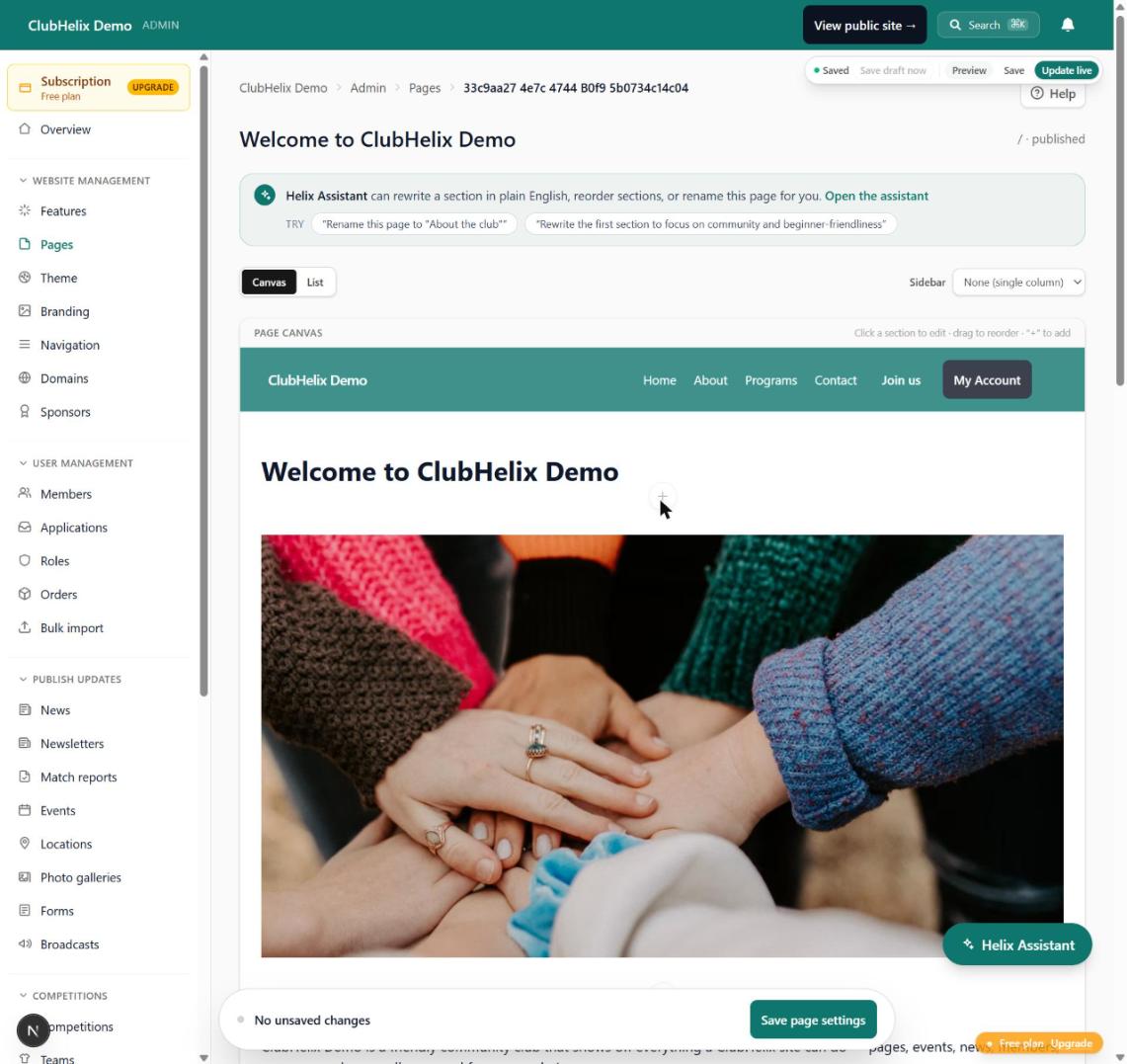
That last step is where the value compounds. Photos published to your club website's news section stay findable for years and give every match report life — and on ClubHelix, dropping photos into a page is a drag-and-drop job in the canvas page editor, with galleries, banners and image sections that keep the club's look consistent.
Level-ups when you're ready
- Golden hour is free production value. Late-afternoon winter light is the best photographer your club will never pay. Schedule the team photo and any promo shots for the hour before sunset, never midday.
- Clean your lens. Genuinely — the pocket-lint smear is the most common cause of "hazy" phone photos. Wipe it on your sleeve before shooting. Every time.
- Video's low-hanging fruit: a few seconds of slow-motion at training, the team running out, the crowd at the final siren. Short vertical clips routinely out-reach photos on social.
- Recruit a real photographer once a season. Many clubs have a member with a proper camera and a hobbyist's enthusiasm. One arranged shoot per season — team photos, headshots, a match — gives the club a premium layer over the weekly phone coverage. Credit them loudly everywhere the photos appear.
- Refresh the website seasonally. The quickest tell of a stale club site is a hero photo of players who left three seasons ago. Put "replace homepage photos" in the pre-season checklist alongside fees and fixtures — with a good library, it's a ten-minute job.
Frequently asked questions
What's the best phone camera setting for sports photos?
Burst mode, plus tap-to-focus on your subject. Hold or drag the shutter to capture a rapid sequence during the action and keep the sharpest frame. Stay within optical zoom (get physically closer instead of pinch-zooming), switch gridlines on to keep horizons straight, and if your phone has an action/sports mode, use it for fast play and dim winter afternoons.
Do we need permission to photograph club members?
Build consent into registration: a tick-box covering photography at club activities and the intended uses (website, socials, newsletter). Keep a live opt-out list that the photographer and social admins check before publishing. For juniors the bar is higher — avoid publishing full names with identifiable photos unless consent explicitly allows it, and follow your governing body's child-safe photography guidelines. Honour take-down requests immediately, without debate.
How should a club store and organise its photos?
In one club-owned shared library — never a volunteer's personal account — organised by season and event, curated down to a handful of keepers per occasion, with the best files given human names. Add a simple funnel (a shared chat or upload link) where team correspondents drop weekend photos for the curator. The test of a good system is whether next year's committee can find the grand final photos in under a minute.
What photos does a club website actually need?
Wide establishing shots for page banners (grounds, clubrooms, crowd), current-season action and celebration shots for news posts, team photos, committee headshots, and club-culture moments — canteen, volunteers, juniors at training. Horizontal frames with empty space to one side crop best behind headlines. Refresh the homepage images every season; outdated photos are the fastest way for a club site to look abandoned.
Give your photos somewhere to shine: ClubHelix's canvas page editor makes galleries and banners drag-and-drop, and every match report on your news page keeps this season's best shots working for the club all year.


