
What this guide answers
- How many people do you need to start a social club?
You can start with as few as four or five committed regulars — enough that a gathering still works when a couple of people can't make it.
- Does a social club need to be a not-for-profit or incorporated?
Not to begin with — an informal group needs no legal structure at all.
- Should we charge a membership fee?
Only if the club has actual costs to cover — venue hire, equipment, insurance, a website.
- How do we find new members after the initial burst?
Three channels do most of the work: a findable website with a current calendar, your council's community directory, and word of mouth engineered by genuinely welcoming newcomers.
Ireland edition. This guide is written for volunteer-run clubs in Ireland. Where rules differ — grants, tax, incorporation, safeguarding — follow the Ireland-specific pointers below or check with your national body.
Not every club needs a ladder and a grand final. Some of the best clubs in any suburb are the book club that's met monthly for fifteen years, the community garden group, the card night at the RSL, the walking group that ends at the good bakery. Starting a social club is easier than starting a sporting club — no leagues, no umpires, far less gear — but the clubs that last more than six months share a few deliberate choices, and this guide walks you through all of them.
Whether you're starting a supper club, a board games night, a men's shed, a craft circle or a general community group, the path is the same: a clear purpose, a first event, a repeatable rhythm, a light structure, and just enough admin to keep it fair.
Start with a purpose you can say in one sentence
"Come hang out" is not a club — it's a vague invitation people politely ignore. The social clubs that thrive are specific: monthly dinners trying a different cuisine each time, Sunday morning walks followed by coffee, board games every second Thursday, beginners welcome. Specificity does three jobs at once:
- It tells the right people this is for them. "Crime fiction book club" recruits better than "book club" because the person who loves crime fiction knows instantly they belong.
- It sets the rhythm. A purpose with a frequency built in ("monthly", "every second Thursday") answers the hardest scheduling question before it's asked.
- It makes decisions easy. When someone suggests the walking group take up kayaking, the one-sentence purpose settles it without a committee vote.
Write the sentence down. It becomes the top line of your website, your community-noticeboard post, and eventually your constitution if you formalise.
Find your founding members
You need a core of five to ten people who will actually show up — the regulars whose presence makes the room feel alive while the club is still small. Places that reliably work:
- Local community social media groups — a short, warm post with your one-sentence purpose, a date, and a venue.
- Community noticeboards — libraries, supermarkets, cafés, community centres. Old-fashioned and still remarkably effective for local groups.
- Your local library or community centre itself — staff know who's been asking for exactly your kind of group, and many centres will host new community groups cheaply or free.
- Neighbourhood houses and councils — most councils maintain a community directory and some run "start a group" support programs.
A simple interest form beats "DM me" every time: collect names, emails, and one or two preference questions (best day of the week? beginner or experienced?). An online form builder gives you a link you can paste anywhere, and the responses become your first mailing list rather than a pile of scattered messages.
Run the first event — small, cheap, repeatable
Your first gathering has one goal: prove the club is real. Optimise for low stakes and low cost — a café that takes group bookings, a library meeting room, a park with a decent barbecue area. Keep it to ninety minutes or two hours, have a loose plan (introductions, the actual activity, "when should we do the next one?"), and end on time — leaving people wanting more is a feature.
Two small things that make a big difference:
- Name tags. Genuinely. The awkwardness of forgotten names kills more fledgling clubs than bad venues do.
- Set the next date before everyone leaves. Momentum is everything early on. A club that meets "sometime next month" meets never.

Build the rhythm: from one event to a calendar
The difference between "some people who met up once" and "a club" is a repeating calendar. Same week of the month, same day, same time wherever possible — people build habits around predictability, and the regulars who form your core need to be able to say "second Thursday is games night" without checking anything.
Once the rhythm exists, publish it somewhere better than a chat thread. A simple website with an events calendar and RSVPs means new people can find you, see exactly what's coming up, and put their hand up without having to be added to anything first. RSVPs matter more for social clubs than almost any other feature — dinners need numbers for the booking, workshops have limited seats, and a venue booked for six feels very different with nineteen people in it.
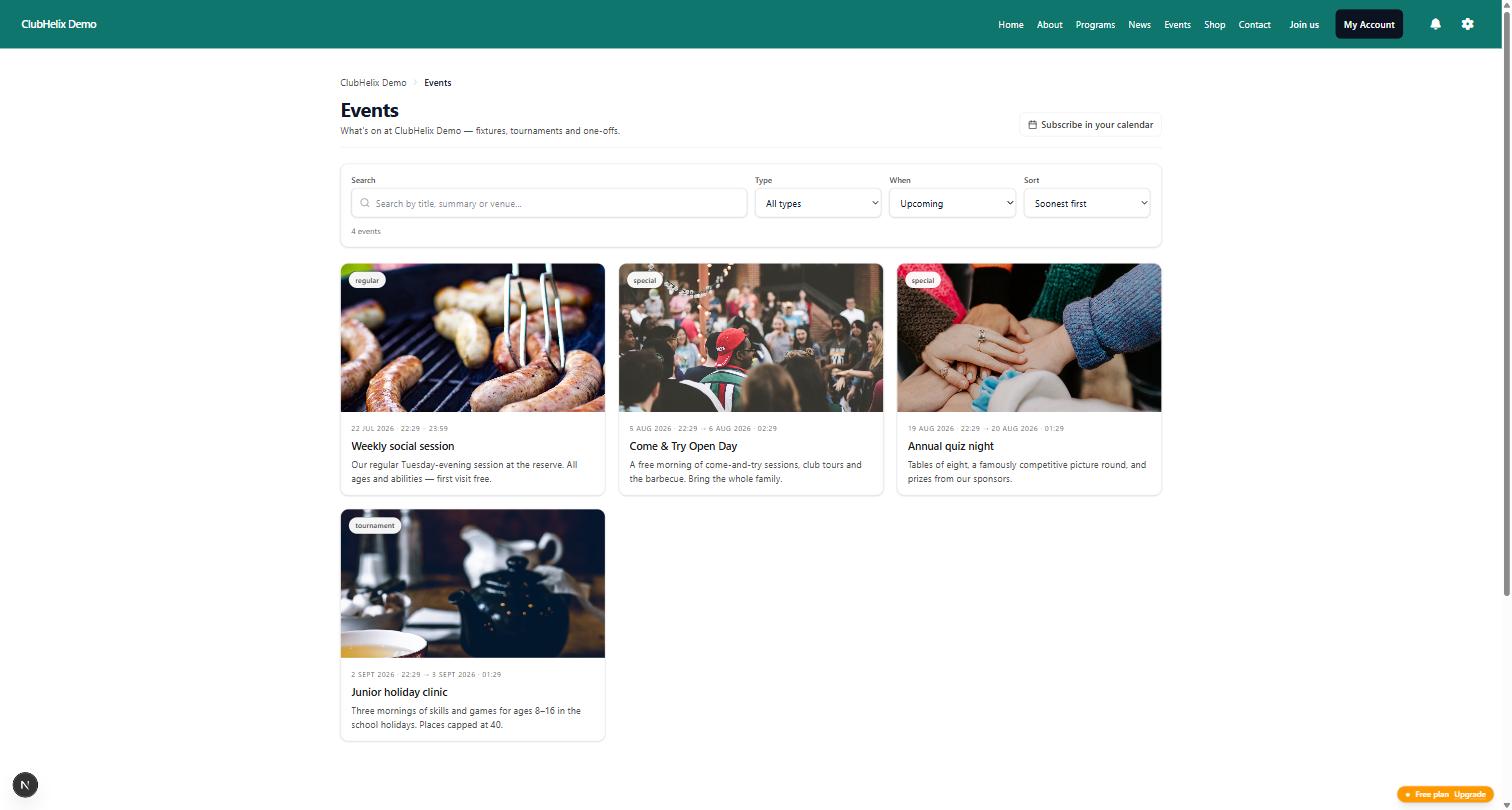
Chat groups still have a place — the banter, the "running five minutes late" messages — but the calendar, the member list and the money should live somewhere structured, or the club's entire memory walks out the door when one phone dies.
Handle money lightly but properly
Plenty of social clubs run for years with no money at all: everyone pays their own way at the venue, done. Stay that way as long as you can — it's the least admin and the least friction.
The moment money does enter the picture — a shared venue hire, equipment, catering deposits, a small annual membership fee — three rules keep it from ever becoming a problem:
- Collect digitally, never in cash. A payment link attached to the event RSVP means the organiser isn't chasing people or carrying an envelope of twenties.
- Track it transparently. Even a simple shared ledger of what came in and went out, visible to members, prevents 95% of the disputes that sour community groups.
- Separate club money from personal money the moment amounts get beyond trivial — which for most groups means it's time to formalise (next section) and open a club account.
Keep fees as low as your actual costs allow. Social clubs are volume businesses: twenty happy members at $20 beats eight grumbling members at $50, and the low-fee club recruits its replacements automatically by word of mouth.
Decide whether to formalise (and when)
An informal group of friends needs no structure at all. But certain milestones are signals that it's time to become a not-for-profit incorporated association:
- You're holding real money — membership fees, grant funds, equipment worth insuring.
- You want to hire venues in the club's own name, or the venue is asking for a certificate of currency for insurance.
- You want to apply for community grants — almost all require incorporation.
- The group has grown past the point where "whoever started it decides" feels fair.
Incorporation gives the club its own legal identity, protects the organisers personally, and unlocks club bank accounts and grants. It also obliges you to have a constitution, a committee and an AGM — a light burden, honestly, and one that forces healthy habits. We've covered the whole process in how to incorporate a club, and most states publish model rules that suit a social club with barely any changes.
If you're not there yet, adopt the informal version: three named organisers instead of one, a shared email address, and a simple agreement about how decisions get made. Structure-lite beats structure-none.
Give the club a home online
A social club's website doesn't need to be big — but it needs to exist, because "searchable" is how a club outlives its founders' friend circles. The minimum viable club site is four things:
- The one-sentence purpose and a couple of genuine photos.
- The calendar of upcoming gatherings, with RSVP.
- A join form that feeds a real member list.
- Contact details that reach a role, not one person's personal inbox.
That's an afternoon with a drag-and-drop page editor, and free tiers exist — see our honest guide to setting up a club website for free. Once it's live, list the club in your council's community directory and keep the calendar current; a stale website reads as a dead club.
Keep it alive: the people part
Social clubs don't fail from lack of interest — they fail from organiser burnout and cliquishness. Guard against both deliberately:
- Share the load early. Rotate hosting, delegate the booking, let different members program different months. A club with five people who each do a little outlasts a club with one person who does everything.
- Engineer the welcome. Assign someone to greet newcomers at every gathering and make one introduction. The difference between "everyone was lovely" and "everyone already knew each other" is one intentional person.
- Prune gently. Activities that stopped working, times that no longer suit — change them. The purpose is the constant; everything else serves it.
- Celebrate milestones. First birthday, fiftieth gathering, hundredth member. Rituals turn a calendar entry into a community.
Frequently asked questions
How many people do you need to start a social club?
You can start with as few as four or five committed regulars — enough that a gathering still works when a couple of people can't make it.
Most social clubs here never formalise at all, and that is a perfectly sound choice — an unincorporated association needs no registration, just members who agree a set of rules. Formalise when money or a lease appears: the moment the club holds meaningful funds, signs a hire agreement or employs anyone, the personal exposure of whoever signed becomes a real issue rather than a theoretical one.
Does a social club need to be a not-for-profit or incorporated?
Not to begin with — an informal group needs no legal structure at all. Incorporation becomes worthwhile once real money, venue contracts, insurance or grants enter the picture: it gives the club its own legal identity and protects organisers personally. Until then, keep money minimal and transparent, and read our incorporation guide so you'll recognise the moment it's time.
Should we charge a membership fee?
Only if the club has actual costs to cover — venue hire, equipment, insurance, a website. Many social clubs run happily on pay-your-own-way. If you do charge, keep it modest, publish what it covers, and collect it online with the join form so nobody is chasing cash. Low fees plus transparency is the combination that keeps goodwill high.
How do we find new members after the initial burst?
Three channels do most of the work: a findable website with a current calendar, your council's community directory, and word of mouth engineered by genuinely welcoming newcomers. Post each month's gathering to local community social media groups, and make the join step trivially easy — a form and a "come along Thursday", not an application process.
Give your new club a home — ClubHelix pairs a simple website with events and RSVPs and sign-up forms that build your member list automatically. Start free today.
