
What this guide answers
- What age should a junior sports program start at?
Most clubs start at ages 5–7 with a fun, games-based format, because that's when families first shop for a sport and skill gaps don't matter yet.
- How many kids do you need to start a junior program?
Ten to fifteen in one age band is plenty for a viable first term — enough for small-sided games and a good atmosphere, small enough for one coach and a helper.
- Do volunteer coaches need a Working with Children Check?
Whatever the scheme is called where you are, the discipline is identical: check every adult in a child-related role before they start, record the clearance and its expiry date centrally, and never let anyone begin on…
- How do clubs grow junior membership once the program starts?
Retention first: keep sessions fun and every child involved, communicate reliably with parents, and make re-enrolment a five-minute online job.
USA edition. This guide is written for volunteer-run clubs in the United States. Where rules differ — grants, tax, incorporation, safeguarding — follow the USA-specific pointers below or check with your national body.
Every strong club you admire has the same engine under the bonnet: juniors. A junior program feeds your senior teams, brings whole families through the gate, refills your volunteer ranks, and gives sponsors a reason to care. Clubs without one are always recruiting; clubs with one are always growing.
Starting one feels daunting — coaches, checks, equipment, nervous parents — but it breaks down into five manageable pieces: format, coaches, safety, communication and enrolment. Here's how to start a junior sports program that families actually join, and stay in.
Start smaller than you think
The most common way clubs fail at junior club development is launching too wide: four age groups, two nights a week, full fixtures — with three volunteers. When it wobbles, families quietly leave, and the club concludes "juniors didn't work here".
Flip it. Launch with one age band, one weekly session, one term. A single under-8s group of fifteen kids, running well every Saturday morning for ten weeks, is a foundation; it generates the word of mouth, the parent volunteers and the confidence to add the next age band the following season. Growth from a good small program is nearly automatic — recovery from a bad big one is nearly impossible.
Before launch, answer three questions in committee:
- Which age band first? Ages 5–8 is usually the sweet spot: least competition for kids' time, most parental involvement, and skills gaps don't matter yet.
- Who owns it? Appoint a junior coordinator — one named person whose job is the program, not "the committee generally". This role matters more than any coach.
- What does term one cost us? Equipment, venue time, insurance implications, affiliation. Keep fees modest — juniors are a growth investment, not a profit line — but not zero, because free programs get treated as optional. Check whether your insurer and governing body have junior-specific requirements before the first session.
Make it age-appropriate (or lose them by week three)
Nothing kills a junior program faster than running it like a shrunken senior session. Under-7s doing positional drills and lap running will vote with their feet. The formula at every age is maximum touches, small groups, games over drills, everyone plays — and the mix shifts as they grow:
| Age band | Session length | Format that works | What to avoid |
|---|---|---|---|
| 5–7 | 45–60 min | Games with a ball each, stations, zero standing still | Queues, laps, scores, positions |
| 8–10 | 60 min | Small-sided games, basic skills through play, everyone rotates | Fixed positions, benching, ladders |
| 11–13 | 60–75 min | Modified rules, real skills focus, light competition | Win-at-all-costs coaching, cuts |
| 14–17 | 75–90 min | Near-senior training, pathway into senior teams | Treating them as fill-ins, not a squad |
Most governing bodies publish modified junior formats for their sport (smaller fields, softer balls, shorter games, rules that guarantee participation) — use them rather than inventing your own, since parents from other clubs will recognise them and fixtures against other clubs become possible later.

The golden metric at every age is simple: does every child touch the ball, every few minutes, every session? Retention follows fun, and fun follows involvement. Our guide on how to increase junior participation digs into keeping them once you've got them.
Recruiting coaches (they're closer than you think)
You don't need accredited coaches to start — you need reliable, enthusiastic adults, and your best source is standing on the sideline: parents. Recruit them like this:
- Ask individuals, not the crowd. "Sam, you're here every week anyway — would you run the warm-up station?" converts; "we need volunteers" doesn't.
- Offer roles smaller than 'coach'. Station helper, equipment manager, first-aid parent, team photographer. Helpers become assistant coaches; assistant coaches become coaches.
- Pay for their accreditation. Most sports offer cheap foundation coaching courses; the club covering the fee is the strongest "we're serious about you" signal available, and it professionalises your program for a few hundred dollars a year.
- Pair every new coach with a plan. Handing a parent a whistle and a hope is unfair. Hand them a written session structure instead — our training session plan template is built exactly for volunteer coaches — and pinch drills from your governing body's junior libraries.
- Write the role down. A one-page description (time commitment, what the club provides, who supports them) removes the fear of an open-ended commitment. Our volunteer position descriptions template helps here.
Working with Children Checks and child safety
Anything involving children comes with real obligations, and getting this right from day one protects kids, volunteers and the club.
Adults in child-related roles need criminal background checks, and the specifics come from three directions at once: your state's law, your national governing body or league, and your insurer. Satisfy all three. Expect checks to be repeated on a fixed cycle rather than done once. Two further points that catch clubs out: many states make youth-sport volunteers mandatory reporters by law, whether or not anyone tells them, and federal law imposes abuse-prevention training and specific reporting duties on many youth sport organisations, including a requirement to report suspected abuse to law enforcement promptly. Get written policies on one-on-one contact and electronic communication with minors in place at the same time.
Beyond checks, build simple habits from the first session: verify and record every volunteer's check (with its expiry date) before they start; never leave one adult alone with children; agree pick-up/drop-off rules with parents; know your governing body's child-safeguarding policy and appoint a contact person for concerns. The Child Safe Standards give clubs a practical framework. Keep a register of who's checked and when checks expire — an expired WWCC nobody noticed is a genuine risk, so put renewal dates somewhere that reminds you, not in a drawer.
This is general information, not legal advice — check the current requirements with your state's Working with Children Check body and your sport's governing organisation.
Parent communication: the make-or-break channel
In a junior program your real members are the parents — they choose the club, pay the fees, do the driving and decide whether to return next term. Communicate accordingly:
- Send a welcome pack before session one: times, venue and parking, what to wear and bring, fees, coach names, wet-weather policy and who to contact. A family that knows what to expect turns up; one guessing doesn't. (Our club welcome pack template is a head start.)
- One channel, agreed early. Pick where program news lives — email plus your club website is the reliable spine — and tell parents "if it matters, it comes from here". Chasing information across three chat threads is how families miss things and drift.
- Wet-weather calls by a fixed time. "Cancellation decisions by 7.30am, by email and SMS" prevents the single most common junior-program complaint.
- Show them their kid. A weekly photo or two-line "what we worked on" note does more for retention than anything else you'll do. Parents who can see progress re-enrol.
- Ask, twice a term. A two-question survey — what's working, what's not — catches problems while they're small.
Enrolment: make joining a five-minute job
Here's where good programs leak families: a keen parent hears about your program, and joining requires printing a form, a bank transfer with a reference, and an email to someone's personal address. Half of them never finish.
Enrolment should work like anything else parents buy: find the program on your club website, see dates, times, price and age range, fill in the child's details (including medical notes and emergency contacts), pay online, get a confirmation email. Done in five minutes on a phone.
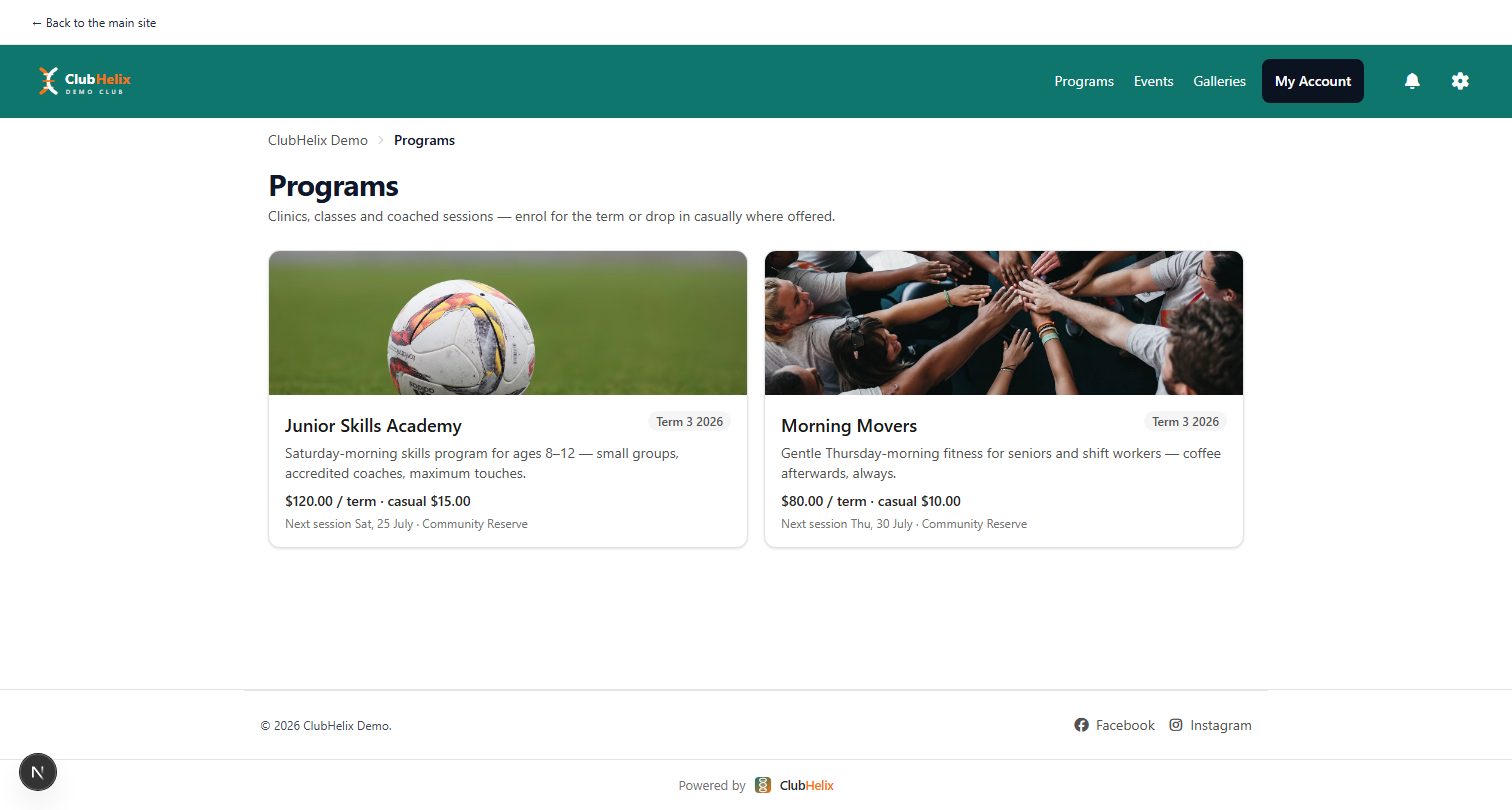
This is exactly what programs and term enrolment on ClubHelix does: publish each term as a program with dates, fees and a capacity cap, take enrolments and card payments through online registration, and your junior coordinator gets a live list of enrolled kids — with contact and medical details — instead of a shoebox of forms. Add RSVPs and attendance and coaches can mark the roll each Saturday in thirty seconds.
Launch with a come-and-try day
Don't launch with "registrations are open" — launch with a free, zero-commitment taster session. A come-and-try day two or three weeks before term one lets kids sample it and parents inspect it, and it converts far better than any flyer. Promote it through local schools, community groups and your members' networks; run it exactly like a real session (your best coaches, maximum fun); and have enrolment open on the spot — a QR code on a sign pointing at the program page catches families at peak enthusiasm.
Then measure one number all term: how many kids come back next week. Retention above 80% means the program works and you can plan age band number two. Below that, fix fun, communication or logistics before growing.
If you're setting up a program this season, ClubHelix gives you the whole junior toolkit — program pages with online enrolment and payments, parent email lists, attendance, and a club website families can actually find — with a free tier to start on. Create your club and you can be taking enrolments this week.
Frequently asked questions
What age should a junior sports program start at?
Most clubs start at ages 5–7 with a fun, games-based format, because that's when families first shop for a sport and skill gaps don't matter yet. Launch with one age band and add the next one each season as numbers and volunteers grow.
How many kids do you need to start a junior program?
Ten to fifteen in one age band is plenty for a viable first term — enough for small-sided games and a good atmosphere, small enough for one coach and a helper. Growth comes from running that group well, not from launching big.
Do volunteer coaches need a Working with Children Check?
Whatever the scheme is called where you are, the discipline is identical: check every adult in a child-related role before they start, record the clearance and its expiry date centrally, and never let anyone begin on the promise that the paperwork is coming.
Here that means a criminal background check meeting your state's, your league's and your insurer's requirements — plus abuse-prevention training and clear policies on one-on-one contact and messaging with minors.
How do clubs grow junior membership once the program starts?
Retention first: keep sessions fun and every child involved, communicate reliably with parents, and make re-enrolment a five-minute online job. Then grow through come-and-try days, school connections and word of mouth — a happy family on the sideline is your best recruiter.