
What this guide answers
- How does a club start accepting donations online?
Set up a payment method on your club website, create a campaign page with a specific purpose and a suggested amount ladder, and then ask — by email, from the microphone, and as an optional add-on wherever members…
- Are donations to a sports club tax deductible?
That depends entirely on your organisation's legal status and where you are, and for many community clubs the answer is no.
- How much should we suggest people donate?
Offer three or four amounts with a description of what each buys, plus an open field.
- How do we get recurring monthly donations?
Give the program a name and an ongoing purpose, launch it to a warm list of people you can name rather than to the whole database, keep it to two or three tiers with an easy entry point, and make the benefit belonging…
- How soon should we thank a donor?
Within forty-eight hours, from a named person, saying what the gift will do.
New Zealand edition. This guide is written for volunteer-run clubs in New Zealand. Where rules differ — grants, tax, incorporation, safeguarding — follow the New Zealand-specific pointers below or check with your national body.
Somewhere on most club websites there is a donate button that has taken almost nothing in two years. It sits in the footer, or on a page called Support Us, and every so often somebody at a committee meeting suggests making it bigger. It gets made bigger. Nothing changes. Eventually the club concludes that its community is not the giving type, which is a strange conclusion to reach about people who buy raffle tickets, stay back to pack up chairs and drive four hours to an away game.
The button is not the problem. The ask is. "Donate" is a request to solve a problem the reader has not been told about, for an amount they have to invent themselves, at a moment when they were doing something else. Almost nobody responds to that, and the ones who do are the people who would have given anyway. Meanwhile the same club can raise a meaningful sum in a fortnight by saying, in plain words, that the junior program needs a new set of training gear before the season starts, that it costs a specific amount, that a specific number of people giving a specific figure would cover it, and here is where to do that.
This guide covers how to set donations up properly — writing an ask that people can picture, putting it in the places where your supporters already are rather than in a page nobody visits, the records and receipts to keep and the tax questions to put to your own adviser, building a recurring giving program, and the stewardship that turns a one-off gift into a decade of them. It is general information rather than financial or legal advice, and the tax treatment of gifts differs enormously between places, so the rule throughout is to check your own position with your adviser and your regulator before you publish anything about it.
Why a donate button raises nothing on its own
Four things go wrong, and they are all fixable.
There is no problem. A donation is a response to a need. If your page says the club "relies on the generosity of supporters", the reader has nothing to respond to. Name the need and name what happens if it is not met.
There is no number. Asked to choose their own amount, most people either give the smallest figure that does not feel rude or close the tab. Suggested amounts do the deciding for them, and they raise the average gift considerably.
There is no deadline. Without one, giving is something to do later, and later is where gifts go to die.
Nobody is asked. This is the big one. A button is not an ask — it is a facility. Someone has to actually ask, out loud, in an email, from a microphone. Clubs that raise money from donations are not the ones with better buttons; they are the ones that ask three or four times a year and thank people properly in between.
Write an ask people can picture
The strongest club asks share a shape. Work through these four parts and you will have written the whole campaign in about twenty minutes.
- The specific thing. Not "club funds" — a set of junior training gear, the second defibrillator, the shade sail over the spectator area, the bus that gets the under-14s to the regional carnival. Specificity is not a marketing trick; it is what lets someone imagine the outcome and feel responsible for it.
- The number and the maths. What it costs, what you have, what is missing. Then break the gap into human units. "Forty people at fifty each closes this" turns an abstract total into an achievable job.
- The deadline and the consequence. "Before the season starts in six weeks" is a reason to act today. Without a date the ask has no urgency and no natural conclusion — which also means no natural thank-you.
- The proof. A photograph of the thing that is worn out, a quote from the supplier, a sentence from the junior coordinator. One honest concrete detail beats three paragraphs of sentiment.
Build an amount ladder
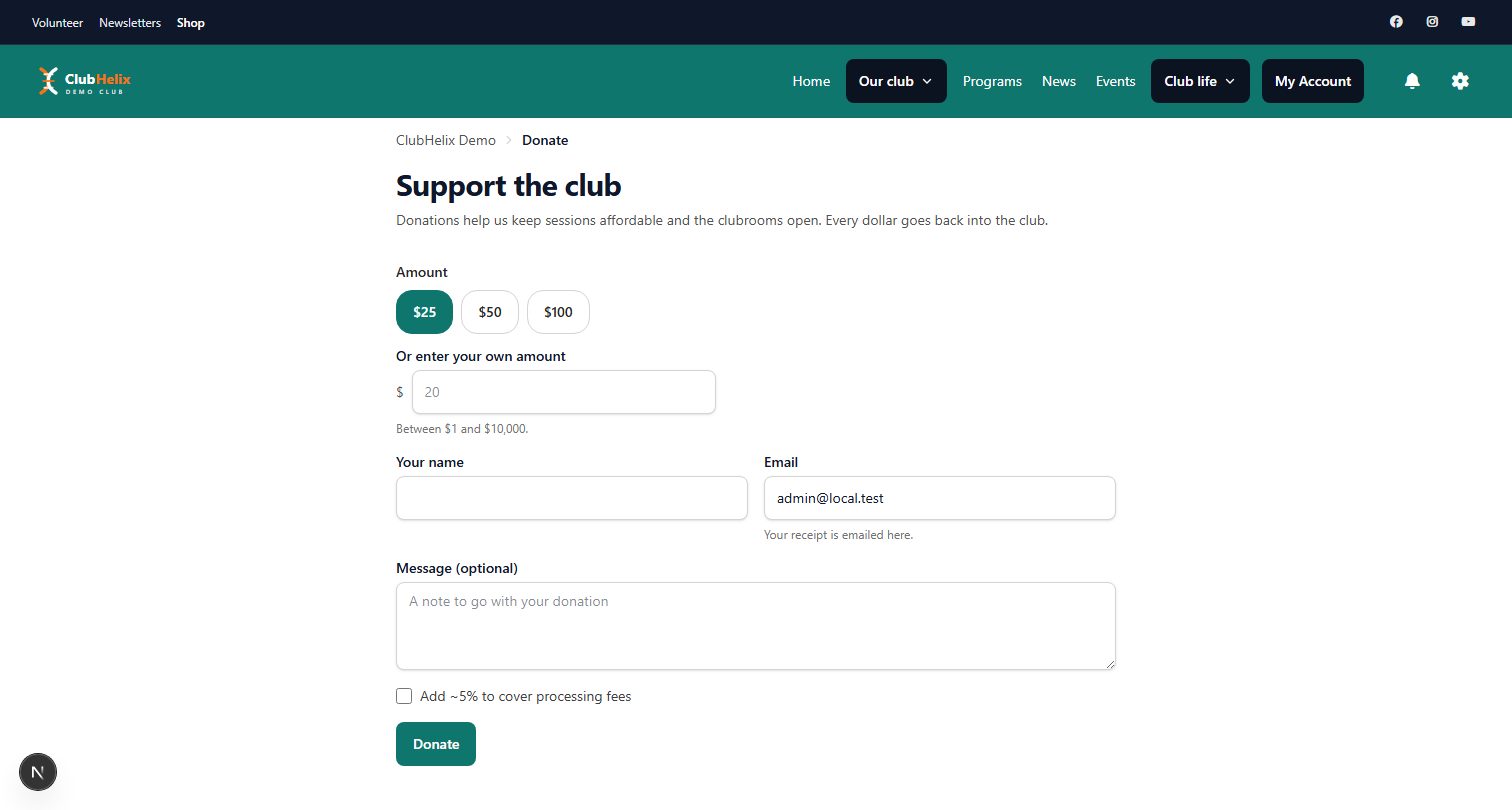
Offer three or four suggested amounts with a description attached to each, plus an open field for people who want to give something else. Descriptions matter more than the amounts themselves — they turn a payment into a purchase of something real.
| Suggested gift | What it does | Who tends to choose it |
|---|---|---|
| Small | Covers one junior's registration for the season | Members, regular supporters |
| Medium | Buys a full set of match balls or a training kit | Parents, past players |
| Large | Funds a piece of equipment outright, named if wanted | Life members, local businesses |
| Open | Whatever the giver decides | Everyone else, including the rare very large gift |
Put the medium option second in the list and make it visually the default. People choose from the middle far more often than from the ends, and where you place the middle sets the average gift for the whole campaign.
For a community club, a ladder of $25, $50, $100 and $250 works for most campaigns, with the second option set as the default. If the campaign has a capital target, add a higher naming tier — $1,000 or more attached to a plaque, a locker or a seat — because there is almost always one supporter waiting to be asked for that and nobody has ever asked them.

Put the ask where people already are
A dedicated donations page is necessary and almost never sufficient, because it is a page people visit only if something sent them there. The gifts come from the places your supporters already pass through.
| Placement | Why it works | Effort |
|---|---|---|
| An add-on at registration | People are already paying, already in a giving frame of mind | One-off |
| On the ticket page for events | A small optional amount alongside a ticket converts surprisingly well | One-off |
| On the receipt or confirmation | The one message everybody opens, and the ask is a postscript | One-off |
| Newsletter footer, every issue | Persistent, unobtrusive, cumulative | One-off |
| A QR code at the ground | Canteen, clubroom wall, sponsor board, the back of the toilet door | Low |
| The end of the season report | Attached to a year of evidence that the club does what it says | Annual |
| The presentation night microphone | Warm room, one clear ask, a code or a link on every table | Per event |
| A campaign page with a thermometer | The visible total is what makes people give a second time | Per campaign |
The registration add-on deserves particular attention. A single optional line where a member is already checking out — "add a donation to the junior equipment fund" — captures more in a season than a donations page does in a year, because it reaches everybody rather than the handful who go looking. If your registration already takes payments online, this is a change of one line rather than a project, and collecting membership fees online covers the checkout itself.
Keep it comfortable rather than grating. Ask no more than three or four times a year in a concentrated way, with the persistent placements running quietly in between. And never make the optional feel compulsory — a pre-ticked box is the fastest way to turn a supporter into a complainant.
Time the concentrated asks to the rhythm of your year. The end of the financial year in the middle of the calendar year is a natural moment, because supporters are already thinking about their own affairs and any deductibility question is top of mind. The other reliable windows are the weeks before the season starts, when the need is concrete and immediate, and the end of the season, when the results are fresh.
Receipts, records and the questions for your adviser
This section is general information, not advice. Whether a gift to your club is deductible for the giver, what wording a receipt must carry, and whether your organisation can issue one at all depend entirely on your legal structure and where you are — and they change. The consistent part is what you should have ready before you accept a single donation.
Keep these records for every gift, regardless of jurisdiction:
- Date received and date banked
- Amount and payment method, with the transaction reference
- Donor name and contact details, and whether they wish to remain anonymous
- The campaign or purpose the gift was given for
- Whether the donor received anything in return, and what it was worth
- Any conditions the donor attached, in their own words
- Which receipt or acknowledgement was issued, and when
That last two lines matter more than committees expect. A gift given for a specific purpose is generally restricted to that purpose, and spending it elsewhere is a governance problem even when the money is desperately needed somewhere else. And a donor who receives something in return — a ticket, a jersey, a seat at a dinner — has usually made a purchase rather than a gift, at least in part.
The questions to put to your accountant, auditor or regulator, in writing:
- Given our legal structure, can we issue a receipt that lets the giver claim anything, or not?
- If not, is there a status we could apply for, what would it require of us, and is it worth the compliance burden?
- What exact wording must a receipt carry, and what must it never imply?
- How do we treat a gift where the donor received something in return?
- Do we need to register anywhere before publicly soliciting donations?
- How should restricted gifts be recorded and reported in our accounts?
- How long must we retain donation records, and in what form?
- What are our obligations if we receive a large gift, an anonymous gift, or one from outside our area?
In New Zealand, donors can generally claim a tax credit for gifts to organisations with donee status, which is granted by Inland Revenue and is not automatic for a sports club. Registration with Charities Services is a separate question. Confirm your own status with your accountant and Inland Revenue's published guidance before you say anything about tax treatment on your donation page, and issue receipts in the form they specify.
Recurring giving is the quiet transformation
A one-off appeal is a spike. Recurring giving is a floor — a predictable monthly amount that arrives whether or not anyone runs a campaign, and that compounds year on year as the base grows. Sixty supporters giving a modest amount monthly produces more over three years than almost any single event a volunteer committee can run, at a fraction of the effort once it is set up. It also changes the relationship: a monthly giver is invested in a way an occasional one is not, and they show up to things.
How to start one
- Give it a name and a purpose. A program with an identity — the century members, the junior fund — recruits far better than "monthly donations". Attach it to something ongoing rather than a one-off item, because the point is that it never finishes.
- Launch it to a warm list first. Life members, past players, committee members past and present, parents of juniors who have moved on. Launch to fifty people you can name and let it grow from there.
- Offer two or three tiers only. Too many choices reduce sign-ups. Set the lowest at a genuinely easy amount, because you are recruiting a habit rather than maximising the first month.
- Make the benefit belonging, not merchandise. A name on a board, an update they get first, an invitation to the season launch. Physical rewards cost margin and create fulfilment work forever.
- Give a graceful exit. People who know they can stop easily start more readily. Say so plainly on the sign-up page.
Keeping it alive
Recurring programs die quietly rather than dramatically. Three habits keep them healthy:
Handle expired cards immediately. Monthly gifts lapse largely because a card expired and nobody noticed. A prompt, friendly message that makes updating the details easy recovers most of them.
Report to the program specifically. A short update a few times a year, addressed to monthly givers as a group and telling them what their money did, is the best retention tool there is. It should not contain an ask.
Offer a wind-back before a goodbye. When someone cancels, respond warmly and offer a smaller amount instead of nothing. Many people take it, because most cancellations are about circumstances rather than dissatisfaction.
Stewardship — the thank-you that earns the second gift
The first gift is bought with a good ask. The second, and the tenth, are earned with what happens afterwards.
- Thank within forty-eight hours, from a named person, saying what the gift will do. An automatic receipt is a transaction record, not a thank-you — send both.
- Come back with evidence. A photograph of the thing that was bought, in use, with the people using it. This is the message that produces the next gift, and it contains no ask.
- Escalate the personal touch with the size of the gift. Small gifts get a good automatic thank-you, medium gifts a personal email, large gifts a phone call from the president and a conversation rather than a form letter.
- Never let a donor find out from the newsletter. Anyone who gave meaningfully to a project should hear how it turned out before the general membership does.
- Keep the donor register alive across committees. Who gave, when, how much, why, and what they were told. This is the asset that walks out the door with an outgoing treasurer if nobody writes it down.
Review a handful of measures once a quarter — total raised, number of donors, average gift, share of gifts that are recurring, retention of last year's donors, and how many gave a second time. Retention and repeat rate tell you far more about the health of the program than the total does, because a total can be flattered by one generous person having a good year.
The same discipline applies to every other income line. Keeping club sponsors happy covers the commercial version of the same relationship, and how to write a grant application covers the institutional one — a club that reports well to one usually finds the others open more easily.
Setting it up on your own club site
The practical barrier is rarely willingness — it is that taking money online, recording who gave what, issuing something back and remembering to thank people is four systems held together by a treasurer's memory. ClubHelix puts them in one place on your own site: donations with campaign pages, suggested amount ladders and recurring gifts, self-registration so a donation can be offered as an add-on at the moment someone is already paying their fees, email broadcasts from your own domain for the appeal and the follow-up, and reports so the donor list, the totals and the reconciliation are all in the same place as the rest of your money.
A campaign page can be live this week without a budget decision — the free tier takes real payments, and every plan's cost is set out on the pricing page. Create your club site, then write the specific ask your club has been meaning to write for two years and give your supporters something they can actually picture. If you would rather see the wider menu first, club fundraising ideas sets donations alongside every other option.
Frequently asked questions
How does a club start accepting donations online?
Set up a payment method on your club website, create a campaign page with a specific purpose and a suggested amount ladder, and then ask — by email, from the microphone, and as an optional add-on wherever members already pay for something. The technical setup takes an afternoon. Writing an ask people can picture is the part that determines whether anything arrives.
Are donations to a sports club tax deductible?
That depends entirely on your organisation's legal status and where you are, and for many community clubs the answer is no. The rules differ significantly between jurisdictions and change over time, so treat this as general information, confirm your position with your accountant and your revenue authority, and never state or imply a tax benefit you cannot substantiate.
How much should we suggest people donate?
Offer three or four amounts with a description of what each buys, plus an open field. Set the second option as the default, because most people choose from the middle of a list rather than the ends, and describe each amount in terms of a real outcome. A ladder with descriptions consistently produces a higher average gift than an empty box.
How do we get recurring monthly donations?
Give the program a name and an ongoing purpose, launch it to a warm list of people you can name rather than to the whole database, keep it to two or three tiers with an easy entry point, and make the benefit belonging rather than merchandise. Then look after it — recover expired cards promptly and report to the group a few times a year with no ask attached.
How soon should we thank a donor?
Within forty-eight hours, from a named person, saying what the gift will do. Send the automatic receipt as well, but do not mistake it for a thank-you. Then come back weeks later with evidence — a photograph of what the money bought, in use — because that follow-up is what makes the second gift possible.
What records should a club keep for donations?
Date, amount, method and reference, donor details and contact preferences, the purpose the gift was given for, whether the donor received anything in return, any conditions attached, and what acknowledgement was issued. Keep gifts given for a specific purpose separately identified in your accounts, and confirm retention requirements with your adviser.
Keep reading — club fundraising ideas puts donations alongside the wider menu, and running a club auction night covers the evening where a well-timed appeal often raises the most.


