
What this guide answers
- How much should we charge for a university ball ticket?
Work backwards rather than picking a number that "feels right".
- What do we do if the ball is badly undersold four weeks out?
Act that week, because your options shrink every day after it.
- Should we let people book a whole table?
Yes, and price it slightly below the sum of its parts. A table of ten at a small discount gives you one payment instead of ten, guaranteed heads well before the confirmed-numbers date, and a group who will turn up…
- Does our society need its own insurance for a ball at an outside venue?
Usually not a separate policy, but you almost certainly need approval — and the cover follows the approval, not the intention.
- Can we sell tickets at the door on the night?
Usually yes, and it is nearly free money — your catering is already fixed by the confirmed number, so a door sale drops mostly straight to the surplus.
South Africa edition. This guide is written for volunteer-run clubs in South Africa. Where rules differ — grants, tax, incorporation, safeguarding — follow the South Africa-specific pointers below or check with your national body.
A society ball is the only thing most committees do all year where a single signature — a venue contract signed in week three by whoever happened to be free that afternoon — can cost more than the entire rest of the year's program. A 40-member society sitting on a $600 float can commit itself to a $10,000 minimum spend before lunch, and nobody in the room will have read the clause about confirmed numbers.
The reassuring part is that balls are the most predictable event a society runs. The venue hands you its numbers up front, demand follows roughly the same curve every year, and committees lose money in boringly consistent ways: the price was announced before anyone did the arithmetic, the sale opened three weeks late, the panic discount in the final fortnight infuriated everyone who had already paid, and the door took forty minutes to clear because the guest list was on one person's laptop at home.
This guide is the ticketing half of running a ball — the venue's numbers, pricing against a minimum spend, a sale that does not need rescuing, tables and guests, a door that moves, and fair refunds. The other half, the run sheet and the room, is in our end-to-end event guide.
Get the venue's real numbers before you set a price
Venues quote a headline per-head figure because it sounds manageable, and it is almost never the number that decides whether your ball makes money. Before anybody discusses a ticket price, get every line below in writing, in one email, from the events coordinator.
| What to ask for | Why it decides your ticket price |
|---|---|
| The minimum spend, and exactly what counts towards it | This is your real fixed cost. Bar spend sometimes counts, sometimes does not |
| Per-head price for each menu tier, including the cheapest | The gap between a canapé package and a three-course sit-down is often $25 a head |
| Room hire, and whether it is waived if you hit the minimum | A $1,500 hire fee that disappears at 150 guests changes your whole plan |
| Deposit amount and due date | You commit this before you have sold anything |
| The confirmed-numbers date | The day your costs stop being a forecast and become a bill |
| Whether you can add heads after that date, and the surcharge | Usually yes, at $10–20 a head. Removing heads is almost never allowed |
| Cancellation terms by date | Your only genuine escape route, and it has a deadline |
| The security requirement | Usually the venue's rule, always your cost — two guards for five hours adds up |
| The bar arrangement | Cash bar, pre-paid tab or a drinks package built into the ticket are three different prices |
| Finish time, late fees, and what is hired versus included | Staging, AV, linen and a 1am hard stop with a $400 late fee are all commonly extras |
Then do the thing that feels theatrical and is the cheapest control a society has: read the contract aloud at a committee meeting before anyone signs. It takes about eleven minutes, and someone always says "wait, what does that mean" at exactly the clause that would have cost you $2,000.
Two rules worth adopting permanently. Nobody signs alone — most student associations already require an officer or staff member to countersign above a threshold, and a student who signs a venue contract personally may be personally on the hook for it. And the cancellation dates go into the committee calendar alongside the confirmed-numbers date, because those are the only points at which a struggling ball can still be rescued cheaply.
Break-even is set by the venue minimum, not by your costs
Here is the arithmetic almost every first-time ball committee gets wrong. Say the venue is a function room seating 200, and it has quoted you this.
| Line | Amount | Behaves like |
|---|---|---|
| Minimum spend on food and beverage | $10,000 | A fixed floor |
| Set menu per head above the minimum | $58 | Variable |
| Room hire (waived if you reach the minimum) | $1,500 | Fixed, avoidable |
| Band plus DJ | $1,400 | Fixed |
| AV and lighting hire | $400 | Fixed |
| Security — two guards, five hours | $550 | Fixed |
| Photographer | $350 | Fixed |
| Decorations, printing, wristbands | $300 | Fixed |
| Card processing on an $85 ticket | about $2.80 | Variable |
The trap is the first row. A $10,000 minimum at $58 a head is 172 covers, so anywhere below 172 guests you do not get a cheaper night — you get the same $10,000 bill with emptier tables. For any realistic attendance the catering is not a per-head cost at all. It is a fixed cost of $10,000.
That makes your fixed total $10,000 + $1,400 + $400 + $550 + $350 + $300 = $13,000. At an $85 ticket you keep about $82.20 after processing, so break-even is 13,000 ÷ 82.20 = 159 tickets — 79% of the room's capacity. Last year you sold 132. At 132 tickets this plan loses about $2,150, and the committee only finds out after the night, when the invoice arrives.
Now run it again with three levers instead of one.
- Move the date and negotiate the minimum. Venues discount off-peak nights hard. A Friday in the shoulder season brings the minimum to $8,000. Ask coordinators directly what minimum they could do on a Friday — they have room to move and are used to the question.
- Cut fixed costs that do not sell tickets. Drop the DJ and run a playlist after the band: $1,400 becomes $800. Your photography society will shoot the night for a $100 honorarium and a credit: $350 becomes $100.
- Sell one thing that is not a ticket. A graduate recruiter takes a table sponsorship for $1,200 and buys its ten seats at full price — a different conversation from asking for a donation, and the society sponsorship guide covers how to price it.
New fixed total: $8,000 + $800 + $400 + $550 + $100 + $300 = $10,150, less $1,200 sponsorship = $8,950. At an $89 ticket you keep $86.10. Break-even is 104 tickets — 52% of capacity and 79% of last year's actual sales. That is a plan rather than a bet.
The rule worth writing on the whiteboard: your break-even should sit at or below 60% of the room's capacity and at or below 80% of last year's actual paid attendance. If it does not, change the venue, the date or the package — not the marketing plan.
The other date that ruins committees is the confirmed-numbers date. Whatever number you confirm, you pay for, so confirm the number you have sold rather than the one you hope for; a late-addition surcharge is cheap insurance compared with catering for 30 people who never existed. Our budget template has a break-even sheet built for this shape of event.
Before you publish a price, settle who is actually going to hold the money. Most societies do not run their own bank account: student affairs finance administers it, the SRC's allocation is released in tranches against a submitted budget, and the venue is paid centrally. That is safer than a committee account, but the lag is the thing to design around. If your deposit falls due eight weeks out and a payment request takes a fortnight to clear, the paperwork has to go in ten or eleven weeks out — before a single ticket is sold. Ask student affairs finance three questions early: can the venue invoice the university directly rather than a student paying and claiming it back, what is the current turnaround on a payment request, and can ticket income be credited to your society's account as it arrives rather than after the night. On tax, VAT registration is very unlikely at typical society turnover, but if the university is holding and invoicing your ticket income the treatment may differ, so confirm before you set the price. General information only, not tax advice.
Price in waves, and use structure instead of a panic discount
Once you know your break-even, the ticket price is nearly decided. What is left is the shape of the sale — and that is what separates a ball that sells out in week four from one that spends the last fortnight begging. Sell in waves, with every price and end date published at the start. Nobody feels tricked by a price rise they were told about six weeks earlier.
| Wave | Opens | Price | Cap | What it is for |
|---|---|---|---|---|
| Members' presale | 6 weeks out | $79 | 60 tickets | Rewards paid members, and gives you a demand reading while you can still act |
| General release | 5 weeks out | $89 | to capacity | The bulk of the sale |
| Final release | 2 weeks out | $99 | remainder | Prices late deciders and funds the late-addition surcharge |
| Table of ten | with presale | $760 | 8 tables | One payer, ten guaranteed heads, banked early |
| Concession | any time | $55 | 15 held quietly | Nobody misses the ball because of money |
Three things that table is doing. The members' presale turns membership into a genuine benefit and gives you an early read on demand — if it sells 12 of 60 in a week, you have five weeks to change something rather than five days. The table rate at $76 a head buys certainty: one person pays, ten seats are gone, and the money lands early, when you need it for the deposit. The concession rate, offered without ceremony and without making anyone explain themselves, is the difference between a ball for the whole society and a ball for the part of it with disposable income.
Count complimentary tickets as a cost, because they are one: six committee comps at $89 is $534 of forgone income plus real catering. A better rule is that the two people actually working the door get in free and everyone else on the committee pays the members' rate.
Now the discipline: do not panic-discount in the last fortnight. It refunds nothing to the 90 people who paid full price early, and they find out within minutes because the group chat is faster than your announcement. It teaches next year's cohort that waiting is rewarded, which kills your presale twelve months from now. And it usually does not work — people buying that late are deciding whether they have plans, not whether $89 is too much, so you drop $20 across everyone who had not yet bought and gain a handful of sales.
Use structured codes instead; a discount with a reason attached is not a fire sale. Codes that work well: one for the first-year cohort who have never been, a pair rate for bringing someone new, a code for a partner society you are swapping promotion with, and a code that adds a drink on arrival rather than taking money off. Each one is trackable, so afterwards you know which channel actually sold tickets.
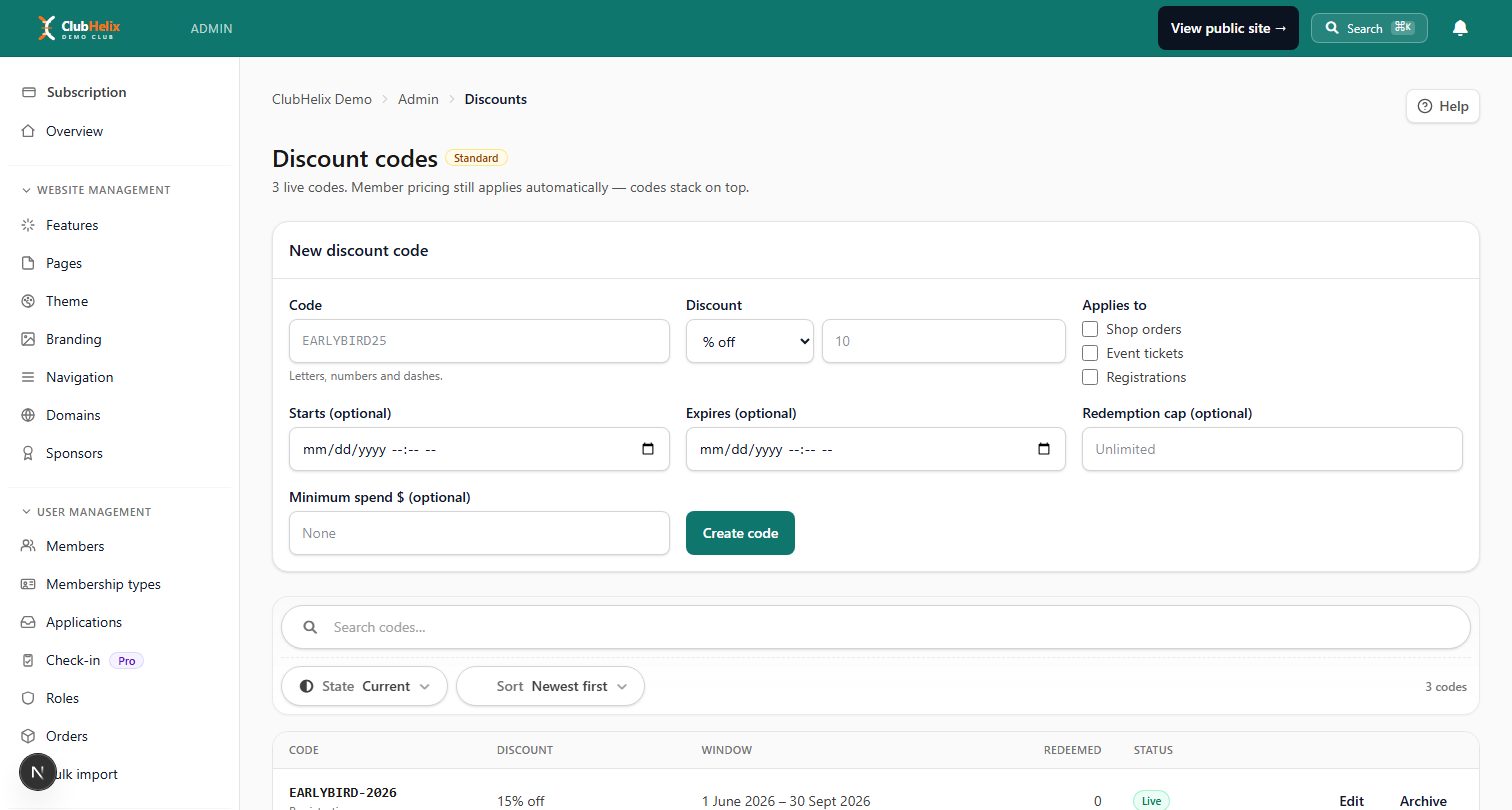
Cap and date every code. An uncapped code posted in a public chat has a way of reaching an entire faculty. Usage limits and expiry dates on discount codes turn that from a $900 mistake into a non-event.
The seven-week selling timeline
Balls fail on the calendar more often than on the idea. This is the timeline that works for a mid-sized society, counted backwards from the night.
| Week | What has to happen |
|---|---|
| −7 | Contract read aloud and countersigned. Deposit paperwork submitted. Break-even sheet locked. Risk assessment started. One person named as ball owner |
| −6 | Ticket page live — price, dress code, times, access information, guest policy, refund policy, all in one place. Members' presale opens |
| −5 | General release. First all-member email. Posters and lecture shout-outs. Tables pitched to course cohorts and societies you share members with |
| −4 | Midpoint check. If sales are under 40% of break-even, this is the week you change the plan — smaller room, cheaper package, or cancel cleanly |
| −3 | Dietary and access needs collected from every buyer. Run sheet drafted. Door and setup rosters filled. Sponsor deliverables confirmed |
| −2 | Final release price begins. Second email with a real deadline. Forecast numbers sent to the venue for a sanity check |
| −1 | Confirmed numbers locked. Attendance list exported and shared with two committee members. Door kit packed. Reminder email with "bring ID" in it |
| The day | Door opens 30 minutes after the time on the ticket. Two people checking names, one floating, one sober named contact for the venue |
| +1 | Reconcile within 48 hours. Process the refunds you promised. Thank the sponsor, the venue and the volunteers |
The most valuable row is week −4. Committees almost always know at four weeks that a ball is undersold, and almost always decide to "push harder" instead of acting. Four weeks out you can still move to a smaller room, downgrade the package, or cancel inside the contract's window and lose only the deposit. One week out you can do none of those things.
Run the whole sale off one page: date, venue, price, what is included, dress code, access information, guest policy, refund policy and the buy button in the same place. Every extra hop — chat message to form to external ticketing site to payment link — loses a slice of the people who were going to come. A society site with events and ticketing built in collapses that into one step, and the reminders, the attendee list and the sales report all come off the same record.
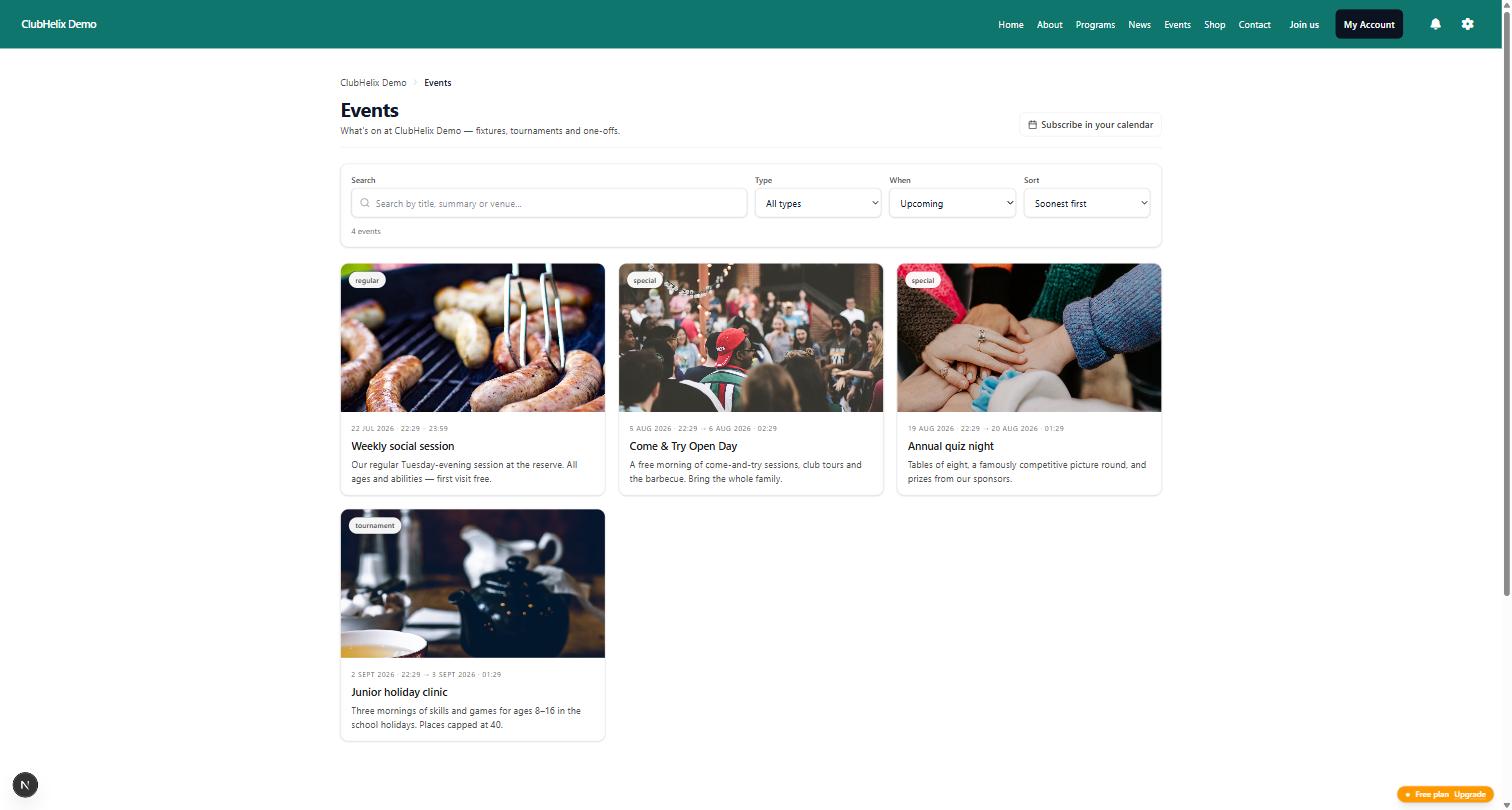
For getting the page seen once it exists, the promoting a club event guide covers the channels, and the society email guide covers the two emails that do most of the work.
Running the door
A 200-person ball with two people checking names clears in about twenty minutes if the list is right and about fifty if it is not, and that queue is the first impression of everything you spent seven weeks building.
The door kit, packed the day before: two charged phones with the attendee list open, a battery pack, a printed backup list (treat the venue's wi-fi failing as a certainty, not a risk), pens, wristbands in two colours, the duty manager's mobile number, the risk assessment, a first-aid contact, and a cash tin only if you are genuinely selling at the door. The roster: two people checking names, one floating to handle problems away from the queue, and one committee member who is not drinking and is the named contact for the venue all night. That last role is not optional — write it into the roster with a name against it.
Six things go wrong at every door. Decide the answer now, not at 8.15pm with forty people waiting.
- A name is not on the list. Nine times out of ten they are under the buyer's name, because group and table bookings sit against one payer. Ask for the confirmation email rather than starting an argument.
- Someone has passed their ticket on. Decide before you sell whether transfers are allowed. The workable rule: the buyer emails the committee with the new name before a stated cut-off and it is changed on the list.
- A screenshot of somebody else's confirmation. Precisely why you check names against a list rather than glancing at an image on a phone.
- A guest with no ID, or no idea they needed one. Publish the guest policy and the ID requirement at the point of sale and repeat it in the reminder. A door is not the place to introduce a rule.
- A guest who arrives already intoxicated. That call belongs to the venue's staff, not your 19-year-old secretary. Agree with the duty manager beforehand who says no and where a refused guest waits safely.
- Someone paid but is not showing. A card may have failed, or they bought at 6pm. One committee member with access to the sales report can check in twenty seconds — put that person on shift.
On plus-ones: cap them at one per member, price them slightly above the member rate, collect the guest's name at purchase rather than at the door, and say plainly that the member is responsible for their guest's behaviour. That last sentence on the ticket page does more work than any amount of door policy.

The venue holds the liquor licence and its trading conditions govern your night, including the hour it must stop serving — make sure the finish time on your ticket page matches the licence rather than your plans. Do not offer to run a bar yourselves. Expect the university's event policy to require an approval form and a risk assessment for an off-campus ticketed event, submitted weeks ahead, and for campus protection services or student affairs to want sight of the arrangements; once you pass a headcount, a registered private security company on the door is normally required rather than volunteers. Everyone drinking must be 18 or over and the venue will check identity documents, so name what it accepts in the confirmation email. Transport home is a real safety issue for a late-finishing event, so build a plan into the ticket page rather than leaving it to chance. Agree beforehand who makes the call on refusing entry and where a refused guest waits safely. General information — the university's event policy and the venue's licence conditions are the authority.
Refunds, transfers and the ticket nobody can use
Write the refund policy before the first ticket sells. Put it on the ticket page, in the confirmation email and behind the terms tick box, in three sentences a stressed 19-year-old can understand at 11pm.
A policy that holds up in practice: full refund up to the confirmed-numbers date; after that no refund, but you may transfer your ticket by giving us a replacement name before a stated cut-off; if we cancel the ball, everyone is refunded in full. That shape works because it is honest about why — your money is committed to the venue on the confirmed-numbers date, which is a fact you can point to rather than a rule you are defending.
Genuine exceptions will arrive: illness, bereavement, a placement that moves. Do not decide those one at a time in a group chat at midnight. Agree the test as a committee — what evidence you ask for, who approves, and whether the refund is full or net of catering already committed — then minute it and apply it identically to everyone. A society that quietly refunds the president's friend and refuses a stranger will hear about it for two years.
Two practical notes. Refund to the original payment method, never in cash from the door float — you need the audit trail, and cash refunds are how treasurers end up personally out of pocket. And watch for chargebacks: the person who disputes the charge with their bank instead of emailing you costs you the ticket and usually a fee. The preventions are a recognisable name on the statement descriptor, a refund policy people genuinely saw before paying, and answering your society email within a couple of days.
The Consumer Protection Act is the one to know here, because section 17 gives consumers a right to cancel an advance booking or reservation, subject to the supplier charging a reasonable cancellation fee. That means an absolute "no refunds under any circumstances" line is not a safe position for a ticketed event. What is defensible is a policy that explains the charge: full refund up to the confirmed-numbers date, and after that a refund net of the catering cost already committed to the venue, because that cost is genuinely incurred and can be evidenced. Publish that reasoning alongside the policy rather than just the rule — it converts an argument into an explanation. If you cancel the ball yourselves, refund in full and promptly. Run transfers yourselves at face value rather than letting a resale market form in a group chat, so the door list stays accurate. And record every refund in your accounts as a refund rather than a reduced sale, so your reconciliation and your handover both tell the truth. General information rather than legal advice — student affairs may have its own refund policy that applies to recognised societies.
The forty-minute reconciliation that makes next year easy
Do this within 48 hours, while people still remember. It is the highest-value thing an outgoing ball committee leaves behind.
Pull the numbers first: tickets sold by wave, comps issued, tables sold, which discount codes were redeemed, total income, the venue's final invoice against the confirmed number, bar and extras, security, and the surplus or deficit. Then add the two numbers nobody records and everybody needs next year — attendance as a percentage of tickets sold (a well-run ball lands between 92% and 96%; under 85% means your confirmed number was optimistic) and tickets sold as a percentage of members, which tells the next committee what demand really looks like rather than what this year's president remembers.
Then write one page and put it where the next committee will find it, which is not a personal drive: venue and contact name, the contract terms and whether you hit the minimum, the deposit and when it fell due, the package and what you would change, which wave sold what, which promotion actually moved tickets, how long the door queue took, and the three things that went wrong. That page is worth more than any amount of enthusiasm at the handover meeting, and it is exactly what a funding panel wants attached to your next application. A system that keeps your sales and attendance reports on the event record does this for you; a spreadsheet in a graduate's drive does not.
If the ball made a surplus, decide where it goes before it evaporates — a reserve for next year's deposit is the best use, because it lets the next committee negotiate from strength instead of desperation. For events that are not balls, the social event ideas list has forty options ranked by budget and effort, and the risk assessment guide covers the paperwork side properly.
Frequently asked questions
How much should we charge for a university ball ticket?
Work backwards rather than picking a number that "feels right". Add your fixed costs including the venue's minimum spend, subtract any sponsorship, and divide by the tickets you honestly expect to sell — last year's number, not your hopes. Add 10 to 15% so a late surcharge does not wipe you out, then check the result against what your members actually spend on a big night out. If the honest price is higher than the room can pay, the answer is a cheaper venue or package, not a hopeful price.
What do we do if the ball is badly undersold four weeks out?
Act that week, because your options shrink every day after it. In order of preference: switch to a smaller room or cheaper menu with the same venue (coordinators would far rather renegotiate than lose you), open a targeted code to a cohort you have not reached, sell a table sponsorship to bring break-even down, and only then consider cancelling within the contract's window so you lose the deposit rather than the full minimum spend. What does not work is discounting for everyone in the final fortnight — it costs more than it recovers and it damages next year's presale.
Should we let people book a whole table?
Yes, and price it slightly below the sum of its parts. A table of ten at a small discount gives you one payment instead of ten, guaranteed heads well before the confirmed-numbers date, and a group who will turn up because they organised themselves. Collect every guest's name at booking rather than at the door, and be clear that the booker is responsible for their table. Watch one thing: a room of pre-formed tables can leave individual buyers stranded, so hold a couple of tables as mixed seating and say so on the ticket page.
Does our society need its own insurance for a ball at an outside venue?
Usually not a separate policy, but you almost certainly need approval — and the cover follows the approval, not the intention. The venue carries insurance for its premises and its staff, and your student association's public liability cover typically extends to society events that have been registered and approved in advance. The trap is assuming that approval is a formality you can do later; it commonly takes several weeks and can come with conditions that change your plans. This is general information — check with your student association or a professional.
Submit the university's event approval paperwork as early as you can. An off-campus ticketed event with alcohol will typically need a risk assessment, the venue's own liability cover, an approved security provider and sign-off from student affairs, and that process can take several weeks. Ask what is required before you sign anything with the venue.
Can we sell tickets at the door on the night?
Usually yes, and it is nearly free money — your catering is already fixed by the confirmed number, so a door sale drops mostly straight to the surplus. Sell at the highest price band rather than discounting, take card rather than cash if you can, and check two things with the venue first: whether it caps entry at a fire-safety number, and whether it can feed a walk-in at all. Never rely on door sales to reach break-even — plan to break even on advance sales and treat the door as a bonus.
Where ClubHelix fits
Ticketing a ball goes wrong in the joins: the sale on one site, the attendee list in a spreadsheet, the dietary needs in a form, the codes in someone's head, and the reconciliation reassembled by hand a week later. ClubHelix keeps the event page, its ticket types, the discount codes, the guest list and the sales report on one record that belongs to the society rather than to whoever set it up — so the door team and the treasurer see the same numbers, and next year's committee inherits the whole ball file instead of a rumour.
If you are setting up a society site for the first time, the ready-made site templates will get you a working ticket page in an evening, and our university clubs solution page shows how a student association can sit above its affiliated societies without taking over any of them. The free tier is for building the site and trying it out — taking payments online and being found in search start on the paid plans; the details are on the pricing page.
ClubHelix gives your society events and ticketing on your own site, discount codes with caps and expiry dates and sales and attendance reporting that survives the handover. Start free before you sign the venue contract.


