
What this guide answers
- What does an amateur radio club need to run a repeater?
A written site agreement with whoever owns the land or structure, the correct licence and any required frequency coordination, a documented installation with configuration notes and photographs, reliable power with…
- How do you fund repeater maintenance and replacement?
Treat replacement as an annual expense rather than a future crisis.
- How should a club run amateur radio licence training?
Choose a format your volunteers can sustain, get hands on equipment in the first session rather than the last, take enrolments and fees through a single online form, publish a refund and transfer policy, and handle…
- How do you keep newly licensed members active?
Pair each graduate with a named mentor before they leave the exam, lend them equipment from a club loan pool, run a beginners' net with relaxed etiquette, and organise antenna working parties to get stations physically…
- What should a club consider before volunteering for emergency communications?
Work through an established agency relationship rather than self-deploying, understand the training, identification and screening requirements the agency sets, keep an accurate call-out list with current clearances…
Most clubs own equipment. An amateur radio club owns infrastructure — and there is a difference. Somewhere on a hill, on a water tower, on the roof of a hospital or on a farmer's ridge, there is a cabinet with your club's name on it. It has a licence, a power supply, a duplexer, an antenna up a mast, and a service agreement with whoever owns the site. It runs continuously. Several hundred people you have never met rely on it working. And the number of members who know the gate code, hold the key, can safely get to the antenna, and understand how the whole thing is configured is usually three, then two, then one.
That is the real shape of the job. A radio club is a small infrastructure operator with a monthly meeting attached. Its committee has to think about tenure, power, maintenance and succession in a way that a chess club never does, while also running the training courses that create its next generation of members and the field days that keep the current one interested.
This guide is for the committee of a club that has a repeater or is thinking about one, runs or wants to run licence training, and turns up to contests, field days and community events. It covers the infrastructure and the money behind it, courses that produce operators rather than certificates, the calendar of portable operating, and the discipline that emergency-communications work demands. It is general information, not technical or regulatory advice — your national regulator and national society set the rules that actually apply.
The repeater is an asset, not a project
The failure mode for club infrastructure is always the same: one enthusiast builds something excellent, maintains it privately for fifteen years, and then stops. Nothing is documented, the site agreement is a handshake with a person who has since retired, and the club discovers what it owned only when it stops working.
Write down what you have and where it stands
For every site, keep a record covering:
- The site agreement. Who owns the land or structure, what the club is permitted to do, notice periods on both sides, what happens if the site is sold, whether the club pays rent, power or nothing, and who the current contact is. Get it in writing even when the arrangement is generous — especially then, because goodwill does not survive a change of owner.
- Access. Gate codes, keys, alarm details, induction requirements imposed by the site owner, and any requirement to notify before attending. Held by at least three named members, and stored where the committee can reach them.
- The licence and coordination details. Frequency pair, callsign, licence holder, expiry, and any coordination approval — including who renews them and when.
- The equipment itself. Make, model, serial numbers, purchase or build date, configuration notes, and photographs of the installation as built.
- Power. Supply type, battery capacity and installation date, charge regime, solar array details if fitted, and expected autonomy through an outage.
- The known weaknesses. Every site has them. Write them down, because the person who knows them may not be at the next meeting.
Who licenses a repeater, and who coordinates the frequency pair, is one of the more jurisdictional parts of this hobby — and it is the part clubs most often inherit as folklore.
In Australia, amateur licensing sits with the national regulator, which moved the amateur service to a class licence arrangement in recent years, while repeater and beacon assignments continue to involve coordination processes and records maintained with the Wireless Institute of Australia. Because the arrangements changed, a club running an installation set up a decade ago should verify its current status rather than assume the paperwork in the folder still describes reality — check with the regulator and the national society, and record the outcome in your asset file.
A maintenance plan anybody can follow
| Frequency | Task |
|---|---|
| Monthly | Remote checks — sensitivity, coverage reports from members, any intermittent faults logged |
| Quarterly | Battery voltage under load, charger function, ventilation and insect ingress, cabinet seals |
| Annually | Site visit with a checklist — connectors, feedline, earthing and lightning protection, antenna inspection, mast hardware, fixings, photographs, and a written report to the committee |
| Every few years | Battery replacement, feedline assessment, and a hard look at whether the equipment is still repairable |
Two safety rules deserve committee minutes rather than tradition. Nobody climbs a mast or tower on club business unless they are trained, equipped and competent to do so — height work is a specialist activity with specialist requirements, and many site owners now require documented evidence before granting access. Contract it out when the work is beyond your members. And nobody attends a remote site alone, at minimum with a check-in call before and after.
Coverage is a service, so treat it like one
Publish what your repeater covers, what its access requirements are, when it is scheduled to be off air, and how to report a fault. A short page on the club website with a coverage description, a fault-report form and a status note does more for the club's reputation than any amount of activity on the machine itself — and it turns the "is it me or is it the repeater?" question into something a visitor can answer without calling anyone.
Funding infrastructure that outlives its builders
Radio clubs are usually cash-poor and asset-rich, which is a difficult combination when something fails. The remedy is unexciting and effective: a schedule that treats replacement as an expense you are already incurring.
| Asset | Realistic service life | Annual provision |
|---|---|---|
| Repeater batteries | A few years | Replacement cost divided by expected life |
| Feedline and connectors | Around a decade, less in harsh sites | Replacement cost divided by expected life |
| Repeater and controller | Longer, but obsolescence bites first | A steady annual amount, reviewed every few years |
| Antenna and mast hardware | Long, but weather and corrosion decide | A modest annual amount plus an inspection budget |
| Club station equipment | Varies widely | Set by the committee against a written wish list |
Add those provisions together, divide by your membership, and you have the honest cost of being a club with infrastructure. Very often it is a small amount per member per year — and far easier to raise as a deliberate levy with a stated purpose than as an emergency appeal after a failure. Members give generously to a named fund with a target and a published balance.
Beyond subscriptions, the practical income sources are a hamfest or table sale, an equipment auction of donated estate gear, sponsorship from a local business that benefits from the club's community work, and grants for capital items. Grant assessors respond far better to infrastructure with a public benefit story attached — coverage for a valley with poor mobile service, support for a community event, training for young people — than to a request to upgrade a hobby. Our guide to writing a grant application covers how to frame that.
Estate equipment deserves its own policy. Clubs are regularly offered a late member's entire station, which is a kindness and a logistical problem. Decide in advance who assesses it, what the club keeps, how the rest is sold, and how the family is thanked and kept informed of what the proceeds funded.
Meetings, nets and the club's social spine
The infrastructure is why the club matters. The meeting is why it survives.
A monthly meeting that consists only of correspondence and a treasurer's report will quietly shrink. The format that works almost everywhere is short business followed by something worth attending for: a talk, a build night, a demonstration, an on-air activity, a problem-solving table where members bring a fault and three people diagnose it. Publish the year's topics in advance so members can plan, and record which nights drew a crowd.

The weekly net is the other half of the spine, and it is the cheapest membership-retention tool a radio club has. Run it at a fixed time, roster the net controllers so it never depends on one person, keep a simple script so a nervous first-timer can take a turn, and log check-ins. That log tells you more about who is drifting away than any survey — a regular who has not checked in for six weeks is worth a phone call.
Two governance details specific to this hobby are worth settling early. Custody of the club callsign — who is the licensee, who may use it, and what happens on their death or resignation — belongs in your rules, not in an assumption. And the club station, if you have one, needs an access and booking arrangement so it is used rather than admired. Keep the constitution, minutes and asset records somewhere the next committee can actually find them; governance and meeting records in one place is what stops a club's history living in a retiring secretary's shed, a theme our succession planning guide treats in more depth.
Licence training that produces operators
Running courses is the most valuable thing a radio club does, and the most commonly measured wrongly. The number that matters is not how many people passed. It is how many were on air three months later.
Choose a format that matches your volunteers
| Format | Strengths | Watch out for |
|---|---|---|
| Intensive weekend plus exam | High completion, easy for people to commit to, one big volunteer push | Very little practical time; graduates often leave without touching a radio |
| Weekly evening course over several weeks | Time to absorb, builds friendships, natural path into membership | Attrition partway through, and it ties up a tutor for a whole term |
| Self-study with club support sessions | Scales well, suits shift workers | Needs a genuinely reliable mentor roster or people simply drift |
| Youth or school program | Best long-term investment a club can make | Screening, supervision and consent requirements — check what applies before you start |
Whatever the format, put hands on equipment in the first session, not the last. People enrol because they want to talk to someone far away. A course that starts with regulations and ends with a contact loses the very people it was designed to attract.
Run the exam session like an event
Book the room, publish the date early, confirm the assessors, brief candidates on what to bring, and have a plan for candidates who need adjustments for a disability. Take enrolments through a single online form so you have accurate numbers and contact details, and take the fee at enrolment rather than in cash on the day.
Candidate details are personal information — names, addresses, dates of birth, sometimes identity documents. Collect only what the exam process requires, store it where only the assessors and the training coordinator can see it, delete it when it is no longer needed, and never leave a pile of paper forms in the clubroom. Handle it as carefully as you would want yours handled.
Publish a refund and transfer policy
Courses cost money to run and people's lives change. A three-line policy — full refund before a stated date, transfer to the next course after that, materials costs are non-refundable — prevents almost every awkward conversation. Publish it on the enrolment page.
Licence structure and exam arrangements in Australia sit with the national regulator, with amateur qualifications organised in classes that carry different privileges, and assessment run through approved arrangements involving the national society and accredited assessors. Verify the current class structure, syllabus and exam process with the regulator and the Wireless Institute of Australia before you advertise a course, because both the assessment arrangements and the callsign rules have changed in recent years.
Getting new licensees on air
The gap between passing an exam and making a first contact is where clubs lose most of their graduates. It is a solvable problem, and solving it costs nothing but attention.
- Pair every graduate with a mentor before they leave the exam room. Named, introduced in person, with an agreed first contact within a fortnight. A mentor is not a technical resource, they are a permission slip.
- Keep a loan pool. A handheld, a simple antenna and a power supply, lent for a month, converts more new licensees than any lecture. Track it in your equipment register so it comes back.
- Run a beginners' net where the etiquette is explicit and mistakes are welcome. The formality of a normal net is genuinely intimidating to someone whose licence is a week old.
- Hold an antenna party. A Saturday morning where three members put up a wire at a new licensee's house does more for retention than a year of meetings, and it is the moment somebody becomes a member for life.
- Track the pathway, not just the pass. Who passed, who has a callsign, who has equipment, who has made a contact, who has joined. Four columns in one place tells you exactly where the leak is.
Contests, field days and portable operations
Portable operating is where a radio club looks like a club. It is also a logistics exercise, and the difference between a great weekend and an exhausting one is a run sheet written a month before.
| When | What |
|---|---|
| One month out | Site confirmed and permission in writing, event listed on the website, roles assigned, equipment list drafted |
| Two weeks out | Roster filled for setup, operating shifts and pack-up; catering and water planned; generator fuel and battery charging organised |
| One week out | Equipment tested at the clubroom — every radio, every cable, every connector. Faults found here are free |
| The day before | Load, check the checklist twice, confirm the weather plan and the abandonment trigger |
| On site | Setup brief covering hazards, boundaries and radio-frequency exposure; sign-in for everyone attending; logging arrangements agreed |
| Afterwards | Logs submitted, gear inventoried back in, a short debrief written while it is fresh |
The safety items specific to this activity are worth naming: guy lines and mast raising with a nominated person in charge, keeping antennas well clear of overhead power lines, generator placement and fuel handling, exposure distances around transmitting antennas, sun and heat management, and a clear rule about who decides to take a mast down when the wind gets up. Publish the abandonment trigger before you go, because nobody makes that call well at two in the morning.
Field days are also your best public-facing event. Put a sign on the fence, invite the local community, and give a member the job of explaining what is happening to passers-by. Clubs that treat a field day as a public demonstration rather than a private contest recruit from it every year, and the same principle applies to school and youth activity weekends, which are the single most effective recruiting channel most clubs have.
Your contest and field-day calendar runs on a southern-hemisphere pattern, with the big outdoor operating weekends falling in the warmer months and the quieter propagation and construction season in the middle of the year. Build heat, fire risk and total fire ban conditions into every summer field-day plan — generators, guy pegs and dry grass are a combination worth a written rule — and schedule your indoor build nights and course delivery for the cold months.
Emergency communications volunteering
Many radio clubs support emergency and community communications, and it is some of the most valuable work the hobby does. It also carries obligations that ordinary club activity does not.
General information only. Arrangements, training expectations and legal duties differ by jurisdiction — work through your national society and the agency itself rather than from this page.
- Work through an agency, never around one. Self-deployment is unwelcome, unsafe and damages the standing of every volunteer group. The relationship is built long before an incident, in writing, with a named contact on both sides.
- Expect training and screening requirements. Agencies commonly require induction, incident-management familiarisation, identification, and background or child-safety checks depending on the role. Track who holds what and when it expires — a volunteer whose accreditation lapsed is a volunteer you cannot deploy.
- Maintain a current call-out list. Names, capabilities, equipment held, availability and current clearances, kept accurate rather than accurate two years ago.
- Check insurance explicitly. Ask whether members are covered while training, while travelling, and while deployed under an agency's direction, and get the answer in writing.
- Exercise regularly, and debrief honestly. The exercises that teach you something are the ones where something failed.
In Australia, amateur emergency communications support has historically been coordinated through WICEN groups working alongside state emergency services, and many clubs also assist at community events as a way of maintaining skills and relationships. Arrangements vary considerably between states, so approach your state emergency service and the Wireless Institute of Australia to find out what applies where you are.
One membership list behind the repeater, the course and the roster
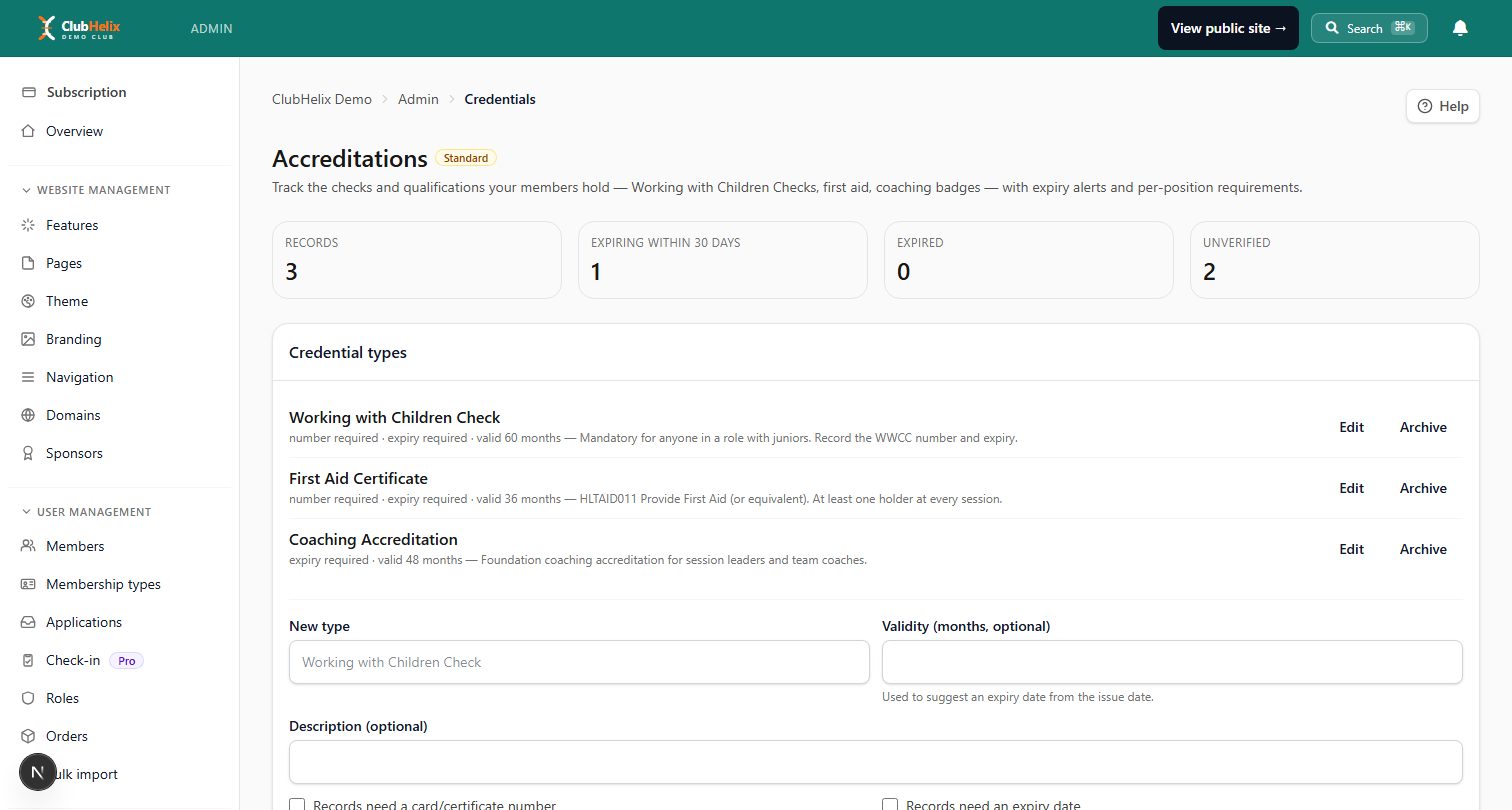
The administrative load of a radio club is unusual: licence classes and expiry dates, course enrolments and exam candidates, an equipment register, a site key list, a net controller roster, a field-day sign-in and a set of accreditations for emergency work. Most clubs run that across a spreadsheet, an email list and one member's memory. ClubHelix keeps it in a single member record — accreditations and expiry tracking for licence classes, agency clearances and first aid, an events calendar that takes course enrolments and field-day registrations with payment, volunteer and net rosters members claim themselves, and email broadcasts that go out from your club's own address rather than a personal account.
The most useful first move is the one that reduces single-person risk: put the site records, the key holders and the licence expiry dates somewhere the whole committee can see, then add the members and the training records around them. The free tier covers that comfortably, pricing is published openly rather than quoted, and a secretary can set the club up and bring it to the next meeting as an agenda item rather than a proposal. Technical and hobby clubs of every kind can see the fit on our hobby and interest groups page, and clubs juggling a similar mix of shared assets and public events may find our guides to model aircraft clubs and drone racing clubs useful reading.
Frequently asked questions
What does an amateur radio club need to run a repeater?
A written site agreement with whoever owns the land or structure, the correct licence and any required frequency coordination, a documented installation with configuration notes and photographs, reliable power with battery backup, and a maintenance plan with named people who hold access. Just as important is redundancy of knowledge — at least three members who know how the system is configured and how to get to it.
How do you fund repeater maintenance and replacement?
Treat replacement as an annual expense rather than a future crisis. Estimate the service life of each major component, divide the replacement cost by those years, and provision that amount every year through subscriptions or a named infrastructure levy with a published balance. Equipment auctions, hamfests, sponsorship and capital grants cover the larger items, and grant applications do far better when they lead with the public benefit.
How should a club run amateur radio licence training?
Choose a format your volunteers can sustain, get hands on equipment in the first session rather than the last, take enrolments and fees through a single online form, publish a refund and transfer policy, and handle candidate personal details carefully. Then measure the number of graduates who are actually on air a few months later — that is the number that tells you whether the course worked.
How do you keep newly licensed members active?
Pair each graduate with a named mentor before they leave the exam, lend them equipment from a club loan pool, run a beginners' net with relaxed etiquette, and organise antenna working parties to get stations physically on air. Track the pathway from pass to callsign to first contact to membership, and follow up the moment someone stalls.
What should a club consider before volunteering for emergency communications?
Work through an established agency relationship rather than self-deploying, understand the training, identification and screening requirements the agency sets, keep an accurate call-out list with current clearances, confirm in writing what your insurance covers during training and deployment, and exercise regularly with honest debriefs. Treat this as general information and take the detail from the agency and your national society.
Worth reading next — club succession planning, because most of the risk described above is really about who else knows.


