
What this guide answers
- What does all-abilities actually mean for a sports club?
It means the club is set up so that disabled and non-disabled people can take part in the same club, with adjustments made as a matter of course rather than as a favour.
- What support ratio should an all-abilities program use?
There is no single correct ratio, because it depends on the activity, the venue and the individual participation plans in the room.
- Should carers and support workers pay to attend?
Most clubs let a support person attend free when they are there to support a participant rather than to take part themselves, and publish that clearly so nobody has to ask.
- How do you fund an inclusive sports program long term?
By building the program so it does not need the grant to continue.
- What is the first thing a club should change to be more inclusive?
Almost always the information. Rewrite the join page in plain language, add photographs of the real entrance and the real facilities, describe what happens in a first session step by step, publish the full cost…
New Zealand edition. This guide is written for volunteer-run clubs in New Zealand. Where rules differ — grants, tax, incorporation, safeguarding — follow the New Zealand-specific pointers below or check with your national body.
Ask most committees what stops disabled people joining their club and you will hear something about attitudes. Ask the people who did not join and you hear something much more boring — the accessible park was two hundred metres from the gate, the session started at four when support workers finish at three thirty, the fee was non-refundable and health is unpredictable, and nobody could say over the phone whether the toilet had a change table an adult could use. All-abilities is the phrase most clubs here use, and it means very little unless those four things have been fixed.
That is the reframe this guide is built on. Inclusion is an operating model — a set of decisions about scheduling, access, information, money and staffing — rather than a paragraph in the constitution. Clubs that treat it as an operating model grow a genuinely mixed membership. Clubs that treat it as a values statement run a well-intentioned program that quietly ends when the grant does.
This guide is for committees of community sports clubs building or running an all-abilities program, whether that is a dedicated club, a section inside a mainstream club, or a single weekly session you are trying to make sustainable. It covers choosing a delivery model, auditing access across four domains, writing participation plans and agreeing support arrangements properly, and funding the program past its first year.
Choose your delivery model deliberately
There are three viable shapes, and most clubs end up drifting into one by accident rather than choosing it. Choose it, write it down, and tell people which one you are — because participants and families are trying to work out whether your club is for them, and vagueness reads as "probably not".
| Model | What it looks like | Works when | Fails when |
|---|---|---|---|
| Integrated | Participants join existing sessions with adjustments and support as needed | Your coaches are confident adapting, and group sizes are modest | Sessions are large and competitive, and nobody has time to adapt |
| Parallel | A dedicated session or program runs alongside the mainstream club | You have a committed coach and a reliable time slot | It becomes a separate club that never touches the main one |
| Dedicated | The whole club exists for all-abilities participation | There is real demand and a specialist coaching base | Funding is single-source and the club has no other income |
The parallel model is the most common starting point and carries the most common failure. A dedicated session drifts into isolation, its participants never appear in the club newsletter, and when its coach moves on there is nobody in the wider club who knows how it worked. If you run parallel, build deliberate crossings — shared presentation nights, mixed social events, participants photographed in club uniform on the club's own front page, and at least two people from the main club on the program's roster every term.
Whichever model you choose, one principle sits underneath all three: design with participants rather than for them. A committee of well-meaning people guessing at what is needed will get the obvious things right and the important things wrong. Put two or three participants or family members on the working group from the first meeting, pay their expenses, and treat their view as the deciding one when the committee disagrees.
The access audit — four domains, one afternoon
An access audit is not a compliance document. It is a walk-through, done with someone who actually experiences the barriers, from the moment they leave home to the moment they get back in the car. Do it in one afternoon, write down what you find, and split the list into "fix this month", "fix this year" and "tell people the truth about in the meantime". That third column is the one clubs skip, and it is the one that builds trust.
| Domain | What to check | How to test it | Where clubs commonly fail |
|---|---|---|---|
| Venue | Path of travel from parking to playing surface, gradients, surface changes, door widths, accessible toilet and adult change facility, seating with backs and armrests, lighting, noise, a quiet space, clear signage | Walk it with a wheelchair user and again with someone who is autistic or sensory-sensitive | The gate is fine and the 40 metres between the gate and the court is not |
| Transport | Distance to public transport, number and location of accessible parking, a drop-off zone that does not block the gate, whether community transport serves your times, session times against support-worker shifts | Ring the local community transport service and ask what is possible | Sessions scheduled at the one time no support worker is available |
| Information | Where joining information lives, reading level, alt text on images, captions on video, a sensory description of the venue, photos of the actual entrance, more than one way to contact a human | Give your join page to someone outside the club and time how long it takes them to find the session time | A beautiful page that never says what happens in the first session |
| Cost | Total cost including equipment, uniform, transport and any support charge, carer or support-person entry, refund policy when health changes, hardship pathway and how to ask for it privately | Add up every cost a first-year participant faces, then read it back aloud | A modest fee attached to a non-refundable policy and an expensive uniform |
Two findings turn up in almost every audit. The first is the gap between an accessible entrance and an inaccessible route to where sport actually happens — accessible car space, accessible gate, and then a hundred metres of grass. The second is that the information problem is bigger than the building problem. Most clubs could double their reach this month by rewriting one web page and adding photographs of the actual front gate, without spending anything on infrastructure at all. Our guide on building an accessible club website covers the digital half of that in detail.

Transport is the barrier committees here most consistently underestimate, because suburban grounds are often poorly served by public transport and community transport services need booking well in advance with limited operating windows. Before you set a session time, ring the local service and ask which times they can actually cover. Moving a session by an hour costs nothing and can be the single change that makes a program viable.
Participation plans, support and who does what
The most useful document in an all-abilities program is one page per participant, written with them, reviewed each season. It is not a medical file and it is not a risk assessment. It is the answer to a coach's practical question — what does a good session look like for this person, and what should I do if it is not going well.
A workable participation plan covers:
- What the participant wants from the club this season. In their words, not the coach's. Competition, fitness, friends, or all three.
- Communication. How they prefer to receive instruction, how long a demonstration should be, whether written or spoken works better, and which words to avoid.
- Adjustments that help. Equipment, positioning, group size, rest breaks, a modified rule, an alternative to the warm-up.
- What a difficult moment looks like and what helps. Early signs, what to do, what not to do, and who to call.
- Support arrangements. Whether a support person attends, what that person does and does not do, and who is responsible for personal care — which is never the coach.
- Emergency contacts and any information genuinely needed in an emergency.
- Consent and privacy. Who at the club may see this plan, and what the participant agreed to.
- Review date and who signed it.
Store these securely and restrict access to the people who actually need them — the coach on the day, the program coordinator, and nobody else. Collecting the plan through a structured online form with access limited to signed-in members is not just convenient — it is the difference between sensitive information sitting behind a login and sitting in a folder that gets left on a bench.
Support ratios, honestly
Clubs want a number, and there is no universal one. The right ratio depends on the activity, the venue, the group, and the individual plans in the room. What matters is that you agree it deliberately rather than discovering it mid-session.
Take three steps. Ask your governing body and your insurer what they expect, because one or both may set a requirement your club has to meet. Agree your club's own working ratio for each session type and write it into the session plan. Then record the actual ratio each week alongside attendance, so you have evidence when you apply for funding and a warning when it is drifting.
Support people are the other half of this. Decide and publish whether a support worker, carer or family member attends free — most clubs say yes, and it is the single cheapest inclusion decision available. Be clear about role boundaries in writing: the support person handles personal care and individual support, the coach coaches, and neither should be quietly absorbing the other's job. And plan for what happens when a participant's usual support person cannot come, because that is the week attendance drops and nobody records why.
Also worth naming out loud with your committee is dignity of risk. Sport involves risk, adults get to make their own decisions about it, and a program that removes every risk removes most of the point. The role of the plan is to make risk informed and shared, not to eliminate it.
Funding an inclusive program past its first year
Almost every all-abilities program starts on a grant, and a good proportion end when it finishes. The way out is to understand what funders of inclusive participation actually reward, which is consistent across almost every scheme regardless of where you are.
- Evidence of demand that predates the application. A waiting list, a survey with real responses, letters from a school or a support service. Applications that assert demand score worse than applications that show it.
- Co-design. Funders increasingly ask who was involved in designing the program. "Two participants and a parent sat on the working group from the start" is a materially stronger answer than "we consulted the community".
- Outcome measures beyond headcount. Attendance retention across a term, number of participants moving into mainstream sessions, number of coaches trained, and a participant-reported measure. Decide these before you start and collect them from week one.
- A credible plan for after the grant. Which costs continue, which were one-off, and what replaces the funding. A program with equipment bought once and a volunteer coach base has a genuinely lower ongoing cost than one built on paid staff.
- Acquittal discipline. Keep receipts, attendance and photographs with consent, and file the acquittal on time. Funders talk to each other, and a clean acquittal is the cheapest reputation you will ever build.
- Diversified income. Membership fees, a local business sponsor, an annual fundraiser and in-kind venue support all reduce the day the grant ends from a cliff to a step.
Our guide on how to write a grant application covers the writing itself; the point here is that the strongest applications are won in the six months before you write anything.
Funding here typically comes from a mix of regional sports trust community funds, gaming trust grants, local council community funding and disability-focused philanthropic trusts. Gaming trusts in particular fund equipment and coaching costs well, and applications are usually straightforward but require the club's incorporated society details and financials to be current. Your regional sports trust is the fastest route to knowing which rounds suit an inclusion program.
Coaching capability and volunteers who stay
Coaches do not need to become disability specialists. They need four adjustment levers and the confidence to use them: change how the activity is taught, change the rules, change the equipment, and change the environment. Your governing body will have a name and a course for this framework, and getting two or three coaches through it is the highest-return training spend a club can make.
Build the volunteer base wider than one hero. All-abilities programs have a habit of running on one extraordinary person, and the ones that fold usually fold when that person moves. Roster at least two people to every session, keep a trained reserve, and run the roster somewhere everyone can see it rather than in a group chat. Volunteer rostering with reminders does more for reliability than any amount of goodwill, because the failure mode is rarely unwillingness — it is a Tuesday where two people each assumed the other was going. How to recruit club volunteers has the wider approach.
Safeguarding deserves its own line. Adult safeguarding is a different discipline from child safeguarding, and a program serving both needs both. Screening requirements for people working with children and with adults at risk differ by jurisdiction and by role, so confirm what applies with your governing body and the relevant authority rather than assuming one check covers everything. Whatever the requirement, keep the records current, appoint a named contact for concerns, and make sure participants know who that person is and how to reach them without going through their coach.
Communication that works for everyone
Most of what makes a club feel open happens before anyone arrives. Write the joining information as if the reader has never played the sport, has been made to feel unwelcome somewhere else, and needs to know exactly what will happen.
That means: short sentences and plain words; a one-page easy-read version of your join information; photographs of the actual entrance, the actual toilet and the actual playing surface; a sensory description of the venue covering noise, lighting and how many people are usually there; captions on any video; genuine alt text on images; and at least two ways to reach a person, because phone is impossible for some people and email is impossible for others. Text messaging is often the most accessible option a club has and the one it offers last.
Then say what happens in the first session, minute by minute. Where to park, who will meet you, what to wear, what you will be asked to do, and what happens if you want to stop. That single page converts more first enquiries into first attendances than any other piece of communication a club produces.
Putting the program on a system that remembers
The administrative load of an inclusive program is real — participation plans that need reviewing, support arrangements that change, sessions where you need to know who is coming before you set the ratio, and funders who want evidence in a specific format. ClubHelix carries that load: custom forms for participation plans and consent, with responses landing in one admin inbox instead of a printed sheet in somebody's car, RSVPs and attendance so you know your numbers before the session rather than after, volunteer rostering with reminders so the ratio holds, and registration with fee categories that let you handle hardship quietly rather than at the gate.
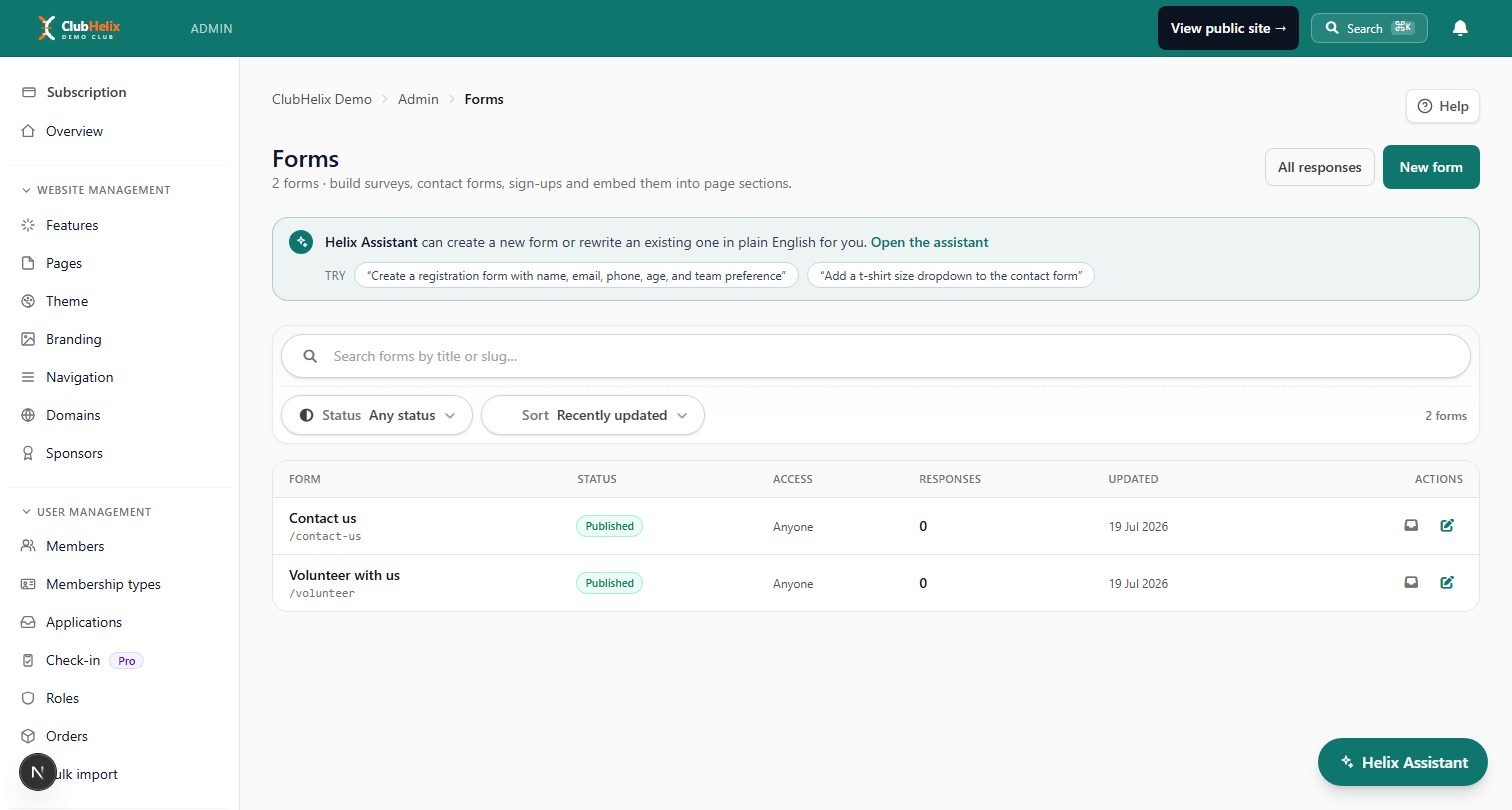
There is a free tier, so you can put an accessible join page and a real enrolment form live before your next committee meeting and see whether the enquiries change. Pricing is published openly, nothing is quoted on request, and you can start building your club site today — including the plain-language first-session page that will probably do more for participation than the next grant you win.
Frequently asked questions
What does all-abilities actually mean for a sports club?
It means the club is set up so that disabled and non-disabled people can take part in the same club, with adjustments made as a matter of course rather than as a favour. In practice it shows up in scheduling, venue access, how information is written, what things cost, and how coaches are trained — not in a values statement on the website.
What support ratio should an all-abilities program use?
There is no single correct ratio, because it depends on the activity, the venue and the individual participation plans in the room. Ask your governing body and your insurer what they require, agree a working ratio for each session type, write it into the session plan, and record what the actual ratio was each week so you can adjust with evidence rather than opinion.
Should carers and support workers pay to attend?
Most clubs let a support person attend free when they are there to support a participant rather than to take part themselves, and publish that clearly so nobody has to ask. Write down what the support person's role is and is not, so the boundary between personal support and coaching is agreed before a session rather than negotiated during one.
How do you fund an inclusive sports program long term?
By building the program so it does not need the grant to continue. Buy equipment with one-off funding, train volunteer coaches rather than depending on paid staff, keep membership fees in the mix, add a local sponsor and an annual fundraiser, and collect outcome evidence from the first week so each subsequent application is stronger than the last.
What is the first thing a club should change to be more inclusive?
Almost always the information. Rewrite the join page in plain language, add photographs of the real entrance and the real facilities, describe what happens in a first session step by step, publish the full cost including uniform and equipment, and offer more than one way to contact a person. It costs nothing and it removes the barrier most people actually hit first.
Keep reading — accessible club website for the digital side, and how to increase junior participation if your program is aimed at young people.


