
What this guide answers
- What is squash pennant?
Pennant — called league squash in some countries — is the inter-club team competition run by regional associations: teams of four or five play home-and-away ties of individual matches on a set weeknight, with players…
- How do box leagues work in a squash club?
Members are grouped into boxes of five or six by standard and play everyone in their box over a few weeks, booking courts in their own time.
- How should a squash club handle court bookings?
Make them self-service and online, with pennant nights, club night and coaching blocked out first.
- How much does it cost to run a squash club?
The facility drives the budget: court hire or lease, lighting and heating, periodic floor and wall maintenance, plus association affiliation, pennant entries and balls.
Ireland edition. This guide is written for volunteer-run clubs in Ireland. Where rules differ — grants, tax, incorporation, safeguarding — follow the Ireland-specific pointers below or check with your national body.
Squash clubs are a different beast from most community sport. Your "ground" is a set of enclosed courts that need booking, lighting, heating and maintenance; your competition is pennant ties played on weeknights in order of merit; and your members range from social hitters who want a lunchtime court to A-graders chasing the top of the club ladder. Running the club well means running the courts well — and keeping enough games on them that the whole thing pays for itself.
This guide covers how to run a squash club from the committee's side of the glass: club structure and affiliation, court booking and access, club nights and box leagues, squash pennant, membership models and fees, maintenance, and the online presence that keeps new players walking through the door.
Getting set up: structure, affiliation and the facility
Squash clubs affiliate with their regional or national association, which runs the interclub competitions, gradings and tournaments, and provides insurance through player registration. Structurally, most clubs are formally constituted with an elected committee; if yours predates living memory, check the constitution still matches how you actually operate before it matters at an AGM.
Clubs here affiliate through Irish Squash and the provincial structures; legal options run from a traditional club constitution to a company registered through the CRO (cro.ie), with the sports-body tax exemption available through Revenue (revenue.ie). Our guide to starting a sports club in Ireland covers the steps.
The defining question for a squash club is its relationship to the courts:
- Club-owned or club-leased courts. You control access, pricing and the calendar — and you also own the lighting bill, the maintenance and the insurance obligations. The committee is effectively running a small venue business.
- Courts inside a larger centre. The club books courts from a recreation centre or commercial operator for club nights and pennant. Less control, less risk; your leverage is a reliable block booking, so negotiate season-long slots, not week-to-week.
Either way, put the arrangement in writing — hire rates, storage, key or fob access, who's liable for what — and revisit it annually.
The committee and volunteer roles
A workable squash committee is compact: president, secretary, treasurer, plus three roles specific to how squash actually runs — a pennant convenor (team entries, selections, results), a club captain (club nights, box leagues, the internal ladder, welcoming new players) and a facilities officer (bookings, lighting, maintenance, the key list). In a small club two of these hats sit on one head; just make sure they're named hats, so handover is possible. Keep the member list, booking records and finances in a shared system rather than a personal laptop — squash clubs are especially vulnerable to the retiring-secretary problem because so much knowledge is about the building.
Court booking: the engine room
Empty courts are the silent killer of squash clubs — every unbooked hour is income and engagement gone. Treat the booking sheet as the club's most important document:
- Make booking self-service and visible. Members should see live availability and book from their phone. A paper sheet by the door (or worse, texting the secretary) suppresses casual play, and casual play is where fees and improvement come from. An online court booking system with member login solves this outright — bookings, no-show tracking and peak/off-peak rules in one place.
- Protect the anchors. Block out pennant nights, club night and coaching first; sell the rest.
- Meter the extras. Lighting on timers or fob-activated power keeps the electricity bill proportional to actual use — standard practice in club-run centres.
- Have a no-show policy. Booked-but-empty courts at peak time infuriate members. A gentle strike system fixes it quickly.
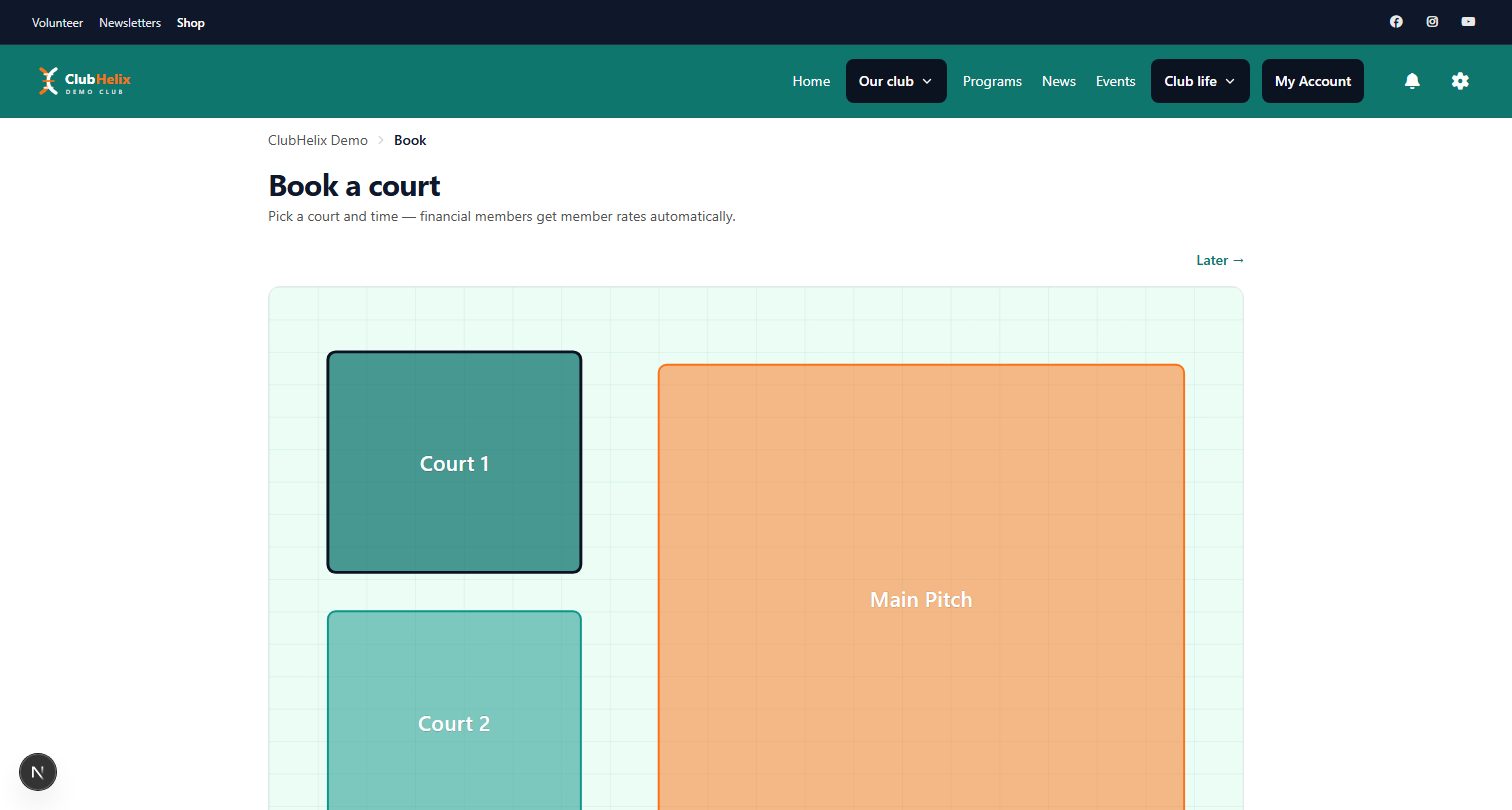
If you're moving off the sheet by the door, the decisions come before the software: slot length (squash runs shorter slots than tennis), member and visitor rates, how far ahead a court can be booked and what a late cancellation costs. Our guide to setting up online court booking walks through each one, including guest bookings and taking payment at the venue for the visitor who turns up without a card.
Club nights, box leagues and the club ladder
Between pennant fixtures, internal competition keeps the courts humming:
- Club night. One night a week, all standards, short matches with rotation so nobody sits long. It's your shop window — a visitor should get three games and a welcome, then an easy path to join. Warm the balls, mix the pairings, and put someone in charge of hosting, not just playing.
- Box leagues. Squash's great retention engine: members grouped into boxes of five or six by standard, playing everyone in their box over a few weeks, arranged in their own time. Winners move up a box, stragglers move down. Because players book their own courts to complete ties, box leagues also drive off-peak court usage. Publish the boxes and deadlines, chase the stragglers cheerfully, and keep results visible.
- The club ladder / order of merit. A challenge ladder or merit ranking gives every member a number to defend and settles pennant selection arguments before they start. Keep it current and public — a ladder nobody can see is a ladder nobody plays for. Running boxes and ladders through competition software beats the corkboard: fixtures generate themselves and standings update when results go in.
Squash pennant: the competitive heart
Pennant is inter-club team competition, and its rhythms shape your season. Teams of four or five play a tie of individual matches against another club, home or away, on a set weeknight — with players ranked in order of merit, meaning your one plays their one, your two plays their two, and so on down the tie. Divisions run from the top grade to social grades, so a club can field everyone from its champion to its improving juniors.
Locally this is simply league squash — the mechanics are exactly as described, run through the provincial leagues. Where this guide says pennant, read league.
The pennant convenor's season, in order:
- Entries. Enter teams per grade honestly — the association will regrade chronic mismatches anyway.
- Selection and order of merit. Publish how the order is set (club ladder position, recent results) and stick to it. Playing someone out of order isn't clever — it's usually against the rules and always against the spirit.
- Home nights. Confirm court availability for home ties, warm courts and balls before start time, and roster someone to host the visiting club. Squash hospitality — a plate of sandwiches after the tie — is a genuine tradition worth keeping.
- Results and eligibility. Submit results on time and track who has played enough ties to qualify for finals. Fill-ins across grades are where eligibility problems hide.
A private team chat per pennant team keeps the Thursday-lineup traffic out of everyone else's evening, and our guide on making a fixture draw helps if you run internal round-robins too.
Membership models, fees and money
Squash clubs juggle two revenue logics — membership and court time — and your fee model should pick a lane deliberately:
| Model | How it works | Watch out for |
|---|---|---|
| All-inclusive membership | One annual fee, courts included (maybe off-peak rules) | Price it on realistic usage; heavy users are your best players, not a problem |
| Membership + court fees | Lower annual fee, pay per booking | Court fees suppress casual play if set too high |
| Pay-and-play plus member rates | Visitors pay full rate, members discounted | Make joining obviously better value after a few visits |
Add a pennant levy for team players (covering entry fees and match balls), junior and student rates, and an off-peak membership for daytime players. Whatever the model, collect it online — online registration and payment gives the treasurer a live paid-up list, and door-access fobs can then follow membership status rather than folklore.
On the expense side, squash has facility costs most clubs don't: court lighting (LED conversion pays back quickly), floor sanding and wall plaster repairs on a multi-year cycle, heating, and balls for club nights. Budget maintenance as an annual line, not a crisis. Fundraising follows the usual community playbook — a club barbecue on open day, a trivia night, local sponsorship on the front wall of each court and the website.

Growing the club and your online presence
Squash's challenge almost everywhere is visibility: plenty of people played once and liked it, but courts are tucked inside centres and clubs can be invisible from the street. Growth is therefore mostly an online and open-day game — see our guide on growing club membership for the full playbook.
Your squash club website has to do real work: show where the courts are and how booking works, list club night and box league details ("all standards, racquets available"), publish pennant teams and results, and let a visitor join and pay on the spot. Squash club management on one platform ties it together — the member list drives court booking access, the ladder feeds pennant selection, and the website stays current because results and fixtures update it automatically.
ClubHelix was built for exactly this shape of club: a proper website with online joining, court and facility booking, competition ladders and box leagues, team chat and club-wide email — with a free tier to start on. See the squash club management software page or compare plans when you're ready to get the courts online.
Frequently asked questions
What is squash pennant?
Pennant — called league squash in some countries — is the inter-club team competition run by regional associations: teams of four or five play home-and-away ties of individual matches on a set weeknight, with players ranked in order of merit so equivalent standards meet. Grades run from the top division down to social divisions.
How do box leagues work in a squash club?
Members are grouped into boxes of five or six by standard and play everyone in their box over a few weeks, booking courts in their own time. Top performers move up a box next round, others move down. It's the best retention and court-usage tool a squash club has.
How should a squash club handle court bookings?
Make them self-service and online, with pennant nights, club night and coaching blocked out first. Meter lighting to actual use, apply a light no-show policy at peak times, and review the booking data each season — it tells you exactly when to schedule everything else.
How much does it cost to run a squash club?
The facility drives the budget: court hire or lease, lighting and heating, periodic floor and wall maintenance, plus association affiliation, pennant entries and balls. Clubs cover it through membership and court fees, topped up with sponsorship and social fundraising — publish the breakdown so fees make sense to members.

