
What this guide answers
- How many volunteers does a softball club need?
A club fielding four to six teams runs well on 10–14 active volunteers: a committee of five or six plus a scorers coordinator, umpires coordinator, junior coordinator, gear steward and rostered game-day helpers.
- Do we have to provide scorers and umpires?
Most associations require each team to supply a qualified scorer and require clubs to cover umpire duties across the season.
- What's the best way to start a junior program?
Start with tee-ball at the same venue and time as your club's home games, keep fees low, and give every parent a small job from day one.
- What should a softball club website include?
Venue and game times, fees, a join link, current draws and results, tee-ball information for new families, sponsors and a monitored contact.
Ireland edition. This guide is written for volunteer-run clubs in Ireland. Where rules differ — grants, tax, incorporation, safeguarding — follow the Ireland-specific pointers below or check with your national body.
Softball clubs punch above their weight. With a handful of diamonds, a gear trailer and a committed committee, one club can field everything from tee-ballers to top-grade fastpitch — often all playing at the same venue on the same day. That concentration is softball's superpower: the whole club sees each other every week, which builds the kind of community most sports envy.
It also means the admin stacks up. Team nominations across multiple grades, a scorer for every game, umpire duties, canteen shifts, gear for eight teams — someone has to organise all of it. This guide covers how to run a softball club without the whole load landing on two people: affiliation, committee structure, diamonds and equipment, juniors, fees, fundraising and getting the club properly online.
Getting set up: affiliation and competition entry
Club softball almost always runs through a local or regional association, which in turn affiliates with the sport's higher governing bodies. Affiliation gets you competition entry, player insurance cover arranged through the governing body, access to accredited umpires and scorers, and a pathway for representative players. Season timing varies from place to place — many associations play through summer, while some run winter or indoor competitions — so confirm your association's dates before you plan anything else.
Each season you'll nominate teams into grades (women's and men's fastpitch, mixed slowpitch or social divisions, and junior age groups). Nominations carry fees and deadlines, and late changes annoy the draw-maker — get playing numbers confirmed early. If your club is new, sort the legal structure early so the club can hold a bank account, sign ground allocations and apply for grants.
In Ireland, clubs choose between a traditional club structure and a company registered through the CRO (cro.ie), and sporting bodies can apply to Revenue (revenue.ie) for the sports-body tax exemption. Our guide to starting a sports club in Ireland covers the steps.
This is general information, not legal or financial advice — check the current requirements with the official body linked above.
Committee and volunteer roles that fit softball
Softball's game-day obligations are specific: most associations require each team to supply a qualified scorer, and clubs typically owe umpire duties across the day. Build your committee around those realities:
| Role | What they actually do |
|---|---|
| President | Association liaison, ground allocations, the public face |
| Secretary | Registrations, team nominations, correspondence, clearances |
| Treasurer | Fees, canteen float, gear budget, association invoices |
| Scorers coordinator | Keeps a roster of qualified scorers, gets new parents accredited |
| Umpires coordinator | Fills the club's umpire duty slots, encourages badge courses |
| Junior/tee-ball coordinator | Runs the junior program and parent helpers |
| Gear steward | Trailer inventory — balls, bats, helmets, catchers' kit, bases |
The scorers coordinator is the unsung hero. A club that steadily accredits two new scorers each season never faces the Saturday-morning panic of a team that can't take the diamond. The same goes for umpiring: pay for members' badge courses and make it a celebrated pathway, not a chore. When you need more hands, our guide on how to recruit club volunteers is full of tactics that work.
Diamonds, dugouts and the gear trailer
Most clubs play at an association venue or on council or municipal diamonds. Either way, someone owns the relationship: allocation paperwork, seasonal fees, lighting for twilight games, and who drags and lines the infield before play. If your club marks its own diamonds, keep a simple laminated diagram in the trailer — pitching circle distance, base paths and batter's boxes differ between age groups and divisions, and a wrongly pegged diamond is a miserable pre-game discovery.
Softball is equipment-hungry: bats, helmets with face guards, catchers' full kit, fielding masks, game and training balls, bases and pegs. A single gear steward with an inventory list — checked at season start and end — saves a small fortune in mystery losses. Budget for helmet replacement on a cycle rather than waiting for cracks, and keep the catchers' gear in its own labelled bag per team.

Membership, fees and registration
Most softball clubs charge an annual subscription tiered by senior, concession, junior and tee-ball, with the association's per-player fees either built in or itemised. Be transparent about what the fee covers — insurance, nominations, balls, umpires — because families with three kids on three teams notice everything.
Take registrations online. A proper online registration flow lets players and parents register from their phone, pay by card (with instalments for families), and lands them straight on your roster with paid-until dates the treasurer can see. It also captures the details softball actually needs — emergency contacts, junior age verification, uniform sizes — without a shoebox of paper forms. Keep in mind players usually must also appear in the governing body's registration system for competition eligibility; make your club form the front door and point people to both steps.
Teams, selection and game day
Once grades are underway, the weekly cycle is: confirm availability, finalise line-ups, publish the draw details, and staff the day's duties. Availability is the perennial headache — mixed social sides in particular live and die on knowing who's coming. Using RSVPs and availability tracking instead of counting thumbs-up emojis means coaches know by Thursday whether they need to borrow a player from the grade below (check your association's rules on playing up and finals qualification before you do).
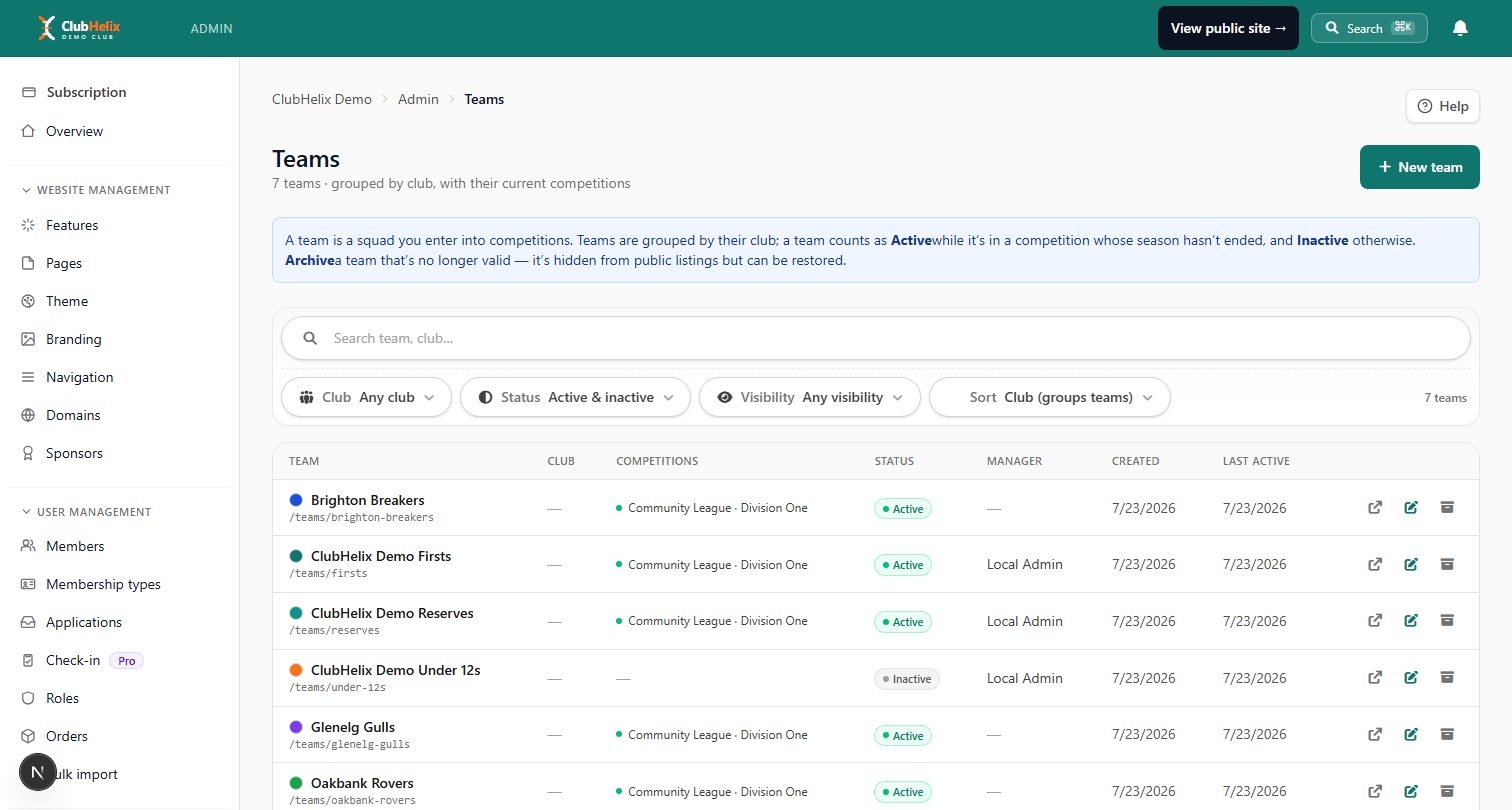
Keeping each team's players, coaches, scorers and contacts in a team management system — rather than in one coach's phone — means nothing is lost when a volunteer steps down. Game day itself runs best with a designated duty team per week: canteen shift, diamond setup, umpire slots and barbecue, published as a roster before round one.
Juniors: tee-ball to fastpitch
Tee-ball is softball's front door. Five-to-nine-year-olds hitting off the tee, everyone batting each innings, scores optional — it's cheap to run, safe, and it recruits whole families at once. From tee-ball, juniors graduate into modified pitched divisions and then age-group fastpitch, and the clubs that manage that transition deliberately (a pitching clinic each pre-season, a celebrated first-pitch milestone) keep far more of them.
Run tee-ball at the same venue and time as club games where you can: parents watching an older sibling's game will happily supervise a tee-ball diamond next door.
Every junior coach and regular helper needs current Garda vetting recorded centrally, arranged through your club or governing body.
Junior fees should stay genuinely low — tee-ball is your recruitment budget, not your profit line. For the wider growth picture, see our guide on how to grow club membership.
Money and fundraising
A softball club's income is subscriptions, canteen and barbecue takings, sponsorship and a couple of events; its costs are affiliation and insurance, nominations, diamond hire and lighting, umpires, and that ever-hungry gear trailer. The canteen at a full Saturday of home diamonds is your most reliable earner — roster it like a duty, stock it simply, and take cashless payments.
For events, the classics work: a season-launch barbecue, a trivia night, and a major raffle drawn at presentation day. Local businesses respond well to softball's family audience — offer backstop signage, a named junior award or team-of-the-week sponsorship rather than a vague request. Our club fundraising ideas guide has a full menu.
Your softball club online
When a new family searches for softball in your suburb, what do they find? A softball club website should answer the questions people actually have — where and when you play, what it costs, how tee-ball works, how to join — and show current draws and results so existing members keep coming back to it. If softball and baseball share your precinct, clear club branding also stops the two being confused (running both? Read our companion guide on how to run a baseball club).
Purpose-built softball club management beats a generic website builder because registration, teams, fixtures and payments live behind the same site — enter a result once and the site is already current. See how clubs put it together on our softball club management software page.
If your committee spends more evenings on admin than at the diamond, ClubHelix bundles the whole job — registrations and payments, team and availability management, duty rosters, club-wide email and SMS, and a professional website — with a free tier to start on. Have a look at pricing or set up your club this week.
Frequently asked questions
How many volunteers does a softball club need?
A club fielding four to six teams runs well on 10–14 active volunteers: a committee of five or six plus a scorers coordinator, umpires coordinator, junior coordinator, gear steward and rostered game-day helpers. Small, defined jobs get filled; giant vague ones don't.
Do we have to provide scorers and umpires?
Most associations require each team to supply a qualified scorer and require clubs to cover umpire duties across the season. Budget for accreditation courses each year and treat both as celebrated club pathways rather than penalties.
What's the best way to start a junior program?
Start with tee-ball at the same venue and time as your club's home games, keep fees low, and give every parent a small job from day one. Plan the transition to pitched softball deliberately with a pre-season pitching clinic.
What should a softball club website include?
Venue and game times, fees, a join link, current draws and results, tee-ball information for new families, sponsors and a monitored contact. Connecting the website to your registration and fixtures system keeps it current without extra volunteer work.


