
What this guide answers
- What does it cost to run a rugby union club?
The major costs are insurance and competition levies, ground hire and floodlighting, qualified trainer or physio coverage for match days, jerseys and equipment, and clubhouse running costs.
- How many players do we need per grade?
Plan on a squad of 22–25 registered players per grade to reliably field fifteen plus a bench through injuries and unavailability, including at least three accredited front-rowers per grade so scrums stay contested.
- When should rugby registration open?
Open by late January, push hard through February trials, and aim for the bulk of players registered and paid before round one in April.
- Do we need special software to manage a rugby club?
You need the governing body's registration system regardless — the question is what sits alongside it.
Canada edition. This guide is written for volunteer-run clubs in Canada. Where rules differ — grants, tax, incorporation, safeguarding — follow the Canada-specific pointers below or check with your national body.
A rugby union club is really two organisations wearing one jersey. On Saturday it's a sporting outfit — grading sides, managing front-row cover, getting fifteen fit players plus a bench onto the paddock for each grade. The rest of the week it's a small community business: a clubhouse and bar, a canteen, sponsors to look after, juniors to grow, and an after-match function that visiting teams should leave talking about.
Running it well means treating both halves seriously. This guide walks through the whole of rugby union club management — affiliation and the grade structure, the committee and volunteer roles rugby specifically needs, registration and fees, juniors and colts, the winter season and match day, money, and the rugby club website that holds it all together.
Affiliation, grades and the shape of the season
Affiliation puts your teams in the draw, covers players under the sport's national insurance and registration scheme, and sets your obligations: team nominations, per-player levies, ground standards and judiciary processes.
Community rugby sits under a local union or conference, which sits under a regional structure and the national governing body. Expect a flatter and less resourced structure than in the traditional rugby nations, and plan accordingly: significant travel to fixtures, a season often split into distinct fall and spring competitions, and squads built largely from college players and converts from other codes. Two practical points — confirm exactly what your affiliation insurance covers rather than assuming, and get your field agreement with the parks department or school district in writing before you nominate teams.
Most clubs field multiple grades on the same Saturday — first grade down through the lower grades, plus colts (under-20s) and often a women's side. That structure has a management consequence people underestimate: selection is a pipeline, not a list. Lower grades feed upward when injuries hit first grade, so availability has to be visible across the whole club by Thursday selection night, not locked in six separate group chats.
The season is typically split in two — a fall competition and a spring one — with the balance between them varying by union. The off-season checklist mirrors any club sport — AGM, field permits from the parks department or school district, registration open well ahead of pre-season, coaching and first-aid certifications renewed — and our pre-season checklist covers the generic list. Add one item specific here: confirm your field permits for both halves of the season at once, because the two are usually applied for in separate cycles and clubs routinely secure one and lose the other.
Rugby adds two items of its own everywhere: confirm you have enough accredited front-rowers in every grade (without them scrums go uncontested, and repeated uncontested scrums can cost competition points), and book your physio or sports trainer coverage for every home match day.
The committee and the volunteer roles rugby needs
Alongside president, secretary and treasurer, a rugby club runs on a set of named jobs. Fill them by name at the AGM — vague "helpers" evaporate by round three.
| Role | Why rugby specifically needs it |
|---|---|
| Registrar | Owns the national registration system, clearances for players arriving from other clubs, and eligibility for finals |
| Director of rugby / coaching coordinator | Aligns coaches across grades, runs trials and grading, tracks coaching accreditation |
| Team managers (per grade) | Team sheets, jerseys, water runners, availability for Thursday selection |
| First-aid / trainer coordinator | Rosters qualified trainers for every grade, every Saturday — a compliance requirement, not a nicety |
| Ground marshal | Sideline behaviour, technical zones, visiting-team liaison |
| Bar and function manager | The after-match function, licensing compliance, stock and floats |
| Kit steward | Jerseys washed, numbered and back in the bag by Saturday — harder than it sounds across five grades |
Recruiting for these is easier when each role has a one-page description and a defined season. Our guide on recruiting club volunteers has scripts that work.
Registration, membership and fees
Rugby's registration reality: every player must be registered in the national system before they take the field, and your club must separately know who has paid, what grade they're in, and whether their clearance from a previous club has come through. Reconciling those by spreadsheet is where registrars burn out.
Set fees by grade and category — seniors, colts, juniors, social/non-playing members — and be transparent about what the levies and insurance take before the club keeps anything. Offer instalments for students and families. Decide up front how you handle the classic rugby cases: the player who arrives a month after the season started, the colt who plays two grade games and disappears, and the injured player asking about a partial refund.
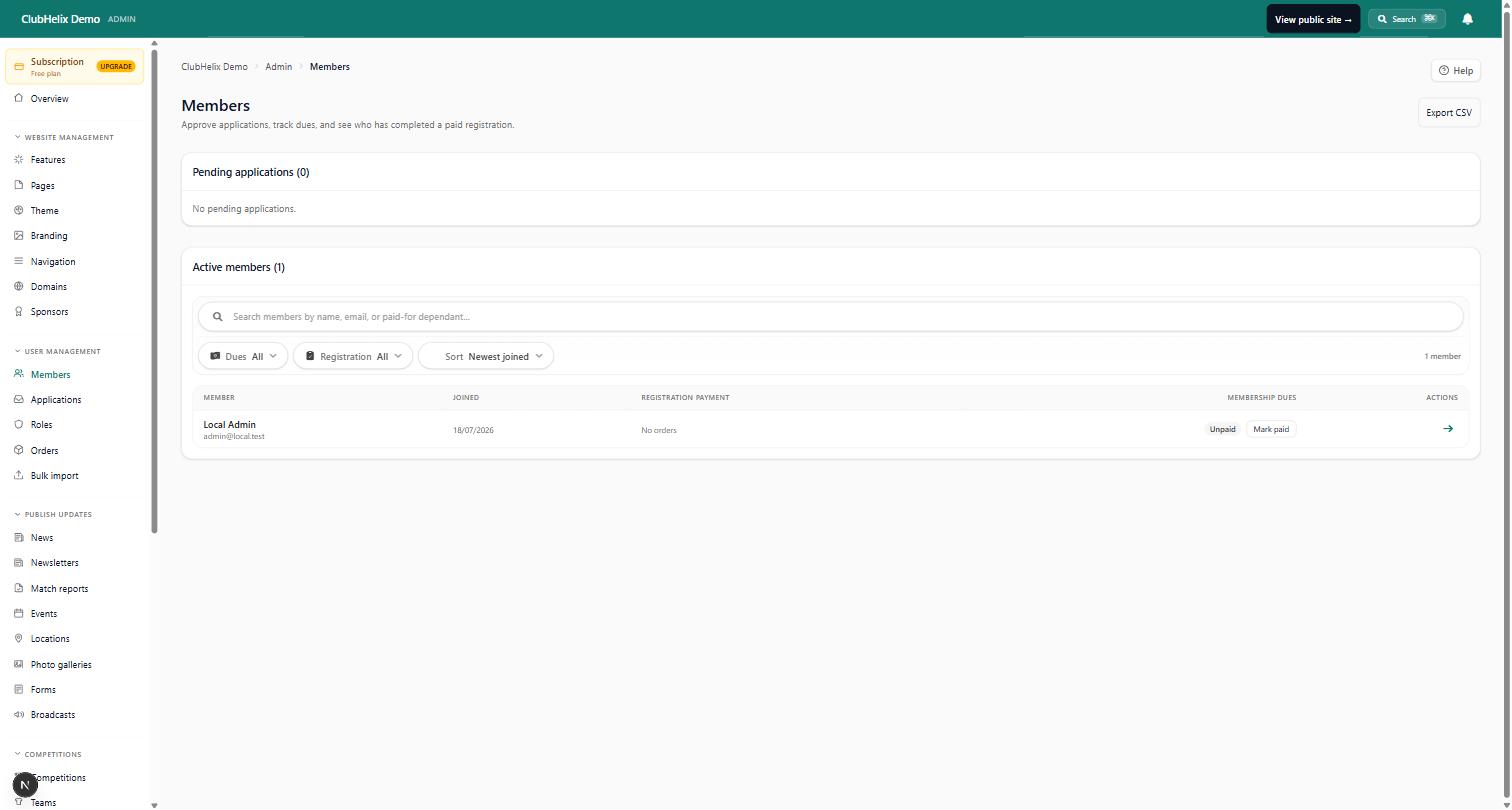
This is where rugby union club management software pays for itself. ClubHelix gives you online registration that takes payment at sign-up (with instalment options), writes players straight into a roster with a paid-until date, and lets team managers run availability and selection through team management instead of message threads. The registrar chases the exceptions, not the entire playing list.
Juniors, minis and the colts pathway
Junior rugby starts with modified, minimal-contact formats for the youngest age groups — small fields, passing games, no scrums or lineouts — and introduces contact progressively through the age grades, with structured tackle-safety programs along the way. For the club that means trained coaches at every level (the governing body's junior coaching accreditations are mandatory, not optional), plenty of parent volunteers as ground marshals, and a Sunday-morning operation that's logistically separate from senior Saturdays.
The pathway is the point: minis feed juniors, juniors feed colts, colts feed grade. Clubs that let the colts program wither spend the next decade buying players back. Keep junior fees low, run come-and-try days in February, make the step from juniors into colts a celebrated rite rather than an administrative gap, and watch the retention numbers at each age transition — that's where players leak.
Match day and the after-match function
A rugby Saturday at home is an all-day production: lower grades kick off mid-morning, first grade mid-afternoon, and the clubhouse runs from the first canteen coffee to the last function speech. The operational checklist per home Saturday: grounds set (posts padded, technical zones marked, flags out), team sheets submitted for every grade, qualified trainer present per the competition's requirements, ground marshal on duty, canteen and bar rostered, and someone on the gate or raffle if you run one.
The after-match function deserves its own paragraph because it's rugby's distinctive asset. Hosting the visiting club for a meal and a drink, player-of-the-match presentations, sponsors mingling with players — this is where sponsorship renews itself and where social members are made. Budget for it, roster it, and put a committee member in charge of it. A good function turns a home game into revenue; a dead clubhouse turns rugby into just another fixture.

Money: bar, canteen, sponsors and the shop
Player fees rarely cover a rugby club's real costs — insurance levies, ground hire and floodlights, physio coverage, jerseys and match balls, travel for country fixtures. The gap closes through the bar and canteen (rostered, stocked, and priced deliberately), sponsorship, and events like a long lunch or ladies' day.
Sponsorship is rugby's strong suit because the clubhouse gives sponsors something real: signage seen every Saturday, a function to attend, a community to be visibly part of. Build tiered packages (jersey, ground signage, website and function naming rights), invoice annually, and track renewals like registrations — our guide on getting sponsors covers the pitch. A club shop for supporter kit — caps, hoodies, polos — turns loyalty into revenue with no committee time once it's set up.
Communication and the rugby club website
The weekly information cycle — selections Thursday, teams published Friday, results and reviews Monday — needs one authoritative home. A rugby club website that shows fixtures, grades, selected teams, news and the function calendar saves every team manager fifty messages a week, and it's what a new player or returning expat finds when they search for a club.
ClubHelix builds that site and the admin behind it in one place: pages and news, registration and payments, per-grade team management, volunteer and trainer rostering, broadcasts and a members' app. See the rugby union club management software page for how union clubs set it up — there's a free tier, and pricing is public. If your committee is stretched, start with a template and have the site live before trials.
Frequently asked questions
What does it cost to run a rugby union club?
The major costs are insurance and competition levies, ground hire and floodlighting, qualified trainer or physio coverage for match days, jerseys and equipment, and clubhouse running costs. Most clubs cover them through a mix of player fees, bar and canteen trade, and sponsorship — fees alone rarely balance the books.
How many players do we need per grade?
Plan on a squad of 22–25 registered players per grade to reliably field fifteen plus a bench through injuries and unavailability, including at least three accredited front-rowers per grade so scrums stay contested. Colts and lower grades need deeper squads because availability is less predictable.
When should rugby registration open?
Open by late January, push hard through February trials, and aim for the bulk of players registered and paid before round one in April. Clearances for players transferring from other clubs can take time, so start those the moment a new player commits.
Do we need special software to manage a rugby club?
You need the governing body's registration system regardless — the question is what sits alongside it. A platform that combines your website, payments, roster, team selection and communication means the registrar, treasurer and team managers work from one source of truth instead of parallel spreadsheets.

