
What this guide answers
- How many volunteers does a netball club need?
As a rule of thumb: a committee of five to seven, one team manager per team, one coach per team, and a shared pool of umpires and canteen helpers.
- What does it cost to run a netball club?
The big line items are association affiliation and court levies, umpire payments, uniforms and bibs, training court hire, and insurance through your governing body's registration.
- How do netball clubs find enough umpires?
Grow your own: fund badge testing for teenage players, pay umpires promptly and fairly, pair beginners with a mentor, and make the umpires convenor a real committee role.
- What should a netball club website include?
Registration link, fees, training nights and venue, weekly fixture information, contact details, and club news.
Canada edition. This guide is written for volunteer-run clubs in Canada. Where rules differ — grants, tax, incorporation, safeguarding — follow the Canada-specific pointers below or check with your national body.
Almost all community netball runs on volunteers. If you've just taken on a committee role — or you're wondering how to run a netball club without it eating every evening — the good news is that netball clubs follow a fairly predictable rhythm. Grading before the season, a weekly competition, finals at the end, and a pile of admin in between.
In Canada, netball is an emerging sport with clusters of clubs in the bigger cities, often founded by players who grew up with the game elsewhere — expect to help build the league as well as your club, a job this guide flags along the way.
This guide walks through the whole job: affiliation, committee roles, registration and fees, the season itself, juniors, umpires, money and communication — with netball-specific detail, not generic sports advice.
Getting set up and affiliated
Community netball is typically organised through local associations or leagues, which in turn affiliate with a national governing body. Your club most likely plays its weekly competition at courts run by that association or league, which sets the competition rules, bylaws, fixture and finals format.
Practical things to sort early:
- Affiliation. Confirm your club's affiliation with the local association each year, including the number of teams you intend to enter and the age groups and grades you're nominating for.
- Registration system. Most associations require every player to be registered through your governing body's registration system for insurance purposes. Your club still needs its own records on top of that — who has paid your club fees, uniform sizes, emergency contacts, availability.
- Incorporation and insurance. A formal legal structure protects committee members personally, and player insurance usually flows through governing-body registration — confirm both rather than assuming them.
In Canada, incorporate provincially as a not-for-profit and confirm insurance through your provincial association where one exists — emerging-sport clubs often need to arrange liability cover directly. Our guide on how to start a sports club in Canada covers the steps.
The committee: sharing the load
A netball club with eight teams can generate a surprising amount of admin, and it goes badly when one person does all of it. A workable structure looks like this:
| Role | What they actually do at a netball club |
|---|---|
| President | Association delegate meetings, disputes, the public face of the club |
| Secretary | Team nominations, association paperwork, meeting minutes |
| Treasurer | Club fees, court levies, umpire payments, canteen float |
| Registrar | Player registrations, clearances, age eligibility checks |
| Coaching coordinator | Recruiting coaches, training court allocation, coach accreditation |
| Umpires convenor | Rostering umpires, mentoring new badge candidates |
| Team managers (one per team) | Scoring roster, bib count, wet-weather messages, match-day availability |
Team managers are your most important recruits. A parent who sends the weekly availability message and keeps the score bench covered saves the committee dozens of hours a season. Our guide on recruiting club volunteers has scripts that work for exactly this ask.
Membership, registration and fees
Netball fees usually stack several layers: the national/state registration component, the association's affiliation and court levies, and your club's own fee that covers umpires, equipment, trophies and training courts. Be transparent about the stack — parents are far happier paying when they can see where it goes.
A few netball-specific things to plan:
- One fee, or fee plus weekly? Some clubs charge a single up-front season fee; others keep the registration fee lower and collect a small weekly match fee. Up-front is far less work to chase — offer instalments instead if the lump sum is a barrier.
- Uniforms. Dresses are a significant cost. Decide whether the club owns and loans dresses (common for juniors, needs a bond and a returns process) or players buy their own. Bibs, on the other hand, should always be club property — one full set per team, counted back in by the team manager every match day.
- Family discounts. With juniors, you'll routinely have two or three siblings across different age groups. A family cap or sibling discount keeps those families in the club.
Run registration online rather than on paper. An online registration form that takes payment at the same time means your registrar isn't chasing envelopes of cash at training, and your paid-up list is always current. If you still like a registration day for uniform fittings and grading sign-ups, our club registration day guide shows how to run it with the payment step already done online.
The netball season, from grading day to finals
Pre-season and grading
Before the season starts, your association or league will run grading — trial matches that place teams into divisions where they'll get competitive games. Take grading seriously: a team graded too high loses every week by 30 goals and you lose players; too low and your strongest team gets bored. Nominate honestly, and use pre-season trials to settle team lists before the deadline for locked team sheets.
Training nights
Most clubs train one night a week per team, often sharing a bank of courts. The coaching coordinator's main job in pre-season is the training grid: which teams, which courts, which time slots, and which coaches are double-booked. Publish the grid before the first week and keep it somewhere every parent can find it.
Match day
The weekly competition is the heartbeat of a netball club. Each round, every team needs:
- Seven players on court plus reserves — with positions covered. If your only goal shooter is away, you need to know by Thursday, not at the first centre pass.
- A scorer on the bench — usually rostered among parents by the team manager.
- Bibs — a full set of seven, in club colours, on the right bodies. GS and GA in the goal third, WA, C and WD through the middle, GD and GK defending. New parents genuinely appreciate a one-page "who can go where" explainer in the welcome pack.
- An umpire contribution. Most associations require clubs to supply umpires in proportion to teams entered. Pay your umpires promptly, fund badge testing for teenagers coming through, and treat the umpires convenor as a first-class committee role — umpire shortages are the most common reason clubs get fined or lose match points.
Track availability weekly. Clubs that collect it through an app rather than a group-chat scramble field full teams far more often — RSVPs and attendance tracking turns "who's in this week?" into a list the team manager can see at a glance.
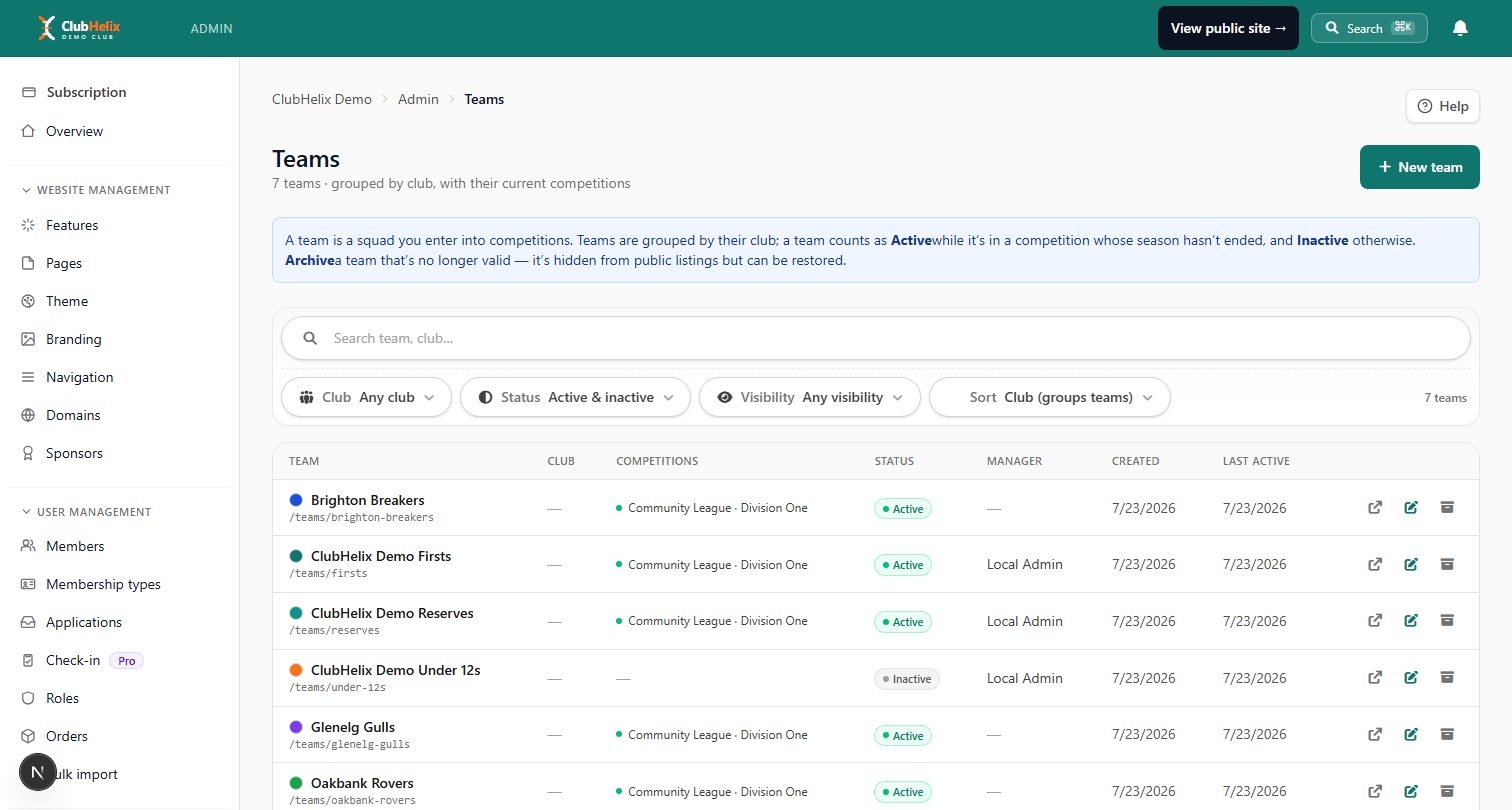
Keeping every team's list, coach and manager in one place — rather than in seven different spreadsheets — is exactly what team management software is for, and it pays for itself the first time a registrar has to prove age eligibility at finals time.
Finals
Finals eligibility rules bite at the end of the season: most associations require players to have played a minimum number of matches with a team to qualify for its finals. Your registrar should be tracking this from round one, especially where players fill in across grades. Publish the finals fixture, umpire allocations and eligibility list early, and expect your biggest sideline crowds of the year.
Juniors: building your pathway
A healthy netball club is a pyramid: a junior starter program at the bottom, age-group teams through the middle, seniors at the top. Many governing bodies run a branded introductory program for five-to-ten-year-olds — short sessions, modified rules, lower rings — and hosting it is the single best recruitment tool your club has. Every child who does the intro program with you is a likely junior-grade player next season.
Make the pathway visible: on your website, show the journey from starter program to juniors to seniors, name the coaches, and tell parents exactly what each stage costs and which night it trains. Our guide on increasing junior participation goes deeper on come-and-try days and school partnerships.

Communication that keeps parents onside
Netball clubs live and die on match-day logistics, and most complaints trace back to communication. Three habits fix nearly all of it:
- One official channel. Pick one place where club news is authoritative — ideally email plus your club website — and post everything there first. Group chats are fine for team banter, but wet-weather calls, grading news and fee reminders need a channel that reaches every family, including the ones not in the chat.
- A weekly rhythm. One email each week of the season: this week's fixtures and court numbers, duty roster, canteen roster, any association news. Written once by one person, read by everyone.
- Wet-weather protocol. Decide in advance who makes the call, by what time, and where it's posted. A wet-weather communication plan template saves the 7 am phone tree.
Email broadcasts sent from your club's own domain, with the fixture pulled in automatically, make the weekly rhythm a ten-minute job.
Money, canteen and fundraising
Beyond fees, most netball clubs fund themselves through a canteen and a couple of set-piece fundraisers. The canteen at a busy match-day venue can be a genuine earner if it's rostered fairly — one shift per family per season is a common and accepted ask. Add a food stall at grading day, a trivia night mid-season, and a club raffle drawn at presentation day, and you've usually covered new bibs, post pads and trophies without touching fees.
Keep the money side clean: every payment through the club account (not a coach's pocket), a treasurer's report at every meeting, and receipts for everything. Collecting fees, canteen floats and fundraiser ticket money digitally makes the treasurer's report a printout rather than a reconstruction.
Your netball club website and online presence
When a parent searches "netball club near me" before the season, the clubs with a current website get the registrations. Yours needs five things above the fold: how to register (with a working link), fees, training nights, where you play on match days, and a contact that gets answered.
This is where netball club management software earns its keep. A platform built for clubs gives you a netball club website with registration and payments built in, team pages that update from your fixtures, and a news feed for grading announcements — instead of a generic website builder that goes stale by round three because nobody on the committee can edit it. See what's included for netball clubs on our netball club management software page, and compare plans on the pricing page — there's a free tier to start on.
If your committee is short on time (whose isn't?), ClubHelix can set the whole thing up for you — website, registration forms, teams and fixtures — through the done-for-you service, and you just keep it updated from there.
Frequently asked questions
How many volunteers does a netball club need?
As a rule of thumb: a committee of five to seven, one team manager per team, one coach per team, and a shared pool of umpires and canteen helpers. A ten-team club runs comfortably on about 30 people doing one small job each.
What does it cost to run a netball club?
The big line items are association affiliation and court levies, umpire payments, uniforms and bibs, training court hire, and insurance through your governing body's registration. Most clubs cover these through player fees plus canteen and fundraising income — publish the breakdown so families can see where fees go.
How do netball clubs find enough umpires?
Grow your own: fund badge testing for teenage players, pay umpires promptly and fairly, pair beginners with a mentor, and make the umpires convenor a real committee role. Clubs that rely on ad-hoc volunteers each match day are the ones that get fined.
What should a netball club website include?
Registration link, fees, training nights and venue, weekly fixture information, contact details, and club news. Keep it current — a site showing last season's grading news costs you new families at registration time.


