
What this guide answers
- What does a model flying club committee need to have documented?
Site tenure, a site plan showing the flight line, pits, spectator area and dead zone, the club rules and flying hours, a member record with association membership and competency stage, a mowing and instructor roster…
- How should a club handle noise complaints?
Prevent them structurally — published flying hours, a measured noise standard applied to every aircraft, and a register of neighbours with a direct contact for the club.
- How do clubs run a training pathway for new pilots?
With a written ladder — buddy-lead flying, supervised solo, then assessed certificates — and a published instructor roster so beginners know when someone will be there.
- What records should a club keep for airspace and registration rules?
Whatever the regulator and your national association currently require, held per member with an expiry date — typically association membership, any operator or pilot registration or identifier, competency stage, and…
- How much of a club subscription goes on the field?
It varies enormously with tenure, but affiliation and insurance, lease or licence payments and mowing are usually the three largest items, and together they often account for most of a member's subscription.
Ireland edition. This guide is written for volunteer-run clubs in Ireland. Where rules differ — grants, tax, incorporation, safeguarding — follow the Ireland-specific pointers below or check with your national body.
Ask a model flying club what its biggest asset is and someone will point at the clubhouse or the trainer fleet. The real answer is the strip, and the reason the strip is still there is a set of relationships nobody wrote down: the farmer whose gate you use, the council officer who has never had a complaint about you, the neighbour a kilometre away who tolerates two-stroke engines on Sunday mornings because your president brings him a bottle at Christmas.
That is the strange thing about aeromodelling clubs. The technical side — engines, radios, airframes, competency — is where the passion goes, and it is almost never what kills a club. Clubs die when a lease is not renewed, when a housing estate arrives at the fence line, or when one avoidable incident with a spectator changes what the landowner is prepared to carry.
Most clubs in Ireland fly from a farmer's field or ground rented from a local landowner, and the arrangement is usually built on a personal relationship rather than a long lease. Rain and wind set the rhythm: soft ground for much of the year, a short window of good evening flying in summer, and cancellations that need to reach members within the hour. Agree with the landowner what happens during silage and grazing, and keep the gates-and-stock rules in your club rules rather than in folklore.
This guide is for the committee of a model aircraft, model flying or aeromodelling club. It covers keeping the field — access, mowing, layout and the neighbours — building a training pathway with instructors and competency ratings, and the compliance records you should be able to produce on request. It is general information rather than advice, particularly where it touches aviation rules, which differ by jurisdiction and change more often than club constitutions do.
The field is the club
Treat the site as an asset with an owner, a maintenance schedule and a risk register, the same way a sports club treats a ground. Start with tenure. Whatever you have — a lease, a licence, a handshake — write down what it says, who signed it, when it renews and who at the other end you would ring. If the arrangement lives in the memory of one long-serving member, the club is one funeral away from a problem.
Then map the site properly. A model flying field has a layout whether or not anyone drew it, and drawing it forces the arguments to happen on paper:
- Flight line — where pilots stand, marked, with a clear no-fly side behind it
- Pits — where aircraft are prepared and engines run, physically separated from the flight line
- Spectator area — behind the pits, never between the pits and the strip
- Parking — approached so no car crosses an active landing path
- Dead zone — the airspace over pits, parking, road and neighbouring property, marked on the plan
- Start-up and restraint — where a running engine is held or restrained, away from the walkway
- Storage and safety — mower shed, fuel store, fire extinguishers, first aid kit, water
Publish the site plan on your website and pin a laminated copy at the field. It is your induction tool for new members, your evidence of a considered safety system, and the thing you hand a landowner or council officer who asks how the site works.
The mowing roster
Mowing is the single most reliable source of resentment in a flying club, because it is unglamorous, weather-dependent and habitually done by the same three people. Deal with it structurally rather than morally.
| Approach | How it works | Trade-off |
|---|---|---|
| Rostered members | Named member per fortnight through the growing season | Cheapest; needs enforcement and a competent mower |
| Mowing levy plus contractor | Every member pays a levy, a contractor cuts the strip | Reliable and fair; the biggest line in your budget |
| Hybrid | Contractor for the strip, members for surrounds and pits | Usually the best value for a mid-sized club |
| Landowner arrangement | Landowner mows or grazes in exchange for rent relief | Cheap and fragile; depends on one relationship |
| Fee-exempt roster | Rostered volunteers get a reduced subscription | Recognises real work; needs clear rules |
Whichever you choose, publish the roster twelve months ahead so people can swap rather than skip, and keep a machine log — hours run, services due, who last had it, what broke. Set a rule that only members inducted on the mower use it, and hold that line: a ride-on tipped into a drainage ditch is an insurance claim and an ambulance, not an anecdote.
Run two or three working bees a year for everything the mower does not fix — fence repairs, pit tables, shade structure, drainage, weed control on the strip edges, clubhouse maintenance. Publish the task list beforehand so members can pick a job that suits them, and feed everyone at the end; the barbecue is doing organisational work, not just lunch.

Neighbours, noise and the complaint that ends a club
Noise complaints do not usually arrive as a slow build. They arrive as a formal letter from a council, referencing a specific Sunday, and by then the club is defending itself rather than managing a relationship. The clubs that survive this treat neighbour relations as a standing committee item.
Four practical measures:
- Agreed flying hours, published and enforced. Later starts on weekends and public holidays, an evening cut-off, and no exceptions for the member who drove two hours to get there. Put the hours on your website, on the field sign and in the induction.
- A noise standard with numbers. Adopt a measured limit — your national association will have a recommended method and threshold — and test aircraft against it rather than debating whether something "sounds loud". Keep the results per aircraft. A member with a documented noise test is a member you can defend.
- A neighbour register. Who lives or works within earshot, when you last spoke to them, and a direct contact for the club. Ring them before an event that will be busier or louder than usual.
- A complaint log. Date, time, what was flying, who took the call, what you did. Six entries with actions attached is a club managing a problem. No entries at all, followed by a letter from the council, looks like a club that was not listening.
Silence pays. Electric flight has quietly solved most of this for many clubs, and clubs that actively encourage electric on evenings and Sunday mornings buy themselves years of goodwill. So does landscaping — a screening hedge on the noise-facing boundary is cheap and permanent.
Teaching people to fly — instructors and the ratings ladder
The training pathway is your membership pipeline and your safety system at the same time. A club with no structured training gets three outcomes: beginners who destroy an aircraft on day one and never come back, beginners taught by whoever is free that day and given contradictory advice, and eventually an incident.
Build a ladder with names, and record where every member sits on it.
| Stage | What it means | Signed off by |
|---|---|---|
| Visitor / trial | Flies only on a buddy lead with an instructor holding the master | Any instructor |
| Trainee member | Inducted, insured, briefed on field rules; buddy lead only | Membership officer |
| Supervised solo | May fly alone at the field with an instructor present at the strip | Instructor |
| Basic certificate | Assessed on circuits, approach, landing and emergency procedure | Two instructors |
| Advanced certificate | Assessed for larger, faster or more complex aircraft | Chief instructor |
| Instructor | Assessed to teach; refreshed on a set cycle | Committee and chief instructor |
The names differ everywhere — wings, certificates, solo ratings, achievement schemes — so use whatever your national association calls them rather than inventing your own. What matters is that the ladder exists, that the criteria are written and identical for everyone, and that a member's current standing is recorded somewhere the duty instructor can check.
Run the instructor roster like a duty roster, not a goodwill arrangement. Publish which instructors are at the field on which mornings, so a beginner can turn up knowing someone will be there. Cap how many trainees an instructor takes in a session — two is plenty — and give instructors permission to say the conditions are unsuitable. Recognise them properly: reduced subscription, first pick of the mowing exemption, and their names on the website.
Two habits keep the ladder honest. First, put an expiry on currency: a member who has not flown for two seasons goes back to a check flight rather than straight to solo, and nobody takes offence because the rule applied to the president last year. Second, record the assessment, not just the result — date, assessor, aircraft type, what was flown. That record is what you produce if an insurer or association ever asks how you knew a member was competent.
Airspace, registration and records you can actually produce
This is general information, not advice. Rules for model aircraft and remotely piloted aircraft differ by country and have changed repeatedly in recent years — registration thresholds, online competency tests, height and distance limits, and where model flying sits relative to drone regulation have all moved. Point members at the national aviation regulator's current published rules and at your national model-flying association, and update the link on your club website whenever it changes. Do not let club folklore be the source of truth.
In Ireland the national aviation regulator administers the European framework for unmanned aircraft, which sets out operator registration and remote-pilot competency categories, alongside arrangements for model-flying clubs and associations. The categories and thresholds have been phased in over several years, so check the regulator's current guidance and record each member's operator registration and competency evidence.
Whatever the local rules, the club's job is the same: hold evidence, keep it current, and be able to produce it in a minute rather than a fortnight. A workable record per member looks like this.
| Field | Why you hold it |
|---|---|
| Association membership number and expiry | Usually the basis of your insurance cover |
| Regulator registration or identifier, where required | Evidence the member is compliant |
| Competency stage and date achieved | Determines what they may fly and unsupervised or not |
| Last check flight or currency date | Triggers a re-check after a long layoff |
| Site induction date | Proof they were briefed on the field rules |
| Signed club rules and waiver | Sets expectations and records acceptance |
| Aircraft noise tests | Your defence if a complaint escalates |
Set expiry reminders rather than auditing the list once a year in a panic. The realistic failure is not a member who refuses to comply; it is thirty members whose association renewal lapsed in July and nobody noticed until August.
The flight line, incidents and the things that go wrong
Every flying session should start with the same short briefing, even when everyone present has been flying for thirty years: conditions and wind direction, who is instructing, anything unusual (a working bee, stock in the next paddock, an event), and the reminder that calls are mandatory — taking off, landing, dead stick, on the strip.
Beyond that, a handful of rules do most of the safety work. Nobody walks onto the strip without calling it. Engines are started and restrained in the pits, never pointing at people. Transmitters are checked out before a model is powered on, using whatever system your club runs. Battery charging happens in a designated place, on a fireproof surface, never unattended and never in a car boot. And there is a fire extinguisher and a first aid kit that somebody actually checks.
Then log what happens. An incident register — including near misses, fly-aways and anything that left the field boundary — is not bureaucracy, it is how you notice the pattern before it becomes an injury. Record the date, aircraft, pilot stage, conditions, what happened and what changed as a result. If a model leaves the site, record where it went and whether you needed to speak to anyone. Our guide on sports club risk management covers the wider risk register a committee should be keeping alongside this.
Members, subs and a calendar worth belonging to
Membership subscriptions in a flying club typically cover association affiliation and insurance, field lease or licence, mowing, and clubhouse costs, with the balance funding equipment. Publish the split. Members who can see that most of their subscription leaves the club as affiliation and lease payments complain far less about the number.
The calendar is what turns a field into a club. A year that works has a mix of low-effort regulars and two or three set-piece events: a monthly fun fly with a silly task, a scale or vintage day, a swap meet that draws people from other clubs, a training-focused morning aimed squarely at beginners, and one open day where the public comes and watches from a properly separated spectator area. Each event should have a named organiser, a run sheet and a roster — see how to recruit club volunteers for splitting jobs small enough that people say yes.
Junior members deserve a deliberate plan, since aeromodelling has an obvious ageing problem and a simulator plus a buddy lead is a genuinely good way in. Check what youth-safeguarding requirements apply to your club through your association or the relevant authority, since these vary by jurisdiction and by any public funding you accept.
Keeping the field, the ratings and the roster in one place
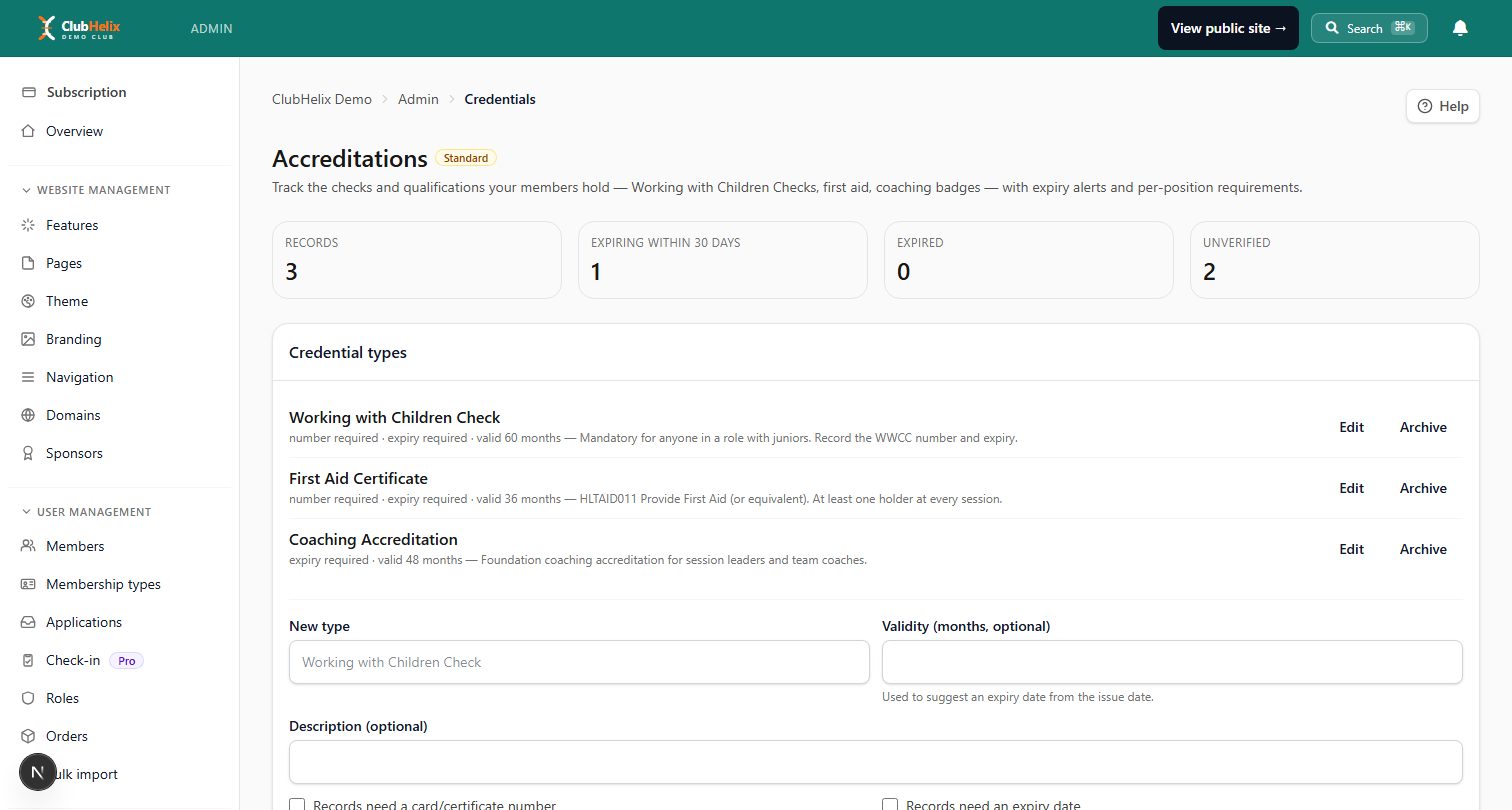
The administrative load in a model flying club is unusual — it is not fixtures and results, it is currency, records and rosters. ClubHelix is built for exactly that shape: accreditations tracking holds each member's association number, competency stage and check-flight date with expiry reminders, digital waivers capture signed club rules and site inductions, volunteer rostering runs the mowing and instructor rosters without a phone tree, and incident reporting gives you the log that keeps your safety system honest.
All of it sits behind a public club website that answers the questions a prospective member actually has — where the field is, what it costs, and how a complete beginner starts. The free tier is enough for a small club to run on, the pricing above it is published rather than quoted, and one committee member can get the club online between two flying days.
Frequently asked questions
What does a model flying club committee need to have documented?
Site tenure, a site plan showing the flight line, pits, spectator area and dead zone, the club rules and flying hours, a member record with association membership and competency stage, a mowing and instructor roster, and an incident log. Those seven items answer almost every question a landowner, insurer or regulator will ever ask you.
How should a club handle noise complaints?
Prevent them structurally — published flying hours, a measured noise standard applied to every aircraft, and a register of neighbours with a direct contact for the club. When a complaint does come, log it with the time, the aircraft and what you did about it. A club that can show a pattern of managing noise is in a completely different position from one that can only offer assurances.
How do clubs run a training pathway for new pilots?
With a written ladder — buddy-lead flying, supervised solo, then assessed certificates — and a published instructor roster so beginners know when someone will be there. Record who signed off each stage and when, cap the number of trainees per instructor per session, and require a check flight after a long layoff. Use the stage names your national association uses rather than inventing local ones.
What records should a club keep for airspace and registration rules?
Whatever the regulator and your national association currently require, held per member with an expiry date — typically association membership, any operator or pilot registration or identifier, competency stage, and evidence of site induction. Because these requirements change, the club's job is to keep the record current and to point members at the regulator's published rules rather than at club custom.
How much of a club subscription goes on the field?
It varies enormously with tenure, but affiliation and insurance, lease or licence payments and mowing are usually the three largest items, and together they often account for most of a member's subscription. Publishing that breakdown before the annual general meeting turns a contentious fee discussion into a short one.
Keep reading — how to organise a working bee for the maintenance days that keep a field usable, and how to run a drone racing club if your members are heading towards first-person-view flying.

