
What this guide answers
- What questions should a club member survey ask?
Keep it to ten or fewer: an overall experience rating, likelihood of recommending the club, intention to return, ratings of the key areas (training, match day, communication, events), a value-for-fees question, and one…
- How long should a member survey be?
Five minutes or less — around eight to ten questions, mostly multiple choice or ratings with one or two free-text questions.
- Should member surveys be anonymous?
Yes, by default — anonymity gets you honesty. Add an optional name field for members happy to be followed up, so you get both candour and conversations.
- What's a good response rate for a club survey?
For a volunteer-run club, 30–50% of members is a strong result, and even 20% is more representative than informal feedback.
UK edition. This guide is written for volunteer-run clubs in the UK. Where rules differ — grants, tax, incorporation, safeguarding — follow the UK-specific pointers below or check with your national body.
Committees make dozens of decisions a season on behalf of members — fees, training nights, uniforms, events, canteen menus — usually based on what the loudest three people at the clubrooms think. A member survey replaces that guesswork with actual evidence, and it does something subtler too: asking members what they think tells them their opinion matters, which is itself a retention tool.
The catch is that most club surveys fail before they start — too long, too vague, sent once into the void, results never mentioned again. This guide covers how to run a club member survey that people actually finish: what to ask, when to send it, how to get a response rate worth acting on, and what to do with the answers.
The rules that make surveys work
- One survey, one purpose. "Tell us everything about the club" gets abandoned halfway. "Help us plan next season" gets finished. Decide the single decision this survey will inform, and cut every question that doesn't serve it.
- Ten questions or fewer, five minutes or less. Say so up front: "5 minutes, 10 questions" in the invitation measurably lifts completion.
- Mostly multiple choice, a little free text. Ratings and choices are quick to answer and easy to compare season on season. One or two open questions ("what's one thing we should change?") catch what you didn't think to ask. Ten open questions is an essay exam, and people decline essay exams.
- Anonymous by default. You'll get politeness with names attached and truth without. Add an optional "leave your name if you're happy for us to follow up" field for those who want a conversation.
- Ask about behaviour, not just satisfaction. "Would you recommend the club to a friend?" and "are you planning to return next season?" predict retention far better than a general happiness score.
- Never ask about something you won't change. If Saturday fixtures are fixed by the association, don't ask members to rate them — every question implies the answer might change something.
Question sets you can copy
Three ready-made sets for the three surveys most clubs should run. Adapt the wording to your club; keep the length.
End-of-season survey
Send within two weeks of the last game, while the season is fresh. This is the big one — it feeds directly into next season's planning and your end-of-season report.
- Overall, how would you rate your experience this season? (1–5)
- How likely are you to recommend the club to a friend or family member? (1–10)
- Are you planning to return next season? (Yes / Probably / Unsure / No)
- How would you rate: training, match days, communication, social events, facilities? (1–5 each, one grid question)
- Did fees feel like good value for what you received? (Yes / Mostly / No)
- What's ONE thing the club should keep doing? (free text)
- What's ONE thing the club should change? (free text)
- Anything else you'd like the committee to know? (free text, optional)
Question 3 is your early-warning system: everyone who answers "Unsure" or "No" represents recoverable revenue and a fixable reason. Our guide to how to retain club members covers what to do with those answers.
New member survey
Send about six weeks after joining — long enough to have formed an impression, soon enough to fix a bad one.
- How easy was it to join the club? (Very easy → Very hard)
- How welcome have you felt so far? (1–5)
- Has anyone from the club personally checked in with you since you joined? (Yes / No)
- Do you know who to contact if you have a question? (Yes / No)
- Was anything confusing or missing when you started — training times, uniforms, fees, where things are? (free text)
- What almost stopped you from joining? (free text)
Questions 3 and 4 are the pair to watch: new members who feel anonymous in their first two months are the most likely to quietly not return.
Volunteer survey
Send mid-season or straight after it — this is your burnout detector.
- How manageable is your volunteer workload? (Very manageable → Overwhelming)
- Roughly how many hours a week do you give the club in season? (ranges)
- Do you feel appreciated for what you do? (1–5)
- Do you have what you need — information, tools, support — to do your role well? (Yes / Mostly / No)
- Are you willing to continue in your role next season? (Yes / Yes with changes / No)
- What one change would make volunteering here better? (free text)
Anyone answering "Overwhelming" or "Yes with changes" deserves a conversation before the AGM, not after they've resigned.
Building and sending the survey
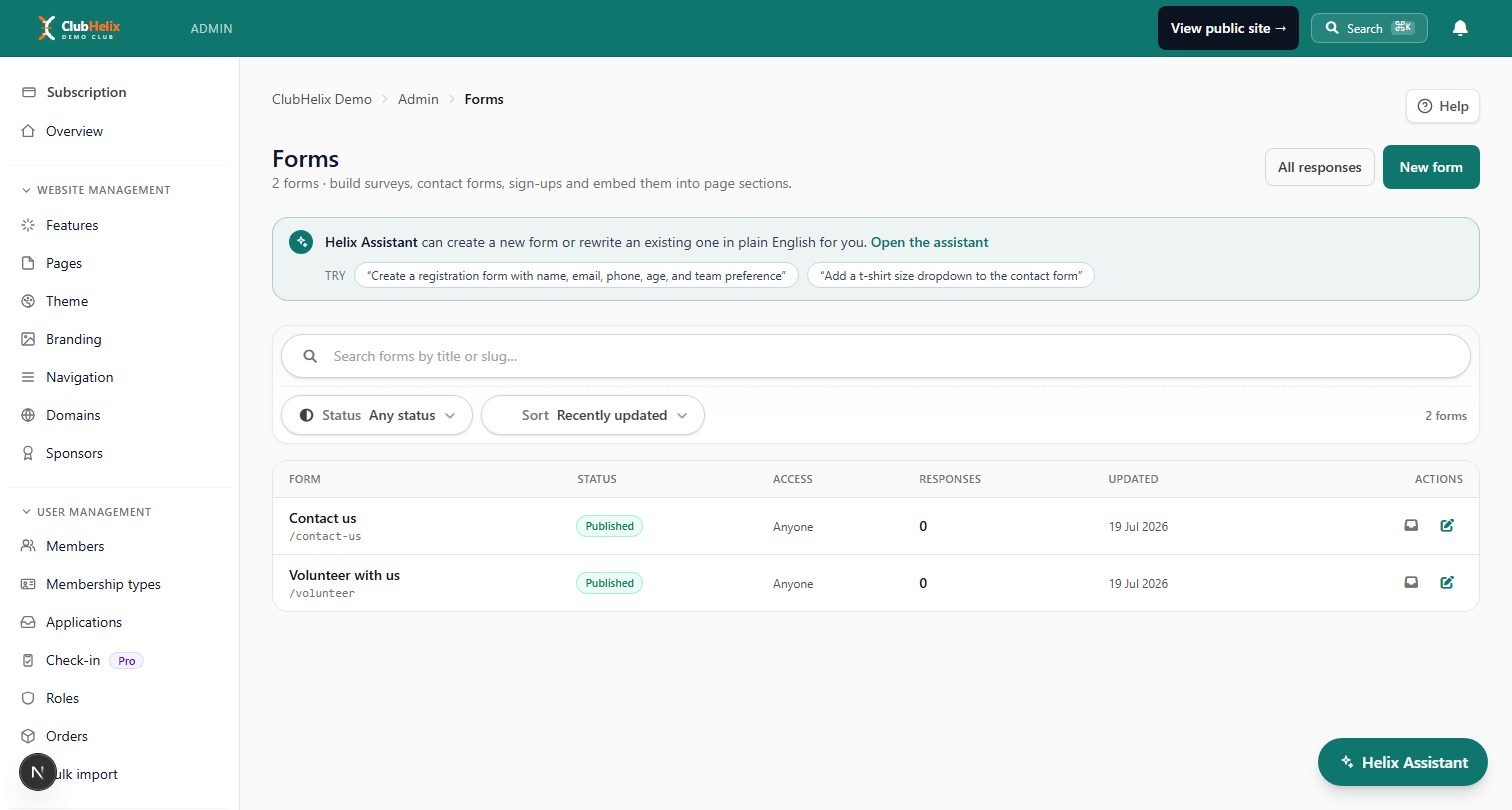
Build it as an online form — paper surveys get lost in kit bags, and you'll be retyping answers for a week. With ClubHelix forms and surveys, you drag together the question types above (ratings, multiple choice, free text), and every response lands in one inbox the committee can review together, rather than in screenshots forwarded between phones.
One housekeeping note: survey responses are personal information, so treat them with the same care as your member records — collect only what the survey needs, say what it's for, and don't keep identified responses longer than you need them.
For UK clubs, data-protection law applies to volunteer-run clubs too — anonymous-by-default surveys keep you comfortably inside it, and the Information Commissioner's Office (ico.org.uk) publishes plain-language guidance for small organisations.
Distribution is where response rates are won:
- Email everyone at once with a direct link — an email broadcast to your full member list is the backbone. Put the time promise in the subject line: "2 minutes: help us plan next season."
- Remind twice. A reminder a week later to non-responders typically doubles responses; a final "closing Friday" nudge adds more. Then stop — three contacts is the polite ceiling.
- Use every channel you have. A link in the newsletter, a post on club socials, a QR code on the canteen counter at the last home game. Your communication plan should treat the survey like any other campaign.
- Time it well. Tuesday–Thursday evenings outperform weekends, and never launch during finals week.
For a typical club, 30–50% of members responding is a good result, and even 20% beats the sample size of "people who talk to the president". Watch for skew, though: if 80% of your responses come from one team or one age group, note it before you treat the results as the club's view.

Acting on the results (the step everyone skips)
A survey that disappears into a drawer is worse than no survey — members notice, and next year's response rate pays for it. Close the loop in three moves:
- Summarise honestly. One page for the committee: the numbers, the three most common free-text themes, and the ugly bits included. Resist the urge to average away bad news.
- Pick three things. Choose two or three concrete changes the results justify — training night moved, a new-family welcome routine, better wet-weather comms — and put owners and dates on them. Ten vague intentions achieve nothing; three visible changes build trust.
- Report back to members. A short "you said, we did" item in the newsletter: what you heard, what you're changing, and honestly, what you can't change and why. This single email is what makes members answer next year's survey.
Then repeat the same survey next season with the same core questions. The real power of a sports club feedback survey isn't one year's snapshot — it's the trend line. "Communication satisfaction went from 3.1 to 4.2 after we fixed the app reminders" is the kind of sentence that makes an AGM sing.
If your club is still cobbling surveys together across free tools and chasing links, ClubHelix gives you the whole loop in one place — build the survey, broadcast it to every member, collect responses into one inbox and report back — alongside your website, registrations and member records. There's a free tier to start on.
Frequently asked questions
What questions should a club member survey ask?
Keep it to ten or fewer: an overall experience rating, likelihood of recommending the club, intention to return, ratings of the key areas (training, match day, communication, events), a value-for-fees question, and one or two free-text questions asking what to keep and what to change.
How long should a member survey be?
Five minutes or less — around eight to ten questions, mostly multiple choice or ratings with one or two free-text questions. Tell people the length up front; completion rates drop sharply beyond that.
Should member surveys be anonymous?
Yes, by default — anonymity gets you honesty. Add an optional name field for members happy to be followed up, so you get both candour and conversations.
What's a good response rate for a club survey?
For a volunteer-run club, 30–50% of members is a strong result, and even 20% is more representative than informal feedback. Two well-spaced reminders and a stated time promise are the most reliable ways to lift it.

