
What this guide answers
- What is the biggest cost in running a hockey club?
For most clubs it's synthetic turf hire — weeknight training slots plus weekend fixtures usually outweigh equipment, insurance and affiliation combined.
- When does the field hockey season run?
It depends on where you play: southern-hemisphere club seasons typically run through winter (roughly April to September), while northern-hemisphere outdoor leagues generally run autumn to spring, often with indoor…
- Do hockey clubs have to provide their own umpires?
Many associations require clubs to supply umpires for at least their junior and lower senior grades.
- What should hockey club management software do?
Handle online registration and payments, team lists and selections across grades, fixtures, results and ladders, duty and canteen rosters, and club-wide communication — all connected to a public club website so members…
South Africa edition. This guide is written for volunteer-run clubs in South Africa. Where rules differ — grants, tax, incorporation, safeguarding — follow the South Africa-specific pointers below or check with your national body.
Field hockey punches above its weight in community sport — strong junior pathways, genuinely mixed participation from under-8s to over-60s masters, and a season culture built around weekend fixtures and clubroom canteens. But hockey clubs carry a burden most team sports don't: the game is played on synthetic turf, the club almost never owns the turf, and every hour on it is hired. That one fact shapes hockey club management more than anything else.
This guide walks through running a hockey club end to end: getting set up and affiliated, the committee and volunteer base, turf hire and the budget, membership and fees, the season of fixtures and grading, juniors and umpires, communication, fundraising — and the hockey club website and software that keep a multi-team club coherent.
Getting set up and affiliated
Hockey clubs affiliate with a local association or their regional governing body, which runs the competitions your teams enter, sets grading and fixture rules, and connects juniors to representative pathways. Affiliation usually brings player insurance and access to the sport's registration system. Talk to the association early about which grades your teams can realistically enter in year one.
In South Africa, hockey is a major school and club sport: clubs affiliate with their provincial hockey association under the national federation, and community clubs commonly register as nonprofit organisations (NPOs), with public benefit organisation (PBO) tax status available via SARS for fundraising.
The club's shape is usually: senior men's and women's teams across several grades, a junior program from introductory small-sided hockey for the youngest kids through under-age teams, and often a masters section. Each team needs a coach and a manager; each grade needs players; and all of it needs the committee below.
Committee and volunteers
Beyond president, secretary and treasurer (see club committee roles and responsibilities), hockey clubs live on these roles:
| Role | What they own |
|---|---|
| Registrar | Registrations, clearances and transfers, association compliance |
| Senior and junior coordinators | Team nominations, grading, coaches and managers for each team |
| Turf/fixtures liaison | Turf bookings for training and home games, the association fixture |
| Umpires coordinator | Recruiting, developing and allocating umpires each round |
| Canteen coordinator | The Saturday canteen — hockey's social heart and a key earner |
| Uniforms/equipment officer | Playing strips, goalkeeper kit, balls, first aid |
Goalkeeper kit is a quiet budget item unique to hockey — a full set of pads, kickers, helmet and body armour is expensive, so most clubs own club sets per grade rather than expecting keepers to buy their own. Track it in an equipment register and budget for staged replacement.
Turf hire: the biggest line in your budget
Most hockey clubs train and play on council- or association-owned synthetic turf, hired by the hour. Between weeknight training slots for every team and weekend fixtures, turf hire is typically the largest expense a hockey club has — bigger than equipment, insurance or affiliation — and it's the number your fees must be built around.
Practical rules for managing it:
- Book the season, not the week. Lock in your training grid with the venue before round one, and confirm the association's home-game allocations as soon as fixtures land.
- Fill every hour you pay for. Half a turf unused on a Tuesday night is money burned. Share slots between squads, run skills sessions in the gaps, and review the grid mid-season against actual attendance.
- Charge fairly across the club. Teams that train twice a week on turf cost more than teams that train once — some clubs reflect that in team levies, others average it out. Decide deliberately, and show the logic in the budget (our club budget template helps).
- Track your own bookings. If your club is lucky enough to control a turf or clubrooms, hire the spare hours out — schools, social competitions and casual bookings turn dead time into revenue, and an online facility booking calendar makes those bookings self-service instead of a phone-tag job.
Membership, fees and registration
Hockey fees stack up from the association component, insurance, turf hire share and club costs, usually with junior, senior and masters rates plus family discounts. Because the turf bill arrives whether or not subs are collected, hockey clubs feel late payers more than most sports — so make paying easy and immediate. Put online registration on your club website with payment at sign-up, offer instalments for families with several players, and let automatic reminders chase renewals so the treasurer doesn't have to. Publish exactly what the fee covers; members grumble less about turf hire when they can see it's most of the bill.
The season: fixtures, grading and match day
The South African club season runs through the winter months, with school hockey dominating the first half of the year — coordinate fixtures and coaching around the school calendar, because most of your juniors (and many coaches) are tied to it.
Inside the club, the season rhythm looks like:
- Pre-season — registrations open, team nominations and grading, trial matches, coach and manager appointments, turf grid booked. Run it against a pre-season checklist so nothing lands in week one.
- In season — weekly selection across grades, fixtures and results communicated, umpires allocated, canteen rostered.
- Finals and wrap-up — finals logistics, presentation night, AGM and handover.
Selection across multiple grades is hockey's weekly admin crunch: players move up and down, fill-ins cascade from lower grades, and everyone needs to know by Thursday where and when they're playing. This is where dedicated tooling earns its keep — with team management and a competitions module on your club site, fixtures, selected line-ups, results and ladders live in one place, and players check their phone instead of messaging their manager.
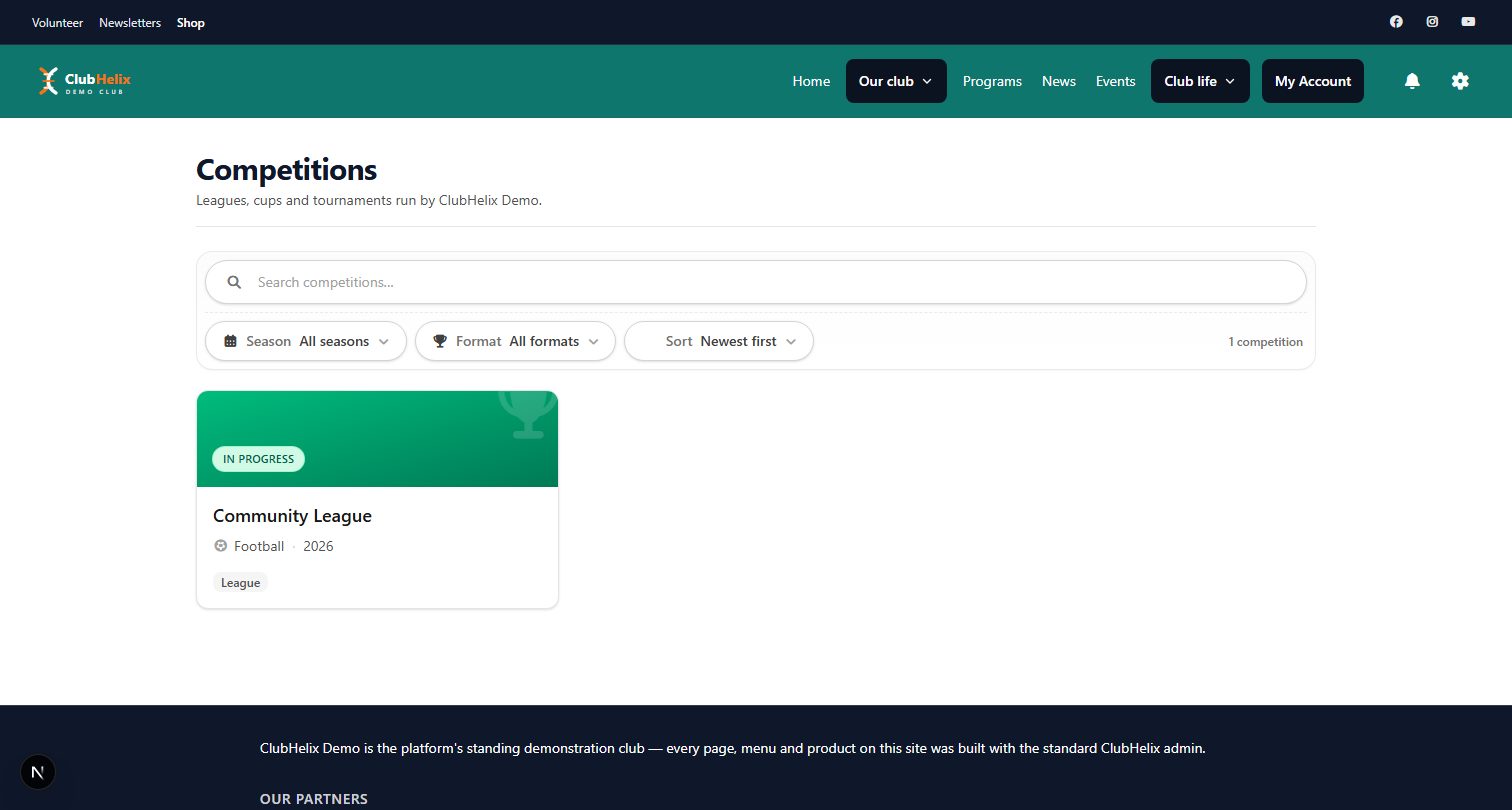
If your club also runs an internal social or summer competition, generating a fair draw is its own small science — our guide on how to make a fixture draw covers round-robin structures and scheduling around turf availability.
Juniors and umpires: the two pipelines
Juniors. Introductory programs and junior grades are where hockey clubs grow or shrink. The clubs that thrive run a visible junior pathway — introductory programs feeding under-age teams, juniors playing up into seniors as they develop — and market it to local schools in the off-season. Our guide on how to increase junior participation applies to hockey almost line for line. Remember the compliance side: coaches and managers of junior teams generally need a valid safeguarding check.
In South Africa that means police clearance certificates for coaches and managers of junior teams, alongside the federation's child-protection requirements.
Umpires. Every fixture needs umpires, and associations increasingly require clubs to supply them for their own grades. Treat umpiring like a pathway, not a punishment: train interested juniors and parents through association courses, pay match fees where the club can, allocate fairly each round, and track accreditations. A club that develops umpires never scrambles at 8am on Saturday.
Communication, canteen and fundraising
Hockey's cold-weather match days make the clubroom canteen both the social centre and a serious revenue line — hot food and drinks to cold spectators add up over a long season. Roster it like any other duty (see how to run a club canteen), and pair it with the usual fundraising staples: sponsor boards at the turf, an annual quiz night, and club merchandise through an online shop.
The braai is the clubhouse's beating heart — boerewors rolls and a busy fire after Saturday fixtures earn real money and keep visiting teams around long after the final whistle.

For communication, keep one authoritative channel: fixtures, selections, wet-weather calls and canteen rosters on the club website, pushed to members by email or app notification — not scattered across a dozen team chats where half the club misses the message.
Your hockey club website and software
Between grading, turf grids, selections, umpire allocations and a canteen roster, hockey clubs carry real administrative complexity — which is why hockey club management software beats a folder of spreadsheets. A good hockey club website gives you online registration and payments, fixtures, ladders and team pages, event RSVPs, duty rosters and news in one place, under your club's colours and domain. That's exactly what ClubHelix does for hockey clubs — see the hockey membership software page for the full setup, browse templates for a starting design, and check pricing (there's a free tier to start on). Most committees can get the club online in an evening.
Frequently asked questions
What is the biggest cost in running a hockey club?
For most clubs it's synthetic turf hire — weeknight training slots plus weekend fixtures usually outweigh equipment, insurance and affiliation combined. Building fees around the turf bill, and filling every booked hour, is the core of a healthy hockey club budget.
When does the field hockey season run?
It depends on where you play: southern-hemisphere club seasons typically run through winter (roughly April to September), while northern-hemisphere outdoor leagues generally run autumn to spring, often with indoor hockey in midwinter. Pre-season registration, grading and trials sit in the couple of months before round one, and many clubs add social competitions on spare turf time in the off-season.
Do hockey clubs have to provide their own umpires?
Many associations require clubs to supply umpires for at least their junior and lower senior grades. Clubs that treat umpiring as a development pathway — courses, fair allocation and match fees where possible — avoid the Saturday-morning scramble entirely.
What should hockey club management software do?
Handle online registration and payments, team lists and selections across grades, fixtures, results and ladders, duty and canteen rosters, and club-wide communication — all connected to a public club website so members find everything in one place.


