
What this guide answers
- How do skating clubs convert learn-to-skate families into members?
With a specific, time-limited offer made at graduation rather than a general invitation.
- How should a club run a test session?
Set the date and book the ice further ahead than feels necessary, invite officials early, close entries on a hard deadline with online payment, and build the running order by level with resurface breaks scheduled in.
- How should ice costs be split between squads and private lessons?
Decide explicitly who pays for the ice a private lesson uses.
- What records should a skating club keep on its members?
Membership and affiliation status, level and test history with dates and results, medical and emergency contact details, consent for photography, and any coach or volunteer accreditation and screening currency.
- Does a small skating club need its own website?
Yes, and mostly for one reason — enrolment. Families searching for beginner classes want dates, prices, what to wear and a way to pay without emailing anyone.
South Africa edition. This guide is written for volunteer-run clubs in South Africa. Where rules differ — grants, tax, incorporation, safeguarding — follow the South Africa-specific pointers below or check with your national body.
Eight o'clock on a Saturday morning, and there are forty children in hire skates clinging to the boards while six helpers try to work out which group each of them is in. Nine weeks later, most of those families will decide whether skating is a phase or the next ten years of their weekends. Almost nothing else your club does matters as much as what happens in the fortnight around that decision — and most clubs leave it to chance, a flyer and whoever happens to be at the barrier that morning.
A figure skating club has a strange shape compared with a football or netball club. It usually does not own its venue, it usually does not employ its coaches, and its members' progress is measured by a test and badge structure the club administers but does not control. What the club genuinely owns is the middle: the ice it buys, the programs it runs on that ice, the test days that give skaters somewhere to aim, and the records that prove who has passed what.
This guide is for the committee running a community skating club — the president who negotiates the ice, the program coordinator who runs learn-to-skate, the test secretary who somehow ended up as the club's institutional memory. It covers how to run intakes that convert into club members, how to run test sessions that do not descend into chaos, how to coordinate coaches you do not employ, and how to allocate ice cost fairly across group squads and private lessons.
Three parties, one sheet of ice
Almost every problem in a skating club comes from confusion about who is responsible for what. Write this down and put it in your welcome pack.
| Party | Typically provides | Typically does not |
|---|---|---|
| The rink | Ice, the plant, hire skates, public sessions, sometimes its own beginner classes | Your program, your records, your coaches |
| The club | Booked ice, programs, test sessions, committee, insurance, membership, calendar | Individual coaching, usually |
| The coaches | Group and private instruction, technical judgement, competitive preparation | Administration, and they should not have to |
The most common failure is a club that behaves like an extension of the coaching business — where the head coach sets fees, holds the records, chooses the sessions and effectively owns the members. That is fine right up until the coach leaves, at which point the club discovers it never had a member list. Keep the club's assets in the club's hands: the ice contract, the member records, the test history, the website and the bank account.
Clubs here affiliate to the national federation for testing and competition eligibility and commonly register as non-profit organisations. With a small number of venues and a shallow skater pool, most clubs run mixed-level sessions and share coaching resources with neighbouring clubs. Build your calendar around what the rink can actually offer, and treat every beginner intake as a national-scale recruitment exercise rather than a local one.
Learn-to-skate intakes and the conversion problem
Run intakes, not a rolling roll
Rolling enrolment feels welcoming and is a quiet disaster. A group where somebody joins every week never progresses as a group, helpers never know who is new, and there is no natural moment to make an offer. Fixed intakes fix all three.
A workable pattern is four intakes a year of eight to ten weeks each, with a one or two week gap between blocks for a make-up week, a badge presentation and the next round of enrolments. Publish all four dates at the start of the year so families can plan, and open enrolment for the next block in week six of the current one — while the child is mid-program and enjoying it, not three weeks after they have stopped coming.
Cap each class properly and hold a waitlist rather than overfilling. A beginner group of eight with two helpers learns; a group of twenty with two helpers queues. If the waitlist is consistently long, that is your evidence when you ask the rink for another hour.
The funnel, stage by stage
Draw your funnel and measure it. Most clubs discover the leak is not where they assumed.
| Stage | What you measure | The usual leak | The fix |
|---|---|---|---|
| Enquiry | Enquiries per intake | People cannot find dates, prices or what to wear | A join page that answers all three without an email |
| Enrolment | Enrolled ÷ enquiries | Payment friction, unclear levels | Online enrolment with card payment and a level guide |
| Attendance through the block | Week 8 attendance ÷ week 1 | Nobody notices when a child stops coming | A register that flags two consecutive absences |
| Completion | Badge awarded ÷ enrolled | The last week is a fizzle | A presentation moment parents are invited to |
| Re-enrolment | Next block ÷ completed | Enrolment opens too late | Open in week six, with a same-time-slot guarantee |
| Conversion to club membership | New club members ÷ graduates | No one ever explicitly asked | A named offer with a deadline and a specific first session |
The last row is the one that decides whether the club grows. Beginner programs generate families who like skating; only a deliberate offer turns them into members who test, compete, volunteer and stay.

Every winter-sport club faces the same seasonal shape — a rush of newcomers at one predictable point in the year, then months of quietly keeping them. The difference between clubs is almost never the coaching. It is whether anyone owns the follow-up.
The graduation offer
Write it once, use it every intake. Three touches, all planned in advance:
- Week six, to every family. "Enrolment for the next block opens today. Skaters who have completed this level can also join the club, which gives them a place on Thursday development ice, entry to our club competition and the option to start working towards their first test. Members enrol first, at the member rate."
- Graduation day, in person and in writing. Present the badge, then hand over one page: what club membership costs, what it includes, the exact date and time of the first session they would attend, and a link to join. A parent standing beside the ice with a proud child is not going to research your club later — make the decision available immediately.
- Two weeks later, to families who have not joined. One short message with a genuine reason to come back — an open development session, a club competition to watch, a come-and-try on the squad ice.
Keep the offer time-limited and honest. A discount that never expires trains everyone to wait, and skating families talk.
Run enrolments online with programs and term enrolment so classes, levels, caps and waitlists look after themselves, and pair it with self-registration so the graduation offer is a link a parent taps once, not a form somebody has to key in later. For the broader playbook on beginner pathways, how to start a junior program is worth reading alongside this.
Test sessions, badges and coach coordination
What the club actually has to organise
A test session is the club's most administratively demanding day, and its most important. Skaters plan their year around it, coaches judge you on how it runs, and officials decide from one experience whether they will travel to you again.
| Element | Who owns it | Get it right by |
|---|---|---|
| Date and ice booking | Committee | Booking further ahead than you think necessary, and holding a reserve date |
| Officials and panel | Test secretary | Inviting early, confirming travel, and knowing the panel requirements for each level |
| Entries and deadline | Test secretary | A hard cut-off with online entry and payment, no exceptions |
| Eligibility check | Test secretary + coach | Confirming membership, affiliation and prerequisites before the running order is built |
| Running order | Test secretary | Grouping by level and discipline, with resurface breaks scheduled |
| Music | Club | Collected in advance in one format, tested on the actual sound system |
| Warm-up ice | Club | Allocating it by group and enforcing it |
| Results and records | Test secretary | Recording the same day, entered into the member record within the week |
| Hospitality | Volunteers | Feeding officials properly — this is not optional |
A test-day run sheet
| Time | What happens | Who |
|---|---|---|
| Four weeks out | Entries close, panel confirmed, fees reconciled | Test secretary |
| Two weeks out | Running order published, music collected, volunteer roster confirmed | Test secretary |
| Week of | Reminder to skaters and coaches with times, arrival window and rules | Program coordinator |
| Doors open | Registration desk, music check, changerooms allocated | Volunteers |
| First warm-up | Group one on the ice, strictly to time | Ice marshal |
| Through the day | Groups rotate, resurface at planned breaks, panel gets a real break | Ice marshal |
| After each group | Results recorded, paperwork signed | Test secretary |
| Close | Badges presented, results posted, officials thanked and paid | Committee |
| Within a week | Results entered into member records and sent to the governing body | Test secretary |
Two practical details make the difference between a smooth day and a shambles. Build the resurface breaks into the running order from the start rather than squeezing them in when the ice deteriorates, and appoint an ice marshal whose only job is time — not a coach, not the test secretary, someone with a clipboard and permission to be firm.
Keeping the record
A skater's test history is the club's most valuable long-term data. It determines competition eligibility, session grouping and, years later, coaching credibility. Hold it centrally, in the club's records, with the level, discipline, date and result — not in a coach's notebook, and not only in the governing body's system that a future test secretary may not be able to access.
Publish results with care. Names and results are usually fine to post; ages, addresses and anything else are not. Keep the public list to what a skater would happily see on a noticeboard.
Coordinating coaches you do not employ
In most clubs, coaches are independent professionals working at your venue rather than employees, and the club's job is coordination, not management. Get the relationship in writing and keep it boring:
- Which sessions the coach may teach on, and what the club charges them for access to club ice.
- Booking rules for private lessons on club sessions — how many skaters at once, whether the ice is shared, who has priority.
- The accreditation, screening and insurance the club requires, and who checks that they are current.
- Conduct expectations covering language, physical contact, photography and social media.
- How disagreements between coaches are handled, and by whom, before one erupts in front of skaters.
- Notice periods, so a coach leaving does not take the Thursday session with them without warning.
Employment status is a genuine legal question with real consequences for tax and insurance, and it varies by jurisdiction — treat this as general information and get advice appropriate to where your club operates before you decide whether someone is a contractor or an employee.
Allocating ice cost across squads and private lessons
Know what each session type is for
| Session type | Who it is for | How it is usually paid for |
|---|---|---|
| Learn-to-skate group | Beginners | Per block, paid upfront at enrolment |
| Development or squad ice | Club members working through levels | Term fee or session pass |
| Freestyle or patch ice | Skaters practising programs and elements | Session pass, punch card or term fee |
| Private lesson time | One skater with their coach, on club ice | Skater pays the coach; club charges for the ice |
| Off-ice conditioning | All squads | Term fee, usually much cheaper ice-free time |
| Test and competition ice | Entrants | Entry fee, priced to cover ice and officials |
The one that causes arguments is private lesson time on club ice, because two different transactions are happening simultaneously — the coach is selling a lesson and the club is selling ice. If the club charges nothing for that ice, general members are subsidising private lessons. Say out loud how it works.
Three defensible models
| Model | How it works | Suits | The catch |
|---|---|---|---|
| Pay per session | A published rate per skater per session, paid on the day or from a punch card | Small clubs, irregular attendance | Income is unpredictable, and you carry the empty ice |
| Term fee | One fee per term for a named set of sessions | Squad and development groups | Families resent paying for sessions missed to illness |
| Term fee plus coach levy | Skaters pay a term fee, coaches pay a flat fee or per-lesson levy for teaching on club ice | Clubs with strong private lesson demand | Needs a written agreement or it feels arbitrary |
Whichever you pick, run the arithmetic before the term rather than after it. Take the hours you have booked, apply your rate, add a modest contingency for a session lost to plant failure, and divide by the number of skaters you can realistically expect. If the answer is uncomfortable, the problem is the hours you booked, not the fee.
Who wears the empty ice
Somebody always does. If skaters pay per session, the club wears it. If skaters pay a term fee, they wear it. If coaches guarantee a minimum, they wear it. There is no fourth option, so choose deliberately and be transparent about the choice — a punch card with an expiry, a term fee with a stated make-up policy, or a small buffer built into the fee.
Track attendance on every session, not just the ones you worry about. Once you can see that Thursday development ice runs at half capacity all term, you can merge it, move it, open it to a neighbouring club or hand the hour back. Keeping the whole calendar in one ice and facility booking view is what makes that visible instead of anecdotal.
With very limited venue options, most clubs here take the ice they can get and build the program around it, which makes session-type planning more important than pricing strategy. As an illustration only, if ice costs R1,200 an hour with twelve skaters on it, break-even is about R100 a skater an hour. For coaches and volunteers working with children, confirm the checks that apply under child protection legislation, including police clearance and the National Child Protection Register, and adopt a written child protection policy.
The annual ice show and club competition
Two events carry a skating club's culture, and both are worth running properly.
The club competition gives skaters a low-stakes place to perform a program before an external event, and gives newer members a reason to feel part of something. Keep it internal, keep the levels generous, give everyone a result and a photo, and use it as the shop window for your graduation offer — invite every learn-to-skate family to watch.
The ice show is usually the club's biggest fundraiser and its most demanding production. Treat it like a production: a director with authority, a rehearsal schedule locked eight weeks out, a music and lighting plan tested on the actual system, a costume policy in writing, and a ticketing setup that does not involve cash in an envelope. Sell tickets online through your own events and ticketing rather than a paper list, so you know your numbers before the doors open and the door team is checking names rather than counting change.
Both events need the same three things two months ahead: a date the rink has confirmed in writing, a volunteer roster with names against jobs, and a communications plan so families hear about rehearsal changes without the coordinator answering forty messages.
Money, retention and the quiet middle
Clubs obsess over recruitment and lose more skaters in the middle years than at any other point — the stretch between "finished the badges" and "competing seriously", where training gets harder, private lessons get expensive and friends drift to other sports.
Three things hold that middle group:
- A named next step. Every skater should be able to say what they are working towards and when the next test session is. Vagueness loses people faster than difficulty does.
- Belonging that is not performance. A social calendar, an end-of-term skate-and-pizza, roles for older skaters helping in learn-to-skate. Skaters who help teach almost never quit.
- Predictable costs. Publish term fees, session rates and what a test day costs. Families leave over surprise bills far more often than over the size of the bill.
Model the whole year with the club budget template, and if you are rethinking fee structures, how much should club membership cost covers the trade-offs. For keeping the members you already have, how to retain club members is the companion piece to everything above.
Running the program side from one place
The administrative load of a skating club is concentrated in a few places: enrolments four times a year, test entries, session attendance, and a member record that has to survive committee turnover. ClubHelix handles those directly — programs and term enrolment with levels, caps, waitlists and online payment, events and ticketing for test days, club competitions and the ice show, and facility booking so your whole ice calendar is visible to coaches, skaters and the committee at once. For the whole picture, see our figure skating club management software page.
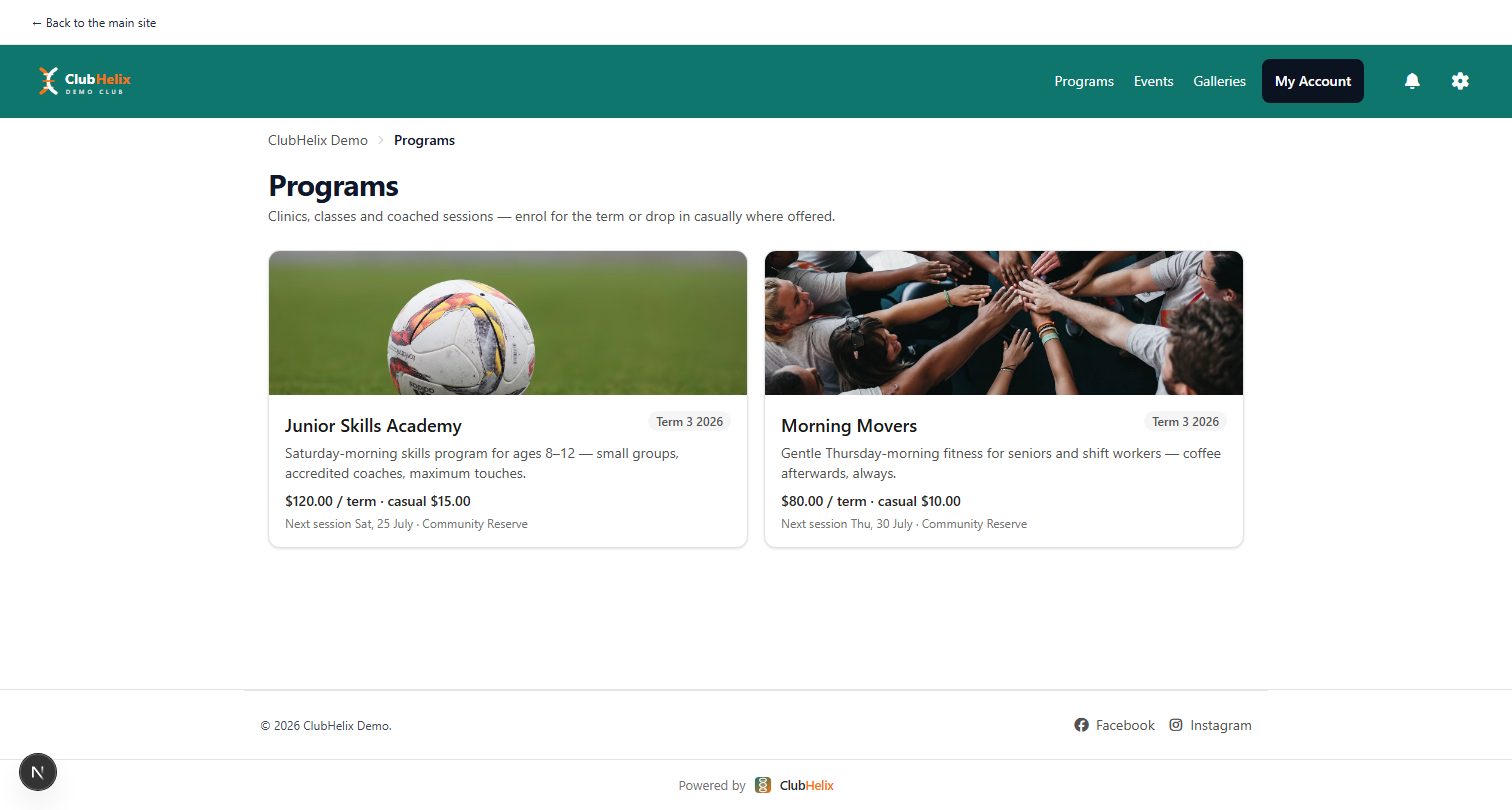
It is free to start, so you can put one intake through it and judge it on whether enrolment morning was calmer. The pricing is published rather than quoted by request, and clubs are typically live with a site, a class list and an enrolment form inside a single evening. Create your club site and set up your next intake before the current block finishes — that timing is worth more than any feature.
Frequently asked questions
How do skating clubs convert learn-to-skate families into members?
With a specific, time-limited offer made at graduation rather than a general invitation. Present the badge, hand over one page with the membership cost, what it includes and the exact date and time of the first session the child would attend, and open next-block enrolment in week six so the decision happens while the family is still engaged. Follow up once, two weeks later, with a genuine reason to come back.
How should a club run a test session?
Set the date and book the ice further ahead than feels necessary, invite officials early, close entries on a hard deadline with online payment, and build the running order by level with resurface breaks scheduled in. Appoint an ice marshal whose only job is keeping to time, record results the same day, and enter them into member records within the week.
How should ice costs be split between squads and private lessons?
Decide explicitly who pays for the ice a private lesson uses. Most clubs charge skaters a term fee or session rate for club ice and charge coaches either a flat fee or a per-lesson levy for teaching on it. The alternative — private lessons using club ice for free — means general members are subsidising them, which is fine only if the club has chosen it and said so.
What records should a skating club keep on its members?
Membership and affiliation status, level and test history with dates and results, medical and emergency contact details, consent for photography, and any coach or volunteer accreditation and screening currency. Hold them in the club's own system rather than in a coach's notebook, because those records are what survives a committee handover.
Does a small skating club need its own website?
Yes, and mostly for one reason — enrolment. Families searching for beginner classes want dates, prices, what to wear and a way to pay without emailing anyone. A site that answers those questions and takes the enrolment converts far more of them than a social media page, and it gives the club somewhere to publish test results, session calendars and the ice show without depending on any one volunteer.
Keep reading — how to run an ice hockey club covers the ice-contract side in depth, and how to start a dance school tackles term enrolment and coach agreements in a very similar business shape.


