
What this guide answers
- How many pilots can race at once?
Four is the usual number, because that is what a standard video channel group supports with clean separation, though clubs run three on tight tracks and more where equipment and space allow.
- What does a race director do?
They own the safety of the event. That means publishing and holding the channel plan, confirming every pilot's transmitter frequency and power at check-in, controlling when transmitters may be powered on, calling…
- How do you stop pilots blacking each other out?
Publish a channel plan before the event, register each pilot's frequency and power at check-in, space channels properly, and enforce a strict power-on rule so nobody transmits out of turn.
- What do you need to build a club race track?
Gates and flags you can transport and reset quickly, a start and finish gate, a timing system with spares, and a layout designed around sight lines and a safe bail-out direction.
- How does a club get new pilots past the beginner stage?
Lower the cost of failing. Simulator nights, ready-to-fly loaner aircraft on the club channel plan, a cheap spec or micro class raced indoors where crashes cost nothing, and a named mentor for each new member's first…
UK edition. This guide is written for volunteer-run clubs in the UK. Where rules differ — grants, tax, incorporation, safeguarding — follow the UK-specific pointers below or check with your national body.
Watch a badly run race night and you will not see crashes. You will see queuing. Twenty pilots sitting in camp chairs for four hours to get eight minutes of air time, because the club is running four-pilot heats off one video channel set, the timing laptop keeps losing the transponder, and nobody can start the next heat until someone finds the pilot who wandered off to fix a bent arm.
Watch a well-run one and the difference is almost boring. Heats roll every three or four minutes. The next four pilots are already on the line with goggles on and channels confirmed. Somebody is calling results as they land. The whole thing is choreography, and the choreography is built on one thing an outsider would never guess: careful management of the radio spectrum above a paddock.
Clubs in the United Kingdom split the year sharply. Summer racing happens on farmland, at flying sites shared with model aircraft clubs, or on hired sports ground, while the darker half of the year moves indoors into sports halls and leisure centres for micro-class racing — which is genuinely good for the club, because indoor nights are warm, weatherproof and far friendlier to beginners. Hall hire is the biggest single cost of that half-year, so book early and sell the season rather than the night.
This guide is for the people running an FPV racing club — the ones who own the timing system, argue about track layout and end up as race director by default. It covers video frequency management and the race director role, building and timing a track, running a meeting that keeps pilots flying, and where to point members for the registration rules that apply to them. Where it touches aviation and radio regulation it is general information only; those rules differ by jurisdiction and change.
What a race night actually is
Strip it back and a race meeting is a scheduling exercise with three constraints: how many pilots can be in the air at once, how long a battery lasts, and how quickly you can turn a heat around. Everything else is decoration.
Most clubs settle on four pilots per heat because that is what a standard video channel group supports cleanly, though some run three for a tight track or six where the equipment and track allow. From there the maths is unforgiving. Twenty pilots in four-pilot heats is five heats per round. If a heat takes four minutes end to end, a round is twenty minutes, and a three-round qualifying session plus finals fills an afternoon. If a heat takes seven minutes because pilots are being found and channels are being sorted at the line, the same event needs six hours and half your entrants will leave early.
So the club's real product is turnaround time. Two things buy it: a staging discipline where the next heat is on the line with goggles on before the current heat lands, and a channel plan that never needs to be renegotiated during the event.
| Format | How it works | Suits |
|---|---|---|
| Timed qualifying | Fixed rounds, best lap or best consecutive laps counts | Club nights, mixed ability |
| Points racing | Heats scored on finishing position, points accumulate | Season-long club championships |
| Bracket elimination | Double elimination from a qualifying seed | Finals day, spectator events |
| Open practice rota | Rolling groups by channel, no scoring | Beginners, new-track shakedown, training |
| Spec class | One aircraft class, tight rules, cheap to enter | Growing the field and levelling it |
Run a spec or micro class alongside your open class if you can. It is the single most effective way to grow a field, because it caps the cost of being competitive and puts newer pilots in heats they might win.
Video frequencies, and why the race director exists
Here is the part that makes drone racing unlike any other club sport. Every aircraft carries a video transmitter, and every pilot's goggles are tuned to a channel. Two aircraft transmitting on channels that are too close together do not produce a warning message — they produce static in someone's goggles at 100 km/h, and a crash into whatever is behind the gate.
That makes spectrum a safety system, and safety systems need an owner. The race director is that owner, and the role should be named and rostered rather than assumed by whoever is loudest.
The race director's job on the day:
- Publishes the channel plan before racing and does not change it mid-event
- Confirms every pilot's transmitter frequency and power at check-in, recorded against their name
- Controls when transmitters may be powered on, and enforces the rule ruthlessly
- Calls the arm, the start, and the stop for every heat
- Decides on re-runs, penalties and whether conditions are safe
- Holds the authority to ground a pilot or an aircraft, with no debate on the line
The discipline that matters most is the simplest: nobody powers up out of turn. A pilot who switches on in the pits to check something while a heat is flying can black out another pilot's video. Clubs enforce this with a physical token system — a peg board, a clip, a lanyard per channel that must be collected from the race director before power-on — because a physical object survives noise, adrenaline and forgetfulness better than a rule does.
| Channel plan element | Why it matters |
|---|---|
| Published group and channels | Pilots arrive already set; no negotiation at the line |
| Spacing between channels | Adjacent channels bleed into one another and cause video breakup |
| Transmitter power setting | Higher power is not better in a tight pit area; it swamps neighbours |
| Antenna type and polarity | Mismatched polarity costs range and adds noise |
| Registered per pilot | Check-in records who is on what; disputes become lookups |
| Spare channel set | For a pilot whose gear cannot make the primary plan |
There is a second, quieter reason the race director role matters. Radio spectrum is regulated, and what you may transmit on — and at what power — without a licence is set by your national spectrum regulator, not by the manufacturer of the gear. Equipment sold overseas is not automatically permitted locally. Make it the club's habit to point members at the regulator's current rules before they buy, and to keep gear that does not comply out of your events.
In the United Kingdom the communications regulator sets which frequencies and power levels may be used licence-free, and the civil aviation regulator requires remote pilots and operators to register and hold identifiers. Both frameworks have changed since FPV racing became popular, and equipment bought from overseas sellers does not necessarily comply, so check the current published rules and keep the links on your club website.
Building a track worth flying
A good track rewards skill without punishing beginners out of the sport. The design principles that hold across venues:
- Sight lines first. Pilots sit in one place with goggles on; spotters and the crowd need to see the whole course. Design from where people will be standing.
- A long enough straight to overtake, or every race becomes a procession behind the first pilot through gate one.
- Vary the element types — flags for direction changes, gates for precision, a split or a dive for character — rather than repeating one shape.
- Consistent lap time. Aim for a lap most of your field can complete in a similar band; very short laps make timing and lap counting fragile.
- A bail-out line. Where does a pilot go when it all goes wrong? That direction must be empty of people.
- Set-up time. A track that takes ninety minutes to build is a track your club will race on twice a year.
| Element | What it does | Practical notes |
|---|---|---|
| Square gate | Precision, timing reference | Cheap to build; needs weighting or pegs in wind |
| Flag or pylon | Direction change, overtaking point | Fastest to reset after a strike |
| Dive or ladder | Vertical interest, spectator moment | Needs a clear run-out below |
| Split gate | Rewards line choice | Two routes of near-equal length or nobody uses one |
| Start gate | Clean, consistent start line | Wide enough for the whole heat to launch together |
| Finish gate | Timing point | Where the timing hardware lives; protect it |
Timing is the other half. Clubs generally use one of three approaches: transponder-based systems on each aircraft, radio-signal-based timing that reads the video transmitter itself, or manual lap counting with one counter per pilot. Manual counting works for a first season and produces arguments; whichever electronic system you choose, buy spares of the fiddly parts, keep the software version pinned across the club's machines, and have a written recovery plan for the moment it fails mid-final. It will.
Own the track as a club, not as one member's garage collection. Number the gates, keep a build-and-pack checklist, store it in labelled crates, and roster a set-up and pack-down crew rather than relying on the same three people to arrive at seven in the morning.

The race-day run sheet
Publish the times and the roles. Every job below can be done by a member who does not race, which is how you convert partners, parents and retired pilots into the volunteer base every club needs.
| Time | What | Who |
|---|---|---|
| 7.30am | Set-up crew arrives; track build, timing, shade | Set-up crew |
| 8.30am | Check-in opens — channels, gear, waivers, entries | Registration desk |
| 9.00am | Safety briefing, track walk, channel plan issued | Race director |
| 9.20am | Open practice by channel group | Race director, spotters |
| 10.00am | Qualifying rounds | Race director, timing |
| 12.30pm | Break, batteries, food | Catering |
| 1.15pm | Finals brackets | Race director, timing |
| 3.00pm | Presentations | Committee |
| 3.30pm | Pack-down and site sweep | Everyone, crew last out |
Roles worth naming: race director, timing operator, registration desk, safety officer, spotters (one per pilot in the air, watching the actual aircraft while the pilot watches the video feed), gate marshals to reset struck gates between heats, a commentator if you have a crowd, and a first-aider. Spotters are not optional at a public event — they are the person who sees the child walking into the flight path.
Keep results visible as the day runs. Pilots who can see the current standings between heats stay engaged, and a public results board removes most disputes before they start. Our guide on how to organise a sports carnival covers the wider logistics of a multi-hour event day, most of which transfers directly.
Registration, safety and where to point your members
This is general information rather than advice, and the specifics differ by jurisdiction. Whatever framework applies to you, the club's practical obligations look similar: know that each competing pilot is compliant, brief everyone on site before racing, separate spectators properly, and record what goes wrong.
- Spectator separation. A physical barrier and distance between the crowd and the flight path, with the pits behind the crowd line rather than beside the track. Netting for indoor and close-quarters venues.
- A briefing nobody skips, including visitors — flight path, bail-out direction, what "land now" sounds like, where the first aid kit is, and who the race director is.
- Waivers and acknowledgement of rules signed by every entrant, held where the registration desk can produce them.
- Insurance. Check what your cover actually extends to, especially for public events, and whether it depends on members holding a national association membership.
- An incident log covering crashes into people or property, fly-aways, and battery fires. Patterns show up in the log long before they show up as an injury. Sports club risk management covers the register a committee should keep alongside it.
- Battery discipline. Charging in a designated area, on a non-flammable surface, never unattended, damaged packs quarantined and disposed of properly. A pit table full of lithium packs in the sun deserves more respect than it usually gets.
If your club shares a site with a model aircraft club — which many do, and it is usually a good arrangement — agree the operating protocol in writing: who has the field when, how you deconflict frequencies, and whose safety rules apply. Our guide on how to run a model aircraft club covers the other half of that conversation.
Bringing new pilots in
Drone racing has a brutal beginner cliff. The gap between "bought a quad" and "can complete a lap without crashing" is measured in months, and most people quit inside it. Clubs that grow are the ones that engineer the first six months deliberately.
Four things work. Run simulator nights — cheap, weatherproof, and the fastest way to learn a line without breaking anything; a hall, a projector and a few controllers is a whole club night. Keep loaner aircraft ready to fly, with the club's channel plan already set, so someone can try the sport without buying anything. Race a micro or spec class indoors, where crashes cost nothing and a beginner can complete laps in week one. And pair every new member with a mentor for their first season, because the barrier is rarely flying — it is soldering, betaflight settings, and knowing which part failed.
Publish a beginner pathway on your website with what to buy, what it costs, and what happens at their first meeting. Half the people who never turn up are not uninterested; they just could not work out whether they would be out of their depth.
Money, gear and the club's own kit
Club finances here are shaped by equipment rather than facilities. The timing system, the gates, the shade tents, the public-address gear and a generator or battery station are club assets that wear out, get lost and need replacing on a cycle.
| Income | Expenditure |
|---|---|
| Membership subscriptions | Venue or ground hire, indoor hall hire |
| Race entry fees per meeting | Timing system, spares and software |
| Open-day and spectator events | Gates, flags, netting and replacement parts |
| Canteen and catering | Insurance and any affiliation |
| Sponsorship from local trade | Charging station, generator or battery, shade |
| Merchandise and spec-class kits | Website, publicity and trophies |
Keep entry fees per meeting rather than loading everything into the annual subscription. It lowers the barrier to a first visit, it means a rained-out meeting costs the club little, and it makes the relationship between what a race day costs and what it takes obvious to everyone. Budget a replacement reserve for the timing system from day one; it is the one item whose failure cancels racing outright.
Running the season without the spreadsheet
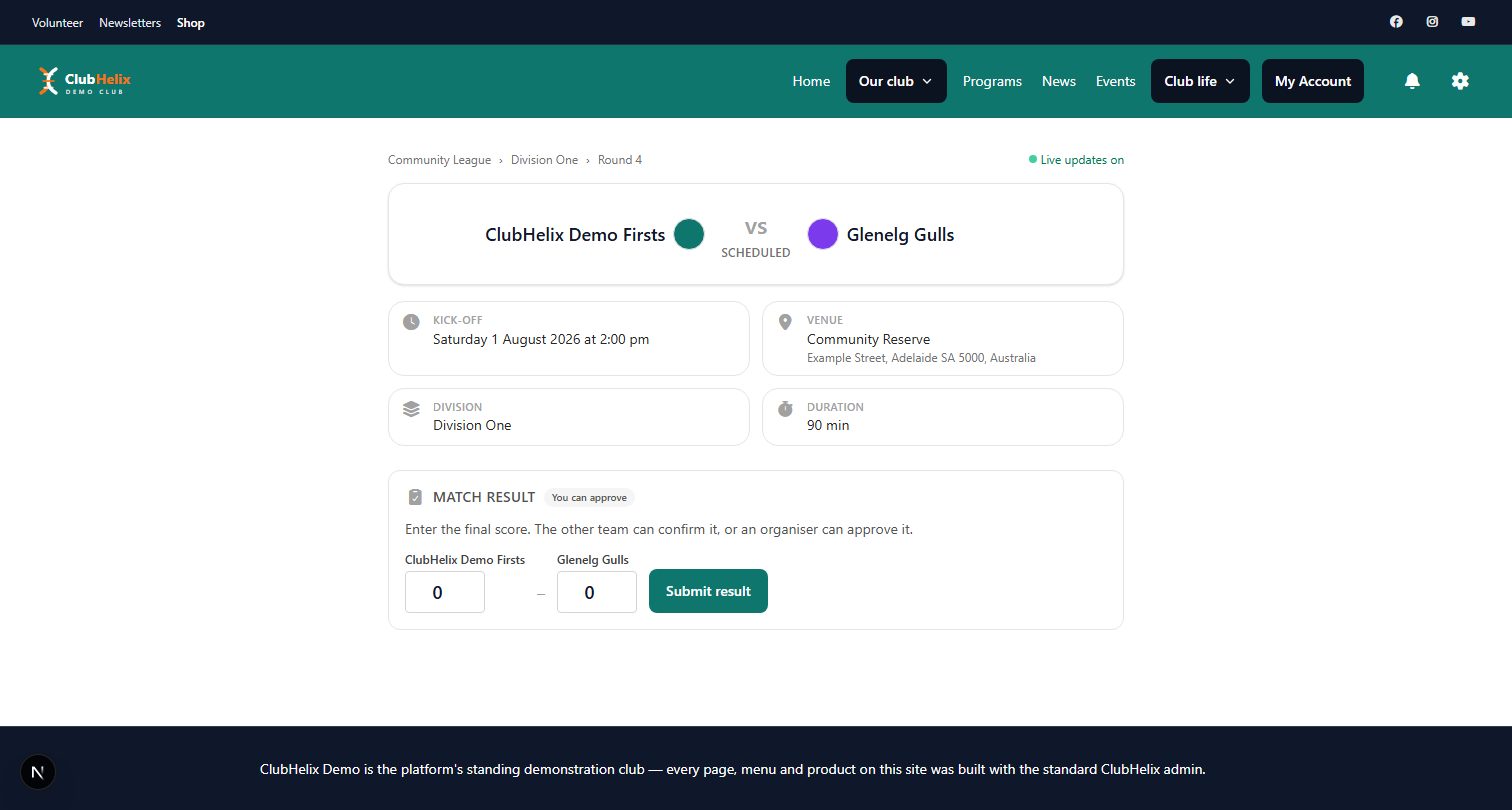
Race days generate exactly the kind of admin that eats a committee: entries, channel allocations, waivers, heat sheets, results and standings. ClubHelix runs that on your own club website — events and entries for meeting registrations and paid entry fees, competitions for a season championship with rounds and standings, live match centre so results go up as heats finish instead of being typed up on Sunday night, and match officials for rostering the race director, timing operator and spotters.
It is a proper public site as well, which matters for a sport most people have only seen on video — a beginner pathway page, your calendar, and a join button that works on a phone at the fence. There is a free tier to start with, the pricing is published openly, and you can create your club site between one race meeting and the next.
Frequently asked questions
How many pilots can race at once?
Four is the usual number, because that is what a standard video channel group supports with clean separation, though clubs run three on tight tracks and more where equipment and space allow. The limit is not the track, it is the spectrum — every extra aircraft in the air needs a channel far enough from its neighbours that nobody's video breaks up mid-corner.
What does a race director do?
They own the safety of the event. That means publishing and holding the channel plan, confirming every pilot's transmitter frequency and power at check-in, controlling when transmitters may be powered on, calling starts and stops, ruling on re-runs and penalties, and grounding a pilot or aircraft when needed. The role should be named and rostered in advance, never assumed on the day.
How do you stop pilots blacking each other out?
Publish a channel plan before the event, register each pilot's frequency and power at check-in, space channels properly, and enforce a strict power-on rule so nobody transmits out of turn. Most clubs back that with a physical token — a peg, clip or lanyard collected from the race director — because an object in someone's hand is harder to forget than a rule in a briefing.
What do you need to build a club race track?
Gates and flags you can transport and reset quickly, a start and finish gate, a timing system with spares, and a layout designed around sight lines and a safe bail-out direction. Keep set-up under about an hour, number and crate the components, and roster a build crew — a track that takes half a morning to erect gets used twice a year.
How does a club get new pilots past the beginner stage?
Lower the cost of failing. Simulator nights, ready-to-fly loaner aircraft on the club channel plan, a cheap spec or micro class raced indoors where crashes cost nothing, and a named mentor for each new member's first season. Publish the pathway and the real costs on your website, because uncertainty about whether they will be out of their depth stops more people than the sport itself does.
Keep reading — how to run a model aircraft club if you share a field with one, and how to organise a sports carnival for running a bigger event day.


