
What this guide answers
- How many volunteers does it take to run a cricket club?
A two-or-three-team club typically needs 12–15 active volunteers: a core committee of five or six, plus captains, a junior coordinator, grounds help and a teas/canteen roster shared across the playing group.
- Should our club play on turf or synthetic pitches?
Play whatever your competition requires, but don't underestimate turf's workload — it needs curator time or serious volunteer hours every week, plus covers before rain.
- How do we organise afternoon teas without burning out one family?
Publish a full-season tea roster before round one, assigning two families per home game, and send automatic reminders in the week before their turn.
- What should a cricket club website include?
Grounds and training times, fees and a join link, current fixtures and results, junior program details, sponsor recognition and a monitored contact.
New Zealand edition. This guide is written for volunteer-run clubs in New Zealand. Where rules differ — grants, tax, incorporation, safeguarding — follow the New Zealand-specific pointers below or check with your national body.
Cricket clubs carry one of the heaviest volunteer workloads in community sport. A single Saturday can involve preparing a pitch, rolling covers on and off, feeding two teams at tea, finding a scorer, and squeezing four grades onto three grounds — and that's before anyone bowls a ball. The clubs that thrive aren't the ones with the most talented First XI; they're the ones where the work is spread across many hands and the admin doesn't fall on one exhausted secretary.
This guide walks through how to run a cricket club from affiliation to finals: setting up the committee, managing turf and synthetic pitches, organising tea rosters and match-day duties, building a junior pathway, collecting fees, and giving the club a proper online home.
Getting set up: affiliation and the basics
Almost every cricket club plays in a competition run by a district, regional or state association, so your first job each year is affiliation. That typically covers your entry into the grades, access to the association's registration system, and — importantly — player insurance arranged through the governing body. Read the affiliation paperwork carefully: it usually sets junior age cut-offs, uniform rules, and the dates nominations for each grade are due.
If your club is new or has been running informally, look at giving it a formal legal identity. That matters when you sign a ground allocation, open a bank account or apply for grants.
Most clubs register as incorporated societies through the Companies Office, which also sets the rules your constitution has to satisfy.
This is general information, not legal or financial advice — check the current requirements with the Companies Office.
The committee: sharing a genuinely big workload
Cricket needs more hands than most sports because match days are long and grounds need real preparation. Beyond the standard president, secretary and treasurer (see our guide to committee roles and responsibilities), a well-run cricket club usually fills these roles:
- Grounds and pitch coordinator — liaises with the council curator or manages your own turf square, books rollers, organises covers before rain.
- Junior coordinator — runs the entry-level skills program, junior teams, and the parent volunteer roster.
- Selection chair — chairs weekly selection across grades and communicates teams by a fixed deadline (Thursday night is the classic).
- Canteen and teas coordinator — runs the tea roster for home games and stocks the canteen.
- Registrar — owns registrations, clearances between clubs, and qualification rules for finals.
Write each role down as a one-paragraph description. Vague jobs never get filled; specific ones do. When you're short, our guide on how to recruit club volunteers has tactics that work mid-season, not just at the AGM.
Membership, registration and fees
Most clubs charge a tiered annual subscription: full senior, student or concession, junior, and a social membership for the bar and club nights. Many also charge modest match fees per game to smooth cash flow across a long season — if you do, be upfront about the total cost of a season so nobody is surprised in the second half of the season.
Collect registrations online rather than chasing paper forms and cash at training. With online registration players sign up from their phone, pay by card, and appear on your roster with their status and paid-until date visible at a glance. Offering instalments helps families with several juniors, and it noticeably reduces the awkward chase for unpaid fees in December. Remember that players usually also need to be registered in your governing body's system for the competition itself — make your club registration form the front door and remind people of both steps.
Grounds and pitches: turf vs synthetic
The pitch shapes everything about your club's workload. If you're choosing, inheriting or maintaining one, here's the honest comparison:
| Turf square | Synthetic pitch | |
|---|---|---|
| Preparation | Days of mowing, rolling and watering per pitch, every week | Sweep, check seams, done |
| Cost | Curator time or serious volunteer hours, plus machinery | Low upkeep; resurfacing every 8–12 years |
| Covers | Essential — rolling covers on before rain is a whole-club duty | Not needed |
| Play | Preferred for higher grades and two-day cricket | Reliable bounce, great for juniors and one-dayers |
| Weather risk | Games lost to a wet square | Playable almost immediately after rain |
If you play on turf, build the covers routine into your communication plan: a Thursday-night forecast check and a call-out for four people to help roll covers on will save more games than anything else you do. If the council prepares your pitches, invest in that relationship — a thank-you carton at season's end for the curator is a fine club tradition.
Book a working bee before round one for sightscreens, nets, boundary markers and the scoreboard. Practice nets deserve their own check: torn netting and worn crease lines cause more pre-season injuries than anything on the field.
The season: grades, fixtures and match day
Most associations run a mix of formats: two-day games where you bat one Saturday and field the next, one-day grades with a result every week, and midweek or Sunday T20-style competitions. Each format changes your logistics. Two-day cricket means the same ground must be held across consecutive weekends and teas hosted twice; one-dayers compress everything into a single frantic afternoon.
The weekly rhythm looks like this: selection Thursday, teams published Thursday night, ground and pitch prepared Friday, match day Saturday with a designated home-game manager responsible for teas, scoring and hosting the umpires. Publish the season's fixtures, grounds and start times somewhere every player and parent can find them — a page on your club website beats a screenshot buried in a group chat. If your club also runs its own internal or junior competitions, our guide on how to make a fixture draw covers the mechanics.
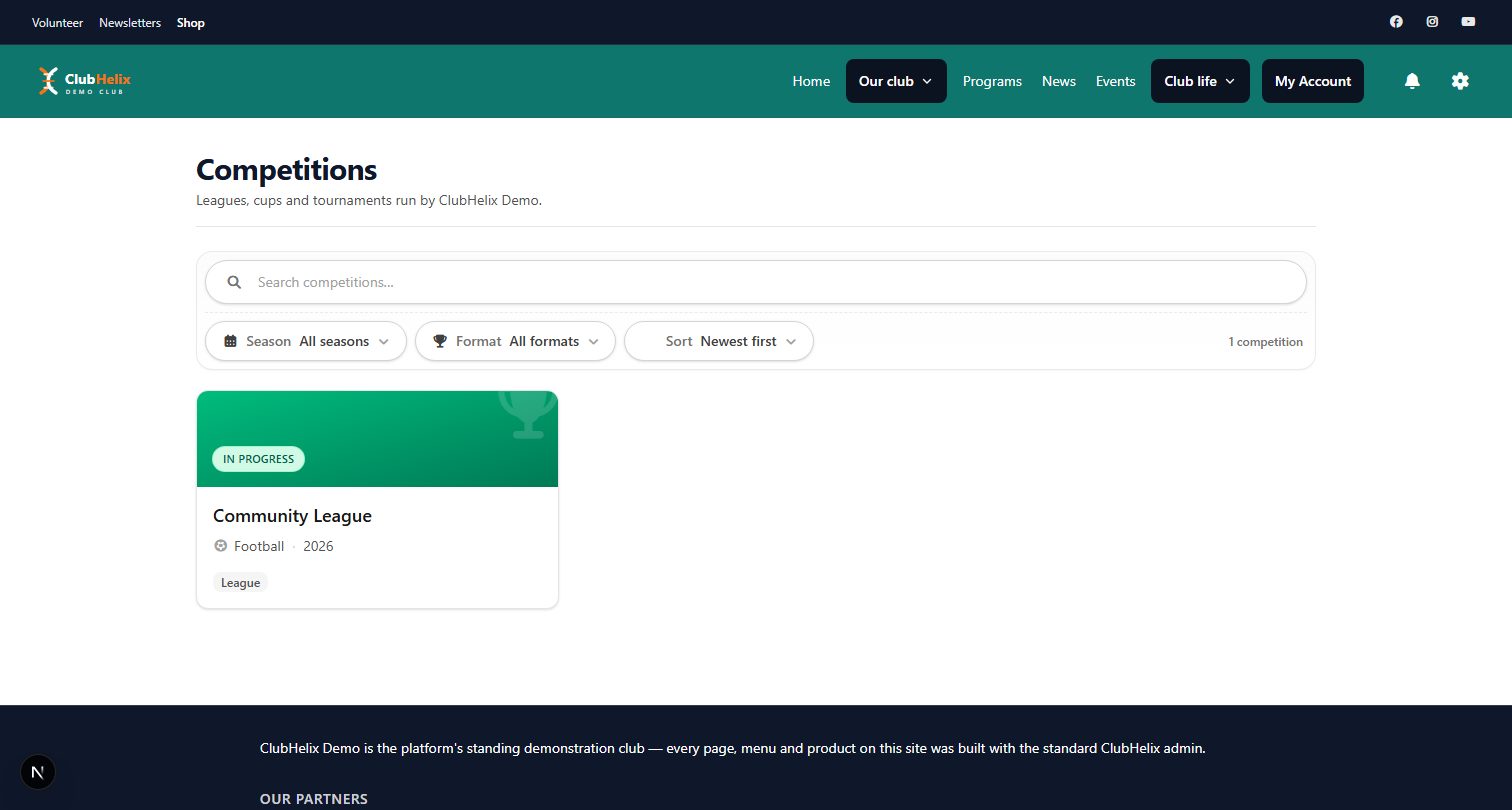
Running fixtures, ladders and results through a proper competitions tool means results entered once appear on the public site immediately — no Sunday-morning spreadsheet session for the secretary.
And then there's teas. The afternoon tea at a two-day home game is a genuine institution and a genuine workload: sandwiches, slices, urns and washing-up for 24 players plus umpires. Run it as a published roster — two families per home game, dates assigned before round one — rather than a weekly plea. A volunteer roster with automatic reminders takes the coordinator out of the nagging business entirely.
Juniors: building your pathway
A cricket club without juniors has a ten-year expiry date. Most governing bodies offer an entry-level skills program for five-to-eight-year-olds — short, game-based sessions with soft balls and plastic bats — and clubs that host one reliably feed players into junior teams two years later. From there the ladder runs through modified-format junior grades (shorter pitches, retiring batters, everyone bowls) into youth cricket and senior grades.
Three things make junior programs stick. First, a dedicated junior coordinator who isn't also captaining a senior side. Second, parent involvement from day one — hand every new family a small job, from scoring to managing a team. Third, visible pathways: when a 15-year-old debuts in the Thirds, celebrate it publicly. Junior fees should be meaningfully cheaper than senior fees, and every junior coach and manager needs a current Working with Children Check recorded somewhere the secretary can audit.

Money, the canteen and fundraising
A typical cricket club budget is built from subscriptions and match fees, canteen and bar takings, sponsorship, and one or two big fundraising events. Costs are dominated by affiliation and insurance, ground and net hire, balls (two-day cricket chews through expensive four-piece balls), and equipment replacement.
Whatever you call your food outlet, it is usually your most reliable earner — a long day of cricket is a captive market — so give it the same roster treatment as teas. Sponsors respond to specifics — boundary signage, a named grade award, or the match ball for each home game — so package what you're actually selling rather than asking vaguely for support.
The canteen is the earner: cold drinks, hot chips and a barbecue across a long Saturday. Beyond that, the classics work — a season-launch sausage sizzle, a quiz night in the clubrooms mid-season, and a well-run club raffle.
Your club's online home
Every conversation about your club — a new family moving to the area, a player checking start times, a sponsor doing due diligence — starts with a search. A cricket club website should answer the basics without anyone having to ask: where you play, training nights, fees, how to join, this week's fixtures, and a contact that actually gets answered.
Purpose-built cricket club management software beats a generic website builder here because the fixtures, ladders, registration and payments live in the same place as the website — update a result and the site is already current. See how clubs set this up on our cricket club management software page, and browse templates to start from a layout designed for sporting clubs rather than cafés.
If your committee is drowning in admin, ClubHelix was built for exactly this: registrations and payments, fixtures and ladders, tea and canteen rosters, email and SMS to the whole club, and a professional website — all in one place, with a free tier to start on. See pricing or create your club in an afternoon.
Frequently asked questions
How many volunteers does it take to run a cricket club?
A two-or-three-team club typically needs 12–15 active volunteers: a core committee of five or six, plus captains, a junior coordinator, grounds help and a teas/canteen roster shared across the playing group. The key is many small defined jobs rather than a few enormous ones.
Should our club play on turf or synthetic pitches?
Play whatever your competition requires, but don't underestimate turf's workload — it needs curator time or serious volunteer hours every week, plus covers before rain. Synthetic pitches suit junior and one-day cricket well and survive wet weekends far better.
How do we organise afternoon teas without burning out one family?
Publish a full-season tea roster before round one, assigning two families per home game, and send automatic reminders in the week before their turn. Rotating a defined duty works; weekly open pleas don't.
What should a cricket club website include?
Grounds and training times, fees and a join link, current fixtures and results, junior program details, sponsor recognition and a monitored contact. Keeping fixtures and registration in the same system as the website means it stays current without extra work.


