
What this guide answers
- How do you start a comic book club?
Pick a format, a fixed night and a venue, then announce the first three reads before the first meeting so nobody arrives unprepared.
- What should a comic book club read?
Work that someone can start cold — self-contained graphic novels, first volumes, complete runs — and that is available from a library, in print and digitally.
- How do you run a comic book club discussion?
Start with a one-sentence round from everyone, including anyone who did not finish, then work through three or four prepared questions.
- How do you get a discount at a comic shop for a club?
Bring an offer, not a request. Members on standing orders, a bulk club order placed early, volunteers on the shop's busy days and promotion to your list all reduce a retailer's risk, and a modest verified member…
- How do you organise a creator visit?
Agree a fee and expenses in writing, ask what the creator wants to talk about, send your questions ahead, and arrange a selling table with a volunteer staffing it.
A new member arrives at 7.10pm. The room is forty minutes into an argument about a crossover from the mid-eighties that ran across eleven titles, was partly undone by two subsequent continuity reboots, and is being cited from memory. Everyone is enjoying themselves enormously. The new member drinks their coffee, says nothing for an hour, and does not come back.
That is the specific failure mode of a comic book club, and it is worth naming up front because it is the opposite of the problem most reading groups have. Comics reward accumulated knowledge — decades of it, spread across formats, publishers and reboots — and that accumulation is both the deepest pleasure of the hobby and a wall that newcomers hit within ten minutes. A club that does nothing about it slowly becomes six people who already knew each other.
This guide is for whoever is organising one: a monthly graphic novel group at the library, a weekly gathering in the back of a comic shop, a university society, or a group that has outgrown a chat thread. It covers choosing reads and running a discussion people can actually join, building a genuine partnership with a local retailer, and the events that turn a reading group into a cultural fixture — creator visits, zine nights and small-press showcases.
Decide the club's reading shape
Before anything else, decide what the club reads and in what format. Comics fragment in a way prose does not: single issues, collected editions, original graphic novels, webcomics, manga volumes and self-published work all have different rhythms and different costs.
| Format | How it runs | Suits |
|---|---|---|
| Collected edition monthly | One trade or graphic novel a month, discussed in full | The default, and the easiest to join mid-year |
| Single-issue follow | The club follows a current monthly series together | Groups near a shop, members who like the wait |
| Creator retrospective | A season on one writer or artist across several works | Established groups wanting depth |
| Small press and indie | Self-published, small-press and local work only | Clubs with a creative streak and a zine night |
| Manga rotation | A volume or arc per meeting, often a long series over a year | Younger membership, library-friendly |
| All-ages or family | Titles that work for readers from about eight upwards | Library and school-adjacent clubs |
| Bring what you read | No shared text — everyone talks about their own current read | Low-commitment groups and summer or holiday meetings |
Most healthy clubs run a primary format with one wildcard slot — eleven collected editions a year and one "bring what you are reading" night, or a small-press month every quarter. That single variation does a lot of work: it lets lapsed members return without homework and gives you an obvious meeting to invite a newcomer to.
If your group leans as much toward animation and manga as toward Western comics, the programming ideas in our anime club guide transfer directly, and the general mechanics of starting a reading group are covered in how to start a book club.
Choosing reads and running a discussion newcomers can join
The on-ramp rule
Every pick gets tested against four questions before it goes on the list:
- Can someone start here? Self-contained works, first volumes and clean runs beat "issue 214 of a series in its third continuity". If you must pick something embedded in a larger story, write the two-paragraph catch-up yourself and send it with the announcement.
- Can everyone get it? Check the library holds it, the collected edition is in print, and a digital version exists. A pick nobody can find is a month of lost attendance.
- Can everyone afford it? Rotate expensive hardcovers with library-available and cheaper picks so cost never quietly decides who participates.
- Does it repay discussion? Some brilliant comics leave nothing to say. Look for work that makes a choice — about structure, art, ending or point of view — that people can reasonably disagree about.
Announce two or three picks ahead. People need lead time to reserve a library copy or wait for a shop order.
Discuss the comic, not just the plot
This is where a comic book club earns its existence and stops being a book club with pictures. Prose discussion habits leave two-thirds of the work on the table. Build a question bank around what comics actually do:
- Layout and pacing. Where did the page turn land, and what did it do to you? Which panel got the most space, and was it the most important?
- Art and storytelling. What is the artist telling you that the script is not? Track a character's face across a scene and see how much dialogue was unnecessary.
- Colour. Look at the palette shifts. Colourists are the most under-discussed people in the medium and the easiest to notice once you start.
- Lettering. Balloon placement, sound effects, whose voice gets a different font. Once someone points this out, nobody unsees it.
- Format. Was this written to be read monthly or in a sitting? How does that change it?
- Adaptation and expectation. If members have seen a screen version, what did the comic do that the adaptation could not?
Give one member per meeting the job of noticing one craft element and reporting back on it — a rotating "art spot" three minutes long. It teaches the whole room to read differently and it distributes preparation, so no single person carries the club.
A meeting shape that includes people
| Minutes | What happens |
|---|---|
| 0-10 | Arrivals, coffee, and a deliberate welcome to anyone new |
| 10-15 | One-sentence round from everyone, including "I did not finish it" |
| 15-20 | Sixty-second context from whoever chose it — no spoilers |
| 20-45 | Open discussion, run from three or four prepared questions |
| 45-50 | The art spot |
| 50-60 | Next month's pick, upcoming events, recommendations for the newcomer |
Two social rules keep the door open. Continuity talk gets translated, not curtailed — the deep lore is half the fun, so when it comes up someone summarises it in a sentence for anyone who was not there in 1994. And nobody is quizzed. "Have you not read that?" is the most common way a comic club loses a member, usually said by someone being friendly.

Shop partnerships, pull lists and member discounts
A local comic retailer is the single most valuable relationship a comic book club can have, and the clubs that get the most out of one are the clubs that turn up with an offer rather than a request.
Understand the pull list first
A pull list is a standing order — the shop sets aside each issue of the titles you have nominated and holds them for collection. It is how the trade actually works: shops order weeks in advance and carry the risk on anything unsold, so a customer who commits in advance is worth far more than one who browses. That is your leverage. A club that brings ten members onto pull lists has materially reduced a small business's risk, and that is worth discussing openly.
What to offer, and what to ask for
| You offer | You might ask for |
|---|---|
| Members onto pull lists or standing orders | A modest standing discount for members |
| A bulk club order of the monthly pick, ordered early | Priority ordering and a held copy per member |
| A meeting held in-store on a quiet night | Use of the space after hours |
| Promotion of shop events to your list | The shop promoting the club to browsers |
| Volunteers on the shop's busy promotional days | A stall or table at those events |
| A club shelf of recommendations with written notes | Visibility in the shop and a reason for browsers to ask |
Put it in writing as a one-page arrangement — who does what, how the discount is applied and verified, who places the club order and by when, and how either side ends it without awkwardness. Verify membership properly, because an unenforceable discount becomes a resented one. Give the shop a reliable way to check who is current — a members list they can look up, refreshed each term — rather than leaving it to whoever is behind the counter to remember faces. On the club's own side, member discount codes do the same job for your ticketed events and anything the club sells itself.
Running a club order
Nominate one person as the order coordinator, set a hard cut-off a fortnight before each meeting, collect money up front rather than on collection, and never let the club carry unpaid stock. Keep the order list and the payment record in the same place. If you sell anything yourself — a club zine, an anthology, badges — run it through a proper club shop rather than a shoebox and a notebook, so the treasurer can reconcile it later.
Be a good customer. Small retailers operate on thin margins and a club that demands deep discounts, orders late, or reads in-store stock without buying is a cost, not a partner. The strongest partnerships are the ones where the shop mentions the club unprompted to new customers.
Where a comic shop is a long drive away, lean on the library. Public library networks carry substantial graphic novel collections, will usually take purchase suggestions, and can source titles from other branches through an interlibrary system — which makes the "can everyone get it" test much easier to pass. A library branch also makes a good meeting venue, often free, and being listed in its program brings walk-ins.
Creator visits, zines and small-press showcases
The clubs that become fixtures in their town are the ones that make things happen rather than only reading things. Three events do most of that work.
Inviting a creator
- Pay people. A creator visit is work. Agree a fee, or if the club genuinely cannot pay one, be upfront about that and offer what you can — a table to sell from, expenses covered, a good crowd. Never ask a creator to appear for "exposure" without saying so plainly.
- Cover expenses properly. Travel, parking and a meal. Agree it in writing before the date.
- Ask what they want to talk about. A structured interview with prepared questions beats an open Q&A that stalls after three minutes. Send the questions in advance.
- Sort the selling side. Table, change float, card reader, a volunteer on the table so the creator can talk to people. If a shop is partnering with you, this is a natural job for them.
- Check access and comfort. Step-free access, a quiet space, water, and a clear finish time. Say the finish time out loud at the start.
A workable run sheet: doors and mingling for twenty minutes; a five-minute introduction that has actually been prepared; thirty minutes of interview; twenty minutes of audience questions taken by a volunteer with a roving microphone; then signing and selling for as long as people stay. Photograph it with permission, and write it up afterwards on your own site — that write-up is what convinces the next creator to say yes.
Zine nights and jam comics
You do not need artists to run a making night. A zine night with photocopied folded paper, glue sticks and a two-hour limit produces something real by the end of the evening, and it changes how members read for months afterwards. Variations worth stealing: a jam comic, where each person draws one panel and passes it on; a one-page challenge on a shared prompt, collated into a club anthology; and a 24-hour comic day for the committed, run as a supervised all-day session rather than an overnight one.
Collect the results. An annual club anthology — even a stapled photocopy — is the single best recruitment object a comic club can own, because it is a thing people can hold that no other club in town has.
Small-press showcases
A showcase is a step up: a public event where local creators and small publishers take tables and sell directly. Start small — six to ten tables in a library or hall — and get the fundamentals right. Table cost that covers the room and no more. A published deadline for applications and a clear, written policy on what may be sold. Clear signage and a floor plan. A volunteer on the door counting people in, because that number is what your next funding application and your next set of exhibitors will want to see. And a rule that exhibitors are not left alone at their tables all day without a break.
Local council community and arts grants and state arts funding both suit an event like this, and they are more accessible than committees expect for a first-time showcase with a modest budget. Reading and writing centres, library services and regional arts bodies also run small project grants. Build the application around participation numbers and local creator income rather than around the club itself.
The club library and the shelf-space problem
Comic clubs accumulate. Members donate, estates get cleared, and within three years someone's spare room is the club library.
- Decide whether you want one at all. A club library is a genuine service and a genuine liability. If nobody will own it, politely decline donations.
- Catalogue it, however crudely. A shared spreadsheet with title, format, condition and who holds it beats memory. Ten minutes a month keeps it true.
- Run a lending register. Who has what, since when, due back when. Comics vanish through kindness, not theft.
- Set a condition and value policy. Anything genuinely collectible should not be in a lending library. Store bagged and boarded, out of sunlight, off the floor, and tell your insurer if the collection is worth insuring — most standard cover has limits that a club collection can quietly exceed.
- Have a disposal rule. Duplicates go to a raffle, a swap night or a local school. Decide this before the boxes arrive.
Money, membership and the club's year
A comic book club can genuinely run on nothing, and many do. Once you have a venue cost, an anthology to print or a creator to pay, you need a small subscription and someone looking after it.
| Line | Where the money goes |
|---|---|
| Venue | Room hire, or free at a library or partner shop |
| Events | Creator fees and expenses, showcase venue, printing |
| Publications | Zine and anthology printing, which is your best return per dollar |
| Club library | Storage, bags and boards, replacements |
| Website and comms | One small annual line that replaces four free tools |
A subscription of $20 to $50 a year covers a modest program, with creator nights ticketed separately at $10 to $20 to cover the fee. Members buy their own picks. If you sell an anthology, price it to cover printing and a little more, and be clear about where any surplus goes.
Shape the year around the calendar you actually live in: the long break over the turn of the year kills attendance for about six weeks, so make that meeting a relaxed "bring what you are reading" social or skip it deliberately and announce that you are skipping it. Use the quiet weeks to line up the next year's picks and your creator invitations.
Give the club a front page, not just a group chat
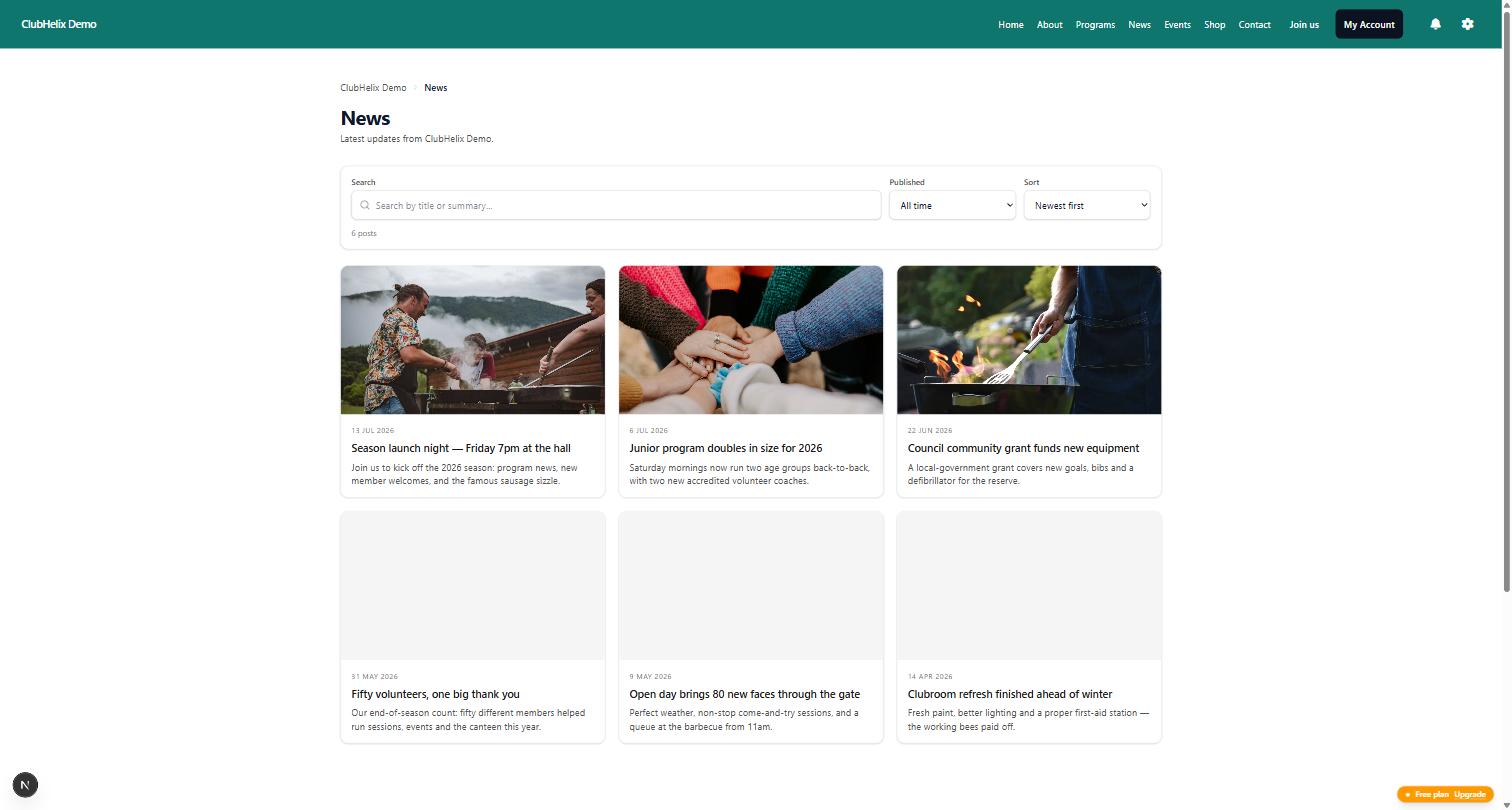
The reason most comic clubs stay at six people is not the reading — it is that nobody outside the room can find them. A club with a page listing the next three picks, the meeting time, the shop partnership and a short review of last month's book is discoverable by exactly the people who want it, and it stays discoverable when the group chat scrolls away. ClubHelix gives you that page with a news feed for reviews and write-ups, an events calendar with RSVPs so you know whether to book the big room for a creator night, and member discount codes for your ticketed nights and anything the club sells itself.
Start free, stay on clear pricing if the club grows into ticketed events and an anthology to sell, and get your club online in the time it takes to read a trade paperback. Groups of every stripe run the same way on our hobby and interest clubs page, and our guide to club social media ideas pairs well with a site that gives you something to link to.
Frequently asked questions
How do you start a comic book club?
Pick a format, a fixed night and a venue, then announce the first three reads before the first meeting so nobody arrives unprepared. Four or five people is enough to start. Approach a local comic shop or your library early, because both can give you a room, a discount or an audience you cannot generate alone.
What should a comic book club read?
Work that someone can start cold — self-contained graphic novels, first volumes, complete runs — and that is available from a library, in print and digitally. Rotate expensive hardcovers with cheaper or library-available picks so cost never decides who takes part, and keep one wildcard month a quarter for small press or a free-choice night.
How do you run a comic book club discussion?
Start with a one-sentence round from everyone, including anyone who did not finish, then work through three or four prepared questions. Push the conversation past plot into layout, art, colour and lettering — a rotating three-minute "art spot" run by a different member each month teaches the whole room to read the medium properly.
How do you get a discount at a comic shop for a club?
Bring an offer, not a request. Members on standing orders, a bulk club order placed early, volunteers on the shop's busy days and promotion to your list all reduce a retailer's risk, and a modest verified member discount is a fair exchange. Put the arrangement in writing and give the shop a reliable way to check who is a current member.
How do you organise a creator visit?
Agree a fee and expenses in writing, ask what the creator wants to talk about, send your questions ahead, and arrange a selling table with a volunteer staffing it. Prepare the introduction, keep the interview to about thirty minutes before audience questions, state the finish time at the start, and write the night up afterwards so the next invitation is easier.
Does a comic book club need a website?
Yes, because it is how people who would love your club actually find it. A page with the next picks, the meeting time and place, past write-ups and a join form does more for growth than any amount of posting, and it survives committee changes in a way a chat thread never does.
Keep reading: how to start a book club for the reading-group fundamentals, and how to run a cosplay club if your members are already making things.


