
What this guide answers
- How many volunteers do we need for a registration day?
For 100–200 visitors over three hours, plan on 12–18 people across greeting, registration desks, coaching conversations, uniforms, catering and a floater — rostered in shifts rather than end-to-end.
- Should we still accept paper forms and cash on the day?
Keep one graceful fallback — a single paper form and a cash tin at the desk — for the rare family that needs it, but make online-with-card the default path and make it the easy path (QR codes, club tablets, volunteers…
- What's the difference between an open day and a come and try day?
An open day shows off the whole club — facilities, coaches, food, atmosphere — and suits clubs whose barrier is "people don't know us".
- How do we handle families who can't pay on the day?
Quietly and kindly. Have a payment-plan option ready (instalments through your registration system, or a committed date), and empower desk volunteers to offer it without escalation or ceremony.
New Zealand edition. This guide is written for volunteer-run clubs in New Zealand. Where rules differ — grants, tax, incorporation, safeguarding — follow the New Zealand-specific pointers below or check with your national body.
A registration day is the one day a year your whole recruitment funnel stands in the same car park. Families who saw the banner, juniors dragged along by a mate, returning members who need a nudge, curious locals who wandered over from the dog park — they're all there, and they're all one good conversation away from joining. Run the day well and you bank a season's worth of memberships in three hours. Run it badly — one long queue, one broken EFTPOS machine, one "just take a form home" — and most of them quietly don't come back.
This guide is the full playbook: what a sign-on day is actually for, how to lay out the stations, who you need on deck, how to take registrations online on the spot instead of collecting paper, and the follow-up that converts the maybes.
Decide which day you're running
Clubs use "registration day", "sign-on day", "open day" and "come and try day" almost interchangeably, but they're different events with different success measures:
-
Registration day / sign-on day — for people who've already decided. The goal is completed, paid registrations. Efficiency wins: short queues, working payments, five minutes per family.
-
Open day — a shop window for the whole club. Facility tours, meet the coaches, sausage sizzle, memorabilia out on tables. The goal is warm leads and a great impression; registrations are a bonus.
-
Come and try day — an activity, not a desk. Kids (or adults) actually play: skills stations, mini-games, gear provided. The goal is "can we contact you?", with registration as the follow-up.
The best format for most community clubs is a hybrid: a come-and-try session running on the field while a registration marquee runs beside it. The activity removes the pressure; the marquee captures the decision while enthusiasm is at its peak. Whichever you run, name it clearly in your promotion so families know whether to bring boots.
Timing matters as much as format. Hold it four to six weeks before round one — late enough that people are thinking about the season, early enough that grading and team nominations can still use the numbers (see the pre-season checklist for how the whole countdown fits together). Saturday mornings, 9am to midday, out-perform almost everything else.
Promote it for four weeks
A registration day with no promotion is a committee barbecue. Four weeks out, in rough order of effectiveness:
- Direct contact with lapsed and returning members. A personal message — "we've missed you, sign-on day is the 14th" — from a coach or manager beats every poster you'll ever print.
- Your website. Banner on the homepage, event page with the date, time, venue and what to bring, and a register button for people who want to skip the queue entirely. Publishing it as a proper event with RSVP gives you a headcount for catering and staffing.
- School newsletters and community Facebook groups. Free, local, and read by exactly the parents you want.
- Physical presence. A banner on the clubhouse fence facing the road, corflutes at the local shops, flyers at the school gate the week before.
Put a QR code linking to your online registration on everything. A meaningful slice of your sign-ups will happen on the couch the night someone sees the flyer — those are wins too.
Station layout: the one-way flow
The difference between a calm sign-on day and a scrum is a one-way flow of clearly signed stations. Set up so a family naturally moves through in order:
Station 1 — Welcome. At the entrance, unmissable, staffed by your two friendliest humans (not your two most senior). Their whole job: greet, ask "new or returning?", hand over a one-page info sheet (fees, training nights, key dates), and direct people onward. New families get walked, not pointed.
Station 2 — Talk to the club. Coaches and team managers, ideally in club polos, near the info tables. This is where questions get answered: which team will my kid be in, what nights are training, what gear do they need. For a come-and-try day this station is the field, with coaches running the activities.
Station 3 — Register and pay. The engine room — covered below in its own section. Two or more tables, each able to complete a registration end-to-end, so one slow conversation doesn't stall the whole line.
Station 4 — Uniforms and merchandise. Sizing samples to try on, plus stock to sell on the day. Fitting a junior for a jersey is a commitment device; families who've held the uniform sign up.
Station 5 — Food and hang around. The barbecue, a coffee cart if you can get one, and somewhere to stand and chat. People who linger join; people who transact and leave in ninety seconds were already yours.

Signage rule of thumb: every station labelled in letters readable from twenty metres, plus an A-frame at the entrance showing the flow. If your layout needs explaining, it needs redesigning.
Staffing the day
For a typical club expecting 100–200 visitors over a three-hour window:
| Role | People | Notes |
|---|---|---|
| Welcome / greeters | 2 | Rotate every hour — greeting is draining done properly |
| Registration desk | 3–4 | Must be trained on the registration flow beforehand |
| Coaches / club talkers | 3–6 | One per age group or section if you can |
| Come-and-try activity runners | 2–4 | Only if running the activity format |
| Uniforms & merch | 2 | One fitting, one selling |
| BBQ / catering | 2–3 | The classic under-staffed station |
| Floater / runner | 1 | Fixes problems, relieves breaks, restocks |
Brief everyone the week before — a twenty-minute run-through of the flow, the fees, and the answers to the ten questions families always ask. Volunteers who can answer confidently are the day's real infrastructure. And roster in shifts: three hours of straight greeting or grilling burns people out and it shows.
Take registrations online, on the spot
Here's the biggest single upgrade to a modern sign-on day: stop collecting paper. Paper forms mean a fortnight of data entry, unreadable email addresses, "the cheque's in my other bag", and a registrar who quietly resigns in March.
Instead, run the registration desk as an assisted online registration station:
-
QR codes on every table pointing at your registration form. Most families complete the whole thing on their own phone while the volunteer answers questions — form, medical details, consents and card payment in one pass through a proper self-registration flow.
-
Two club tablets or laptops for anyone who'd rather not use their phone, with a volunteer driving.
-
Card payment inside the registration itself. When payment is part of the online flow, "registered" and "paid" become the same fact — no reconciliation, no chasing, receipts issued automatically. Keep one EFTPOS terminal for merchandise and the barbecue.
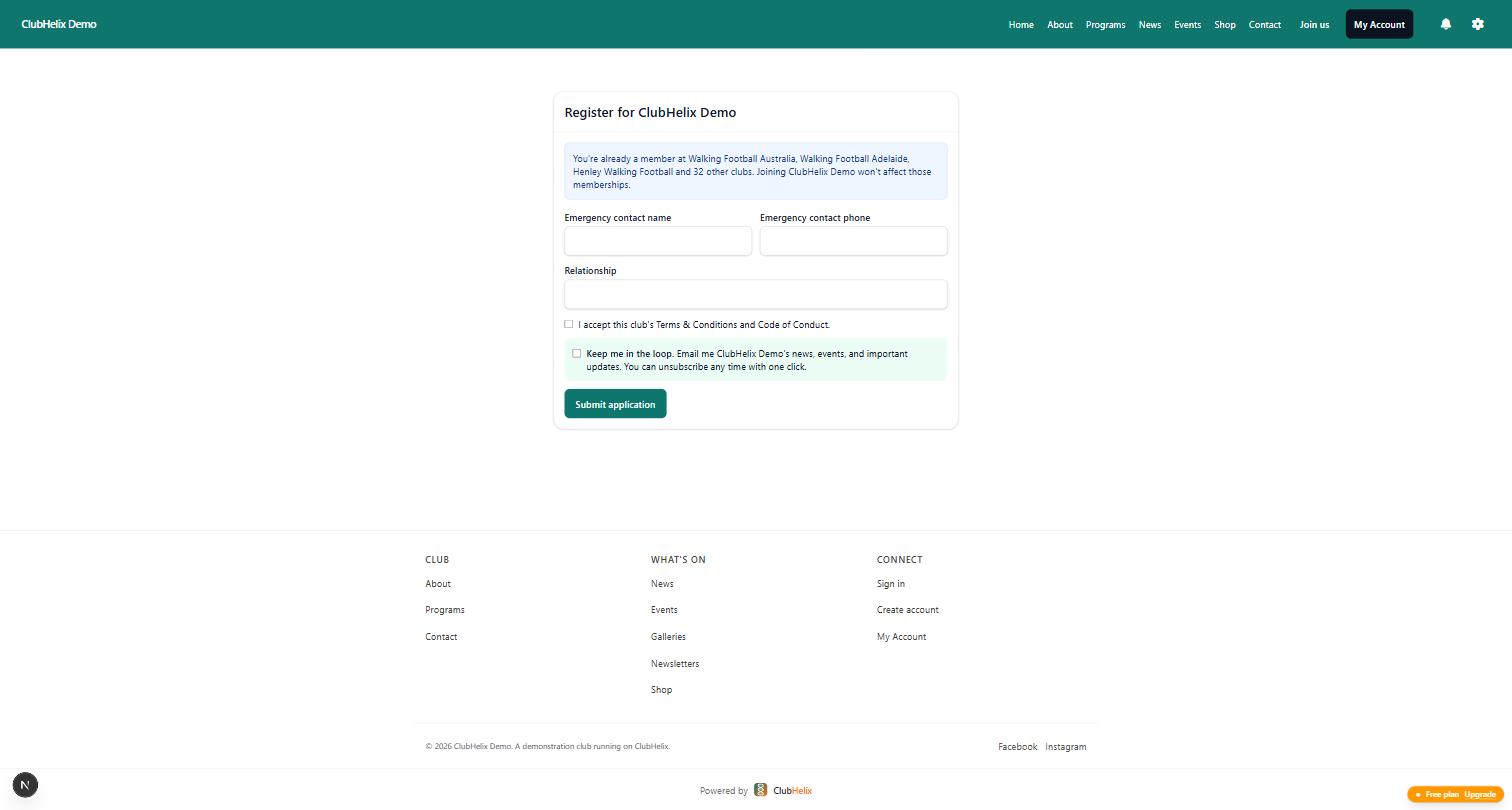
The payoff is enormous: registrations land in your member database as they happen, the treasurer watches money arrive in real time, and the registrar's after-day workload is zero. Volunteers on the desk shift from data-entry clerks to hosts.
One preparation task makes this work: test the full flow yourself the week before, on a phone, on the venue's actual mobile reception. If reception is poor, arrange a wi-fi hotspot and put it near the registration marquee.
For the come-and-try crowd who aren't ready to commit, have a lighter capture ready: a short interest form — name, age group, contact — via its own QR code. A forms tool that drops responses straight into your admin beats a clipboard you'll lose. These are your follow-up list.
Sign-on day ideas that lift the numbers
- Early-bird pricing that expires at day's end. "Register today and save" converts fence-sitters better than any brochure.
- Bring-a-friend incentive. A canteen voucher or raffle entry for members who bring someone new who signs up.
- Free sausage with every completed registration. Silly, cheap, effective.
- A skills challenge with a leaderboard. Fastest lap, target kick, longest throw — kids drag parents back to see their name on the board.
- Club legends on deck. Life members and senior players mingling gives new families the "this club has soul" feeling no flyer can.
- A raffle drawn at midday. Captures contact details from everyone and gives visitors a reason to stay (and keep chatting) until the draw.
After the day: the 48-hour follow-up
The day isn't over when the barbecue's packed up. Within 48 hours:
- Message everyone who registered — welcome to the season, training start dates, what happens next.
- Message everyone who left contact details but didn't register — thanks for coming, here's the registration link, early-bird ends Sunday. This list converts at a rate that will surprise you; they came, they liked it, they just didn't finish.
- Thank the volunteers publicly. Photos from the day, names named.
- Hold a ten-minute debrief. What queued, what ran out, what confused people. Write it down for next year while it's fresh — future-you will be grateful, just as it is for the end-of-season report.
Frequently asked questions
How many volunteers do we need for a registration day?
For 100–200 visitors over three hours, plan on 12–18 people across greeting, registration desks, coaching conversations, uniforms, catering and a floater — rostered in shifts rather than end-to-end. The two stations clubs consistently under-staff are the welcome station and the barbecue; the two that most need training are the registration desks.
Should we still accept paper forms and cash on the day?
Keep one graceful fallback — a single paper form and a cash tin at the desk — for the rare family that needs it, but make online-with-card the default path and make it the easy path (QR codes, club tablets, volunteers who walk people through it). Every paper form is twenty minutes of someone's evening later; every cash payment is a reconciliation line. Most clubs that switch find fewer than one in twenty families uses the fallback.
What's the difference between an open day and a come and try day?
An open day shows off the whole club — facilities, coaches, food, atmosphere — and suits clubs whose barrier is "people don't know us". A come and try day gets newcomers actually playing, and suits clubs whose barrier is "people aren't sure the sport is for them (or their kids)". If you can staff it, run a come-and-try activity inside an open day and put the registration marquee beside both.
How do we handle families who can't pay on the day?
Quietly and kindly. Have a payment-plan option ready (instalments through your registration system, or a committed date), and empower desk volunteers to offer it without escalation or ceremony. A family embarrassed at the registration desk doesn't come back — a family offered a no-fuss plan becomes your most loyal membership. Note any hardship arrangements privately for the treasurer only.
ClubHelix turns sign-on day into a QR code: online registration with payment built in, interest forms for the not-yet-sure, and an event page with RSVP to promote the day itself. Start free and be ready for your next sign-on day.


