
What this guide answers
- What is the correct club election procedure?
Publish notice of the meeting and open nominations within the period your rules require, close nominations by the published deadline, check every nomination against your eligibility rules, publish the candidate list…
- Who can nominate someone for a club committee?
In most clubs a nomination must be proposed and seconded by two members who are themselves entitled to vote, and the nominee must consent in writing and be a financial member in a voting category.
- Can a club committee election be held online?
Only if your governing document permits electronic voting, or a valid bylaw made under it does.
- What happens if nobody nominates for a committee position?
Reopen nominations from the floor if your rules allow it, and otherwise leave the position vacant and let the incoming committee fill it as a casual vacancy.
- Do we have to use a secret ballot?
Many rule sets only require a secret ballot when a member asks for one, but it is good practice to use one automatically for any contested position.
USA edition. This guide is written for volunteer-run clubs in the United States. Where rules differ — grants, tax, incorporation, safeguarding — follow the USA-specific pointers below or check with your national body.
Most club elections are decided before anybody votes. Two people have quietly agreed to stand, nobody else raises a hand, and the annual meeting confirms them in about ninety seconds. That is a real election and a valid one, and it is how the overwhelming majority of community club committees are formed year after year.
The trouble arrives on the rare occasion when a position is genuinely contested — a long-serving president is challenged, or two groups have very different ideas about where the junior program is heading. Suddenly every small step matters. Who was entitled to nominate. Whether the notice went out in time. Whether proxies were allowed, and whether the person holding eleven of them was allowed to hold eleven. Who counted the votes, and where the papers went afterwards. A club that has never needed a rigorous process has to invent one under pressure, in a room where half the people already have a side.
This guide is written for the secretary or returning officer who has to run that election properly. The trick is to use the same process every year, contested or not, so that the year it matters you are following a habit rather than improvising. It covers reading your rules, building a notice timetable, running nominations and testing eligibility, choosing between secret, proxy, postal and online ballots, counting and declaring the result, and handing over cleanly so the new committee can function from the first week.
Start with your rules, not the ballot box
Every club election is governed by a document the club already has, and almost nobody on the committee has read it recently. Before you send a single notice, sit down with your governing document and write out the answers to a fixed list of questions. Most election disputes come from a club doing something entirely reasonable that its own rules did not permit.
In the United States the operative document is your bylaws, sitting under the nonprofit corporation statute of the state you incorporated in. State statutes often set default rules that apply when the bylaws are silent — on notice periods, on quorum, and in particular on whether members may vote by proxy or electronically. If your bylaws are silent on a point, you are not free to invent an answer; the statutory default applies. Take advice before an election that is likely to be contested.
Whatever your document is called, extract these answers and put them at the top of the election file:
| Question to answer | Where it usually sits | Why it bites later |
|---|---|---|
| Which positions are elected, and which are appointed? | Committee composition clause | Clubs routinely hold ballots for roles the committee is meant to appoint |
| How long is a term, and are terms staggered? | Committee composition clause | Electing everyone every year guarantees a knowledge cliff |
| Who is entitled to vote? | Membership categories clause | Junior, social and unfinancial members often cannot vote |
| How much notice must members get? | General meeting clause | Short notice is the single most common ground for challenge |
| When do nominations open and close? | Election clause | A verbal nomination from the floor may or may not be permitted |
| Are proxies allowed, and is there a cap per person? | Voting clause | Uncapped proxies let one person decide a contested position |
| Is a secret ballot required, or only on request? | Voting clause | Show of hands for a contested role reads as intimidation |
| Is electronic or postal voting permitted? | Voting clause, or a bylaw | Many older rule sets predate online voting entirely |
| What is the quorum, and what happens if it is not met? | General meeting clause | An inquorate election is void, however popular the result |
| How are casual vacancies filled mid-term? | Vacancies clause | Determines whether you need a by-election or a committee appointment |
If your rules turn out to be silent, contradictory or plainly unworkable, run this year's election under the most conservative reading of them and put a rules amendment on the agenda for next year. Do not fix the constitution by ignoring it. Our guide on how to write a club constitution covers what a modern election clause should say.
Build the timetable backwards from meeting day
Set the date of the meeting first, then count backwards. Publishing this timetable early is the single cheapest thing you can do to prevent a dispute, because every deadline becomes a published fact rather than a decision somebody made later.
| Working backwards | What happens |
|---|---|
| Meeting day minus 8 weeks | Committee sets the date, appoints a returning officer, confirms the voter roll date |
| Minus 6 weeks | Notice of meeting and call for nominations published to every member |
| Minus 5 weeks | Position descriptions published so people know what they are volunteering for |
| Minus 3 weeks | Nominations close |
| Minus 2 weeks | Eligibility checked, candidate list and any statements published |
| Minus 2 weeks | Proxy or postal ballot papers issued if your rules use them |
| Minus 2 days | Proxy forms due back |
| Meeting day | Ballot, count, declaration |
| Plus 1 week | Minutes circulated, records and access transferred |
| Plus 2 weeks | First meeting of the new committee |
Two of those rows do more work than the rest. The voter roll date freezes who may vote — usually members paid up by a stated date. Set it in advance and publish it, or you will spend the week before the meeting arguing about someone who paid their subs in the car park. The position descriptions row turns an election from a popularity contest into recruitment; see club committee roles and responsibilities for descriptions you can adapt.

Nominations, eligibility and deadlines
Who may stand, and who may nominate
Your rules almost certainly require that a candidate be a financial member in a voting category, and that the nomination be proposed and seconded by two other members who are also entitled to vote. Some clubs add a minimum membership period, a requirement that the candidate consent in writing, or a disqualification for people who cannot lawfully serve on a management committee. Check all of those before you publish a candidate list, not after.
Eligibility is worth testing quietly and early. If a nomination is invalid, tell the nominee privately, tell them exactly which clause it falls foul of, and give them time to fix it if it is fixable — an unpaid subscription usually is. Discovering an ineligible candidate on the floor of the meeting is humiliating for them and corrosive for the club.
The nomination form
Keep it to one screen. Everything on this list has a reason to be there:
- Position being nominated for, with a line for a second preference if your rules allow standing for more than one
- Candidate name, membership number and contact details
- A statement that the candidate is a financial member and consents to stand
- Proposer name and membership number, with signature or verified account
- Seconder name and membership number, with signature or verified account
- Optional candidate statement, hard-capped at something like 150 words
- Any declaration your rules require, such as conflicts of interest or a screening clearance for roles working with young people
- The closing date and time, stated in full, in the form itself
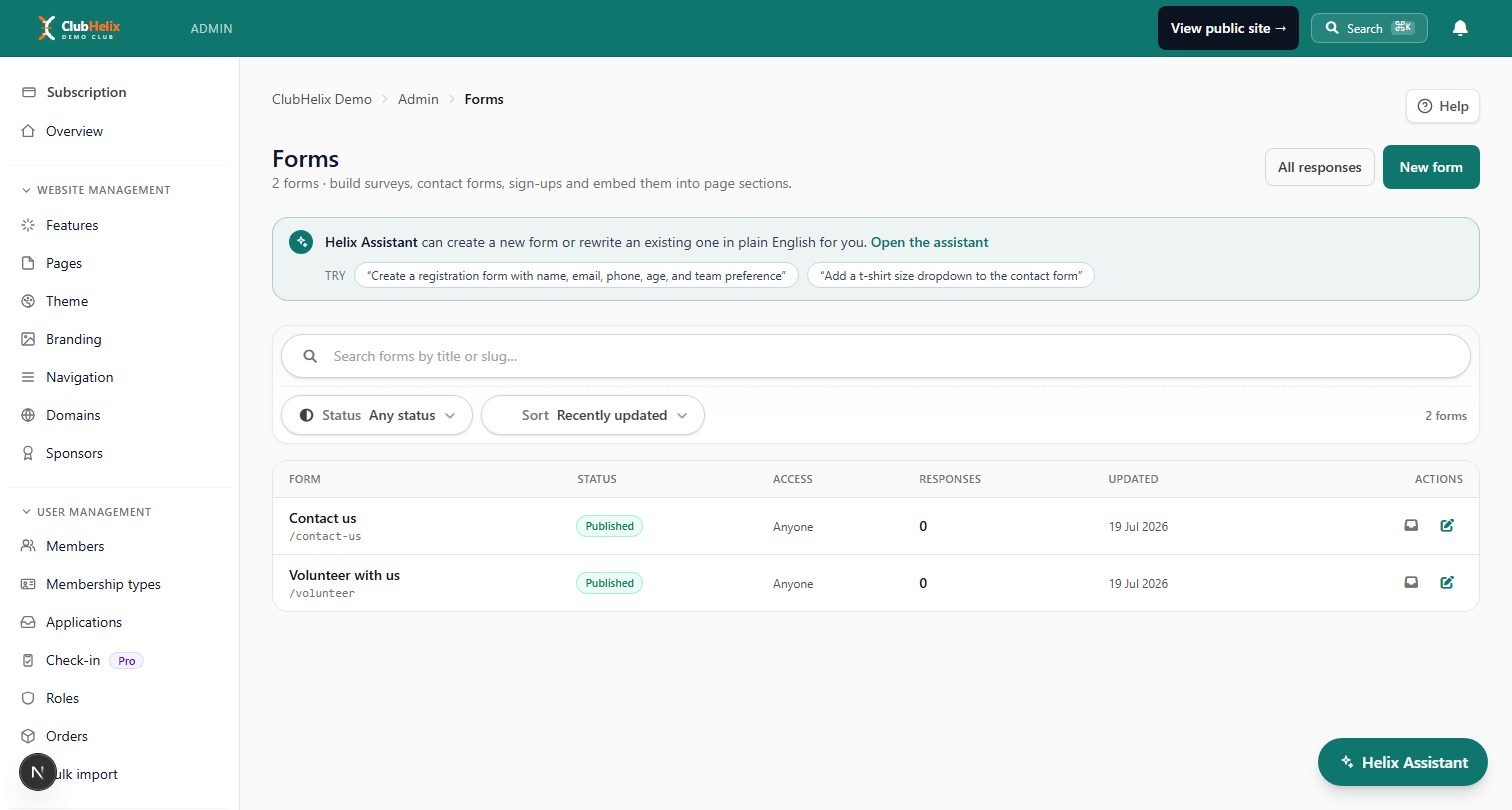
Take nominations online. A shared inbox loses them, and a paper form on the noticeboard is only available to people who visit the club. A simple online nomination form timestamps every submission, refuses late ones automatically, and gives the returning officer a single list to check against the membership roll. ClubHelix does this with forms and surveys tied to your member records, so a nomination arrives already linked to a membership.
When nobody nominates
More clubs face empty positions than contested ones. Prepare for it rather than being surprised:
- Do not leave the call generic. Ask specific people, in person, for a specific role. A general "we need a treasurer" email recruits almost nobody; a direct ask from the president recruits reliably.
- Split the role. If nobody will take on secretary, offer minutes-taker plus correspondence as two smaller jobs. Two half-roles filled beats one whole role vacant.
- Reopen nominations from the floor if your rules allow it, and say clearly in the notice that you intend to.
- Appoint to the vacancy afterwards. Most rule sets let the incoming committee fill a casual vacancy, which buys you months to recruit properly rather than pressuring someone into a role at the meeting.
- Fix the pipeline. A position nobody wants is usually a position that has been allowed to grow unmanageable. See club succession planning for how to shrink roles before they scare people off.
Ballots — secret, proxy, postal and online
Your rules determine which of these you may use. Within that constraint, match the method to the stakes.
| Method | Best for | Watch out for |
|---|---|---|
| Show of hands | Uncontested positions, procedural motions | Never for a contested personal position — people vote with the room |
| Secret paper ballot | Any contested position at an in-person meeting | Ballot paper design, and a controlled count |
| Proxy | Members who cannot attend but want a voice | Caps, deadlines, and whether the proxy is directed or open |
| Postal | Geographically spread memberships | Cost, timing and the chain of custody for returned envelopes |
| Online ballot | Large or dispersed memberships, hybrid meetings | Only if your rules or a valid bylaw permit it, with one vote per member |
Default to a secret ballot for any contested position, even if your rules only require one on request. It costs you three minutes and it protects the candidate who loses, the member who voted against a friend, and the credibility of the result.
Proxies are where the arguments happen
A proxy is a member authorising someone else to vote for them. They are legitimate and useful, and they are also the mechanism by which a determined group can decide a contested position without most of the room realising. Handle them with rules that were published in advance:
- Use a single official proxy form. Handwritten notes and text-message authorisations are unverifiable.
- Set a deadline for lodgement — a day or two before the meeting — and hold it.
- Check whether your rules cap how many proxies one person may hold. If they do not, propose a cap as a rules amendment at the same meeting.
- Distinguish a directed proxy (vote for this named candidate) from an open one (vote as you see fit) and record which is which.
- Read the total number of valid proxies aloud at the start of the meeting, before any vote, so nobody discovers them at the count.
Online and postal ballots
An online ballot solves a real problem for clubs whose members are spread across a region or cannot get to an evening meeting. Two conditions apply. Your rules must permit it — many older rule sets predate the idea entirely, in which case amend the rules first and vote online next year. And the mechanics must give you one verified vote per eligible member, with a result that someone other than the organiser can check.
Postal ballots do the same job more slowly, and they remain the fallback where rules require a physical ballot paper. Use two envelopes — an inner unmarked one holding the ballot, an outer one carrying the member's details — so eligibility can be checked without anyone seeing how a member voted.
The meeting day run sheet
Print this and give it to the returning officer. The returning officer should not be a candidate, and ideally is not on the outgoing committee at all — a life member, a member from another club, or the auditor are all good choices.
- On arrival. Mark attendees against the frozen voter roll. Issue voting cards only to eligible members. Record proxies received and who holds them.
- Before business. Confirm quorum aloud and minute the number. If quorum fails, do not proceed to an election.
- Hand over the chair. The president vacates the chair for elections; the returning officer takes it and remains in it until all positions are declared.
- Position by position, in order. Read the position, read the valid nominations in the order received, and confirm each candidate is present or has consented in writing.
- Uncontested. Declare elected unopposed. Do not hold a confirming vote unless your rules require one.
- Contested. Allow each candidate up to two minutes to speak, in an order drawn by lot. Distribute ballot papers, collect them in a single container, and appoint two scrutineers who are not associated with any candidate.
- Count out of the room but with the door open. Returning officer plus both scrutineers, nobody else. Count twice.
- Declare the winner without the numbers unless your rules require the tally, or the meeting resolves to hear it. Ask the meeting to accept the result and move on.
- Retain the ballot papers in a sealed envelope, signed by the scrutineers, for the period your rules or your records policy require.
If a count is tied, your rules will usually specify a casting vote or a fresh ballot. If they do not, the safest course is a second ballot, then a lot drawn in front of the meeting — and a rules amendment next year.
Declaring, recording and telling the right people
The declaration is a sentence, and it should be the same sentence every year. Something like: "I declare that the following members have been elected to the committee for the year ahead, and that all positions are filled except those noted." Then read the list.
The minute matters more than the announcement, because in a year's time the minute is the only evidence. Record the position, the candidates, whether the ballot was secret, the number of proxies admitted, the declaration, and any position left vacant. Do not record who voted for whom. The club meeting minutes template has a structure you can lift, and how to run a club AGM covers the meeting the election usually sits inside.
In the United States, most states require a nonprofit corporation to keep a current registered agent and to file a periodic report listing directors and officers, with the frequency and deadline varying by state. Some states also expect prompt notification of officer changes. Check your state's requirements after each election, and treat this as general information rather than advice.
Beyond any regulator, the list of people to tell is short and predictable: your national or regional governing body, your bank, your insurer, your grant funders where an office-bearer is named on an agreement, and your own members. Send members the result the same week, with a short thank-you to everyone who stood.
Handing over cleanly in the first fortnight
An election that produces a committee which cannot access the bank account, the email address or the website has failed at the last step. Work through this in the two weeks after the meeting:
| Item | From | To | Watch for |
|---|---|---|---|
| Bank mandate and signatories | Outgoing treasurer | Incoming treasurer | Bank appointments and identity checks take longer than you expect |
| Club email accounts | Outgoing officers | Incoming officers | Transfer the account, never just forward it to a personal address |
| Website and admin logins | Outgoing secretary | Incoming secretary | Change roles, do not share a single password |
| Social media accounts | Whoever holds them | New communications lead | Recovery numbers pointing at a departed member's phone |
| Records and minutes | Outgoing secretary | Incoming secretary | Keep the archive with the club, not in a personal cloud drive |
| Keys, alarm codes, equipment | Outgoing committee | New role holders | Make a list on the night, collect within a fortnight |
| Governing body portal access | Outgoing registrar | Incoming registrar | Often needs the governing body to action it, so start early |
On the digital half of that list, role-based access beats shared passwords in every respect. When the secretary changes, you change who holds the secretary role rather than resetting a password that four people know. Our committee handover checklist covers the rest of the transition, including the first meeting agenda.
Running the whole election from your club site
The election is a sequence of small administrative jobs that each have a deadline, and missing any one of them is what creates a dispute. A nomination form that closes itself on time, a members list that tells you instantly who is financial and therefore eligible, a notice that reaches every member on the same day, and a permissions system where the new secretary gets the secretary's access the moment they are elected. ClubHelix handles those with online forms and surveys for nominations, email broadcasts from your own club domain for notices and results, roles and permissions so access follows the position rather than the person, and governance and meetings for the agenda, papers and minutes.
It is free to start, and the pricing is on one page with no sales call in the way. If your election is already in the diary, you can set your club up in an afternoon and have nominations open by the weekend.
Frequently asked questions
What is the correct club election procedure?
Publish notice of the meeting and open nominations within the period your rules require, close nominations by the published deadline, check every nomination against your eligibility rules, publish the candidate list, hold a secret ballot for any contested position run by a returning officer who is not a candidate, count with two independent scrutineers, declare the result, and minute it. Use the same procedure whether or not a position is contested.
Who can nominate someone for a club committee?
In most clubs a nomination must be proposed and seconded by two members who are themselves entitled to vote, and the nominee must consent in writing and be a financial member in a voting category. Some rule sets also require a minimum period of membership. Check your own governing document, because these details vary and an invalid nomination is the most common reason a result gets challenged.
Can a club committee election be held online?
Only if your governing document permits electronic voting, or a valid bylaw made under it does. Where it is permitted, an online ballot needs one verified vote per eligible member, a clear close time, and a result that someone other than the organiser can verify. If your rules are silent or predate online voting, run this year's ballot the traditional way and amend the rules for next year.
What happens if nobody nominates for a committee position?
Reopen nominations from the floor if your rules allow it, and otherwise leave the position vacant and let the incoming committee fill it as a casual vacancy. That is usually permitted and it buys months to recruit properly. It is also a signal worth acting on — a role nobody wants is normally a role that has grown too large, so split it before you advertise it again.
Do we have to use a secret ballot?
Many rule sets only require a secret ballot when a member asks for one, but it is good practice to use one automatically for any contested position. A show of hands in a small room asks members to vote against a friend in public, which suppresses honest voting and makes a close result feel unsafe. It takes a few minutes and it protects everyone involved.
How long should we keep the ballot papers?
Keep them sealed and signed by the scrutineers at least until the period for challenging the result has passed, and ideally for as long as your records policy keeps meeting papers. Store them with the minutes rather than in a committee member's house, so that if the result is queried the evidence still exists and is under the club's control.
Keep reading — how to run a club AGM covers the meeting the election sits inside, and the committee handover checklist picks up the morning after.

