
What this guide answers
- Do we need a licence to run a club canteen?
Usually yes, but the rules are set by your county or city health department and vary enormously — from a light touch for pre-packaged food to a full permit with a certified food protection manager on site.
- How long should a canteen shift be?
Sixty to ninety minutes. Short shifts are dramatically easier to fill, and rostering pairs on rotating short shifts beats asking one hero to run the whole day.
- How much profit should a club canteen make?
It varies with your sport, crowd and menu, but a canteen that buys at wholesale prices, prices with real margins and controls waste should comfortably clear its costs and become one of the club's steadiest earners.
- What sells best at a sports club canteen?
The staples: sausage sizzles, pies, cold drinks, hot drinks on cold mornings and lolly bags at junior sport.
USA edition. This guide is written for volunteer-run clubs in the United States. Where rules differ — grants, tax, incorporation, safeguarding — follow the USA-specific pointers below or check with your national body.
Ask any long-serving committee member where the club's spare money comes from and the answer is usually the same: the canteen. A well-run canteen quietly funds new equipment, subsidises junior fees and keeps the club social — because the queue for a sausage and a coffee is where half the club's conversations happen.
A badly run canteen, on the other hand, is a weekly scramble: no roster, no float, a fridge full of expired stock and one exhausted volunteer who's threatening to retire. The difference isn't effort — it's a handful of systems. This guide covers how to run a club canteen from setup and approvals through menus, stock, rosters, money handling and the small tricks that turn "roughly breaking even" into a genuine fundraiser.
Set up the basics: space, gear and approvals
Before the first sausage hits the grill, get three things sorted:
-
The space. You need a servery with a bench, power for fridges and urns, hand-washing facilities and somewhere lockable for stock. If your clubrooms are council-owned, confirm what you're allowed to install or modify.
-
The gear. A realistic starter kit: a good barbecue, a fridge and freezer, an urn, a pie warmer, tongs and utensils, cleaning supplies, and a card reader — more on that below. Add a coffee machine only when you have volunteers who can drive it.
-
The approvals. Rules are set locally, by your county or city health department, and they vary enormously — some jurisdictions treat a concession stand serving pre-packaged food very lightly, others require a full permit, a certified food protection manager on site, and a plan review before you open. Many states have a specific exemption for non-profit and occasional fundraising sales; find out whether yours does before you assume anything. Call the health department directly and ask what applies to a volunteer-run concession stand operating on game days only.
This is general information, not legal advice — check the current food business requirements with your local council and your state's food authority before opening.
Plan a menu that actually sells
The biggest canteen mistake is an ambitious menu. Every extra line means more stock to buy, store, rotate and waste. Start small, sell out, then expand:
| Menu staple | Why it works | Stock tip |
|---|---|---|
| Sausage sizzle | Cheap ingredients, cooks in batches, smells like sport | Buy sausages and bread the day before; freeze leftovers |
| Pies and sausage rolls | Pie warmer does the work; no skill required | Frozen stock keeps for months — buy in bulk |
| Hot and cold drinks | Best margins in the canteen, especially coffee and tea | Shelf-stable; never runs out of date if stored properly |
| Lolly bags and snacks | Junior sport's reliable earner | Pre-bag at home during the week; price for coin-free sums |
| Fruit and water | Keeps parents and healthy-canteen guidelines happy | Small quantities, topped up weekly |
Two principles do most of the work. Shelf-stable core, perishable top-ups: build the menu around things that can't spoil (drinks, snacks, frozen goods) and buy perishables in small weekly amounts. Round pricing: price everything so change is trivial — it halves queue time and till errors.
For canteen ideas beyond the staples, watch what sells out first and double it, and steal shamelessly from other clubs' canteens when you play away.
Stock, suppliers and margins
Treat the canteen like the small business it is:
- Buy at wholesale prices — warehouse clubs, cash-and-carry suppliers or a friendly local butcher who'll do club pricing. Never pay retail for sausages.
- Know your unit cost for every item and price with a healthy margin — as a rule of thumb, aim to sell for at least double what an item costs you, more for drinks.
- Run a simple stocktake sheet. Count stock at close, note what sold, and let that drive the next order. Ten minutes a week ends both sell-outs and waste.
- Ask sponsors and local businesses for product support — a bakery donating bread or a wholesaler doing club pricing is often an easier ask than cash sponsorship.
Feed the numbers into your club's finances properly rather than treating canteen cash as a mystery envelope — our club budget template has a line for exactly this.

The club canteen roster (the make-or-break bit)
Canteens don't fail because of food — they fail because the same three people staff every shift until they quit. A fair, visible club canteen roster is the single most important system you'll build:
- Keep shifts short. Sixty to ninety minutes is the sweet spot — almost anyone will say yes to an hour, almost no one to a full Saturday.
- Staff in pairs, and always roster a newcomer with someone experienced. Two people per shift also keeps the cash honest.
- Spread the load by team. Many clubs assign each team one canteen date per season — the duty is predictable and peer pressure does the reminding.
- Publish the roster early and make swaps self-service, so a sick volunteer finds their own replacement instead of texting the coordinator at 7am.
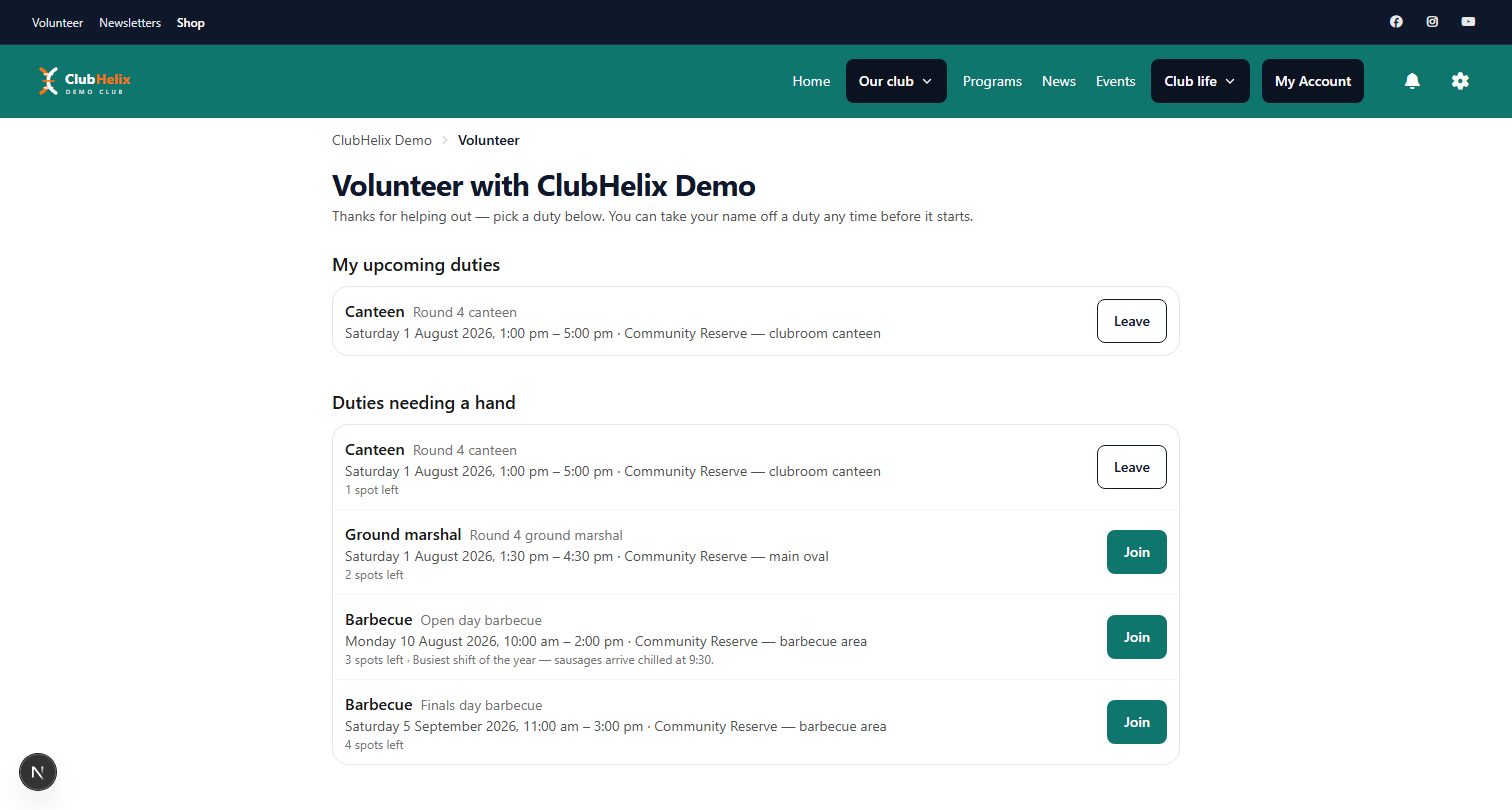
Start with our free volunteer roster template if you're on paper today. When the spreadsheet starts fraying, volunteer rostering lets members claim canteen shifts themselves online, with automatic reminders before their duty — which quietly ends the no-show problem.
Handle the money properly
Nothing sours a canteen faster than money going missing — or looking like it might have. Simple discipline protects your volunteers as much as your funds:
- Start every shift with a counted float in a lockable tin, recorded on the stocktake sheet.
- Take cards. A cheap tap-and-go reader typically lifts takings noticeably, because nobody carries cash to junior sport any more.
- Count together at close. Two people count the tin, record the total against the float, and both initial it.
- Bank promptly and hand the treasurer the shift record — takings, float, card total — so the canteen appears cleanly in the monthly report.
Food safety without the fear
You don't need a commercial kitchen to be safe — you need a few habits done every time: keep hot food hot and cold food cold, wash hands and use gloves and tongs, separate raw and cooked, label and date anything stored, and keep a visible allergen note for common items. Nominate one person per shift to own temperatures and handwashing, and induct every new volunteer with a two-minute rundown. The full checklist lives in our guide to food safety for club canteens.
Make it profitable — and fun
The gap between a break-even canteen and a genuine fundraiser is a few habits:
- Coffee is your margin king. Even a basic pod machine turns cents of ingredients into a few dollars a cup on cold mornings.
- Meal deals move stock and speed the queue — sausage, drink and lolly bag at one round price.
- Take pre-orders for juniors. Some clubs take half-time order forms from teams, or sell canteen vouchers and meal deals through their online club shop so parents pre-pay for the season.
- Announce it. A line in the weekly club broadcast — "canteen's open from 8am, bacon rolls till they run out" — measurably lifts sales.
- Track weekly takings on one sheet. When the committee can see the canteen cleared its costs by round four, keeping it staffed gets much easier.
And if your canteen crew gets good, take the show on the road — a Bunnings sausage sizzle uses exactly the same skills for a lump-sum payday.
A canteen runs on the same rails as the rest of your club: a roster people can see, reminders that arrive by themselves, and money that reconciles. ClubHelix gives clubs volunteer rostering, broadcasts and an online shop in the same place as the membership list — there's a free tier, so you can set up your club and roster next Saturday's canteen this week.
Frequently asked questions
Do we need a licence to run a club canteen?
Usually yes, but the rules are set by your county or city health department and vary enormously — from a light touch for pre-packaged food to a full permit with a certified food protection manager on site. Many states carve out non-profit or occasional fundraising sales. Call your local health department and ask specifically about a volunteer-run concession stand — this is general information, not legal advice.
How long should a canteen shift be?
Sixty to ninety minutes. Short shifts are dramatically easier to fill, and rostering pairs on rotating short shifts beats asking one hero to run the whole day.
How much profit should a club canteen make?
It varies with your sport, crowd and menu, but a canteen that buys at wholesale prices, prices with real margins and controls waste should comfortably clear its costs and become one of the club's steadiest earners. Track takings weekly so you know, rather than guess.
What sells best at a sports club canteen?
The staples: sausage sizzles, pies, cold drinks, hot drinks on cold mornings and lolly bags at junior sport. Coffee usually has the best margin of anything in the canteen. Watch what sells out first each week and stock more of it.