
What this guide answers
- How should a cheer club run tryouts fairly?
Publish the scoring rubric and the squad composition you need before tryouts, score against it on the day with at least two independent assessors, and keep the signed sheets.
- What should a cheer club tell families about costs?
Everything, before tryouts, on one page. List registration, training fees, choreography and music, uniform, practice wear, shoes and accessories, competition entries, travel and spectator admission, each with a due date.
- Who is allowed to coach stunting and spotting?
That is set by your governing body and by the rules of the events you enter, and it changes — always work from the current published version rather than last season's understanding.
- How far ahead should uniforms be ordered?
Earlier than feels necessary. Custom cheer uniforms have long production lead times and a single missing measurement can delay a whole squad's order.
- Does a cheer club need its own website?
Yes — it is where the cost sheet, the selection policy, the competition briefs and the enrolment forms live in a form families can find without asking.
USA edition. This guide is written for volunteer-run clubs in the United States. Where rules differ — grants, tax, incorporation, safeguarding — follow the USA-specific pointers below or check with your national body.
Almost every community sport lets a club fudge selection. Grade the teams roughly, shuffle a player between sides mid-season, and nobody's year is ruined. Cheer does not work like that. A routine is a two-and-a-half-minute piece of choreography built around specific bodies in specific positions, learned over months, and it cannot absorb a mid-season change without unpicking the stunt groups and the pyramid. So the squad is locked early, selection is compulsory and visible, and the day you publish the lists is the day your club's reputation with families is made or damaged.
The other thing that makes cheer distinctive is the money shape. Most sports charge a season fee and leave it there. A cheer season charges a training fee, then a uniform, then a competition entry, then travel, then a warm-up jacket, then shoes and bows, and each of those arrives as a separate ask from a separate person. Families who would have happily paid the total up front feel nickelled and dimed by the drip, and the complaint you eventually get is never about the amount — it is about not having been told.
This guide is for committees and program directors running a community or all-star cheer club. It covers building a tryout and squad placement process that survives an unhappy parent, publishing the true cost of a season before anyone commits, running uniform and kit orders without burying your treasurer, and the safety side — stunt progressions, spotting and coach qualifications — where getting the paperwork right matters as much as getting the coaching right.
The shape of a cheer year
Cheer runs on a fixed sequence rather than a calendar of fixtures, and every deadline in it is downstream of the first competition date. Build your club year backwards from that, expressed in weeks, so it transfers cleanly whichever way your seasons fall.
| Stage | Timing | What has to be finished |
|---|---|---|
| Registration of interest | 14-16 weeks out | Enquiries, come-and-try sessions, cost sheet published |
| Tryouts | 12-14 weeks out | Assessment, placement, appeals window closed |
| Squads announced | 12 weeks out | Rosters locked, fees invoiced, deposits taken |
| Choreography camp | 10-11 weeks out | Routine set, positions assigned, stunt groups formed |
| Uniform sizing and order | 10 weeks out | Measurements taken, order placed, balance invoiced |
| Skills deadline | 6 weeks out | Every element in the routine performed cleanly at training |
| Competition entries close | 4-6 weeks out | Entries paid, division declared, athlete lists submitted |
| Full-out run-throughs | 2-4 weeks out | Routine performed at pace, music cut final |
| Competition day | Week 0 | Call times, warm-up slot, uniform check |
With the school year starting in the fall, most all-star programs hold tryouts in late spring or early summer, place athletes for a season that runs into the following spring, and take deposits well before the first practice. That long runway is an advantage on planning and a risk on attrition — families commit financially many months before the first competition, so your withdrawal and refund policy needs to be written and agreed at sign-up, not improvised in the new year.
Tryouts and squad placement that survive an unhappy parent
Selection disputes are not really about the decision. They are about the process feeling arbitrary. A process that is written down, published before tryouts, applied identically to everyone and explainable afterwards will survive almost any individual disagreement. One that lives in the head coach's judgement will not, however good that judgement is.
Publish the criteria before anyone tries out. A workable rubric splits the score across skill and non-skill areas, because a squad selected purely on tumbling ability tends to be a squad that cannot hold a pyramid or arrive on time.
| Area | What is assessed | Suggested weight |
|---|---|---|
| Tumbling | Standing and running skills, consistency under fatigue | 25% |
| Stunting | Base, back, flyer competence in the positions you need | 25% |
| Jumps and motions | Technique, sharpness, timing | 15% |
| Dance and performance | Retention of choreography, energy, facial performance | 15% |
| Attitude and coachability | Response to correction, treatment of teammates | 10% |
| Commitment record | Attendance at trials and previous season, punctuality | 10% |
Six things make the process defensible:
- Two assessors minimum, scoring independently, with at least one who is not the parent or coach of anyone trying out. Average the scores and keep both sheets.
- Score against the rubric on the day, not from memory afterwards. Sheets get signed and dated and are retained for the season.
- Position needs are declared in advance. If you need three flyers and eleven bases, say so publicly before tryouts. Families accept squad composition maths; they do not accept discovering it afterwards.
- Announce placements privately first, then publish the lists. A short private message before the public post gives a disappointed athlete somewhere to put the first reaction.
- Offer a feedback conversation to everyone who asks, framed as "here is what to work on", with the rubric in front of you.
- Run a genuine appeals step — narrow, quick and written.
An appeals policy does not mean re-running the tryout. It means a defined path for a family who believes the process was not followed. State plainly that appeals may be made on process grounds only, not on disagreement with a scoring judgement; set a short window such as five working days; require the appeal in writing; have it heard by two committee members with no connection to the athlete or coach; and cap the outcome at either "process was followed, decision stands" or "process was not followed, athlete is reassessed". Publish that alongside the criteria. Our team selection policy template gives you the wording to adapt.

Publishing the true cost of a season
The single highest-value document a cheer club produces is a one-page season cost sheet, published before tryouts, listing every foreseeable charge with its due date. It converts a series of unpleasant surprises into an informed decision, and it dramatically reduces the mid-season withdrawals that leave you rebuilding a stunt group in week nine.
List every line, including the ones you are not charging for, marked as included:
| Line item | When it falls due | Notes to give families |
|---|---|---|
| Registration or club fee | At sign-up | Covers insurance and affiliation |
| Training fees | Weekly, monthly or per term | State the number of weeks covered |
| Choreography and music | Once, after squads announced | Usually a per-athlete share of a fixed cost |
| Competition uniform | Once, at order | Often the single largest one-off item |
| Practice wear and warm-up | Once | Say clearly whether it is optional |
| Shoes, bow, accessories | Once | Specify the required model so nobody buys twice |
| Competition entry fees | Per event | Per athlete, set by the event organiser |
| Travel and accommodation | Per event | Estimate honestly rather than omitting |
| Spectator admission | Per event | Families rarely expect this one |
Three practices turn the sheet into a fair system rather than a bigger bill:
- Take a deposit at placement and offer instalments for the rest. A season paid weekly or fortnightly by direct debit is far easier on a household than three lumps, and it is easier on your cash flow too — direct debit versus upfront membership fees works through the trade-offs.
- Publish a hardship pathway. One line — "if cost is a barrier, contact the club in confidence" — plus a named person and a documented, quiet process. Clubs that do this keep athletes they would otherwise lose without ever discussing it publicly.
- Never charge for something that was not on the sheet. If a cost genuinely emerges mid-season, put it to families as an opt-in, not an invoice.
For an all-star program here, families should expect the uniform, choreography, music, competition entries and travel to add up to substantially more than tuition across a season, and the total commitment is typically made a year in advance. Program fees are commonly billed monthly. Publish the full-season total in dollars alongside the monthly figure — the monthly number on its own understates what a family is signing up to.
Uniform and kit orders without burying your treasurer
Uniform is where cheer club admin most often collapses, because it combines sizing risk, a long supplier lead time, per-athlete customisation and a hard deadline that is somebody else's. Run it as a project with dates, not as a rolling collection.
Hold a single sizing day with a sample set of garments and two people measuring, and record measurements against each athlete in your membership records rather than on a clipboard that goes home in someone's bag. Set one order deadline and hold it — communicate from the start that a late measurement means a late uniform, and mean it, because a single late athlete can delay an entire squad's dispatch. Take payment at the point of order, not on delivery; you are placing a non-returnable custom order on families' behalf and should not be carrying that risk on the club's account.
Two further habits pay for themselves. Order a small buffer of common sizes if your supplier allows it, because growth spurts between sizing day and competition are guaranteed in a junior squad. And run a second-hand exchange for practice wear, warm-ups and shoes — a simple pinned listing with sizes and prices, refreshed each season, saves families real money and reduces the amount of barely-worn kit sitting in cupboards. Your club uniform policy template is a good place to write down what is compulsory, what is optional and who owns what.
Collect the orders through an online form tied to each athlete's record, with sizes, payment and consent captured in one submission. It is the difference between a treasurer reconciling a spreadsheet against a bank feed for a weekend and a treasurer exporting a supplier-ready list in a minute.
Stunt safety, spotting and coach qualifications
This section is general information, not a rule book. Cheer safety standards — permitted skills by division and age, spotting requirements, surface requirements and coach qualification levels — are set by your governing body and by the rules of the events you enter, they are revised, and they differ by market. Take the published version of your own body's rules as the source of truth and check it before every season.
What is universally yours to manage is the system around those rules:
- Progression discipline. Skills are introduced in a documented order, and an athlete does not attempt a new element until the prerequisites are consistently clean. Write the progression down so a substitute coach cannot accidentally skip a step.
- Never above the level you have entered. Squads sometimes train a skill "for next year". Keep that out of routine training time and out of any session where the whole squad is working at pace.
- Spotting as a staffed role. A spotter is a trained position, not the nearest available adult. Record who is qualified to spot and at what level.
- Surfaces and space. Skills are performed on the surface they were cleared for, with enough clearance around the group. A hall booking that shrinks your usable floor changes what can safely be trained that night.
- A written injury and concussion protocol, including who makes the call to stop, who contacts the family, and what evidence is needed before return. Follow your governing body's guidance and, for any head injury, medical advice.
- Currency tracking for coaches. Coaching accreditation, first aid, CPR and any required background screening all have expiry dates. Keep them in one register with alerts, not in a folder someone checks in February.
Coaches and volunteers will generally need criminal background screening arranged through the program or its governing body, plus abuse-prevention training, first aid and CPR, and a coaching credential appropriate to the level being coached. Requirements are set at national, state or provincial level and change, so verify the current position with your governing body before the season starts.
Floor time is your scarce resource
A cheer club's real constraint is not coaches or athletes — it is metres of usable, appropriately surfaced floor at the hours families can attend. A full competition floor is bigger than most community halls offer, and a squad that has only ever trained a routine in two halves will find out on competition day that its spacing is wrong.
Work out early how many full-floor sessions your routine genuinely needs and buy them deliberately. A workable pattern for a community club is weekly training in a general hall for skills, conditioning and section work, plus a small number of booked full-floor sessions clustered in the last month — at a gymnastics facility, a school hall with adequate matting, or shared time with another club. Book those dates before you announce squads, because they are the sessions that cannot be moved.
Run your squads as enrolled programs with a defined block of weeks, a cap on numbers and a waitlist, rather than as an open training night. It makes the venue maths honest, it tells families exactly what they are paying for, and it gives you a clean list of who is actually enrolled in what. Programs and term enrolment handles that structure directly, and if you also run recreational classes as a feeder, how to start a junior program covers building the pipeline into competitive squads.
Competition day
The day itself is short, tightly timetabled by the event organiser, and unforgiving of a club that improvises. Build a one-page athlete and family brief for every event and send it three days out.
| Time relative to performance | What happens |
|---|---|
| Minus 3 hours | Hair and makeup done at home to the published standard |
| Minus 2 hours | Team arrival and roll call at a named meeting point |
| Minus 90 minutes | Uniform and jewellery check, hair check, nails checked |
| Minus 60 minutes | Stretch and general warm-up |
| Minus 30 minutes | Allocated warm-up floor, stunts and tumbling in the order coached |
| Minus 10 minutes | Move to holding area, final motions, phones handed to team manager |
| Performance | Squad on floor |
| Immediately after | Team photo, coach debrief, no scores discussed with athletes yet |
| Awards | Full squad attends in uniform |
The brief should state the arrival time, the meeting point, the hair and makeup standard, what athletes bring, what parents should not do at the warm-up floor, the anticipated finish time, and one named contact who is reachable on the day. Publish it to your club site as well as sending it, so nobody is scrolling a chat thread in a car park. Collect medical information, photo permissions and emergency contacts once at registration through digital waivers rather than passing paper forms around a competition venue.
Putting the season on one page
Everything that makes a cheer club stressful is information that exists but is scattered — the cost sheet in a document nobody can find, tryout sign-ups on a clipboard, uniform sizes in a chat thread, coach accreditation expiries in someone's inbox, medical forms in a folder in a car. ClubHelix keeps it in one club website and admin: programs and term enrolment for squads with caps, waitlists and instalment billing, online registration that captures sizes, medical details and consents at sign-up, digital waivers that are signed once and stored against the athlete, and accreditation tracking so a coach's expiring qualification surfaces months before it becomes a problem.
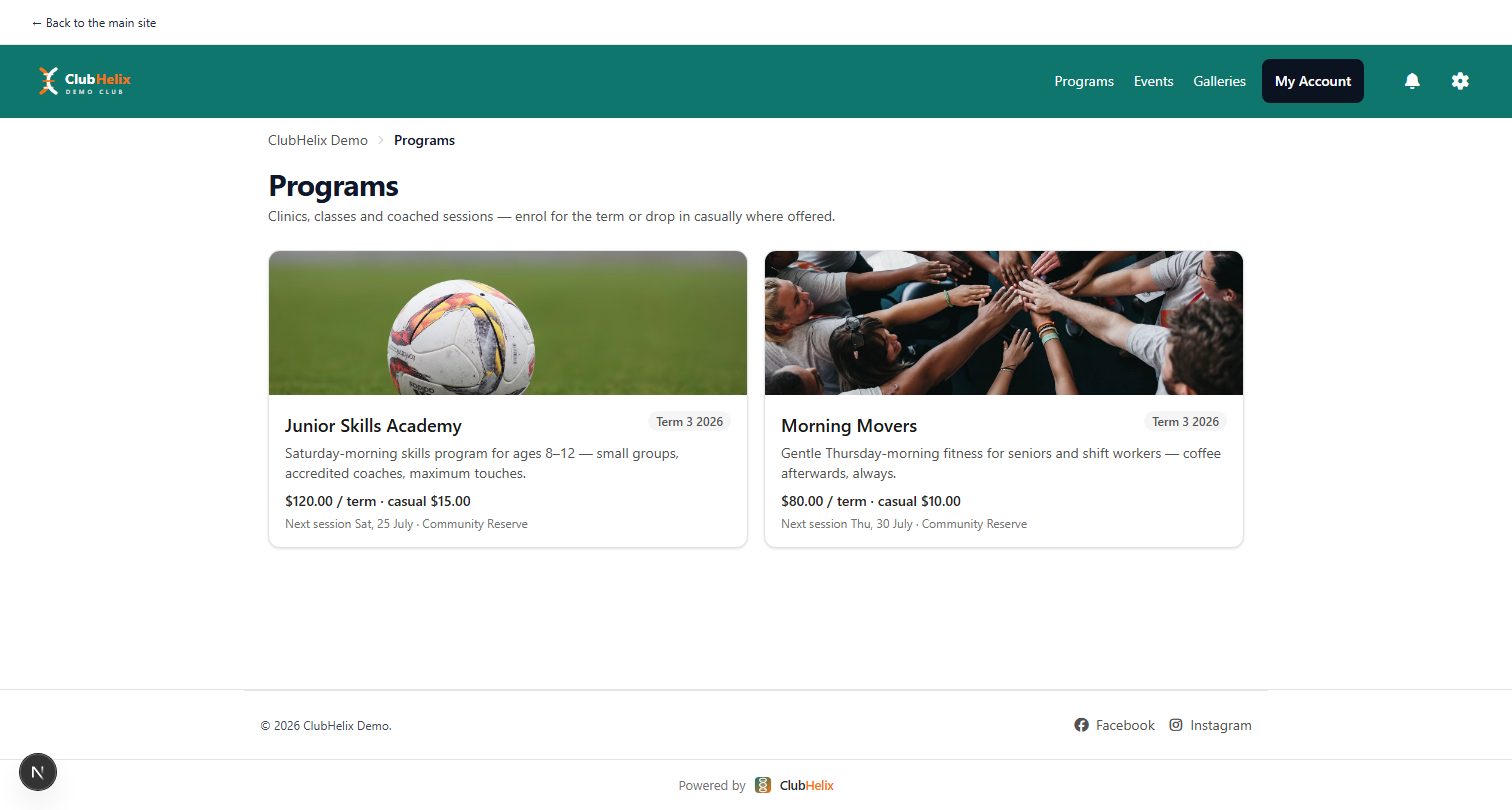
Given how much of this article is about being straight with families on cost, it would be odd not to apply the same standard to ourselves — every plan and its price is listed openly, so your committee can do the sums before committing anything, and the free tier covers a club that simply wants its squads, calendar and enrolments online. It is a locally built and locally hosted platform. Most committees have a squad page, a cost sheet, an enrolment form and an event calendar up in a single evening, so create your club site and see how far you get before training finishes. If you also run recreational classes as a feeder, the gymnastics club management software page shows the same tools in a class-based club, and our cheerleading club management software page shows them arranged around tryouts, tuition and competition entries.
Frequently asked questions
How should a cheer club run tryouts fairly?
Publish the scoring rubric and the squad composition you need before tryouts, score against it on the day with at least two independent assessors, and keep the signed sheets. Announce placements privately before publishing lists, offer a feedback conversation to anyone who asks, and run a narrow written appeals step limited to whether the published process was followed.
What should a cheer club tell families about costs?
Everything, before tryouts, on one page. List registration, training fees, choreography and music, uniform, practice wear, shoes and accessories, competition entries, travel and spectator admission, each with a due date. Offer instalments and a confidential hardship pathway, and never invoice for something that was not on the published sheet.
Who is allowed to coach stunting and spotting?
That is set by your governing body and by the rules of the events you enter, and it changes — always work from the current published version rather than last season's understanding. What every club should manage itself is the system around it: documented skill progressions, spotting treated as a qualified role, and a register of coach accreditations, first aid certificates and background screening with expiry dates tracked.
How far ahead should uniforms be ordered?
Earlier than feels necessary. Custom cheer uniforms have long production lead times and a single missing measurement can delay a whole squad's order. Hold one sizing day with sample garments, record measurements against each athlete's record, set a firm order deadline, and collect payment at the point of order rather than on delivery.
Does a cheer club need its own website?
Yes — it is where the cost sheet, the selection policy, the competition briefs and the enrolment forms live in a form families can find without asking. It also lets you take registrations, sizes, medical details and consents in one submission, which removes most of the paperwork that otherwise lands on a volunteer treasurer and team manager.
Keep reading — how to run a gymnastics club for the class and term model in more depth, and how much should club membership cost for pricing the season itself.


