
What this guide answers
- What does a car club committee actually have to do?
Two jobs that look nothing alike. The social job is the calendar — runs, meetings, shows, the trip away and the presentation night.
- How do you organise a club run?
Pick a route with a lunch stop that can take your numbers, write a one-page route card, appoint a leader and a sweep, brief everyone in the car park, and use the rule that each driver keeps the car behind them in sight.
- How should a car club judge a show and shine?
Publish classes and criteria before entries open, use a printed scoring sheet with a stated maximum per criterion, and have two judges score independently before comparing.
- What records does a car club need to keep for registration schemes?
At minimum, dated membership records that prove who was financial on any given day, the list of officers authorised to inspect and sign, inspection records with dates and vehicle identifiers, a published calendar of…
- Can a car club run a classifieds board for members?
Yes, and it is one of the strongest reasons people renew. Keep it members-only, publish a standing disclaimer that the club is not a party to any sale, moderate listings before they appear, never let officers hold…
New Zealand edition. This guide is written for volunteer-run clubs in New Zealand. Where rules differ — grants, tax, incorporation, safeguarding — follow the New Zealand-specific pointers below or check with your national body.
Ask a car club committee what the club does and you will get a list of runs. Ask what the club is for and you get something more interesting. For a lot of members, the club is the reason the car is legally on the road at all — a concessional registration scheme that only works if a recognised club signs the paperwork, checks the vehicle, and can prove twelve months later that the member was financial when they signed. Behind the coffee runs and the trophies sits a quiet compliance job with a scheme administrator on the other end of it.
That double life is what makes a car club different from most community clubs. The social side is entirely voluntary and entirely optional — people join for the drive and the shed talk. The administrative side is not optional at all, and it is unforgiving of a club that keeps its membership list in one person's email folder and its logbook signatories in living memory.
This guide is written for the committee carrying both halves. It covers the shape of a workable year, how to plan a run that everybody finishes, running and judging a show and shine, the record-keeping that concessional registration schemes demand, marque registers and the club archive, and how to run a members-only classifieds board without the club wearing the risk.
The year on one page
A car club's calendar is its product. Publish it in November for the year ahead and you will get more attendance from the same members, because people plan around it.
The shape that works for most clubs layers three rhythms — something weekly or fortnightly that needs no organising, something monthly that needs a leader, and three or four big days that need a committee.
| Frequency | Event | What it takes |
|---|---|---|
| Weekly | Coffee and cars, same spot | Nothing. Do not over-organise it |
| Monthly | Club run, 120 to 250 km | A leader, a sweep, a route card, a lunch booking |
| Monthly | General meeting with a guest | A venue, a speaker, supper roster |
| Quarterly | Tech day or garage crawl | A host, a topic, insurance check on the site |
| Twice a year | Show and shine | A full committee effort, see below |
| Annually | Long weekend away | Accommodation block, deposits, a year's notice |
| Annually | Presentation night and AGM | Trophies, the annual report, elections |
| As it happens | Display at community events | A roster, a marquee, membership flyers |
Two principles keep a calendar honest. Nothing goes on it without a named owner, and every event gets an online RSVP with a cut-off, because a lunch booking for forty when twenty-two turn up is how a club loses a good venue. RSVPs and attendance tracking does this without the secretary counting replies in a group chat.
Shape the year around a southern-hemisphere calendar. The big shows and the long runs sit in spring and early autumn, and midsummer is worth avoiding for anything that asks an old cooling system to idle in a queue on hot bitumen. The genuine quiet stretch is midwinter, which is where tech nights, the annual dinner and the swap meet belong. Because most members drive their cars year-round rather than laying them up, the club's attendance problem is competition from other events, not the weather.
Planning a run people actually finish
The distinctive planning problem in a car club is not navigation. It is that a good proportion of the field is sixty years old, cooled by a radiator somebody rebuilt in a shed, and running on fuel it was never designed for. Plan properly for the car that stops, and the rest of the day looks after itself.
Drive the route first. A recce a fortnight out finds the things a map cannot tell you — the roadworks, the café that has closed, the gravel detour, the long climb that will boil an old engine on a hot day, and whether the lunch venue's car park can hold thirty cars without anyone reversing blind onto a highway. Note a safe place to pull the whole group off the road at each regroup. Roadside parking is where club runs actually go wrong.
Write a route card. One page, emailed the night before and printed for the members who will not read email — start point and departure time, total distance, the fuel stop before the long leg, morning tea and lunch with the booking name, the regroup points, and mobile numbers for the leader and the sweep. Plenty of older cars have no navigation and nowhere to mount a phone. The card is the navigation.
Plan for the breakdown rather than around it. Nominate a sweep carrying jumper leads, a tow strap, basic tools, coolant and water, whose single job is to be the last car on the road so nobody who stops sits alone. Publish the recovery plan as well — who the club rings, which members have a trailer and how far they will travel with it, and the nearest towns with a workshop.
Book the venues like a professional. Country pubs and cafés love a car club right up to the moment forty people arrive on a table booked for twenty-five. Confirm numbers two days out, be explicit about whether people pay individually or the club settles one bill, and ask about the car park before you promise anything.
Publish the run on your website with the route card attached, rather than announcing it in a private group. New members who have not worked out the social ropes yet will come to something they can read about. They will not come to something they have to ask about.

Show and shine — classes, judging and the scoring sheet
A show and shine is your recruitment day, your fundraiser and your public face in one. It is also the event most likely to cause a grievance, because judging is subjective and trophies are personal.
Fix that by publishing the rules before entries open. Three decisions do most of the work.
Classes. Split by era and type rather than by value, and keep the count sensible — twelve classes with real competition beats twenty-four with two cars in each. A workable base set is pre-war, early post-war, the classic decades split in two, modern classic, commercial and utility, competition or race-prepared, modified or custom, motorcycles if you welcome them, and an unrestored or survivor class that has become the most popular category at a lot of shows.
Judging. Use a printed sheet with defined criteria and a stated maximum per criterion, and have two judges score independently before comparing. An illustrative sheet — adjust the weightings to what your club actually values.
| Criterion | Out of | What judges look at |
|---|---|---|
| Exterior — paint, panel, chrome | 25 | Finish, fit, consistency, correctness |
| Interior and trim | 20 | Condition, correctness, presentation |
| Engine bay and underbonnet | 20 | Cleanliness, correctness, quality of work |
| Underbody and wheels | 15 | Preparation carried through where unseen |
| Authenticity or execution | 10 | Period correctness, or quality of the build |
| Overall impression | 10 | The car as a whole |
People's Choice. Run it alongside the judged classes with one vote per paid entrant, counted publicly. It is the award most exhibitors actually want, and it takes the temperature out of the judged results.
The rest is logistics — a marshalled entry lane so cars are parked in class order, entry taken online in advance with a small on-the-day surcharge, a printed running sheet for the announcer, trophies collected the week before, judging closing at a stated time, and results announced from a script. Take the money online where you can; a ticketed event page with class selection on the entry form removes an entire morning of paperwork. How to promote a club event covers filling the field.
Concessional registration and the records it demands
This is the genuinely regulated part of a car club, and the part most committees under-resource. Schemes that let a historic or limited-use vehicle run at a reduced registration cost work much the same way in outline — the vehicle meets an age or category test, the owner is a financial member of a recognised club, an authorised club officer inspects and signs, use is limited to club events or a set number of days, and that use is recorded in a logbook or journey declaration.
The obligations that fall on the club, rather than the member, are consistent and worth writing down:
- Prove membership currency on any given date. If a member's use is challenged, the question is whether they were financial that day. A renewals list with dates, not a spreadsheet overwritten each year, is what answers it.
- Maintain the authorised signatory list. Who may inspect and sign, when they were appointed, and when that authority lapses. Report changes to the scheme administrator promptly.
- Keep inspection records. Date, vehicle, identifiers, who inspected, what was checked, the outcome. Keep them for whatever period the scheme requires.
- Publish the eligible events. If use is tied to club events, the club's published calendar becomes evidence. A calendar living on a website with dates and history is far better proof than a newsletter attachment.
- Notify lapses. When a member does not renew, the club generally has an obligation to say so. Build it into the renewal process rather than remembering.
- Retain and be able to produce. Assume an audit. Records in one committee member's laptop are one hard drive away from a very awkward letter.
This is general information rather than advice. Scheme rules differ by jurisdiction and change, sometimes significantly — confirm your club's obligations with the scheme administrator and your governing association, and take professional advice where the stakes justify it.
There is no club-delegated concessional registration scheme of the kind found in some markets. Vehicles over a certain age move to a longer inspection interval and there are exemptions for very old vehicles, but the paperwork sits between the owner and the transport agency rather than with the club. That changes the club's job — your records matter for membership and insurance, not for a road authority.
Marque registers, the archive and the technical brains trust
A single-marque club has one asset nobody else can copy — knowledge of the cars themselves. A general club can build the same thing by running registers within it.
A register keeper maintains a record of known vehicles — chassis or VIN, body and engine numbers, build date, colour, current custodian if the owner consents, and a history. This is genuinely valuable: it settles authenticity questions, it helps a buyer avoid a bad car, and it is the thing that brings members back after they sell. It also carries an obvious privacy obligation. Publish nothing about an owner without their explicit consent, keep the personal side of the register access-controlled to members, and let anyone remove themselves. A privacy policy that actually reflects what your register does is worth an afternoon.
Alongside it, run the technical archive — workshop manuals, parts books, wiring diagrams, paint codes, and the accumulated answers to the twenty questions every restorer asks. Scanning the paper and putting it behind a members-only login is one of the highest-value projects a car club can do, and a perfect job for a member who can no longer get to runs. How to record your club's history covers the archiving side.
The third piece is the brains trust. Name model experts in the newsletter with a contact route through the club rather than a published phone number, and run tech days where one member's project is the subject and everybody else offers opinions.
Member classifieds without the club carrying the risk
A classifieds board is one of the top three reasons people stay members of a car club, and one of the top three ways a committee ends up in an argument.
Run it with four rules. Members only, both sides — advertisers and, wherever practical, the audience. The club is not a party to the sale; put that in a standing disclaimer above every listing and in the club rules, and never let an officer act as intermediary or hold money. A moderator approves listings before they appear, with authority to decline anything misleading, commercial from a non-sponsor, or scam-shaped. And listings expire after thirty or sixty days with a renewal prompt.
The categories that matter are complete vehicles, projects, parts and spares, memorabilia and literature, and wanted. Ask for a price or a clear "offers", a location and the seller's member number, and allow several photographs including one clear shot of the whole car.
For a club running this on a website, the neat version is a members-only page that only signed-in members can reach, with listings submitted through a form rather than emailed to whoever answered last time. Forms and surveys drop every submission into one shared responses inbox that opens on the pending-review filter, so the moderator works through them and posts the ones that pass, and roles and permissions decide who can see the page at all.
Membership, the magazine and the money
Car club income is straightforward — subscriptions, show entries, raffle and trade table takings at events, regalia sales, advertising in the magazine, and sponsorship from the specialists your members already use. The cost side is dominated by the magazine, insurance, affiliation, venue hire and trophies.
| Category | Suits | Typically includes |
|---|---|---|
| Full member | Vehicle owners | All events, voting, registration scheme eligibility |
| Joint or family | Two adults at one address | As above, one magazine, both may vote |
| Associate | Enthusiasts without a qualifying vehicle | Events and magazine, usually no scheme eligibility |
| Country or distance | Members too far away to attend | Magazine and register access at a reduced rate |
| Life member | Long service, awarded not sold | Everything, no subscription |
Two money habits are worth adopting. Move renewals online with card payment and automatic reminders — online membership and renewals turns the treasurer's renewal month from a reconciliation slog into a dashboard, and it produces exactly the dated membership record a registration scheme audit wants. And decide honestly whether the printed magazine is a tradition worth its cost; many clubs keep print for members who want it and email the rest, which halves the bill without a fight. Broadcast email from your own domain handles the digital half.
Most clubs are incorporated societies registered through the Companies Office, and many affiliate to a national vintage or classic car association whose branch network provides insurance arrangements, technical support and dating services.
Getting the calendar, the records and the classifieds off email
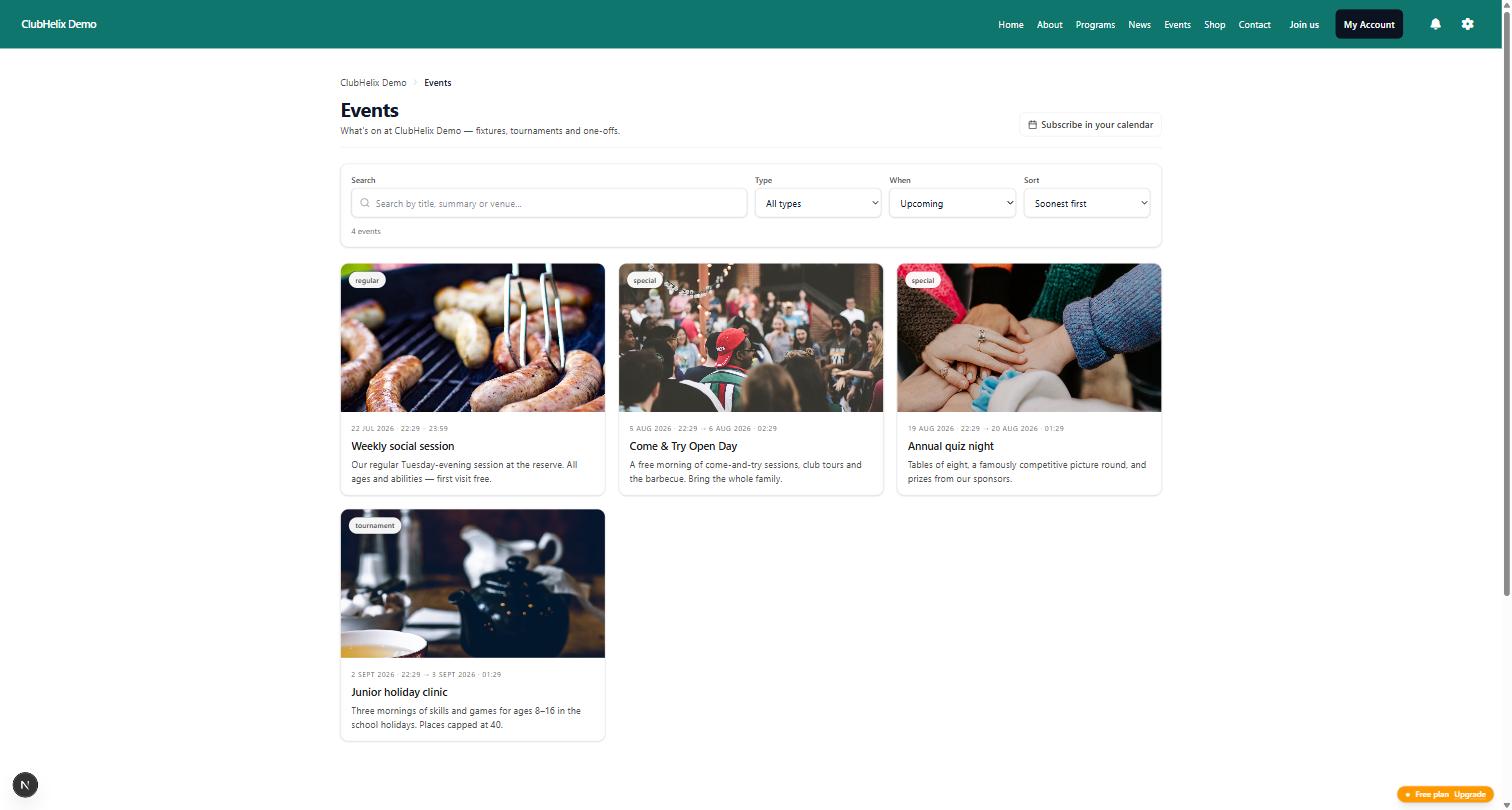
Almost everything above is information that has to reach members and then be findable again later — the run calendar with RSVPs, show entries and classes, the dated membership record a scheme audit asks for, inspection sign-offs, the register, the archive and the classifieds board. Most clubs run that across a website nobody can edit, a spreadsheet, a group chat and one long-suffering secretary's inbox. ClubHelix puts it in one place — an events calendar with RSVPs and ticketed entries, online membership and renewals with dated records, members-only pages and permissions, and email broadcasts from your own club domain.
If your club's site is currently a page somebody built in 2014 that nobody can log into, you can set up a new one between two monthly meetings. There is a free tier, so a small club can begin without a motion about spending, and pricing is published on the page rather than hidden behind a quote — see solutions for hobby and interest clubs for what other clubs put on theirs.
Frequently asked questions
What does a car club committee actually have to do?
Two jobs that look nothing alike. The social job is the calendar — runs, meetings, shows, the trip away and the presentation night. The administrative job is membership records, insurance, the magazine or newsletter, and, where a concessional registration scheme delegates authority to clubs, the inspections, signatories and dated membership evidence that scheme requires.
How do you organise a club run?
Pick a route with a lunch stop that can take your numbers, write a one-page route card, appoint a leader and a sweep, brief everyone in the car park, and use the rule that each driver keeps the car behind them in sight. Set the pace to the slowest capable vehicle, split into two groups above about fifteen cars, and take an RSVP so the lunch booking is right.
How should a car club judge a show and shine?
Publish classes and criteria before entries open, use a printed scoring sheet with a stated maximum per criterion, and have two judges score independently before comparing. Keep the class count modest so each class has real competition, and run a People's Choice award alongside the judged results — it is usually the one exhibitors care most about.
What records does a car club need to keep for registration schemes?
At minimum, dated membership records that prove who was financial on any given day, the list of officers authorised to inspect and sign, inspection records with dates and vehicle identifiers, a published calendar of eligible club events, and a process for notifying the administrator when a member lapses. Assume an audit and keep the records somewhere durable.
Can a car club run a classifieds board for members?
Yes, and it is one of the strongest reasons people renew. Keep it members-only, publish a standing disclaimer that the club is not a party to any sale, moderate listings before they appear, never let officers hold money or act as intermediaries, and expire listings after thirty or sixty days so the board stays current.
Keep reading — how to run a motorcycle riding club if your club also runs two-wheeled events, and how to start a social club if you are building the committee from scratch.


