
What this guide answers
- How do I start a club history project with no budget?
Start with a phone, a shared cloud folder and a call-out for old photos.
- What should we digitise first?
Anything unique and fragile: minute books, loose team photos, scrapbooks and the honour boards.
- Should the club honour board go on our website?
Yes — transcribe it as text rather than just posting a photo, so it's searchable and readable on phones.
- Who should own the club history?
Give it a named owner — a club historian, even informally. Store everything in club-controlled accounts (not a personal drive), keep two copies, and hand access over as part of your committee handover each year.
USA edition. This guide is written for volunteer-run clubs in the United States. Where rules differ — grants, tax, incorporation, safeguarding — follow the USA-specific pointers below or check with your national body.
Every club is sitting on a story. Somewhere in a storeroom there's a box of premiership photos, a scrapbook of newspaper clippings, a minute book from the 1970s and an honour board that hasn't been updated since the clubrooms were repainted. And every year, a little more of that story quietly disappears — a shed floods, a long-serving secretary passes away, a photo album goes home with someone and never comes back.
The good news: a club history project doesn't need a historian, a grant or a working group of twelve. It needs one motivated person, a phone camera, a few conversations with your oldest members and a place online to put what you find. This guide walks through how to preserve club history properly — before the people who remember it are gone.
Why club history is worth the effort
It's tempting to file history under "nice to have". In practice it earns its keep:
- It recruits. Families choosing between clubs notice the one that clearly has roots. A history page full of premiership teams and life members says "people stay here".
- It retains. Members who feel part of something bigger than this season stick around. Nothing does that like seeing your name — or your dad's name — in the club's story.
- It unlocks funding. Milestone anniversaries (50 years, 100 years) are natural hooks for civic recognition, local media coverage and celebration events.
- It honours the volunteers. The people who built your club gave up thousands of hours. Recording their contribution is the least a club can do — and it pairs naturally with a proper life membership process.
The risk of doing nothing is real. Paper fades, sheds flood, and human memory has a hard expiry date. Treat this as maintenance, not a luxury.
Step 1: Audit what you already have
Before you interview anyone or buy a scanner, find out what exists. Put a call-out in your newsletter and at training: "We're recording the club's history — if you have old photos, programs, clippings or trophies at home, we'd love to borrow and copy them." You will be amazed what surfaces from garages.
Then do a physical sweep of the clubrooms: the trophy cabinet, the storeroom, behind the bar, the filing cabinet nobody opens. You're looking for:
| Item | Why it matters | Priority |
|---|---|---|
| Honour boards and trophies | Names, years, premierships — your factual backbone | High |
| Minute books and AGM records | Dates, decisions, office bearers, milestones | High |
| Team photos (framed or loose) | Faces and names — caption them while people can still identify them | High |
| Newspaper clippings and match programs | Colour, stories, exact dates | Medium |
| Old uniforms, banners, pennants | Great to photograph for anniversary displays | Medium |
| Financial records and letterheads | Founding dates, name changes, old logos | Low |
Log everything in a simple spreadsheet: what it is, roughly when it's from, who holds it, and whether it's been digitised yet. That spreadsheet is your project plan.
Step 2: Digitise photos and records properly
You don't need archival equipment — a modern phone camera does a genuinely good job. A few rules make the difference between a usable archive and a folder of blurry rectangles:
- Shoot in good, even light. Indirect daylight near a window beats the clubroom fluoros. Avoid flash on glass-framed photos — take them out of the frame if you safely can, or angle to kill the reflection. (The same basics from our guide to taking good club photos apply here.)
- Fill the frame and hold square. Lay the photo flat, shoot from directly above, crop later.
- Capture the backs too. Names and dates are often pencilled on the reverse. Photograph both sides as a pair.
- Name files consistently.
1978-a-grade-premiers-team-photo.jpgwill still make sense in ten years;IMG_4382.jpgwon't. - Record the caption immediately. For every team photo, write down who's in it while someone can still tell you — left to right, back row first. This is the single most time-critical task in the whole project.
- Store copies in two places. A shared cloud drive the committee controls (not one person's personal account), plus a backup. A club history that lives on one retired treasurer's laptop is one hard-drive failure from oblivion.

Work through the high-priority items first: honour boards, minute books, team photos. A board can be captured in an afternoon; transcribe the names into your spreadsheet so they're searchable, not just photographed.
Outside help exists too: your local historical society and public library often take an interest in community sports collections, and digitised local newspaper archives can pin down exact dates, spellings and game reports from your club's early decades.
Step 3: Interview your life members
Documents give you facts; people give you the story. Your life members and longest-serving volunteers are carrying decades of club memory that exists nowhere else — and this is the part of the project you genuinely cannot postpone.
Keep it simple and human:
- Ask for an hour, record on your phone. Audio is fine; video is better if they're comfortable. Always ask permission to record and explain it's for the club's history.
- Prepare loose prompts, not a script. "How did you first get involved?" "What was the club like in the seventies?" "Who were the characters?" "What's the win you still talk about?" "What nearly killed the club?" Then let them talk.
- Bring props. Old team photos are memory rocket fuel — sliding a 1985 team photo across the table will surface names, nicknames and stories no direct question would.
- Interview in pairs if you can. Two old teammates correcting each other's memories is both more accurate and more entertaining.
- Transcribe the highlights. You don't need every word — pull the best stories and quotes into a document, and keep the recordings in your archive.
Aim for your three or four oldest members first, then work forward. One interview per month is a perfectly good pace; the point is to start.
Step 4: Put honour boards and milestones online
A wooden club honour board is a beautiful thing, but only the people who walk past it ever see it — and it's one clubroom fire away from being gone. The permanent version belongs on your club website.
Build a History section with a page (or several) covering:
-
The club honour board, transcribed — championship seasons, most-valuable-player and club-award winners, presidents and secretaries by year, and your life members' roll. Text, not just a photo, so it's searchable and readable on a phone.
-
A timeline of milestones — founded, first premiership, moves of ground, name changes, anniversaries. Short entries with a photo each beat long essays.
-
A photo gallery by era — your freshly digitised team photos, captioned with names.
-
The best stories — pulled from your life member interviews, written up as short pieces.
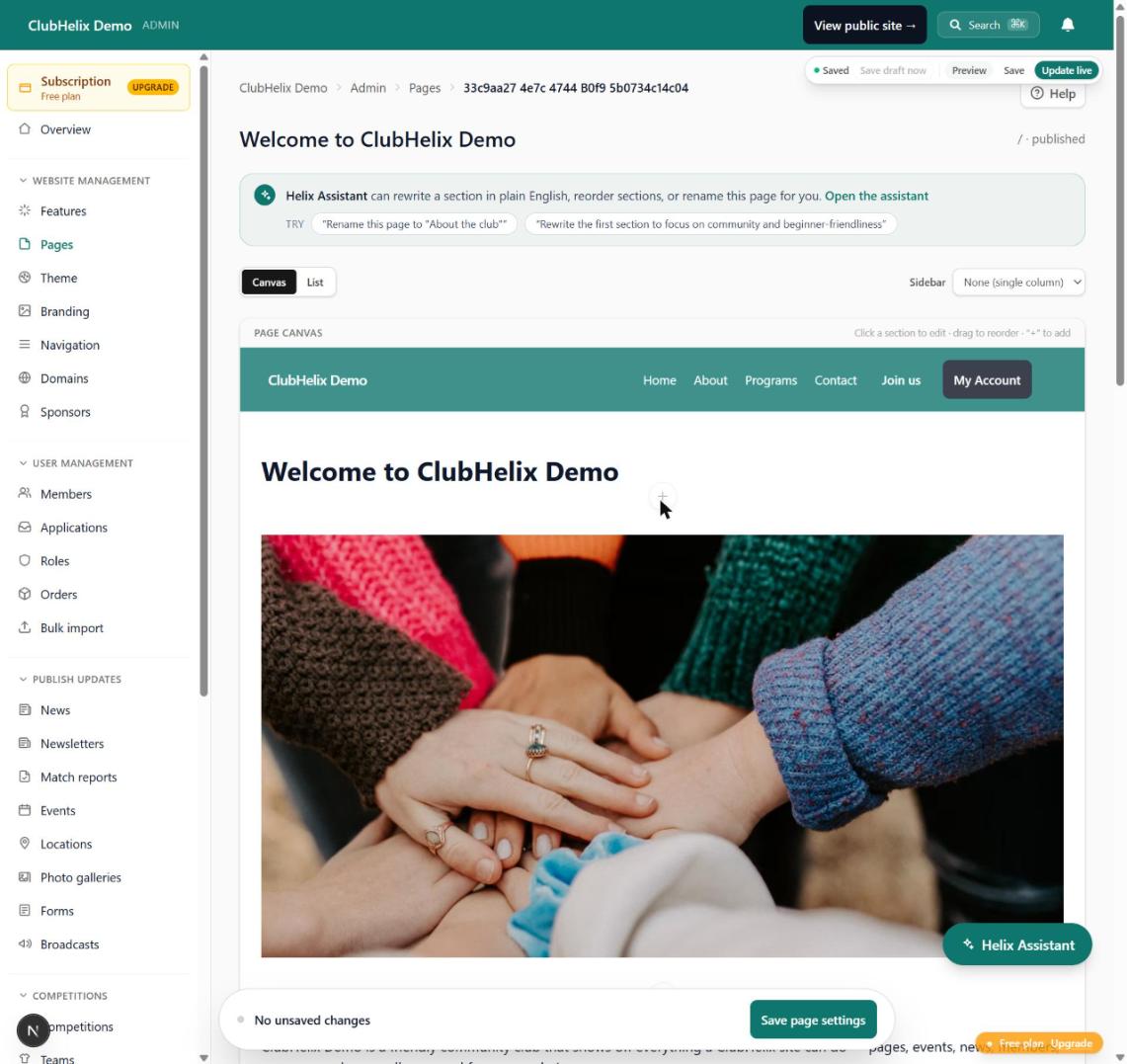
A drag-and-drop page editor makes this an evening's work rather than a web-developer favour: heading, text, image gallery, done. Structure it so it's easy to extend — a page per decade works well for older clubs.
Then keep it alive through your club news: a "From the archives" post is reliable, low-effort content that older members love and share. Photo of the 1990 title winners, three paragraphs, a request for missing names — you'll often get corrections and new photos in the comments and replies. History content is also one of the best answers to the perennial "what do we put on the website?" question — see our club website content ideas for more.
Step 5: Make it a habit, not a one-off
The clubs with great archives aren't the ones that ran a heroic six-month project in 2019. They're the ones where recording history became routine:
- Give it an owner. A "club historian" role — even informally held — means someone caption's this year's team photo, updates the honour board page after presentation night, and files the AGM minutes.
- Capture this season as it happens. Today's grand final photos are tomorrow's archive. Save match reports, team lists and results each season.
- Tie it to your calendar. Update the online honour board the week after presentation night, every year, while the names are fresh.
- Watch for milestone anniversaries. If your 50th or 100th is inside five years, start now — anniversary books and reunion events stand on exactly the archive you're building.
If your club runs its website on ClubHelix, the pieces are already there: build your history pages with the canvas page editor, publish "from the archives" posts through club news, and it all lives on your own domain, backed up, where the next committee inherits it automatically. There's a free tier to get started — see pricing.
Frequently asked questions
How do I start a club history project with no budget?
Start with a phone, a shared cloud folder and a call-out for old photos. Digitise the honour boards and team photos first, then record interviews with your oldest life members. The essential work costs nothing but time.
What should we digitise first?
Anything unique and fragile: minute books, loose team photos, scrapbooks and the honour boards. Caption team photos immediately — identifying faces gets harder every year, and it's the one task you can't do later.
Should the club honour board go on our website?
Yes — transcribe it as text rather than just posting a photo, so it's searchable and readable on phones. The physical board stays in the clubrooms; the online version is the permanent, shareable record.
Who should own the club history?
Give it a named owner — a club historian, even informally. Store everything in club-controlled accounts (not a personal drive), keep two copies, and hand access over as part of your committee handover each year.


