
What this guide answers
- What causes volunteer burnout in clubs?
Almost always structure rather than attitude — roles that grew by accumulation and were never written down, no deputy, no end date, and a peak period nobody planned extra hands for.
- What are the warning signs a club volunteer is about to quit?
Four show up consistently — they stop staying around socially after the job is done, they become uncharacteristically short with people, they start doing other people's jobs rather than chasing them, and they float a…
- How many hours should a club volunteer role take?
A good rule of thumb is three hours a week in season with a clear start and finish.
- How do you split a club volunteer role?
Separate it into the recurring weekly work, the periodic heavy work, the relationship work with suppliers and officials, and the compliance and record-keeping work.
- Should clubs have term limits for committee roles?
Term limits help, provided they are applied as a normal expectation rather than a punishment.
New Zealand edition. This guide is written for volunteer-run clubs in New Zealand. Where rules differ — grants, tax, incorporation, safeguarding — follow the New Zealand-specific pointers below or check with your national body.
The resignation, when it finally comes, is almost never about the thing it says it is about. It arrives in February as a short email about work commitments, or after a small disagreement over a roster that in any other year would have been forgotten by Tuesday. And then the club discovers what that one person was actually holding: the registration system nobody else has a login for, the relationship with the council, the supplier accounts, the knowledge of which key opens the back gate.
That is not a story about an unreliable volunteer. It is a story about a club that let one person carry twelve hours a week for four years and never noticed, because they never complained and everything kept working. Burnout in community clubs is a design problem. It is what happens when roles grow by accretion, are never written down, and are held by whoever last said yes.
The good news is that design problems have design solutions, and they are unglamorous and cheap. This guide covers how to measure the load your club is actually placing on people, the four warning signs that show up months before someone quits, how to split a hero role into three doable ones, and how term limits, deputies and planned rest keep good volunteers for a decade instead of two seasons. It is written for committees who have already noticed that "we need more volunteers" has not worked as a strategy.
Burnout is a load problem, not a commitment problem
Before you can fix the load, you have to see it. Most committees have never counted, and the estimate in everyone's head is wildly wrong — usually about half the real figure, because the invisible work does not get counted at all.
Run a load audit once. Ask every person holding a role to log their club hours for four weeks, including the invisible parts: the messages answered at 10pm, the trip to the hardware store, the twenty minutes chasing an unpaid fee, the thinking-about-it while driving. Then put it in a table.
| Role | Estimated hours per week | Actual, in season | Peak week |
|---|---|---|---|
| President | 2 | 5 | 12 |
| Secretary | 2 | 4 | 9 |
| Treasurer | 2 | 6 | 14 |
| Registrar | 1 | 8 | 20 |
| Canteen coordinator | 3 | 9 | 15 |
| Junior coordinator | 2 | 7 | 16 |
Those figures are illustrative, but the shape is real and it shows up in almost every club that measures: the estimate is roughly half the actual, and the peak week is two to three times the average. Nobody plans for the peak week, which is why the peak week is what breaks people.
Three patterns to look for in your own numbers:
The cliff. One or two roles carrying more hours than the rest of the committee combined. That is your single point of failure and it will fail — the only question is which season.
The lumpy year. A role with a manageable average and a brutal fortnight, usually registration or the start of a season. Lumpy roles need extra hands at the peak, not a lighter year.
The unrostered role. Work that no title covers — the person who always locks up, the one who fields every Facebook message. Invisible work is the most dangerous kind, because when that person stops nobody knows what stopped.
Our guide to club KPIs to track has more on measuring the club's health, but the volunteer load table is the one to start with. Do it once a year, straight after the season ends, while the memory is fresh.
The four warning signs, and what to do in the week you see one
People rarely announce that they are burning out. They signal it, for months, in ways that are obvious in hindsight. Learn the four signals and treat any of them as a same-week intervention, not a topic for the next committee meeting.
| Warning sign | What it looks like | What it usually means | The intervention this week |
|---|---|---|---|
| Withdrawal from the social | Stops staying for a drink, leaves straight after the job is done | The club has become work with no reward left | Ask them to a coffee with no agenda; take one task off them on the spot |
| The sharpening edge | Uncharacteristic irritation, short replies, a public snap at a parent | They are past capacity and running on adrenaline | Name it kindly in private, then remove a specific duty for a month |
| Silent overfunctioning | Doing others' jobs rather than chasing them, "it's quicker if I do it" | They have lost faith the club will back them up | Reassign one of those absorbed jobs to a named person with a deadline |
| The pre-emptive apology | "I might not be able to do next season", floated casually | The decision is already half made | Take it seriously immediately — this is the last easy moment to keep them |
The fourth one matters most. When someone floats a doubt about next season, most committees say "you'll be right, we'd be lost without you" — which is the worst possible answer, because it confirms exactly what is exhausting them. The better answer is: "Tell me which part you'd drop if you could." Then actually drop it. A volunteer who is relieved of the one job they dread will often stay for three more years.
A fifth thing to watch is not a person but a pattern: the same name in every roster slot. If one member appears in more than a third of your roster fills, you do not have a keen volunteer, you have a shortfall being absorbed by an individual.

Splitting a hero role into three doable ones
The most effective single intervention available to a club committee is also the least dramatic: take the role that is crushing someone and cut it into pieces that a normal person with a job and children can hold.
Start from the principle that a good volunteer role for a working adult is three hours a week in season, with a defined start and finish. Anything materially above that is a role for a paid person or a role that will burn through volunteers on a two-year cycle. Anything that has no end date at all is a role nobody will accept in the first place.
Worked example — the registrar
The registrar is the classic hero role: invisible for half the year, then twenty-hour weeks for six weeks straight. Split it three ways.
- Registrations coordinator (in season, 3 hours a week). Owns the registration form and the online process, answers member questions, chases incomplete sign-ups.
- Payments liaison (in season, 2 hours a week). Works with the treasurer on unpaid fees, refunds and payment plans. This is a natural home for someone who likes tidy numbers and does not want to talk to anybody.
- Data and reporting (2 hours a month, year-round). Owns the member list, the governing body upload, the annual numbers for the report and grant applications. Small, quiet, and the single most valuable role to keep stable across years.
None of the three needs to be on the committee. All three can be done by different people. And critically, each one is a specific enough ask that you can approach a named person and describe exactly what they would be doing.
Worked example — the canteen coordinator
- Roster owner — builds and fills the shift roster, chases swaps. Two hours a week, entirely online.
- Stock and supplier — orders, stocktakes, banking the float. Three hours a week, mostly one trip.
- Compliance and training — food handling requirements, cleaning schedule, inductions for new helpers. Two hours a month with a heavy pre-season.
Same job, three doable pieces, and every piece can be handed on independently. Compare that with a single canteen manager who resigns and takes all three streams with them.
The splitting template
Any hero role can be cut with the same four questions:
- What is recurring and weekly? That is one role, and it should be the smallest.
- What is periodic and heavy? That is a second role, or a task force that appears twice a year.
- What is relationship work — suppliers, council, the governing body? That is a third, and it is usually best kept with the same person for years because the relationships are the value.
- What is compliance and record keeping? That is a fourth, and it should never be bolted onto an operational role that is already full.
Write each piece up as a proper position description with hours, season, tasks and who to ask for help — our volunteer position descriptions template has the format. A written role is also a role that can be handed over cleanly, which is the whole point of club succession planning.
Term limits, deputies and planned rest
Splitting the load stops people drowning. Structure stops them quietly serving until they resent the place.
Term limits, applied gently. Set a standard term — three years is the common shape — with the expectation that a person steps back or steps sideways at the end of it. Stagger the terms so the president, secretary and treasurer never turn over in the same year. The purpose is not to push good people out; it is to make leaving normal. In clubs with no term limits, standing down feels like abandoning the club, so people stay two years longer than they wanted and leave bitter instead of proud.
A deputy for every critical role. Not a title on a list — a real person who has done the job. The test is simple: if this person were unreachable for a fortnight, could the club still register a member, pay a bill and run a home game? If the answer is no, that role has no deputy regardless of what the organisational chart says. Deputies should actually do the job for a defined stretch each season, not just shadow it, and they need real access rather than a borrowed password. Scoped roles and permissions make that safe to do.
Planned rest, not accidental collapse. Build in the equivalent of a sabbatical. A volunteer who has done four hard years is allowed to take a season completely off with the door held open, and should be invited back specifically rather than left to wonder if they are still wanted. Clubs are terrible at this — the unwritten rule is that stepping back means gone forever, which makes everybody hang on far too long.
Retire people with honour. A named thank you at the presentation night, a line in the annual report, and a genuine invitation to stay involved in a smaller way. Life membership exists for exactly this — see life membership criteria for how to award it in a way that means something.
Handover as a scheduled event. Every departure should produce a handover, and every handover should be the same document. The committee handover checklist covers what to transfer. Do it while the outgoing person is still warm on the role, not three months after they have gone quiet.
Delete the work before you recruit for it
Committees reach for recruitment when the honest answer is that the work should not exist. Before adding a person, run the load audit's task list through three columns.
| Ask | Example | Action |
|---|---|---|
| Would anyone notice if this stopped? | The printed newsletter nobody reads; a duplicate paper register | Eliminate |
| Is a human doing a machine's job? | Chasing unpaid fees by text; retyping paper forms into a spreadsheet; reminding people about a fixture | Automate |
| Is this being done by the wrong person out of habit? | The president answering every general email | Delegate |
| Does this exist only because the tools do not talk? | Reconciling three lists of the same members | Consolidate |
The second row is where most club hours disappear. Manual fee chasing, retyping registration forms, sending fixture reminders one at a time and reconciling lists are all tasks with no judgement in them, and every hour spent on them is an hour of goodwill burned on nothing. Moving registrations and payments to online self-registration and reminders to automated broadcasts does not just save time — it removes the specific kind of work that makes people resent the role. Our guide on how to run a club with no time is entirely about this move.
The fourth row is worth a hard look every couple of years. A club running a website, a separate registration tool, a spreadsheet and three chat groups has manufactured a reconciliation job that somebody has to do forever.
If the load genuinely cannot be cut far enough, look at funding a paid part-time coordinator before you burn another volunteer out. Gaming trust grants, community trusts and regional council funds all support administration and participation roles, and regional sports trusts can advise on which fund suits a club your size. Grants for salaries are harder to win than grants for equipment, so build the case around participation growth and volunteer sustainability, and be ready to show the hours the role will actually absorb.
Money, expenses and the awkward conversation
Volunteering should not cost people money, and in a surprising number of clubs it quietly does. The canteen coordinator who buys the milk. The junior coordinator driving forty minutes each way with a boot full of gear. The secretary paying for the printing. None of them will ask to be reimbursed, and all of them notice.
Make reimbursement automatic, easy and expected. A one-page expense claim, a stated turnaround, a treasurer who pays it without making the claimant feel like a beggar, and a standing line in the budget so it is not a surprise. Say it out loud at the start of each season: the club reimburses out-of-pocket costs, please claim them.
Reimbursing genuine out-of-pocket expenses is different from paying an honorarium, and the tax treatment differs — a receipted reimbursement is straightforward, while a regular payment for services can create deduction and reporting obligations for the club. As a practical marker, a club paying NZ$200 a season in fuel and consumables to a junior coordinator is reimbursing costs; a flat NZ$2,000 for the season is something else. Check the position with Inland Revenue or your accountant before you set it up.
A season-long rhythm for keeping people
Volunteer wellbeing is not a project; it is a series of small scheduled moments. Put these on the committee calendar and they will happen.
| When | What | Who does it |
|---|---|---|
| Pre-season | Load audit review — is any role over the three-hour rule? | President |
| Pre-season | Confirm deputies for the four critical roles | Secretary |
| Week 3 of season | Ten-minute check-in call with each role holder | President or vice |
| Mid-season | Roster fairness check — is one name in a third of the fills? | Roster owner |
| Mid-season | A social event with no work attached for volunteers | Social group |
| Peak fortnight | Assign extra hands to the lumpy roles in advance | Committee |
| End of season | Named thank-yous and the volunteer hours record | President |
| Post-season | Ask every role holder, individually, about next year | President |
| After the AGM | Handover for every change, using the same checklist | Secretary |
The check-in call is the highest-return item on that list and the one most likely to be skipped. Ten minutes, one question — "what's the worst part of this job right now?" — and then act on one answer. Two of those calls a season prevent more resignations than any recognition scheme.
Speaking of which: recognition works when it is specific and public, and falls flat when it is generic. "Thanks to all our volunteers" thanks nobody. "Fiona rebuilt the entire junior registration process this year and cut the sign-up time in half" is a thank you the person will remember. Keep a record of volunteer hours as you go — it makes the annual report honest, it is often required for grant applications, and it makes those specific thank-yous easy to write. See tracking volunteer hours for grants and volunteer appreciation ideas.
One structural advantage of a summer-to-autumn or winter season is that the off-season is a genuine break, and clubs should protect it rather than filling it with working bees and planning days. Pick one planning weekend, one working bee and nothing else, and tell volunteers explicitly that the rest of the break is theirs. A committee that meets monthly all year without a pause is a committee that will lose someone.
Making the roster do the remembering
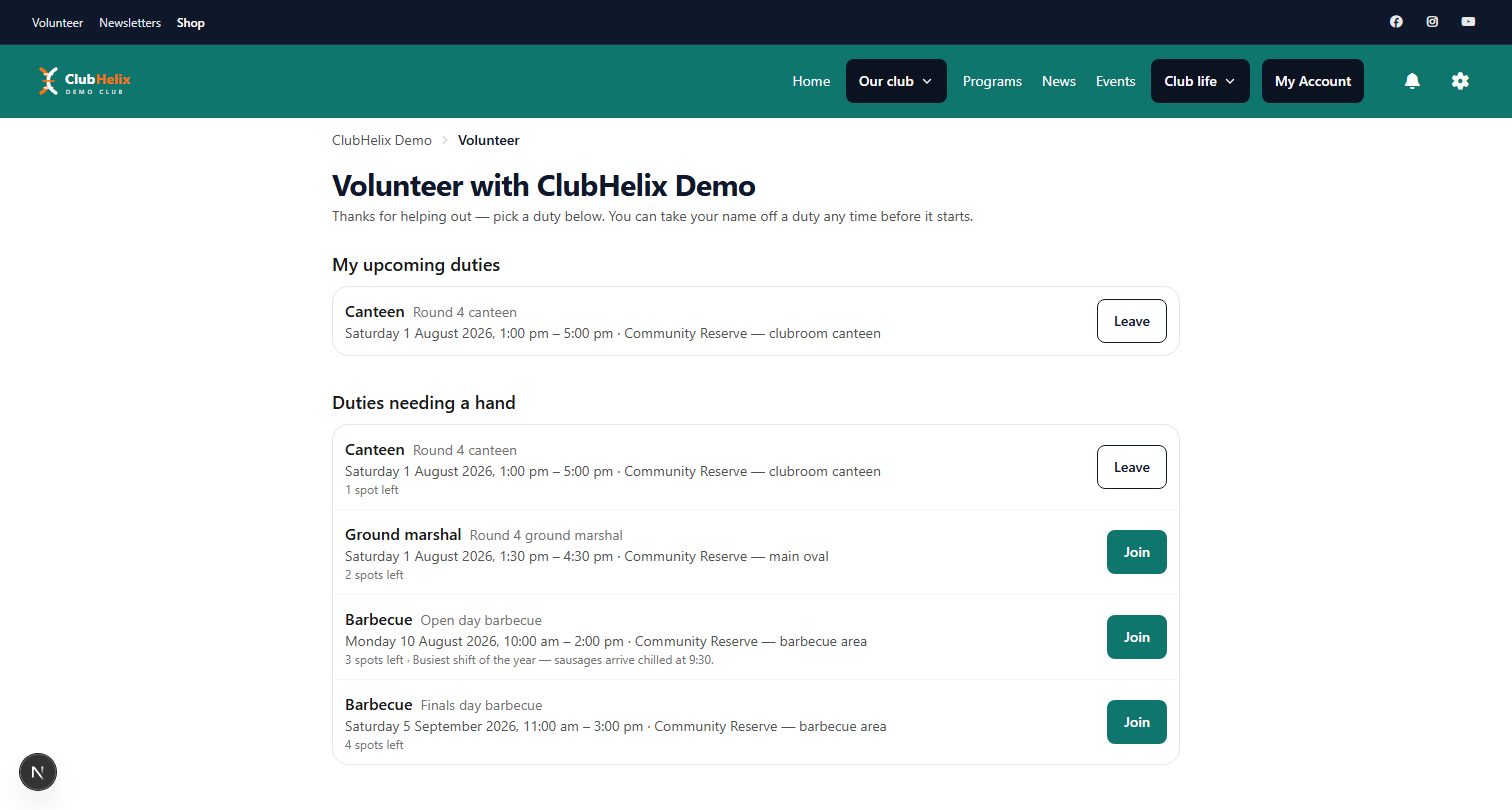
Most of what exhausts a club volunteer is not the visible job — it is the remembering. Who is on Saturday, who has not paid, who needs reminding, who is missing a clearance, which of the four lists is right. Software will not run your canteen, but it will absolutely carry the remembering. ClubHelix does that with volunteer rostering that lets members claim and swap their own shifts, self-registration that collects sign-ups and payments without anyone retyping a form, and broadcasts that send reminders on a schedule instead of one at a time at 10pm.
Every hour of that work you delete is an hour a volunteer gets back, and it is the specific hour they were most likely to resent. ClubHelix is built for community clubs, the free tier is a real one rather than a trial, the pricing is published in full, and you can create your club site and have the roster live before your next round of shifts.
Frequently asked questions
What causes volunteer burnout in clubs?
Almost always structure rather than attitude — roles that grew by accumulation and were never written down, no deputy, no end date, and a peak period nobody planned extra hands for. Add unrewarded invisible work like answering messages late at night and chasing unpaid fees, and a capable person will reach their limit within two or three seasons. Measuring the actual hours each role takes is the fastest way to see where it is happening.
What are the warning signs a club volunteer is about to quit?
Four show up consistently — they stop staying around socially after the job is done, they become uncharacteristically short with people, they start doing other people's jobs rather than chasing them, and they float a casual doubt about next season. That last one means the decision is already half made. Treat any of the four as a same-week conversation rather than an item for the next meeting.
How many hours should a club volunteer role take?
A good rule of thumb is three hours a week in season with a clear start and finish. Roles materially above that either need splitting or need paying. Peaks are unavoidable in some jobs, but a peak should be planned for with extra hands rather than absorbed by one person. If a role has no defined end date at all, expect it to be hard to fill and harder to hand over.
How do you split a club volunteer role?
Separate it into the recurring weekly work, the periodic heavy work, the relationship work with suppliers and officials, and the compliance and record-keeping work. Each becomes its own small role with written hours and tasks, and each can be held by a different person and handed on independently. The bonus is that a specific, finite role is far easier to recruit for than a vague, unbounded one.
Should clubs have term limits for committee roles?
Term limits help, provided they are applied as a normal expectation rather than a punishment. A three-year term with staggered turnover means the president, secretary and treasurer never all leave in the same year, and it makes stepping back feel routine instead of like desertion. Pair term limits with real deputies and a proper handover so the club loses the person, not the knowledge.
How can a club reduce volunteer workload without recruiting more people?
Delete work before adding people. Stop doing anything nobody would miss, automate the tasks with no judgement in them — fee chasing, reminders, retyping forms, reconciling lists — and move jobs that are being done by the wrong person out of habit. Consolidating several disconnected tools into one system removes an entire category of reconciliation work that somebody has been quietly doing for years.
Keep reading — how to recruit club volunteers covers filling the roles once you have made them doable, and club succession planning makes sure the knowledge stays when the person moves on.


