
What this guide answers
- What is the fastest way to grow club membership?
Fix your sign-up flow before anything else. Most clubs already generate enough interest — from search, word of mouth, and local visibility — but lose prospects to slow, manual registration.
- How much should we spend on member recruitment?
For most community clubs, almost nothing — the highest-return activities (come-and-try days, bring-a-friend rounds, school clinics, a findable website with online sign-up) cost volunteer time rather than money.
- How do we recruit members outside our usual demographic?
Go to where they already are rather than broadcasting louder.
- Do come-and-try days really convert into members?
Yes — when there's follow-up. Clubs that collect every attendee's contact details on the day and send a personal message with a direct registration link within 48 hours routinely convert a strong share of attendees.
Canada edition. This guide is written for volunteer-run clubs in Canada. Where rules differ — grants, tax, incorporation, safeguarding — follow the Canada-specific pointers below or check with your national body.
Every club committee has sat through the same agenda item: "membership is down, what are we going to do about it?" The usual answer is a flurry of activity — a flyer, a Facebook post, a registration day — followed by silence until the same conversation next year.
Growing club membership isn't one big idea. It's a pipeline: people have to hear about you, find you, sign up without friction, and have a good enough first season to stay and bring friends. Most clubs lose more prospective members to a broken step in that pipeline than to any lack of interest in their sport. This guide works through each stage with recruitment ideas you can actually run with a volunteer committee, plus the follow-through most clubs skip.
First, find your leaks
Before you spend anything on recruitment, work out where you're losing people now. Ask three questions at your next committee meeting:
- How many enquiries did we get last season, and how many became members? If you don't know, that's the first fix — every enquiry should land somewhere trackable, not in three different volunteers' inboxes.
- How long does it take to go from "I'm interested" to "I'm registered and paid"? If the answer involves a printed form, a bank transfer, and waiting for the registrar to reply, you're leaking people at the exact moment they were ready to join.
- How many first-year members came back for a second year? Recruitment and retention are the same problem viewed from different ends: a club that keeps 85% of members needs far fewer new recruits than one keeping 60%.
Clubs that patch the leaks often grow without any new marketing at all — the interest was always there.
Get found: local search is your biggest channel
When a parent decides their kid should try a sport, or a new arrival wants to meet people, the first move is nearly always a search —
"youth soccer club near me", "hockey club Kingston".
If you're not findable, you don't exist.
- Have a real website with your suburb or town and your sport in the text. A social media page alone doesn't rank in local search, and it hides your information from anyone not logged in. If you don't have a site yet, our step-by-step website guide covers the whole job.
- Claim your Google Business Profile. It's free, it puts you on the map (literally), and it shows your training venue, hours and website link. Ask a few members for honest reviews — clubs with a handful of recent reviews stand out.
- Keep fees and start dates public. Parents comparison-shop. "Contact us for pricing" reads as expensive and slow; a clear fees table reads as organised.
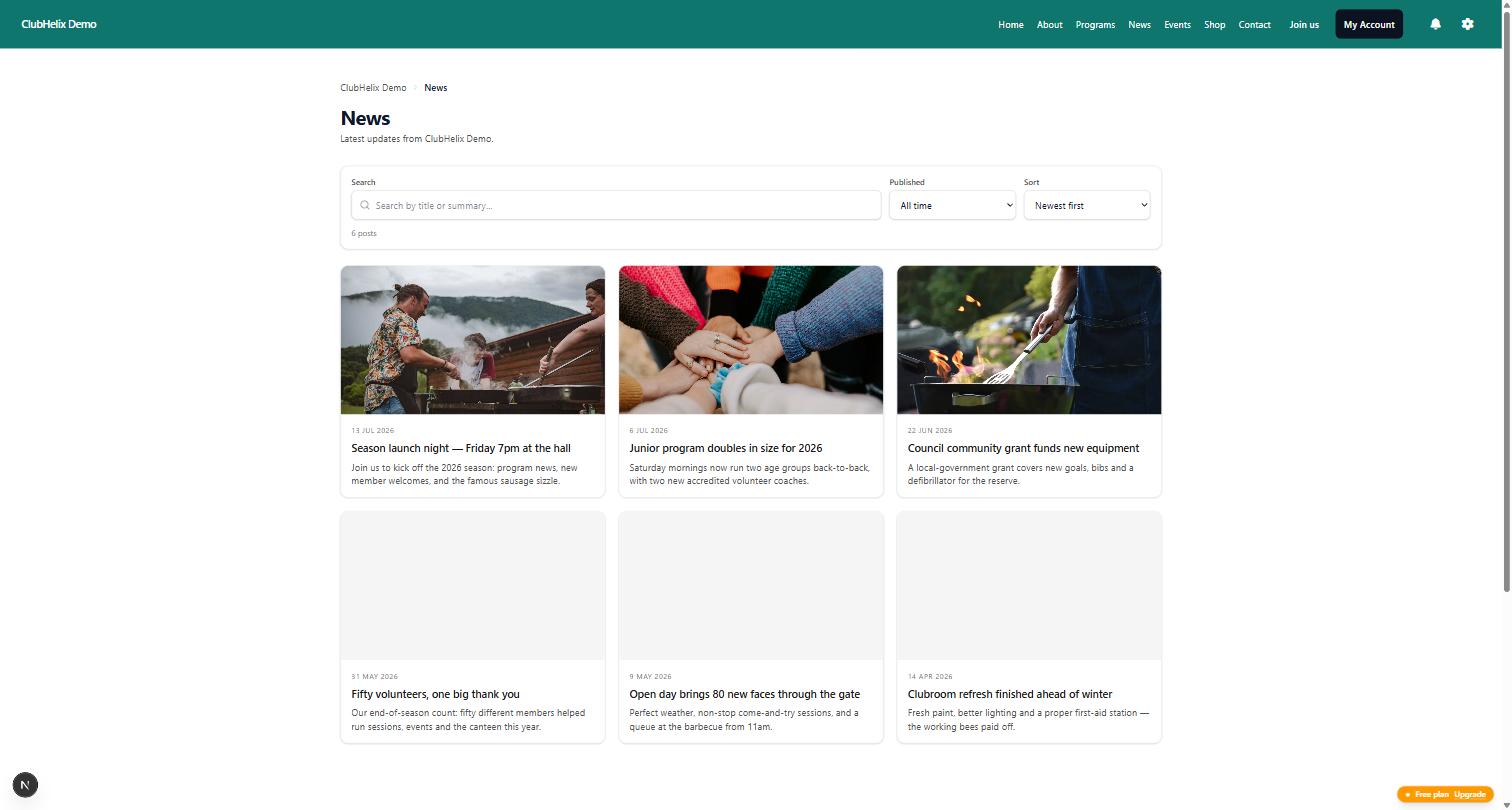
- Publish news regularly. A site with dated match reports and announcements signals a living club to both search engines and visiting parents. A news feed that's easy for any volunteer to update is worth more than a beautiful homepage nobody touches.
Remove sign-up friction — the highest-return fix on this list
Picture the moment someone decides to join. It's usually 9pm on a weeknight, on a phone. What happens next at your club?
If the answer is "download this PDF, fill it in, bring it to training with cash", you will lose a meaningful share of those people before Saturday. Motivation decays fast; every extra step, delay, and reply-needed email loses a percentage.
The gold standard is a single online flow: the person finds your join page, picks a membership category, fills in their details (including the medical and consent items you need), pays by card, and gets an instant confirmation — no volunteer in the loop. That's exactly what a proper self-registration flow does, and it works while your committee sleeps.
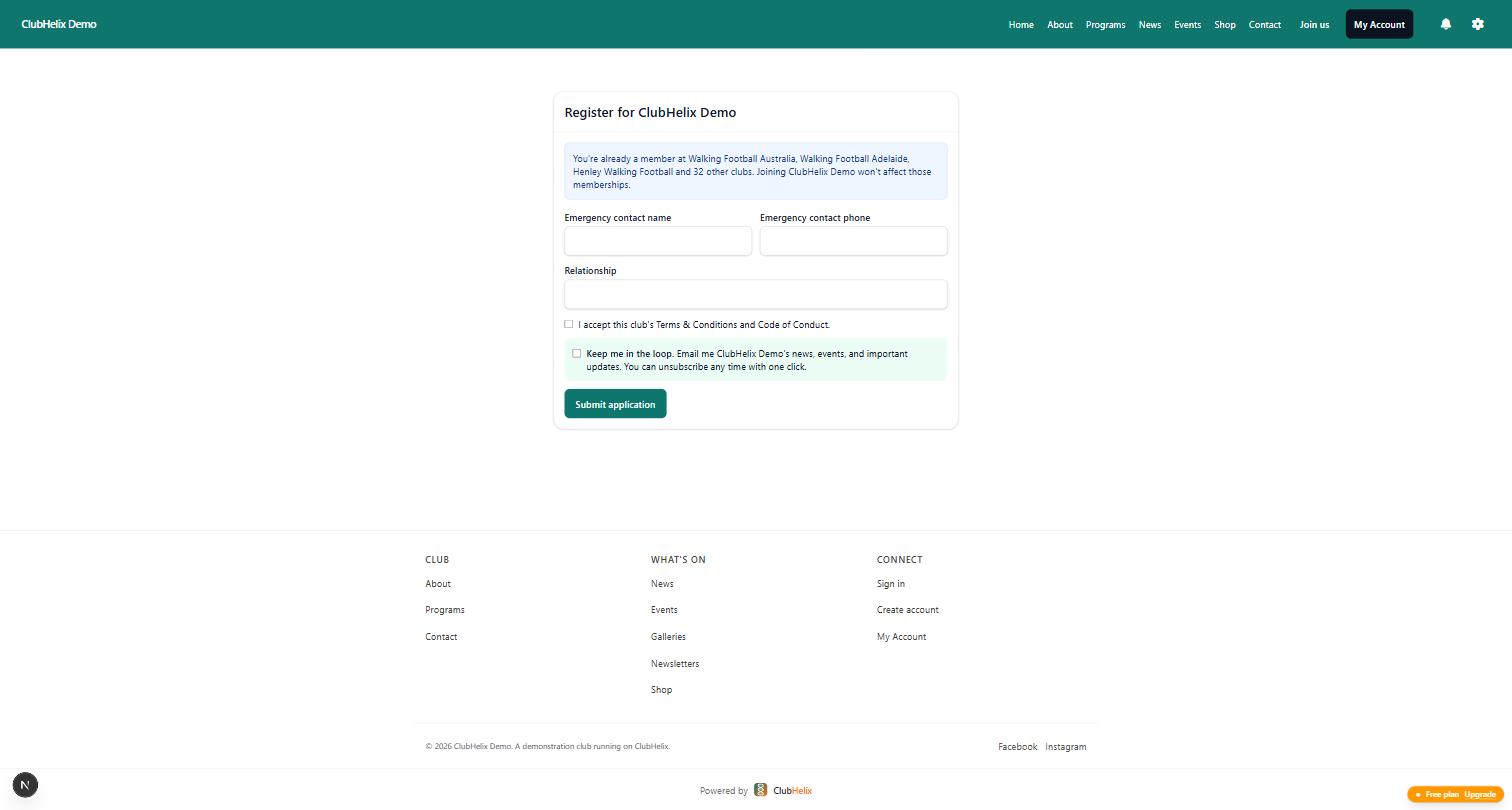
Two details that matter:
- Put the join link everywhere. Top of the website, pinned social post, QR code on every flyer and sandwich board, email signatures of every committee member.
- Let people pay on the spot. Clubs that separate "register" from "pay later by bank transfer" carry a long tail of unpaid registrations into the season. If you're still chasing fees by hand, read our guide on collecting membership fees online.
Member recruitment ideas that actually work
With the pipeline fixed, here are the recruitment plays that consistently deliver for community clubs, roughly in order of return on volunteer effort.
1. Come-and-try days
The single most reliable recruiter for most sports. Keep the format simple: 90 minutes, free, gear provided, real club members running fun drills,
and a cookout or pizza at the end.
The critical part is the capture and follow-up: collect every attendee's name and contact via a short form (a QR code on the day beats a clipboard), then send a personal follow-up within 48 hours with a direct registration link. A come-and-try day without follow-up is a nice community event; with follow-up it's a recruitment engine.
2. Bring-a-friend rounds
Once or twice a season, make a normal training night an open night and ask every member to bring one person. Your existing members are your most credible marketing channel — a friend's invitation converts far better than any advertisement. Sweeten it: the member whose friend signs up gets a club cap
or a concession-stand voucher.
3. School and community partnerships
A single term of lunchtime clinics at a local primary school can feed a junior program for years. Offer to run a session at the school fete or fair, sponsor the newsletter, or provide equipment for PE classes. The same logic applies to community centres, migrant resource centres, and university clubs — anywhere your future members already gather.
4. Social and short-format offerings
The barrier for many adults isn't interest — it's commitment. A "social sixes" competition, a six-week beginner block, or a parents-play-too session while juniors train gives hesitant people a low-stakes entry point. Price it modestly and make the pathway into full membership obvious.
5. Visibility at local events
Market stalls, fairs, and festival days are cheap and effective when you bring the sport with you — a target to shoot at, a speed gun, a mini court — not just a table of brochures. Every activity ends with the same move: "scan this code to book a free trial session."
6. Win the lapsed and the moved-in
Two overlooked groups: lapsed members (a friendly "we'd love to have you back" email each pre-season, with a one-click registration link) and new arrivals to the area (welcome packs through real estate agents and community Facebook groups). Both convert at far higher rates than cold audiences because the interest already exists.
Tell your story all season, not just at sign-up time
Clubs that grow treat communication as a year-round habit. The content doesn't need to be polished — it needs to be regular and human:
- Weekly match reports and results (delegate to team managers — one paragraph is plenty).
- Photos. Nothing recruits like pictures of people having a great time. Sort photo consent once, at registration.
- Milestones and profiles: 100-game players, new coaches, volunteer of the month.
- "Registrations open" pushes at the moments that matter: pre-season, post-finals, and the start of the school year when parents plan the months ahead.
Publish on your website first, then share everywhere else. The website copy works for you in search results for years; a social post is gone in a day.
Make the first season great — growth compounds
Recruitment gets people in the door; experience decides whether the door revolves. Three cheap habits with outsized effect:
- A named welcomer. Every new member or family gets introduced to one person whose job is to learn their name and check in for the first month.
- A new-member welcome email covering training times, what to bring, where to park, uniform orders, and who to ask for help. Write it once, send it automatically.
- An early-season check-in. Four weeks in, ask new members one question: "how's it going so far?" You'll catch small problems while they're still fixable — and the act of asking is itself retention.
Do this well and your growth compounds: this year's happy new members are next year's bring-a-friend recruiters. The full retention playbook is in our companion guide, how to retain club members.
A simple recruitment calendar
Steal this rhythm and put names against each item:
| When | Action |
|---|---|
| 8 weeks pre-season | Website updated: fees, dates, join page live. Lapsed-member email. |
| 6 weeks pre-season | Come-and-try day #1. School clinic block booked. |
| 4 weeks pre-season | Registration day + online push. Follow up all trial attendees. |
| Season start | Welcome emails and welcomer assignments for every new member. |
| Mid-season | Bring-a-friend round. New-member check-ins. |
| Post-finals | "Loved this season? Pre-register for next year" campaign while enthusiasm is high. |
Frequently asked questions
What is the fastest way to grow club membership?
Fix your sign-up flow before anything else. Most clubs already generate enough interest — from search, word of mouth, and local visibility — but lose prospects to slow, manual registration. Moving to instant online registration with card payment typically lifts conversions immediately, and every other recruitment idea works better once the pipeline behind it is sound.
How much should we spend on member recruitment?
For most community clubs, almost nothing — the highest-return activities (come-and-try days, bring-a-friend rounds, school clinics, a findable website with online sign-up) cost volunteer time rather than money. If you do spend, put it on a modest boost for come-and-try event posts in local community groups rather than general brand advertising.
How do we recruit members outside our usual demographic?
Go to where they already are rather than broadcasting louder. Partner with schools, community centres and cultural associations; offer beginner-friendly short formats so newcomers aren't dropped into full competition; and make sure your photos and welcome material actually show the diversity you want to attract. One genuinely welcoming season does more than any campaign.
Do come-and-try days really convert into members?
Yes — when there's follow-up. Clubs that collect every attendee's contact details on the day and send a personal message with a direct registration link within 48 hours routinely convert a strong share of attendees. Clubs that run the day and wait for people to come back convert far fewer. The event is the easy half; the follow-up is where memberships happen.
Ready to fix the pipeline? ClubHelix gives your club online self-registration with payment, a news feed any volunteer can update, and forms for trial-day sign-ups — all on one platform. See pricing to get started.


