
What this guide answers
- How much can a student society realistically charge for sponsorship?
Far more than most committees ask for, provided you sell a specific audience rather than goodwill.
- We have never had a sponsor. Where do we start with no track record?
Start with one event and one number. Pick the event you are most confident will run, count last year's attendance honestly (or estimate it and say you are estimating), and sell that single evening to one partner at a…
- Can we take sponsorship from a bar, a betting company or a vaping brand?
Sometimes for the first, rarely for the second, essentially never for the third — and the decision is not yours alone.
- Is it better to chase one big sponsor or several small ones?
Several, with one anchor. A single sponsor covering 70% of your income is a lovely year followed by a terrible one, because when their marketing manager changes jobs the society discovers it has no relationships at all.
- Our sponsor paid last year and we never delivered anything. Can we go back to them?
Yes, and sooner than you think — but lead with the apology and a make-good, not a new proposal.
Ireland edition. This guide is written for volunteer-run clubs in Ireland. Where rules differ — grants, tax, incorporation, safeguarding — follow the Ireland-specific pointers below or check with your national body.
Here is how it usually goes. Your society has 190 members, a $700 float and a ball in September with a $4,000 hole in the middle of it. So somebody spends a Sunday making a document called "Sponsorship Proposal", writes "we are seeking support from local businesses" on page two, emails it to forty addresses copied off shopfront windows, and gets three replies: two polite noes and one asking whether you want a raffle voucher instead.
Nothing about that is a failure of effort. It is a failure of framing. Sponsorship is not charity and it is not a donation — it is a business buying access to an audience that is otherwise expensive and awkward to reach. A graduate recruiter will happily pay four figures for a stall at a campus careers fair where they get ninety seconds and a lanyard scan per student. You can put eighty of exactly those students in a room, hand the recruiter twenty minutes on a microphone, and email the whole cohort twice about it. That is a better product than the one they already buy.
This guide covers the whole cycle: working out what you are genuinely selling, checking what you are allowed to sell, pricing tiers that a business can say yes to, finding the dozen organisations actually worth approaching, the email that gets replies, the one-page agreement that outlives the committee that signed it, and the delivery record that turns a one-off cheque into a renewal. If you also run community-club sponsorship, our sports club sponsorship guide has the generic asset audit and proposal templates; this one is about what makes a student society different.
What a sponsor is actually buying
There are three completely different buyers, with three different budgets, three different decision speeds and three different reasons to care. Committees lose most of their time by writing one proposal and sending it to all three.
| Buyer | What they are buying | Realistic ask | Who decides, and how fast |
|---|---|---|---|
| Graduate recruiter | Access to penultimate and final-year students in one discipline | $1,000–$6,000 a year | An early-careers team, on a budget set months ahead |
| Local trader | Weekly footfall from students who live nearby for three years | $150–$800, often part in-kind | The owner, in about a week |
| Brand chasing trial | Product in hands, bodies in a room, photos they can reuse | Rarely cash — product plus a modest fee | A field-marketing agency, in a fortnight |
The single most valuable thing you own is not the logo slot. It is the composition of your cohort, written down as numbers. "We are a big society with a great community" is worth $200. "214 members, 68% in penultimate or final year, 71% enrolled in one discipline, an email list of 1,140 opening at 46%, and six events a semester averaging 74 attendees" is worth $2,000 — from the same society, in the same email, on the same day.
So collect those numbers once a year and keep them somewhere the next committee finds them: member count and how it grew, the split by year of study and by course, email list size with delivered and open rates, average event attendance, website visits, social reach, and how many members came to more than three things. Attendance and email figures are the two a sponsor will actually interrogate.
Then do the maths a sponsor does. Divide the asking price by the number of people who will genuinely be exposed to them. Under about 20c a contact is cheap for passive logo presence. Fifteen to thirty dollars a head is entirely reasonable when the sponsor gets a room, a microphone and a conversation — because a careers night with 80 students in it at $1,500 works out at under $19 for a two-hour audience, which compares very well with what they pay for a table at the big campus fair. Show them that division in the email. Almost nobody does, and it moves the conversation from goodwill to value.
Check what you are actually allowed to sell
Three parties own the assets a committee cheerfully offers in a proposal. Your society owns its own member list, its own events, its own website and its own name. The university owns its name, its marks, its buildings and any implication of endorsement. Your student association usually owns the campus-wide categories, the insurance you are relying on, and — frequently — the contract itself.
Selling something you do not own is the fastest way to lose affiliation, and it is an easy mistake: offering "branding at the venue" for a room you booked but do not control, promising a sponsor category exclusivity across campus when the association has already sold it, or letting a sponsor put the university's crest in their own advertising. Before you price anything, get written answers to five questions from whoever runs clubs and societies where you are:
- May the society sign a contract in its own name, or does the association sign?
- Above what value does a deal need approval, and how long does that take?
- Which categories are off limits entirely?
- Which categories has the association or the university already sold exclusively?
- What may the sponsor say about the society, and what may they never say about the university?
Your deal almost certainly needs approval from the clubs and societies committee that recognises you, and in most cases the students' union is the contracting party — it signs, it invoices and it holds the money. The C&S handbook will name banned categories, set a value above which a deal needs committee approval, and reserve the campus-wide categories the union's commercial side has already sold: the campus bank, the beverage supplier, the gym. Alcohol sponsorship is governed by both union policy and the marketing codes that apply to drinks brands, so expect restrictions on anything aimed at first-year students and on branding tied to drinking as the activity. Betting sponsorship is restricted or banned in many unions, and vaping advertising is heavily limited. The university's name and marks belong to the university, and its marketing office will refuse anything that makes a sponsor look institutionally endorsed. One further trap: capitation funding normally cannot pay for something a sponsor is already funding, so declare both when you apply rather than being asked afterwards. General information — your C&S officer and the union's sponsorship policy govern what you can actually sell.
Price the packages so a business can say yes
Do not price from what you need. Nobody has ever paid a society $4,000 because the society needed $4,000. Price from what the assets are worth to the buyer, then check the total covers your costs — and if it does not, the answer is a smaller event, not a bigger ask.
Three tiers plus in-kind covers almost every society. Adjust the numbers to your size; these ranges suit a society of roughly 150–250 members with a working email list.
| Tier | Typical ask | What is in it |
|---|---|---|
| Principal partner (one only) | $2,000–$6,000/yr | Named partner on the site and in the email footer, one event they host with a speaking slot, two dedicated emails to the list, logo on ball tickets, first refusal next year |
| Event partner (per event) | $500–$2,500 | Named on the event, a banner and a table, 15–20 minutes with the room, one pre-event and one post-event email, a table of eight at the ball |
| Supporter | $150–$600/yr | Logo and profile on the sponsors page for twelve months, a mention in four newsletters, a member-discount listing, one thank-you post |
| In-kind | Value it at retail | Venue, prizes, catering, printing, equipment — record the retail value, treat it as real income, and give the same deliverables |
Four pricing rules save committees from themselves. Never discount in the last fortnight — do it once and every sponsor learns to wait, and next year's committee inherits your discount as the price. Never sell exclusivity you cannot police; "the only accounting firm at our events this year" is honourable and enforceable, "the only firm on campus" is not yours to sell. Never promise attendance: guarantee the room, the email and the slot, and forecast the attendance separately with last year's number attached. And never offer unlimited anything — "posts across our social channels whenever you like" becomes a deliverable nobody tracks and nobody delivers.
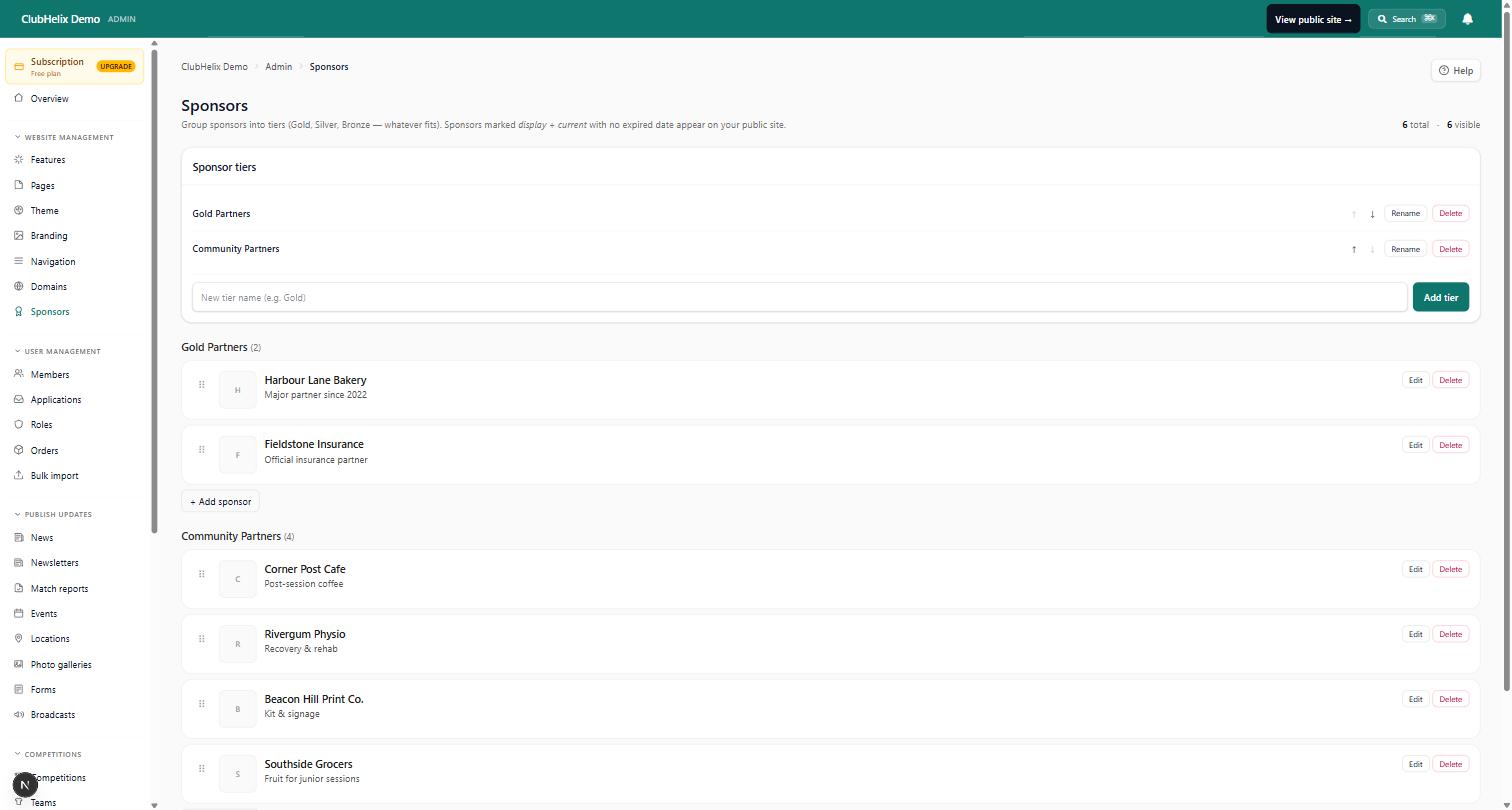
Writing packages down as packages — a name, an asking price and the exact list of assets included — is what makes the next committee able to sell them. In ClubHelix, sponsor packages and agreements work that way on purpose: the package carries the asset list, and when a deal is signed that list becomes the agreement's delivery checklist automatically, so the promise and the to-do list cannot drift apart.
Find the twelve organisations worth asking
A list of twelve researched prospects beats a list of sixty addresses, every time. Build it from six places, roughly in order of how warm they are.
Last year's sponsors. Renewals are several times easier than new business, and most societies never ask because the person who sold the deal has graduated. Start here even if last year's delivery was patchy — especially then.
Graduate employers who already recruit your discipline. If they buy a stall at the campus careers fair, they have a budget line, a target number of applications and a person whose job it is to hit it. You are cheaper and more targeted than the fair.
Alumni of your own society, three to eight years out. They now sit inside firms with campus engagement budgets, they remember the society fondly, and an internal advocate turns a cold ask into a conversation. Keep a personal-email address for every graduating member and this asset compounds — one of several reasons the member records habit matters.
Businesses within a ten-minute walk that already serve students: cafés, print shops, gyms, barbers, phone repair, the pub that hosts your socials. They buy repeat footfall for three years, and a member-discount code is worth more to them than a logo.
Businesses whose product is your society's subject. A music society and an instrument shop, a photography society and a camera retailer, a law society and a professional revision course, a coding society and a developer-tools vendor. The fit does half the selling.
The committee's own networks — parents, employers, part-time bosses. Awkward, effective, and the quickest yes you will get all year.
Rank the twelve by three questions: do they want students specifically, can one person decide without a committee, and can we name that person? Anything that fails all three goes to the bottom.
The money that moves in size comes from graduate recruitment: professional services and accountancy firms, law firms, the technology multinationals with local graduate programs, engineering and pharmaceutical employers, and the agri-food sector. Approach the graduate recruitment or early careers contact named on the company's careers site rather than a partner or the local office, and approach in the summer — graduate campaigns open in autumn and close well before the winter break, so a proposal sent in November has missed the budget. Chartered institutes and professional bodies form the reliable second tier: they sponsor course societies to build student membership and will often pay in a mix of cash and free student memberships your members will actually use. Below that sit the cafés, pubs and gyms around campus, who buy repeat footfall and respond far better to a member-discount arrangement than to a logo on a page. Alumni working three to eight years out are the warmest lead of all, because they can walk your proposal to the person who holds the budget.
The approach that gets replies
Match the channel to the buyer. For the local trader, walk in with a single printed page on a quiet weekday afternoon and ask for the owner by name. For the graduate recruiter, email the named early-careers person — not a generic address — with a subject line describing the cohort, not your society.
Subject: 214 penultimate-year engineering students, one evening in March
Hi Priya,
I'm Sam Okafor, president of the Engineering Society at [university]. We have 214 members: 68% are in their penultimate or final year, 71% are in engineering, and our email list of 1,140 opens at 46%.
Every March we run a careers evening. Last year 84 students came and stayed the full 90 minutes.
We're offering one partner the evening: 20 minutes with the room, a table, your material in the pack, a dedicated email to the list before and after, and your logo on the event page. That's $1,800 — about $21 per student in the room, with the email reach on top.
If the evening isn't the right fit, our supporter tier is $400 for the year.
Happy to send the one-page outline — is it worth a 15-minute call this week?
Sam
Four things make that work: a number in the subject line, the cohort before the society, one clear offer with one price, and a cost-per-student figure so they do not have to do the division themselves. Attach one page, never a twelve-page document; the long version is what you send after they reply.
Never write "we are seeking support", "any amount would be appreciated" or "we are a non-profit organisation run by volunteers". Every one of those tells a marketing budget that this is a donation request, and marketing budgets cannot spend on donations. Follow up on day eight and again on day twenty, then park them until next year with a note in the record — a "no" in April is often a "yes" in September when the new budget opens.
When you get the meeting, bring the numbers, bring the one-pager, and bring a decision to ask for. Close with the most useful question in fundraising: what would you need to see to be able to say yes to this? You will either get an objection you can fix or a budget cycle you can diarise.
Put it in writing — the one-page agreement
Here is the failure that is specific to societies rather than clubs. The person who sold the deal graduates in June. Nobody else knows what was promised. The sponsor's logo never goes on the tickets, the second email never goes out, and in October they do not renew and nobody can work out why. The agreement is not paperwork for its own sake — it is how the promise survives the committee.
Keep it to one page, and put these ten things on it:
- The parties, with the sponsor's contact name, their email and a second contact at the same business.
- The term, with exact dates. Not "this year" — societies and businesses do not agree on when the year starts.
- The amount, the payment schedule and the method, including who raises the request for payment.
- Every deliverable with a due date and an owner role — "the communications officer", not "Jaya" — because the role survives and the person does not.
- What they may say about you, in exact wording, and what they may not say about the university.
- Who approves artwork and copy, and how many working days that takes.
- Exclusivity, if any: which category, which scope, which end date.
- What happens if an event is cancelled, moved or shrunk — a make-good, a credit, or a pro-rata refund. Decide it now, not in a stressful week.
- The renewal window, with the date you will come back to them and their first-refusal period.
- Signatures, plus the association's countersignature where that is required.
Store it where the society stores things, not in the president's inbox — and put "sponsor agreements and what is still owed" on the handover checklist so it transfers as a matter of course.
In most cases the students' union holds society funds centrally: the union raises the invoice, the union receives the money, and you claim the spend afterwards through a requisition. Two consequences follow. First, sponsorship is a supply of advertising services rather than a gift, so where the union is VAT registered the invoice may carry VAT — agree in writing whether your quoted price is inclusive or exclusive before you name a figure, because that difference can be the whole margin on an event. Second, your spending timeline is the union's timeline, so a supplier expecting payment in three days will not enjoy the process; build the lead time into the event plan. Sponsorship is not a charitable donation and attracts no charitable receipt, so never let a proposal imply that it does. Keep the signed agreement, the invoice, the payment confirmation and the delivery record together in the society's own records — that bundle is what lets next year's committee answer a sponsor's question about a deal they had no part in. General information, not tax or legal advice; your C&S officer can confirm the process.
Deliver it, then prove it
Renewal is decided in the third week of the agreement, not at renewal time. The sponsors who do not come back are almost never the ones who had a bad event — they are the ones who paid, heard nothing for five months, and quietly concluded the money went nowhere.
Three habits fix that, and together they cost about half an hour a term.
Tick the checklist as you go, with evidence. Every deliverable gets a date and a piece of proof: a photo of the banner, a screenshot of the email, a link to the event page with their logo on it. Do it the same week, because reconstructing six months of delivery in one evening is how committees end up inventing things.
Send a mid-term note. Six sentences, no design: here is what has run so far, here is the attendance, here is what is coming next month. It is the single highest-return ten minutes in the whole sponsorship program.
Send a one-page report at the end of the term, with the renewal ask in it. Include what was delivered against what was promised, the numbers that matter to them (attendance at each event, emails delivered and opened, clicks to their site, views of the sponsors page, an estimate of social reach, and how many students spoke to them on the night), two good photographs, one sentence of member feedback, and the date you will call about next year.
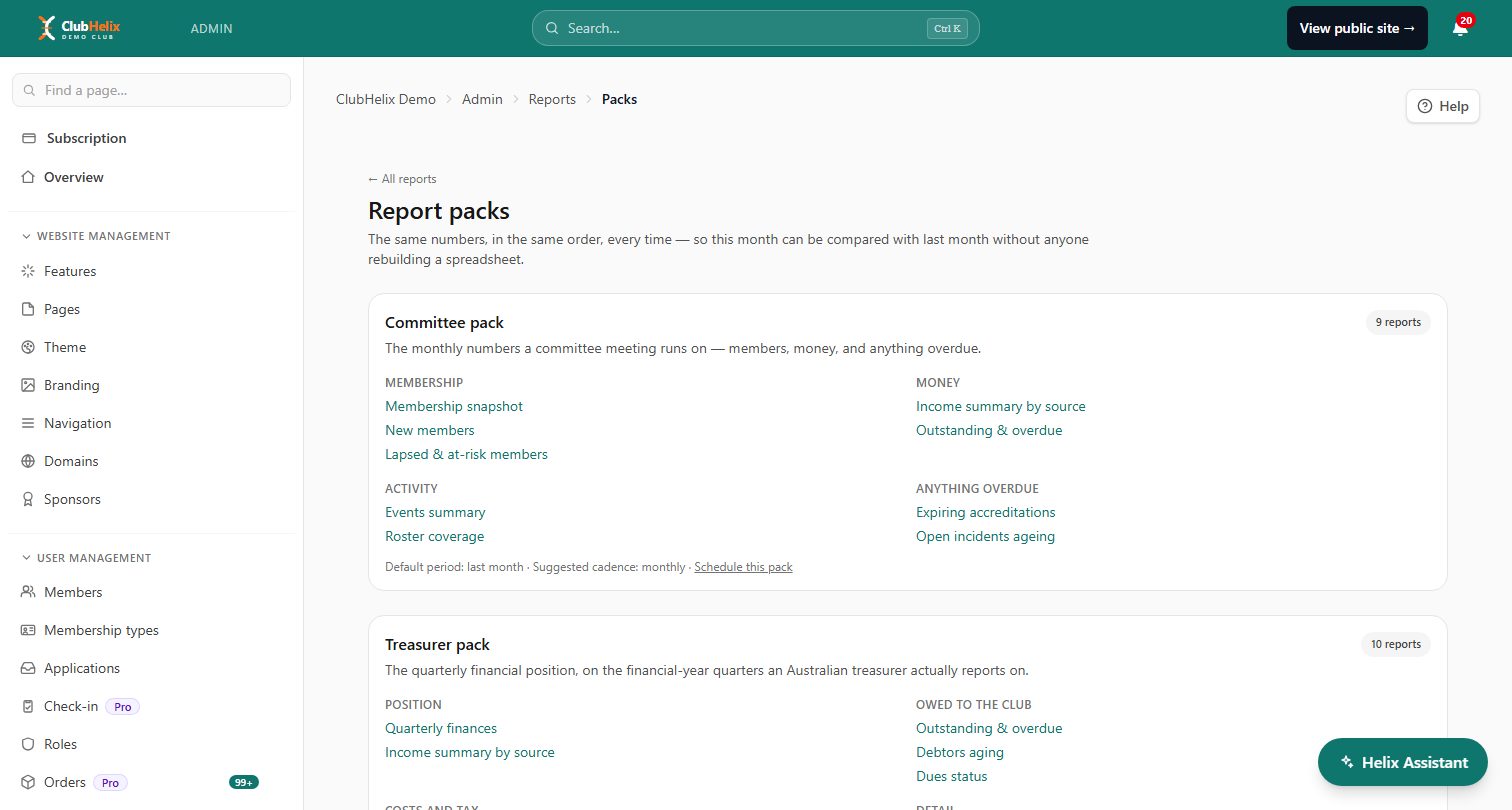
That is the least fun part of sponsorship and the part that decides your income next year, so it is worth automating what you can. In ClubHelix the attendance, email and payment numbers already exist as reports, and a scheduled report pack can email the committee the same set on the same date every month so the figures are sitting there when the sponsor report is due. Agreements carry renewal reminders 30 and 7 days out, a stat tile shows everything expiring within 60 days, and sponsor money sits in its own ledger rather than mixed into member payments — which is what stops a treasurer reporting sponsorship twice. On the public side, sponsor logos are grouped into tiers on your site and retire automatically at the agreement's expiry date, so no committee ever leaves last year's logo up by mistake.
Set the year's rhythm once and it runs itself: research and renew four to six months before the event, agreements signed and countersigned two months out, delivery checked weekly during the term, the mid-term note halfway, the report and renewal ask within two weeks of the last event, and the whole sponsor file handed over at the AGM. Pair that with a realistic budget, and price your ball tickets knowing what sponsorship has actually landed rather than what you hope will.
Frequently asked questions
How much can a student society realistically charge for sponsorship?
Far more than most committees ask for, provided you sell a specific audience rather than goodwill. A supporter-tier logo on a website and four newsletters is worth a couple of hundred; an event where a graduate recruiter gets twenty minutes with eighty students from one discipline is comfortably worth four figures, and a whole-year principal partnership with a society of two hundred can reach several thousand. The number that decides it is not your size but your cohort — a small society whose members are all final-year students in one discipline out-earns a large general-interest society every time.
We have never had a sponsor. Where do we start with no track record?
Start with one event and one number. Pick the event you are most confident will run, count last year's attendance honestly (or estimate it and say you are estimating), and sell that single evening to one partner at a modest price — a first-year deal at $500 that you over-deliver on is worth far more than a $2,500 deal you cannot service. Then document everything and send the report. Year two you are not selling a promise, you are selling a repeat, and the price roughly doubles.
Can we take sponsorship from a bar, a betting company or a vaping brand?
Sometimes for the first, rarely for the second, essentially never for the third — and the decision is not yours alone. Your student association's sponsorship policy will list prohibited categories, and advertising regulation sits on top of that for alcohol, gambling and nicotine products regardless of what a committee thinks is reasonable. Check before you take the meeting, because unwinding a signed deal is worse than declining one, and taking a banned category can put your affiliation at risk. This is general information — confirm with your student association or a professional.
In practice: union policy plus the drinks industry's own marketing codes restrict alcohol sponsorship aimed at students, betting sponsorship is restricted or banned by many unions, and vaping advertising is heavily limited. Assignment-writing services are banned outright.
Is it better to chase one big sponsor or several small ones?
Several, with one anchor. A single sponsor covering 70% of your income is a lovely year followed by a terrible one, because when their marketing manager changes jobs the society discovers it has no relationships at all. Aim for one principal partner at roughly a third of sponsorship income, two or three event partners, and a handful of supporters — and make sure at least two committee members have met each of them, so the relationship does not graduate along with the president.
Our sponsor paid last year and we never delivered anything. Can we go back to them?
Yes, and sooner than you think — but lead with the apology and a make-good, not a new proposal. Write to them, say plainly what was promised and what did not happen, offer something concrete this term at no charge (the event slot, the emails, the sponsors page listing), and only then talk about renewing. Committees are astonished how often this works: businesses understand that student organisations turn over completely every year, and what they resent is silence rather than failure.
Where ClubHelix fits
Sponsorship falls over for administrative reasons far more often than commercial ones — the package that lives in one person's document, the deliverable nobody recorded, the renewal date that passed while everyone was in exams. ClubHelix keeps the packages, the agreements, the delivery checklists, the money and the public sponsor wall in one place that belongs to the society rather than to whoever set it up, alongside the attendance and email numbers that make next year's ask credible. That turns a handover into a permissions change rather than an archaeology project, and it means the sponsor's question in November gets a real answer.
If you want to see how the whole picture fits together for a students' organisation and its affiliated societies, our university clubs and societies page walks through it, and the pricing page includes a free tier for building the site and trying it out, with taking payments online and being found in search on the paid plans. The rest of the money picture is covered in the funding and grants guide, the fundraising ideas ranked by return per volunteer hour, and the email and newsletters guide — because the list you email is the asset you are actually selling.
ClubHelix gives your society sponsor packages, agreements and a sponsor wall, the attendance and income reports that prove delivery, and email to the whole membership in one place. Start free before your next sponsorship season.


