
What this guide answers
- How much does a sports club website cost per year?
Between about $20 (domain only, on a free tier) and $1,500+ (large club on a full-featured platform plan), with most volunteer-run clubs landing in the $200–$900 range for a platform that includes registration…
- Can we get a decent club website for free?
Yes — free platform tiers give a real, functioning club website, usually with platform branding and limits on features like online payments.
- Why do club platforms cost more than basic website builders?
Because you're buying the admin system, not just the pages. A generic builder produces a brochure; a club platform runs registrations with payment, the member database, fixtures, events and email from the same place…
- Is an agency-built website worth it for a club?
Rarely, for volunteer-run community clubs. The build cost is the smaller problem; the ongoing model — paying hourly for every content change, or bottlenecking through one contact — fights how clubs actually operate.
- What ongoing costs surprise clubs most?
5–3% of every online transaction, whoever you use — decide whether the club absorbs or passes them on), per-ticket or per-registration levies on "cheap" tools that scale painfully with member count, and renewal-price…
South Africa edition. This guide is written for volunteer-run clubs in South Africa. Where rules differ — grants, tax, incorporation, safeguarding — follow the South Africa-specific pointers below or check with your national body.
"How much should we budget for the website?" is a question every club committee asks and almost no pricing page answers straight. The honest answer has two parts: the dollars, which range from about $20 a year to five figures depending on the route you take, and the volunteer hours, which are the cost clubs consistently forget to count and the one that actually decides whether the website survives.
This guide breaks down every real cost — domain, hosting, builders, platforms, agencies, and the sneaky add-ons — then gives you a way to match the spend to your club's size and volunteer reality. Numbers are typical market ranges as at 2026; treat them as budgeting guides, not quotes.
Figures below are in rounded rand. Almost every website builder and club platform bills in US dollars, so your cost moves with the exchange rate and usually carries a bank conversion fee on top — this is the single biggest reason club website budgets here overrun, so build in a buffer of at least fifteen per cent.
The one cost every club should pay: a domain
Whatever else you decide, register a domain the club owns — yourclub.org.au or similar. Typical cost: $15–$40 per year, with .org.au usually at the cheaper end and standard .com.au/.com slightly more. It's the price of a couple of sausage sizzles, and it buys permanence: your printed materials, QR codes and sponsor links keep working no matter what you do with the website behind it.
Two budgeting notes: register it in the club's name paid from the club account (never a volunteer's personal card — recovering a domain from a departed member's personal account is a genuine ordeal), and add domain-based email forwarding or hosting (often $0–$100/year depending on provider) so secretary@yourclub.org.au exists. Our domain guide covers the details.
Route 1: Free website options — $0, with strings
Genuinely free options exist: free tiers of website builders and club platforms, free social-media-page-as-website, and free community hosting. The real costs are non-dollar:
- Platform branding and ads on your site, which reads as less established to sponsors.
- Feature ceilings — usually no online payments, limited pages, no custom domain (or the domain costs extra, which is fine — pay it).
- The "Facebook page is our website" trap: invisible to people without accounts, unsearchable, chronological, and algorithmically hidden from most of your own followers. It's a channel, not a home base.
Free is a legitimate starting point for a brand-new club that hasn't signed up its first members yet — we've written a full guide to setting up a club website for free. Budget $20–$40 for the domain anyway. Expect to outgrow free on the member cap first, and on online registration payments soon after.
Realistic annual cost: $0–$40.
Route 2: DIY generic website builder — $200–$600/year
The drag-and-drop website builders you see advertised everywhere typically cost $15–$50 per month ($180–$600/year) once you're on a plan with a custom domain and no ads. That buys you attractive page design and nothing club-shaped. The club-shaped things get bolted on:
- Forms tool for registrations beyond basic contact forms: $0–$400/year.
- Payments/e-commerce tier to take money online: often a plan upgrade of $10–$25/month.
- Email newsletter tool: $0–$500/year depending on list size.
- Events/ticketing tool: per-ticket fees, commonly 2–5% plus a booking fee that your members pay.
The stack tends to land at $400–$1,000/year for a club actually using it for registrations, payments and email — quietly comparable to a club platform, but spread across four logins, four renewal dates, and one volunteer who understands how the pieces connect. That integration cost is the real price: when the form tool's connection to the spreadsheet breaks in March, it's a volunteer's Tuesday night that pays for it.
Realistic annual cost: $200–$600 for site only; $400–$1,000 with the club essentials bolted on.
Route 3: A club platform — $0–$1,500/year
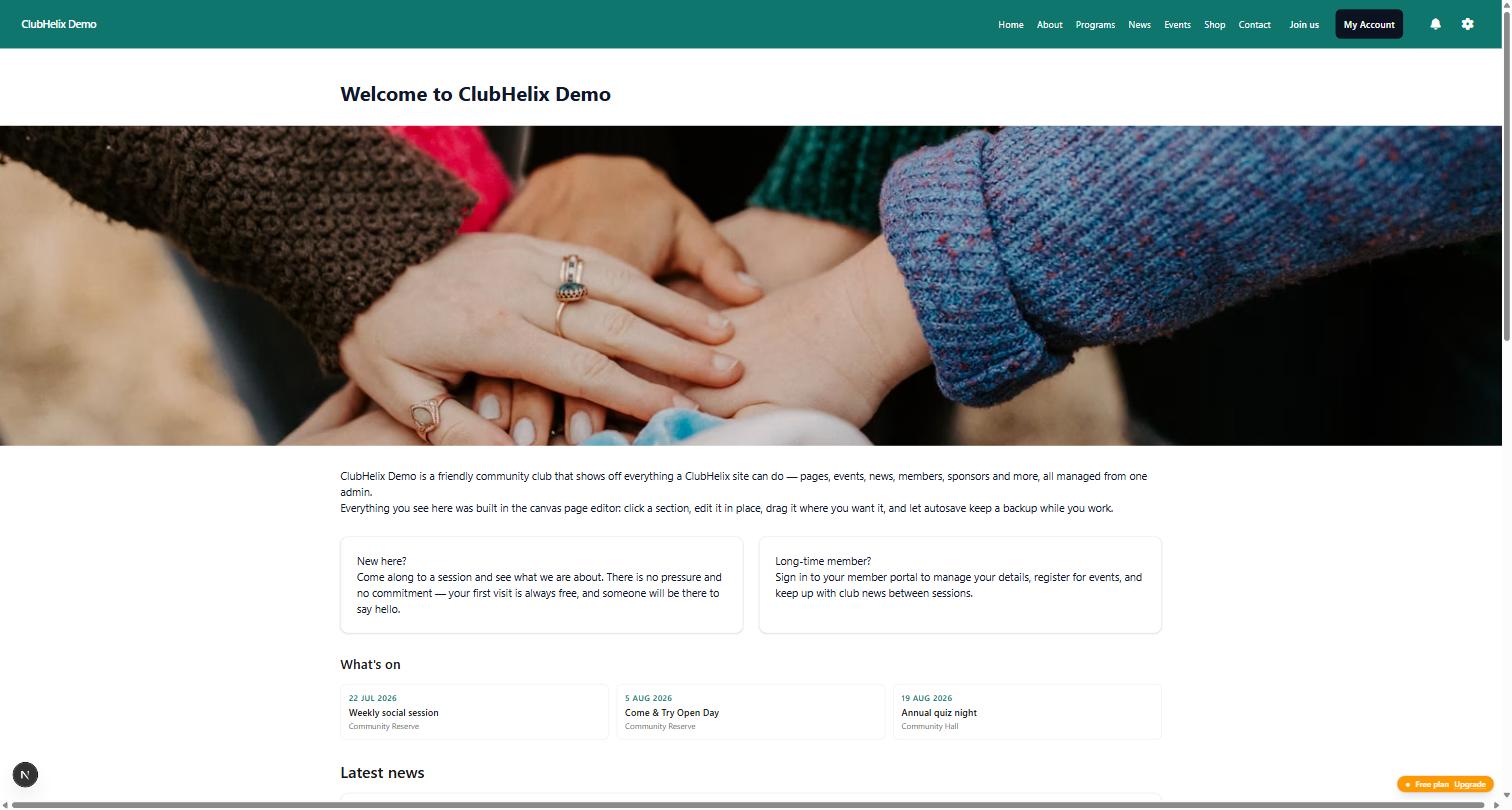
Purpose-built club platforms bundle the website with the club admin behind it: member database, online registration with payment, fixtures, events, email, shop. Market pricing typically runs from free tiers for small clubs to somewhere between a few hundred and $1,500 per year for full-featured plans at larger clubs, usually tiered by member count or features. Rather than quote ourselves here and go stale, see the current ClubHelix pricing — the structure (free tier, then plans by club size) is representative of how the category works.
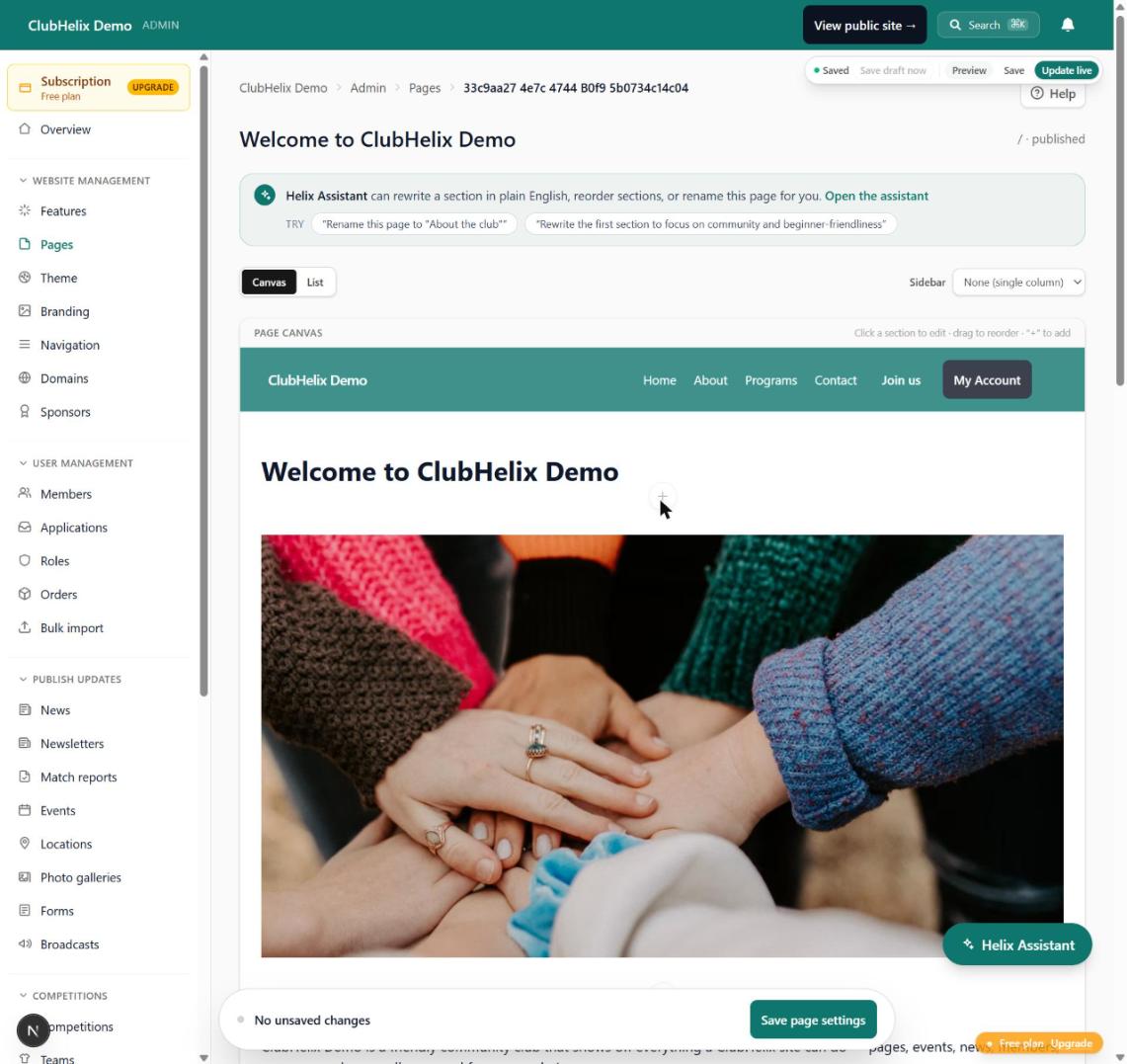
What the number buys, compared with routes 1 and 2, is consolidation: one system, one login handed over at the AGM, and the website updating itself as a side-effect of running the club — fixtures, events and member records flow to the public site without a separate publishing chore. Editing stays volunteer-friendly with a drag-and-drop page editor, and a custom domain connects on top.
Two cost notes for honest comparison:
- Payment processing fees exist everywhere. Whoever you use, online card payments carry a processing fee — typically a small percentage plus a fixed amount per transaction. Compare platform subscription + processing rate across options, and budget for the fee as part of your running cost: whether it can be shown to the payer as a separate line at all depends on local rules and on your card scheme agreements.
- Watch per-member and per-transaction pricing at scale. A "cheap" per-registration levy can exceed a flat subscription for a 400-member club. Do the multiplication for your actual member count.
Realistic annual cost: $0–$1,500 depending on club size and tier.
Route 4: Agency or freelancer build — $2,000–$15,000+
A custom-built website from a local agency or freelancer typically starts around $2,000–$5,000 for a template-based small-business build and runs to $10,000–$15,000+ for genuinely custom design and functionality. Then the recurring costs begin:
- Hosting and maintenance: $300–$1,500/year, often as a care plan.
- Changes: $90–$180/hour. Every fee update, committee change and sponsor logo is a paid task or a bottleneck.
- Registration/payment functionality: custom builds of member registration and payment flows are exactly the expensive, fragile part — many agency-built club sites end up linking out to third-party form tools anyway.
Agency builds make sense for large clubs with paid administrators, unusual requirements, and a budget for ongoing maintenance. For a volunteer-run club, the failure mode is well known: a beautiful site nobody can afford to update, frozen at the season it was built. If you want professional polish without the ongoing hourly rate, a middle path is a platform with a done-for-you setup service — professional build, volunteer-editable afterwards.
Realistic cost: $2,000–$15,000 up front, plus $500–$2,000/year ongoing.
The cost nobody budgets: volunteer hours
Put a number on your volunteers' time — even a notional $40/hour — and the comparison changes shape. A DIY stack that saves $300 a year over a platform but costs the secretary three extra hours a month is $1,440 a year more expensive, paid in the club's scarcest currency. Questions that surface the true cost:
- How many hours a month does keeping the site current take, and whose hours are they?
- When fixtures change, does the website update itself or does someone retype them?
- Can at least three committee members edit the site today? What's the handover cost when the current webmaster leaves?
- How many hours does registration season cost in form-wrangling and payment reconciliation?
The cheapest website is the one your whole committee can update in minutes, that publishes club data automatically, and that survives handovers. That's usually worth paying real dollars for — and it's the honest case for integrated platforms over cheaper fragmented stacks.
What should YOUR club spend? A quick matcher
- Brand-new club, no members signed up yet, no money yet: domain ($20–$40) + a free tier while you build it. Total: under $50/year. Move to a paid tier as soon as you start taking members.
- Established club, up to 300 members, volunteer-run: domain + a paid club-platform tier. Total: roughly $200–$900/year, largely offset by the admin hours and missed registrations it recovers.
- Large club, 300+ members, some paid admin: domain + a top platform tier, or platform + done-for-you setup. Total: $800–$2,500/year. An agency build only if you have genuinely custom needs and a maintenance budget.
- Any club considering an agency quote: get the quote, then price the platform route including setup service, and compare five-year totals including change requests. The five-year gap is usually $8,000+.
Budget template lines
For your treasurer's next budget, the website lines that cover everything:
| Line | Typical annual amount |
|---|---|
| Domain renewal (+ email forwarding) | $20–$140 |
| Website platform/builder subscription | $0–$1,500 |
| Payment processing (net, if absorbed) | 1.5–3% of online revenue |
| Photography/design refresh | $0–$300 |
| Contingency: paid help for one tricky job | $150–$500 |
Frequently asked questions
How much does a sports club website cost per year?
Between about $20 (domain only, on a free tier) and $1,500+ (large club on a full-featured platform plan), with most volunteer-run clubs landing in the $200–$900 range for a platform that includes registration, payments and email. Agency-built sites are a different bracket: $2,000–$15,000 up front plus ongoing hosting and hourly changes. The domain ($15–$40/year) is the one cost every club should pay regardless of route.
Can we get a decent club website for free?
Yes — free platform tiers give a real, functioning club website, usually with platform branding and limits on features like online payments. That's a sensible starting point for new or tiny clubs, and you can upgrade in place when registration season justifies it. Still buy the domain: it keeps every printed URL and QR code valid for life. See our full free-setup guide for the walkthrough.
Why do club platforms cost more than basic website builders?
Because you're buying the admin system, not just the pages. A generic builder produces a brochure; a club platform runs registrations with payment, the member database, fixtures, events and email from the same place — things a generic builder needs three or four paid add-ons and a volunteer integrator to approximate. Priced as a full stack, the two routes usually cost about the same in dollars, and the platform costs far less in volunteer hours.
Is an agency-built website worth it for a club?
Rarely, for volunteer-run community clubs. The build cost is the smaller problem; the ongoing model — paying hourly for every content change, or bottlenecking through one contact — fights how clubs actually operate. Agencies suit large organisations with paid staff and custom requirements. If you want professional polish, a done-for-you setup on a platform gets you the polish and leaves the club able to edit its own site afterwards.
What ongoing costs surprise clubs most?
Three recur: payment processing fees (1.5–3% of every online transaction, whoever you use — decide whether the club absorbs or passes them on), per-ticket or per-registration levies on "cheap" tools that scale painfully with member count, and renewal-price jumps where an introductory first-year price doubles at renewal. Read the renewal price, not the promo price, when comparing.
Want the full stack — website, drag-and-drop editing, your own domain, registration and payments — at a price you can see up front? Start free on ClubHelix pricing, or read the step-by-step club website build guide.

