
What this guide answers
- What is the main difference between Hello Club and TidyHQ?
Their centre of gravity. Hello Club is built around a facility — memberships, bookings and payments for clubs whose life happens on a court or green, with access-control hardware integration as a standout.
- How much do Hello Club and TidyHQ cost?
As at July 2026, TidyHQ publishes a free plan and a Pro plan at US$69 per month (listed as A$89, £49 or NZ$99), with an Enterprise option for governing bodies, unlimited contacts and admins on Pro, and 30,000 emails a…
- Does TidyHQ handle court bookings?
Its product story is membership, finances, meetings and communications, not facility scheduling, so a club whose daily task is rationing court hours should treat booking as the first question in a demo rather than an…
- Can a club run both products at once?
Some do, and it can work if you are deliberate about it, but you inherit the usual two-system tax — members exist twice, the payment picture is split, and somebody has to reconcile.
- Which one suits a bowls, squash or badminton club?
The same logic as tennis. If the green or the courts are your scarce, contested, revenue-earning asset, a booking-led product will feel right from the first week.
Every racquet club committee eventually holds the same two-part meeting. The first half is about courts — who has Tuesday at seven, why the coaching block ate the social ladder again, whether the floodlights should switch off at nine-thirty or ten. The second half is about paperwork — the treasurer's report, a motion about visitor fees, the fact that the membership register still has fourteen people on it who left in 2023.
Hello Club and TidyHQ are both good answers to that meeting. They are just answers to different halves of it. Hello Club grew up around bookings and access at member-owned facilities; TidyHQ grew up around the administration of community organisations — membership, money, meetings, comms. Neither is a watered-down version of the other. They come at a club from opposite ends of the corridor, and once you notice that, choosing gets much easier.
We should declare our position before refereeing. We are ClubHelix, an all-in-one club platform, so we are a third option in this category and we will say plainly at the end where we do and do not compete. Everything below about the two products comes from public sources, current as at July 2026 — where a figure could not be verified against a primary source, we say so instead of guessing. Both companies change their packaging, so check anything decision-critical directly with them.
Two origin stories, still visible in the software
Hello Club is based in Auckland, New Zealand, and is built for the racquet and bowls end of the club world — memberships, bookings and payments for clubs whose life revolves around a facility. Its distinguishing capability, and it is a real one, is integration with access-control hardware: doors and lights, plus visitor logs. That is not a spec-sheet curiosity. It is the difference between a club that must roster a person to unlock the gate and a club where a member's booking opens the gate and turns the lights on. It is strongest on its home turf in New Zealand, with a growing presence across the Tasman.
TidyHQ was born in Adelaide and sells globally, with its stronghold in Australia. It is general club and association administration — membership, finances, meetings and communications — and it has become something close to the default for community groups of the Scouts, Rotary and hobby-association shape. Its committee and meeting tooling is mature in a way that sport-first products rarely bother with, and its finance workflows sit comfortably alongside Xero, which is exactly what a volunteer treasurer wants to hear.
The quickest tell is what each puts on the home screen. One shows you the day's court grid. The other shows you the organisation.
Side by side
| Area | Hello Club | TidyHQ |
|---|---|---|
| Centre of gravity | Facility bookings, memberships, payments | Membership, finances, meetings, communications |
| Home market | Auckland, New Zealand — growing Australian presence | Adelaide-born, Australia — global sales, Australian stronghold |
| Typical customer | Racquet and bowls-type clubs with a facility | Community groups and associations of all kinds |
| Court and facility booking | Mature booking experience — a core strength | Not what the product is sold on |
| Access control hardware | Door and light control integration, visitor logs | Not part of the product story |
| Committee and meeting tooling | Not its emphasis | A genuine strength — the reason many groups choose it |
| Finance workflows | Payments alongside membership | Finance workflows that sit near Xero |
| Sport features (fixtures, ladders) | Not its emphasis | No sport story |
| Public website | Not what it is bought for | A weak part of the offer, in our assessment |
| Pricing (July 2026) | Not verified in our research — check their pricing page directly | Free plan, plus Pro at US$69/mo (A$89 / £49 / NZ$99), Enterprise for governing bodies |
Two notes on that table so it is read fairly. The "not its emphasis" cells are statements about what each product is built and marketed around, not claims that a capability is absent — if one of those rows is your make-or-break, ask the vendor rather than trusting any comparison page, this one included. And the website row is our opinion, from a company that builds club websites for a living, so weigh it accordingly.
Booking and access control, compared
Court booking looks like a calendar and behaves like an air traffic control system. The depth is in the rules, and a club discovers its rules the hard way — usually after an argument.
Here is the list we would take into any trial, whichever product you are testing:
- Member and visitor rates, with peak and off-peak bands that match when your courts are actually contested.
- Recurring blocks that outrank casual bookings — club night, junior coaching, the pennant squad — and can be released back to members when they are not needed.
- One member booking for four, with the other three named, because that is how doubles works and because guest fees depend on it.
- Limits per member per week, the quiet fairness rule that stops the same four people owning every Saturday morning.
- Cancellation windows and no-show handling, including whether a late cancel costs the member anything.
- Weather, for outdoor clubs — a fast way to void an afternoon of bookings and tell everyone at once.
- Lights, for evening play, including who is responsible for the last court of the night.
- Fixture interaction, so a home match takes the courts out of the pool automatically rather than by memory.
- Visitor logging, both for guest revenue and for knowing who was on site.

Access control is where Hello Club genuinely separates itself. If your club runs unstaffed hours — and most racquet and bowls clubs do — the chain from "member books court three at 6am" to "gate opens, court three lights come on, and only then" is worth real money and real volunteer hours. It also gives you a defensible answer to the two questions that come up after every incident or power bill: who was on site, and what was switched on.
Be honest with yourself about whether you need it, though. A club with a staffed reception, or one whose gate is simply open from six to ten, is buying a solution to a problem it does not have. Access hardware also brings its own project — installation, key fobs or codes, someone who knows what to do when a reader fails on a Sunday.
TidyHQ approaches the same building from the other side. It is not sold as a court-booking system, and a club whose central daily task is rationing court hours will feel that. If bookings are the reason you are shopping, that is the single most important question to put to them directly before anything else.
Memberships, invoicing and committee tooling
Now flip it. Suppose your genuine pain is not the court grid — it is that the secretary rebuilds the same agenda every month, the treasurer reconciles subs against a bank statement by eye, and nobody can produce a clean register of members when the insurer asks.
This is TidyHQ's home ground. Its meeting and committee tooling is mature, its Pro plan carries unlimited contacts and admins with 30,000 emails a month, and its finance workflows are shaped for people who will hand a set of numbers to an accountant. For an incorporated club, that machinery is not optional decoration — it is how you stay compliant with your own constitution.
A committee year has a rhythm, and it is worth mapping before you choose software:
| When | Artefact | Who owns it |
|---|---|---|
| Monthly | Agenda, minutes, motions carried | Secretary |
| Monthly | Income and expenditure against budget | Treasurer |
| Pre-season | Subs schedule, family and concession rates | Registrar and treasurer |
| Mid-season | Register of members, insurance declaration | Registrar |
| Annually | AGM notice, quorum, elections, annual report | Secretary and president |
| Annually | Grant acquittals and sponsor reporting | Whoever drew the short straw |
Membership billing has its own awkward corners in a facility club, and both products live in them: family memberships that bundle four people under one payer, pro-rata joins in the back half of the season, life members who owe nothing but must never fall off the register, and the social member who plays twice a year but still votes at the AGM. Ask any vendor to demonstrate a mid-season pro-rata join and a family renewal with one child ageing into a senior rate. That single demo tells you more than an hour of slides.
If you want the committee-tooling comparison from another angle, we have written up TidyHQ against an app-first product as well, and our own view of the category sits at /compare/tidyhq-alternative.
Which fits a club whose main asset is a court
Here is the test we would actually apply, and it has nothing to do with feature counts. What is the scarce resource your club rations?
For a tennis, squash, badminton or bowls club, the honest answer is usually court hours or green time. The asset is physical, finite, contested, and it is also your revenue. For a walking group, a service club or a hobby association, the scarce resource is volunteer attention and the paperwork that consumes it.
Put illustrative numbers on the first case, because committees rarely do. A six-court club with fourteen usable hours a day has 588 court-hours in a week. Say club nights, coaching and pennant fixtures account for a third of that, and casual member bookings fill another fifth. That still leaves several hundred empty court-hours every week — the raw material for visitor play, holiday clinics, corporate hires and off-peak social memberships. Those numbers are made up for illustration, but the point is not: if your asset is a court, the software that manages the court is a revenue system, not an admin system.
| If this is your loudest complaint | Lean towards |
|---|---|
| "The same members own peak hours and nobody else can get on" | Booking-led |
| "We pay someone to unlock the gate at 6am" | Booking-led, with access control |
| "Visitors play for free because nobody logs them" | Booking-led |
| "The AGM papers took the secretary a fortnight" | Committee-led |
| "We cannot tell who has actually paid this season" | Committee-led |
| "Our website is a Facebook page and a phone number" | Neither — that is a third conversation |
Pricing, stated honestly
TidyHQ publishes its pricing: a free plan, a Pro plan at US$69 per month (listed as A$89, £49 or NZ$99 depending on where you are), and an Enterprise arrangement for governing bodies and federations, with unlimited contacts and admins and 30,000 emails a month on Pro (checked July 2026).
For Hello Club we are going to do the unusual thing and decline to quote a number. Third-party software directories carry figures, but we could not verify any of them against the company's own pricing page — and a comparison article that repeats an unchecked number is worse than one that admits the gap. Get the current tiers from Hello Club directly, and ask specifically how the meter works as your member count grows.
Whichever way you go, price the transaction fees separately from the subscription. For a club collecting subs, court fees, guest fees and coaching payments, the percentage taken on the way through can matter more over a season than the monthly licence.
The thing neither one leads with — your public face
Both products are bought for what they do behind the login. Neither is bought for its website, and that leaves a gap that a facility club feels more than most, because a court club sells to strangers. The person searching for a court on a Saturday morning, the parent looking for junior coaching, the local business weighing up a sponsor board, the grant assessor checking whether you look like a going concern — none of them log in. They land on a page.
That is the third job in the room, alongside bookings and paperwork, and it is worth costing deliberately rather than discovering later. Our guides on running a tennis club and hiring out your clubrooms both come back to the same point — the facility only earns when people outside the membership can find it and book it.
One login for the courts, the committee and the front page
This is where our bias becomes relevant, so take it with the appropriate pinch of salt. ClubHelix is the option that tries to hold all three jobs at once — facility booking with member and visitor rates for the court grid, self-registration and renewals for the membership side, governance meetings for agendas, motions and minutes, and a real branded website built in a canvas page editor on your own domain rather than a members-only portal.
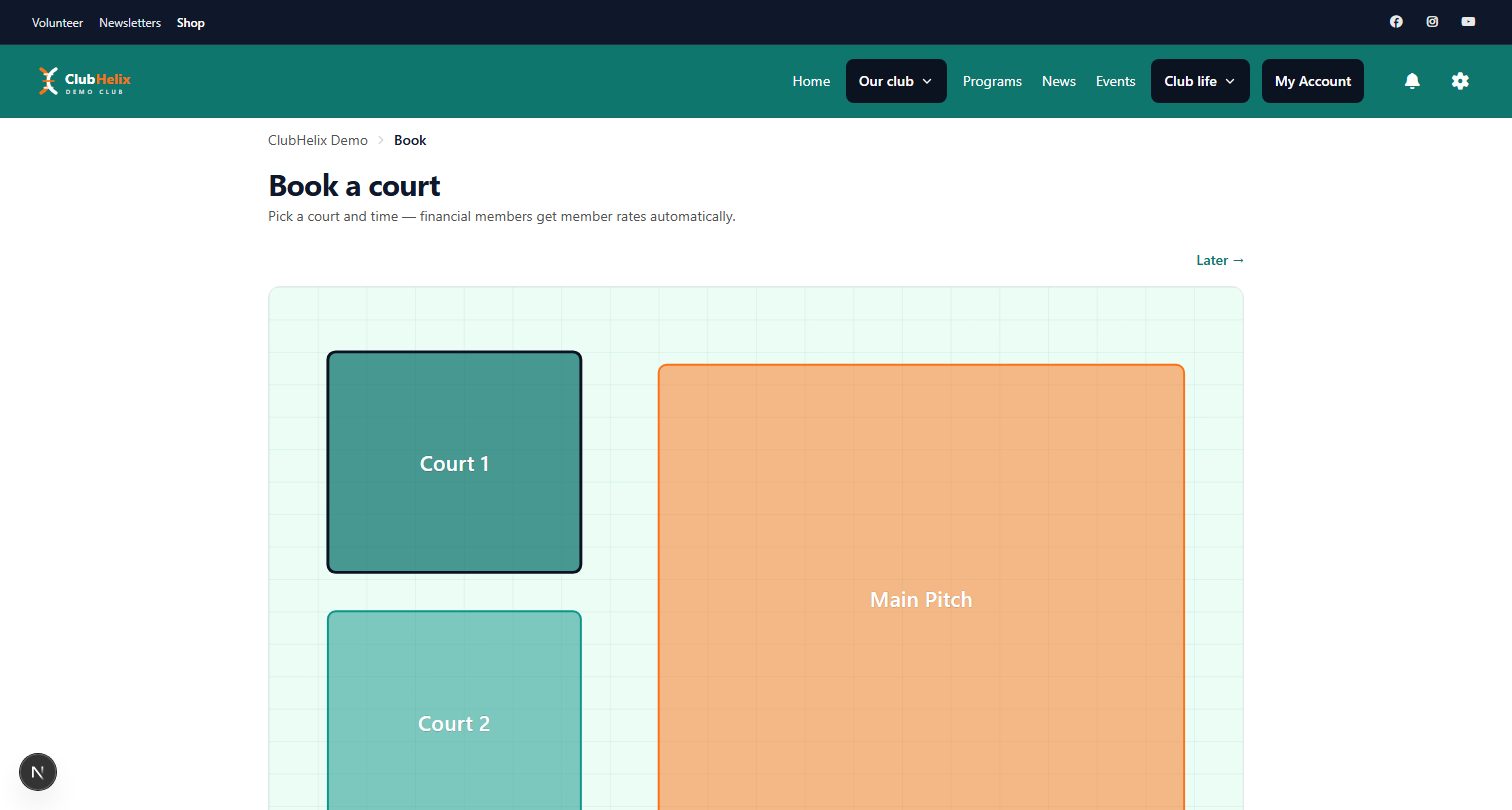
Start on the free tier and load your own court rules into it — peak bands, coaching blocks, weekly limits — before any money is involved. What each plan costs sits openly on the pricing page rather than behind a quote form, and the whole thing runs on Australian soil under Australian ownership. One committee session is usually enough to launch your club site with a working booking grid, and the racquet-club specifics are laid out under tennis.
What we cannot do, and it matters in this particular match-up: we have no access-control hardware integration. If the reason you are looking at Hello Club is unlocking doors and switching on floodlights from a booking, they do something we do not, and no amount of website polish substitutes for a gate that opens. We also have no native app-store apps — our mobile experience is an installable web app — and TidyHQ has years of community-group mindshare and meeting-tooling refinement that we respect.
Frequently asked questions
What is the main difference between Hello Club and TidyHQ?
Their centre of gravity. Hello Club is built around a facility — memberships, bookings and payments for clubs whose life happens on a court or green, with access-control hardware integration as a standout. TidyHQ is built around running an organisation — membership, finances, meetings and communications — and is a common default for community groups rather than facility clubs. Pick the one whose home screen shows the thing you argue about most.
How much do Hello Club and TidyHQ cost?
As at July 2026, TidyHQ publishes a free plan and a Pro plan at US$69 per month (listed as A$89, £49 or NZ$99), with an Enterprise option for governing bodies, unlimited contacts and admins on Pro, and 30,000 emails a month. When we re-checked in October 2026, TidyHQ also charged its own service fee on payments, on top of Stripe's: 3% + A$0.20 on Free and 1% + A$0.20 on Pro. Hello Club's current tiers are not something we can verify from a primary source, so we are not quoting a figure — ask them directly. Whatever the subscription, get the transaction fees in writing too.
Does TidyHQ handle court bookings?
Its product story is membership, finances, meetings and communications, not facility scheduling, so a club whose daily task is rationing court hours should treat booking as the first question in a demo rather than an assumption. Ask them to show your actual rules — peak and off-peak rates, recurring coaching blocks, per-member weekly limits — before you decide.
Can a club run both products at once?
Some do, and it can work if you are deliberate about it, but you inherit the usual two-system tax — members exist twice, the payment picture is split, and somebody has to reconcile. If you go that way, decide up front which system is the source of truth for the member list, and give one named person the weekly job of keeping them aligned.
Which one suits a bowls, squash or badminton club?
The same logic as tennis. If the green or the courts are your scarce, contested, revenue-earning asset, a booking-led product will feel right from the first week. If your club is small, the courts are rarely full, and the real burden is the committee's paperwork, the administration-led product will do more for you. Size matters less than which problem is loudest.
Do we still need a separate website?
Almost certainly, unless whichever platform you choose publishes a real public site on your own domain. Members-only portals are invisible to the people you most need to reach — casual players, coaching enquiries, sponsors and grant assessors — and a facility club earns much of its income from exactly those strangers.
Keep reading — how to run a tennis club covers the operating year in detail, and how to hire out your clubrooms works through turning an under-used facility into income.


