
What this guide answers
- Is a family cap or a sibling discount better for a club?
It depends entirely on your roster shape. A cap costs least at clubs where most multi-member households have exactly two members, because a cap set above two full fees never bites on them.
- How big should a family membership discount be?
Size it from your cost structure, not from what feels generous.
- How should a club define a family for membership pricing?
Attach the discount to the person paying rather than to an address or a relationship.
- Should governing-body fees be included in a family cap?
Generally no. Registration levies and insurance charged per head are money you collect and forward, so capping them means the club funds the difference out of its own reserves.
- Can we change our family pricing part way through a season?
You can, but it is rarely worth the goodwill it costs. Announce changes before renewals open, show worked before-and-after examples for real household shapes, and honour the price anyone has already paid for the…
USA edition. This guide is written for volunteer-run clubs in the United States. Where rules differ — grants, tax, incorporation, safeguarding — follow the USA-specific pointers below or check with your national body.
The family cap on your fee schedule was almost certainly set by a committee that has long since moved on. Someone proposed a round number, someone else said it felt about right, and it has been nudged up a little every couple of years since. What nobody has done is go back and ask the only two questions that matter — what is this cap costing us, and what is it buying us?
Both questions have answers, and you can work them out in an evening with last season's roster. A family price is a volume discount on a service where most of your real costs are per head. The third child in a household needs the same insurance cover, the same registration with your governing body, the same coach-to-player ratio and the same square metres of playing surface as the first. Discount too hard and you are selling below cost on your busiest households. Discount too softly, or not at all, and a parent with three kids does the sum on your fee page, decides your sport is not affordable this year, and takes the whole household somewhere else. You never hear from them, so the cost never appears on any report.
This guide is for the treasurer, registrar or membership officer who has to set that number and defend it. It covers the two workable models and what each actually costs, how to size the discount against your own household mix rather than the club down the road, how to define "family" so the definition survives separated parents and blended households, and how to implement the whole thing so nobody is manually editing invoices in week three of the season.
What a family price is actually buying
A family discount is not charity and it should not be argued for as though it is. It is a commercial decision with four real returns.
Household lock-in. A household that has two or three members at your club is dramatically harder to lose than one with a single member. Leaving becomes a logistics decision about three sets of training nights, not one.
The cheapest recruitment you will ever do. Siblings arrive at the boundary of an existing relationship. There is no marketing spend, no come-and-try day, no follow-up sequence — just a parent already standing at the ground with a younger child who is bored. Pricing that makes the second and third registration an easy yes is recruitment, filed under the wrong budget line.
Volunteer supply. Multi-member households are over-represented in the people who end up scoring, running the canteen, managing a team and eventually joining the committee, because they are at the club anyway. That is not a reason to give the discount away, but it belongs in the argument.
Removing the price objection at exactly the point it bites. For most households the first registration is a decision about the sport. The second and third are decisions about the household budget. Those are different conversations and a flat per-head fee answers only the first.
Against that, every discounted member still consumes real cost. Before you set any number, sort your cost lines by whether they scale with heads:
| Cost line | Scales with | Safe to discount? |
|---|---|---|
| Governing-body registration or affiliation | Every registered member | No — this is a pass-through you collect and forward |
| Insurance and participant cover | Every registered member | No — usually charged per head on the same basis |
| Playing kit, uniforms, equipment issued | Every member | No — sell separately at cost rather than bundling it |
| Coaching hours and contact time | Roughly per head | Partly — group sessions have some slack, squads have very little |
| Ground, court or hall hire | Per team or per session | Yes — mostly fixed, so an extra sibling is close to free |
| Competition entry fees | Per team | Yes — same logic, the team is entered either way |
| Admin, communications, website, insurance admin | Barely at all | Yes — marginal cost of one more member is near zero |
The shape of that table is the whole argument. Your family discount should come out of the fixed and near-fixed lines, never out of the pass-throughs. A club that caps the total bill including per-head levies is quietly paying its governing body out of its own reserves for every third and fourth child, which is a subsidy nobody ever voted for.
One thing to check before you set the number — if your club is organised as a 501(c)(3), a documented financial-aid or scholarship policy usually does more for the families you are worried about than a broad sibling discount does, and it is far easier to fund from donations. Many youth clubs run both — a modest sibling ladder for everyone plus a confidential aid application for households that need more. Take advice on how aid is recorded and acknowledged, since the treatment differs from an ordinary fee discount.
Model one — the family cap
A cap says: no household pays more than a set total, however many members it has. It is the easiest model to explain on a fee page and the easiest for a parent to check.
To compare models without arguing about currency, express everything as multiples of one full junior fee. Call that fee 1.0. A common cap sits at 2.5×.
| Household | Full price | With a 2.5× cap | Revenue kept |
|---|---|---|---|
| 1 member | 1.00 | 1.00 | 100% |
| 2 members | 2.00 | 2.00 | 100% |
| 3 members | 3.00 | 2.50 | 83% |
| 4 members | 4.00 | 2.50 | 63% |
| 5 members | 5.00 | 2.50 | 50% |
The cap's virtue is certainty — a family knows the worst case before they start. Its flaw is that the discount accelerates. The fifth member is free, and the household with five members is also the one generating the most coaching hours, the most kit, the most fixtures and the most pass-through levies. Almost every cap that gets a club into trouble is one with no upper limit on members.
The fix is to say the quiet part out loud in the fee schedule — the cap covers a stated maximum number of members, and pass-through costs sit outside it. That is not mean-spirited; it is the difference between a discount you can afford forever and one you have to withdraw in three years.
Model two — the sibling ladder
A ladder discounts each additional member by a stated percentage rather than capping the total. A typical shape is full price for the first member, 25% off the second, and 50% off the third and each one after.
| Household | Full price | With the ladder | Revenue kept |
|---|---|---|---|
| 1 member | 1.00 | 1.00 | 100% |
| 2 members | 2.00 | 1.75 | 88% |
| 3 members | 3.00 | 2.25 | 75% |
| 4 members | 4.00 | 2.75 | 69% |
| 5 members | 5.00 | 3.25 | 65% |
Set side by side, the two models trade places:
| Household | Cap at 2.5× | Sibling ladder | Cheaper for the family |
|---|---|---|---|
| 2 members | 2.00 | 1.75 | Ladder |
| 3 members | 2.50 | 2.25 | Ladder |
| 4 members | 2.50 | 2.75 | Cap |
| 5 members | 2.50 | 3.25 | Cap |
The ladder is more generous to the two-member household and more sustainable at the top end, because it never stops charging something for an extra member. The cap is more generous to the rare large household and easier to advertise. Which is right for you depends entirely on the shape of your roster, which is the next section.
A third option that works well for clubs with genuinely different fee levels — seniors, juniors, social, midweek — is a household bundle: one price for a defined package such as two adults and up to three juniors. It is the cleanest thing to sell, because the household buys one product rather than negotiating a discount. It is also the least flexible, so it suits clubs where the typical family shape really is typical.

Sizing it against your own roster
Here is the twenty-minute exercise that turns this from a debate into a decision. Take last season's member list, group it by household, and count households by size.
Take this illustrative club as a worked example — 198 households, 304 members:
| Household size | Households | Members |
|---|---|---|
| 1 member | 120 | 120 |
| 2 members | 55 | 110 |
| 3 members | 18 | 54 |
| 4 members | 5 | 20 |
| Total | 198 | 304 |
At full price the roster is worth 304 fee-units. Now cost each model in the same units.
A 2.5× cap only bites on households of three or more. Three-member households give up 0.5 units each — 18 × 0.5 = 9. Four-member households give up 1.5 each — 5 × 1.5 = 7.5. Total discount: 16.5 units, or 5.4% of gross membership revenue.
The sibling ladder bites on every household of two or more. Two-member households give up 0.25 each — 55 × 0.25 = 13.75. Three-member households give up 0.75 each — 18 × 0.75 = 13.5. Four-member households give up 1.25 each — 5 × 1.25 = 6.25. Total discount: 33.5 units, or 11.0% of gross.
The ladder costs this club roughly twice what the cap costs, and the reason is entirely in the roster shape — most multi-member households have exactly two members, which the ladder discounts and the cap does not. Run the same arithmetic on a club with a big cohort of three-and-four-child families and the answer flips. This is why copying the neighbouring club's fee schedule is such a reliable way to lose money.
Two sanity checks before you sign off:
- What proportion of gross revenue are you giving away? Anything above about 10% deserves a conscious vote rather than a quiet renewal. Compare it to what you would spend on recruitment to replace the members it retains.
- Where does the marginal member land? Take the last member in your largest discounted household and check the price they pay against your per-head pass-through costs. If it is lower, you are paying for that member to play.
To put currency on it — say a youth registration of $225 with $95 per head going out as national membership, league entry and insurance. Capping the total at 2.5× would mean a four-child household paying $562.50 while $380 is already spoken for, leaving $182.50 to cover four players' worth of coaching, field time and equipment. Cap the club's own portion instead. If the club's share is $130 per head, a cap of 2.5 club-shares is $325 plus $380 in pass-throughs — $705 rather than $900, and the club keeps enough to actually run the program.
Defining a family without writing a rule you will regret
Most fee schedules still carry a definition written when households were simpler — "two parents and their dependent children residing at the same address". That sentence fails in a dozen ordinary situations, and every failure lands on a volunteer registrar who now has to make a ruling with a queue behind them.
The definitions that hold up in practice attach the discount to who pays, not to who lives where. One responsible payer, a stated maximum number of members, and a line of committee discretion for the cases nobody predicted.
Here is a definition you can adapt:
Family membership. A family membership covers up to [four] members registered and paid for by the same responsible person, regardless of address or relationship. Governing-body registration, insurance levies and playing kit are charged per member and sit outside the family price. Members must be added to the family membership at the time of registration; the discount is not applied retrospectively. Where a household's circumstances do not fit this definition, the committee may apply the family price at its discretion, and will record the decision in the minutes.
Test any definition you write against this list before you publish it:
| Situation | Should it get the family price? | The reasoning |
|---|---|---|
| Two children, separated parents, each paying for one | Usually no | Two payers, two separate bills — offer the discount to whichever parent registers both, and let them settle it privately |
| Blended household, four children, three surnames | Yes | One payer, one household — surnames are irrelevant |
| Grandparent registering and paying for two grandchildren | Yes | The payer test handles this cleanly |
| Adult child living elsewhere but still on the parent's account | Committee call | Set an age limit and write it down rather than deciding case by case |
| Two adult housemates who train together | No | The discount exists for dependants, not for co-tenancy — say so plainly |
| Foster or kinship carer registering children | Yes | Same payer test, and treat any documentation request with care |
| A fourth child joining mid-season | Yes, pro-rated | Decide the pro-rata rule in advance, not at the counter |
Three operational rules save more grief than the definition itself:
- Decide the mid-season rule before the season. A member who joins in round six either pays a pro-rated fee that still counts toward the family total, or does not count at all. Either is defensible; being undecided is not.
- Decide the refund rule before the season. If one member withdraws and the household drops below the discount threshold, does the remaining bill go up? Almost always the answer should be no — but write it down. Our guide on refunds for club registrations covers the wider policy.
- Never ask for documents you do not need. You are pricing a membership, not assessing a benefit claim. The payer test avoids birth certificates, tenancy agreements and awkward questions entirely.
Running it without hand-editing invoices
This is where good pricing goes to die. A committee agrees an elegant family model in April, and by June the registrar is issuing manual credits, the treasurer is reconciling part-payments against a spreadsheet, and three households have paid the wrong amount because a code got shared in a team chat.
There are two clean implementations, and they suit different clubs:
| Approach | How it works | Best when | Watch out for |
|---|---|---|---|
| A family membership type | You sell one product priced at the cap; the payer registers each member under it | Your family price is a fixed bundle and household shapes are predictable | Households that fall outside the bundle still need a manual path |
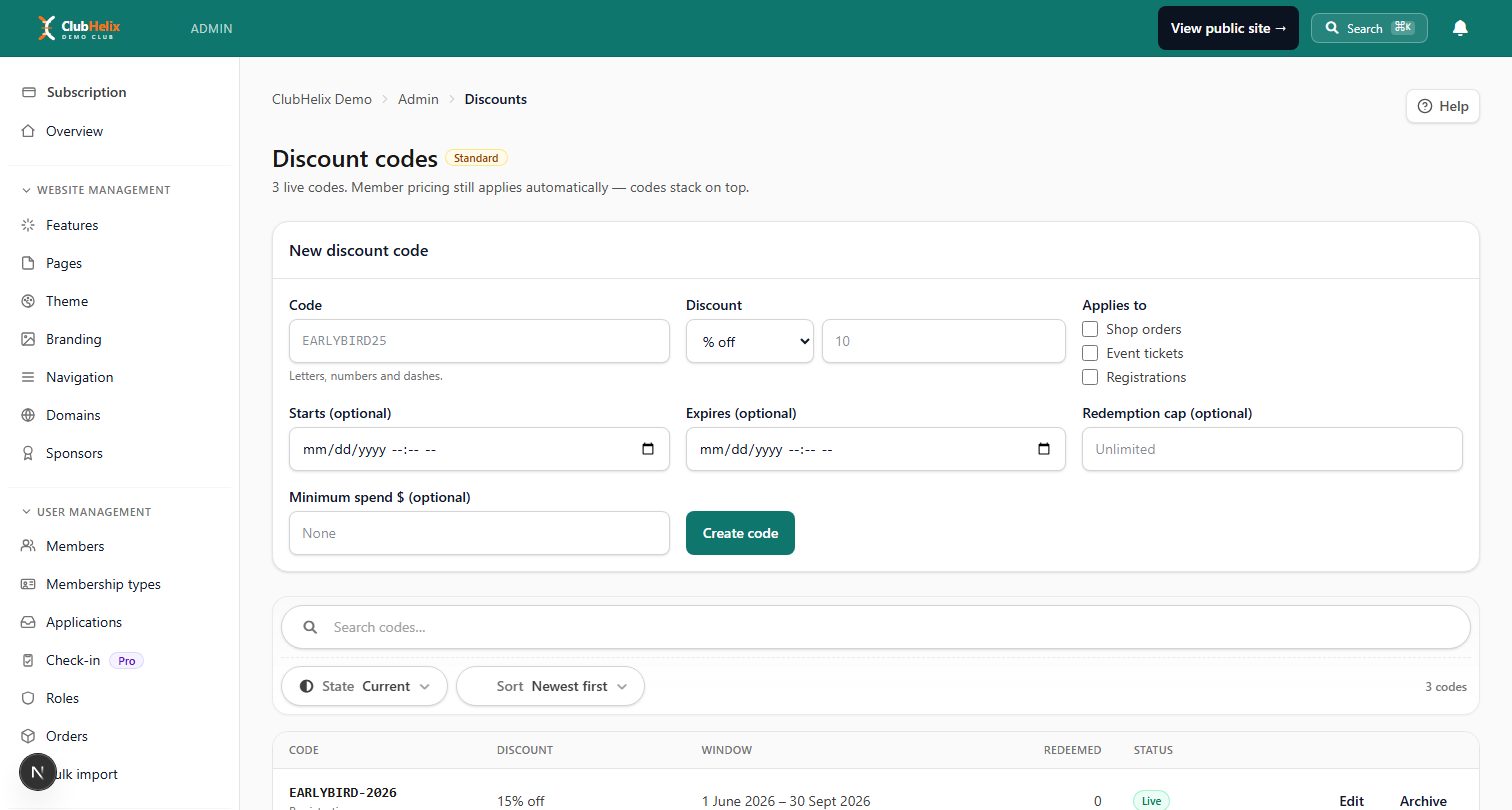
| A discount code on extra members | Each member registers and pays individually; a code takes the agreed percentage off the second and subsequent registrations | You run a sibling ladder, or fee levels differ a lot by member | Codes need usage caps and validity windows, or they escape into group chats |
In ClubHelix, both run on the same rails. Online registration collects each member with their own details, consents and emergency contacts, so your roster stays accurate whoever paid. Discount codes carry validity windows, usage caps and minimum spend, enforced at checkout rather than on the honour system — which is what stops a family code turning into a club-wide sale. And because every payment lands in the same ledger, reports will tell you at the end of the season exactly what the family discount cost, which is the number you were guessing at when you set it.
Two habits that make the numbers reusable next year:
- Give the family discount its own code or product, rather than folding it into a general early-bird. If it shares a line with everything else, you can never separate the two.
- Record the household on the member record, even when the discount does not apply. It is what makes the twenty-minute exercise above take twenty minutes rather than an afternoon.
Announcing a change without an AGM ambush
If you are changing an existing family price, the mechanics of the change matter as much as the number. Publish it before renewals open, not with them. Show the before-and-after for two or three real household shapes — one child, two children, four children — so nobody has to do arithmetic to work out whether they are worse off. Say why in one sentence, and tie it to something concrete such as a rising per-head levy. And if the change is significant, run it past a general meeting rather than a committee vote, because a family cap is one of the very few fee decisions members will genuinely argue about.
Setting it once and letting the system hold the line
The reason family pricing degrades is almost never the policy. It is that the policy lives in a document and the invoicing lives in someone's head. Every manual exception is a future reconciliation problem, and every honour-system code is a discount you have lost control of. Putting the rule where the money actually moves — a family membership type or a capped discount code applied at registration, with discount codes enforcing the caps and windows automatically — means the price the committee agreed is the price that gets charged, in July and in March.
ClubHelix gives your club a branded website with member registration, household-aware pricing, payments and the reports that tell you what your discounts actually cost, all in one place. There is a free tier to start on, the pricing is published in full with no setup fees, and you can create your club site and have your fee schedule live in an afternoon.
Frequently asked questions
Is a family cap or a sibling discount better for a club?
It depends entirely on your roster shape. A cap costs least at clubs where most multi-member households have exactly two members, because a cap set above two full fees never bites on them. A sibling ladder costs less at clubs with lots of three-and-four-member households, because it keeps charging something for every extra member instead of stopping. Count your households by size and cost both models before choosing.
How big should a family membership discount be?
Size it from your cost structure, not from what feels generous. Work out which of your costs genuinely scale with each additional member — registration levies, insurance, kit, coaching — and only discount the fixed portion. A discount that takes more than about 10% of gross membership revenue should be a deliberate, minuted decision rather than a habit, and no member should ever be priced below the pass-through costs they generate.
How should a club define a family for membership pricing?
Attach the discount to the person paying rather than to an address or a relationship. One responsible payer, a stated maximum number of members, and a written discretion clause for edge cases will handle separated parents, blended households, grandparent carers and foster arrangements without a registrar having to interrogate anyone at the sign-up desk.
Should governing-body fees be included in a family cap?
Generally no. Registration levies and insurance charged per head are money you collect and forward, so capping them means the club funds the difference out of its own reserves. Charge them per member as a clearly labelled separate line and apply the cap only to your club's own portion. Families still see a genuine saving, and the discount stays affordable year after year.
Can we change our family pricing part way through a season?
You can, but it is rarely worth the goodwill it costs. Announce changes before renewals open, show worked before-and-after examples for real household shapes, and honour the price anyone has already paid for the current season. If the change is substantial, take it to a general meeting rather than deciding it in committee.
Keep reading — how much should club membership cost works through the base fee that every family discount is a multiple of, and membership tiers vs one flat fee covers the structure it sits inside.


