
What this guide answers
- What should a club say in the first hour of a crisis?
Publicly, usually nothing yet. The first hour belongs to making people safe, establishing facts and telling the people directly affected by phone or in person.
- Who is allowed to speak to the media on behalf of a club?
One named spokesperson, with one named deputy for when they are unavailable or personally involved.
- Should a club delete social media comments during a crisis?
Turn comments off or moderate them tightly rather than deleting selectively, and never delete the club's own published statements.
- How do we tell members bad news without it leaking first?
Accept that you cannot fully prevent leaks, and design the sequence so the club is early rather than first.
- What is a holding statement and why does it matter?
It is a short, factual message issued before the full picture is known.
Canada edition. This guide is written for volunteer-run clubs in Canada. Where rules differ — grants, tax, incorporation, safeguarding — follow the Canada-specific pointers below or check with your national body.
Most club crises do not begin with a phone call from a journalist. They begin with a photo in a group chat, a parent asking a question in a comment thread at 9pm, or a committee member forwarding a message that starts "have you heard about". By the time anyone official knows, forty people already have a version of the story, and the club is not writing the first draft of it.
That is the uncomfortable truth about crisis communication at community level. You will almost never be the first to speak. What you can control is whether the club's voice arrives early enough to matter, whether it says something responsible, and whether it comes from one person or from six people improvising in different threads. Clubs rarely get into trouble because something bad happened. They get into trouble because of what the club said, or failed to say, in the hours afterwards.
This guide is written for volunteer committees, not communications professionals. It covers what counts as a crisis, the five decisions to make while nothing is wrong, a run sheet for the first two hours, a holding statement you can copy, the order in which people should hear from you, and the specific things clubs say that turn a bad weekend into a bad season. Everything here is general guidance — for anything involving a serious injury, a criminal matter, a child-safety concern or a legal claim, follow your governing body's procedures and take proper advice early.
What actually counts as a crisis
Not every bad day needs a statement. Treating a broken window like a scandal exhausts everyone; treating a serious allegation like a broken window is far worse. Grade the situation first, because the grade decides who is involved and how fast you move.
| Level | Examples | Who leads | First response |
|---|---|---|---|
| 1 — Operational | Cancelled round, burst pipe, gear stolen, a heated sideline argument | Duty officer or venue lead | Normal channels, normal tone, no escalation |
| 2 — Serious | Ambulance attends, a fight involving spectators, a safety failure, a significant financial loss | President plus one committee member | Facts gathered, members told same day, incident logged |
| 3 — Critical | A death, a serious allegation involving a member or official, suspected fraud, forced closure | President, secretary and the governing body | Holding statement, single spokesperson, external advice |
Two rules save a lot of argument in the moment. Grade up when unsure — it is easy to stand down a level-3 response and impossible to retrofit one. And write the grading down in your risk register so it is a club decision rather than one person's judgement on a stressful Saturday. Our guide to sports club risk management covers where that register lives.
Five decisions to make while nothing is wrong
Every one of these takes ten minutes at a committee meeting and is impossible to make well under pressure.
- Who speaks. One named spokesperson, usually the president, and one named deputy for when the president is unreachable, on holiday, or personally connected to the matter. Nobody else speaks for the club — not to media, not to other clubs, not in comment threads.
- Who authorises a statement. Normally two people: the spokesperson plus one other office-bearer. Two signatures is enough to prevent a panicked solo post and few enough to be achievable in twenty minutes.
- Where the club's word appears first. Your own website, then the direct channels you own. Anything you can only say on a platform you do not control is a hostage.
- Who keeps the log. One person records what was known, when, who was told and what was sent. This single habit protects the club more than any clever wording. Timestamped notes and the incident report form belong together.
- Who you must notify externally, and how fast. Insurer, governing body, landlord, regulator — write the list and the contact details now, while you can look them up calmly.
Clubs in Canada generally carry several duties at once — notifying the insurer, notifying the provincial or national sport organisation under its own policies, informing the facility owner or permit issuer, and, where a child is involved, duty-to-report obligations that vary by province and territory. Many sports also operate a national safe-sport mechanism with its own reporting route. Confirm what applies with your provincial body and keep the contacts written down.
The first two hours — a run sheet
Print this. Put it in the same folder as the first-aid kit and the ground keys.
| Time | Action |
|---|---|
| 0-15 min | Make people safe. Nothing else matters yet. Emergency services, first aid, clear the area, stop play. |
| 15-30 min | Call the spokesperson. Start the log. Write down what is known, what is not known, and who has been told already. |
| 30-45 min | Tell the committee in one message — facts only, plus the instruction that nobody else comments anywhere. |
| 45-60 min | Notify the external list — insurer, governing body, landlord, regulator, as applicable. |
| 60-90 min | Draft the holding statement. Two people authorise. Nothing goes out with a name, a cause or an opinion in it. |
| 90-120 min | Send to members. Publish on the club website. Pause scheduled posts. Turn comments off if the platform allows it. |
The pattern to notice: the club says nothing publicly for the first hour and a half, and that is deliberate. The first hour belongs to safety and facts. What breaks clubs is not a ninety-minute silence — it is a fifteen-minute guess.
The holding statement, and who may send it
A holding statement is not an explanation. It exists to do four things: confirm the club knows, show it is taking the matter seriously, say what happens next, and give one contact. That is all. Everything else is what you say once you actually know something.
The template
[Club name] statement — [date, time]
We are aware of an incident at [venue] on [date]. Our immediate priority is the wellbeing of everyone involved and their families.
The matter has been reported to [emergency services / our governing body / the relevant authorities] and we are supporting that process. Out of respect for those affected and to avoid interfering with that process, we will not be commenting on specifics or on individuals.
[Training and matches are proceeding as scheduled / All club activities are suspended until further notice]. We will provide an update by [time and date].
Members with questions or concerns should contact [name, role] at [email or phone]. Support is available — [details of your governing body's member-support line or a national support service].
— [Name], [role], on behalf of the [club name] committee
Fill in the brackets, read it aloud once, and check that every sentence is a fact you can defend at an inquiry. The commitment to "provide an update by" is the most important line in the template: it buys you time honestly, and it obliges you to come back.
Who is authorised to use it
Write this into your handbook in one paragraph:
- The spokesperson is the only person who speaks for the club publicly. Everyone else, without exception, replies "the club will make a statement — I'm not the right person to comment."
- Any statement needs two authorisers before it goes out.
- Coaches, team managers, committee members and volunteers do not comment on the incident in team chats, private groups, other clubs' pages or comment threads. Tell them this explicitly at the time, because "obviously" is not an instruction.
- Members are not gagged. You cannot and should not tell members what they may say as individuals. Ask, don't order — explain that speculation can hurt people and can compromise a process, and most people respond well to being asked.
Three variants worth pre-writing
- Serious injury. Add a line acknowledging the people who responded, and remove anything that speculates on cause. Never name the injured person without the family's explicit permission.
- An allegation involving a person connected to the club. Say that the matter has been referred to the appropriate body and that the club will not comment further. Do not describe the allegation, do not name anyone, do not indicate belief either way, and do not announce internal disciplinary steps before the external process has been consulted.
- Sudden closure or cancellation. Be specific about what is closed, for how long, and what happens to fees or bookings already paid. Vagueness here reads as evasion when it is usually just uncertainty, so state plainly what you do not yet know.
Sequencing — who hears it, in what order
The order matters more than the wording. People forgive a clumsy sentence. They do not forgive finding out about their own club from a stranger.
| Order | Audience | Channel | Timing |
|---|---|---|---|
| 1 | People directly involved and their families | In person or by phone, by a named person | Immediately, before anything else |
| 2 | Committee and staff | One group message, facts only | Within the first hour |
| 3 | Coaches, team managers, volunteers | Direct message with the "do not comment" line | Before members hear |
| 4 | Members and parents | Email plus SMS or push for anything urgent | Within two hours |
| 5 | Governing body, insurer, landlord, sponsors | Phone first, then written confirmation | Same day |
| 6 | The public and media | Website statement, then any media reply | After members, never before |
Three notes on that table. The people most affected are told by a human voice, never by a broadcast — a mass email that reaches an injured player's family as a bulk message is a wound the club inflicts on itself. Sponsors belong in the stakeholder tier, not the public tier; a sponsor who reads about it online has every right to be annoyed. And the media step is a reply, not an announcement: community clubs rarely need to call journalists, but they very often need a prepared answer when one calls them.
For the mechanics of routine club messaging — which channel for what, and how to stop six people sending six versions — see the club communication plan. Crisis messaging is the same architecture under load.
What not to say, and the social-media silence rule
The phrases below have hurt more community clubs than any journalist ever has.
- "No comment." It sounds like guilt. Use "the club will make a statement once we have accurate information" instead.
- Naming anyone — the injured, the accused, the accuser, a child, or the person who "started it".
- Speculating on cause. "We think the surface was fine" is an admission-shaped sentence and it will be quoted back to you.
- Anything that sounds like liability — apologies phrased as fault admissions, promises of compensation, statements about what insurance will cover. Express sympathy for people freely; leave the analysis of blame to the process.
- Minimising. "It was blown out of proportion" tells everyone affected that you are not taking them seriously.
- Pre-empting a process. Announcing that someone has been suspended, cleared, or "dealt with" before the relevant body has finished can damage both the person and the club.
- Off-the-record chats. At community level there is no such thing. Assume every message, every group chat and every conversation in the car park will be screenshotted.
The silence rule
The moment a level-3 situation is declared, the club's social channels go quiet:
- Pause every scheduled post. A cheerful sponsor promotion going out four hours after a serious incident is the image people will remember.
- Stop posting anything unrelated until the club has made its statement and given people somewhere to go with their questions.
- Turn off or heavily moderate comments on the statement itself. Not to hide criticism — to stop a comment thread naming people or repeating allegations while a process is underway.
- Do not argue with anyone, anywhere. No replies to critics, no corrections to rumours in other groups, no private-message debates. Correct the record once, in the club's own statement, and let it stand.
- Do not delete your own factual posts once published. Update them with a dated note instead. Deletion reads as concealment.
- Resume normal posting deliberately, with a short note that the club is returning to regular updates, rather than simply reappearing with a photo of a trophy.
Nominate one person to watch the channels during this period. Their job is to log what is being said and escalate anything that names an individual or misstates a fact — not to reply.

After the first day
The days after a crisis are where clubs either rebuild trust or slowly lose it. Ordinary club life resumes faster than anybody expects, and how you handle that transition is noticed.
- Keep the promise you made. If the statement said "an update by Thursday", send something on Thursday even if the update is "there is nothing new to report and the process continues."
- Hold a proper committee meeting and minute it. Decisions taken in a phone-call flurry need to become formal club decisions with a record. Structure and minutes matter here; see how to run a club AGM for the discipline of a well-run meeting, and use your standard minutes format rather than inventing one.
- Look after the people who responded. The volunteers who performed first aid, made the calls or held a crowd back frequently do worse afterwards than anyone realises. Contact each of them personally, and point them to your governing body's support arrangements.
- Answer the same question once, publicly. A short frequently-asked-questions note on the club website beats fifty individual replies and stops the answer drifting.
- Debrief within two weeks — while memory is fresh and before relief turns into avoidance. Four questions: what did we know and when, what worked, what did we say that we would not say again, and what goes in the pack for next time.
Feed the answers straight back into your incident records and risk register, so the club's second crisis is met by a system rather than by the same three exhausted people.
Getting the message out when it counts
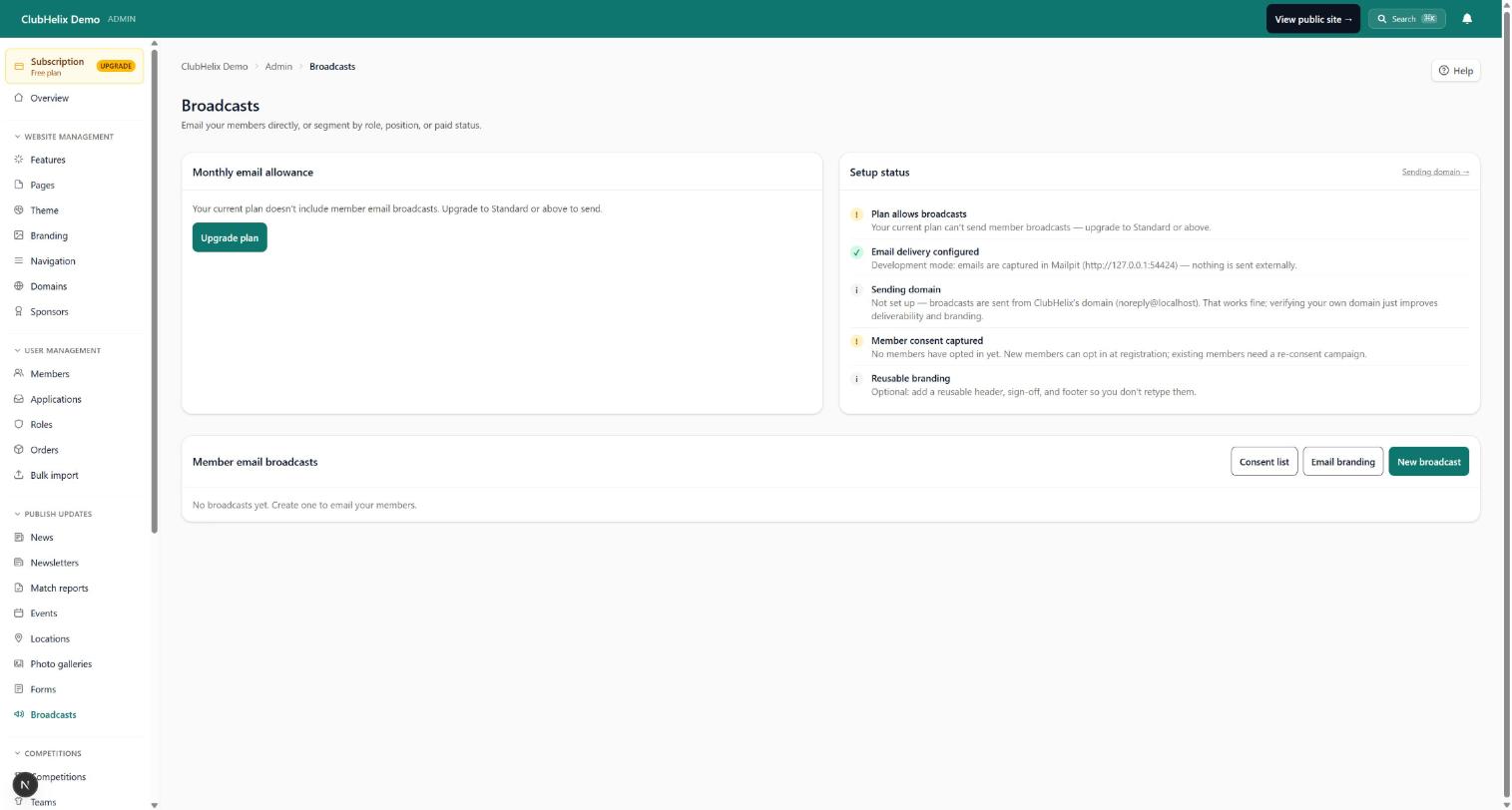
The practical bottleneck in a real crisis is almost never the wording — it is reaching everyone quickly, from an account that is unmistakably the club. Sending an authorised statement to every member from your own domain with email broadcasts, pushing the urgent version by SMS, and logging the facts as they emerge through incident reporting means the club's version arrives first, once, and from one place.
ClubHelix brings those together with your club website, so the statement, the member notice and the record all live in the same admin instead of three tools and one person's phone. There is a free tier to try it on, straightforward pricing when you outgrow it, and you can set your club up in an afternoon — ideally on a quiet week, which is exactly when this work should be done.
Frequently asked questions
What should a club say in the first hour of a crisis?
Publicly, usually nothing yet. The first hour belongs to making people safe, establishing facts and telling the people directly affected by phone or in person. Once two authorised office-bearers agree, issue a short holding statement that confirms the club is aware, expresses concern, says the matter has been reported to the appropriate authorities, and commits to a time for the next update.
Who is allowed to speak to the media on behalf of a club?
One named spokesperson, with one named deputy for when they are unavailable or personally involved. Everybody else — coaches, team managers, committee members, volunteers — declines politely and refers the enquiry on. Write the rule into your handbook before you need it, and remind people explicitly at the time, because assumptions do not survive a stressful weekend.
Should a club delete social media comments during a crisis?
Turn comments off or moderate them tightly rather than deleting selectively, and never delete the club's own published statements. Removing individual comments looks like concealment and usually provokes more posting. Moderation is defensible when the reason is protecting named individuals and an ongoing process, and it is worth saying that plainly.
How do we tell members bad news without it leaking first?
Accept that you cannot fully prevent leaks, and design the sequence so the club is early rather than first. Tell those directly affected personally, brief the committee and team officials with a clear instruction not to comment, then send members a single authorised message through email and SMS at the same moment the statement goes on the website.
What is a holding statement and why does it matter?
It is a short, factual message issued before the full picture is known. It confirms the club is aware, shows the matter is being handled seriously, states what happens next and gives one point of contact. It matters because it fills the vacuum that rumour otherwise fills, and it does so without speculating, naming anyone or pre-empting an investigation.
How long should a club stay quiet on social media after a serious incident?
Until the club has issued its statement and given members somewhere to take their questions, and longer for unrelated promotional content. Pause scheduled posts immediately, resume normal updates deliberately with a brief note rather than reappearing mid-celebration, and keep the pause proportionate to how serious the situation is.
Keep reading — the club communication plan sets up the channels this relies on, and the incident report form template is the record you will wish you had started early.


