
What this guide answers
- How long should a treasurer's report be?
One page for a monthly meeting. Two for a quarterly one.
- Should the report name members who owe money?
Not in the general report. Report the total and the ageing, and if the committee needs names — to authorise a hardship arrangement, or to suspend a membership — put them in a confidential annexure.
- Do we need an accountant?
For most small clubs, no — but the threshold at which a review or audit becomes required or expected is set by your legal structure and your revenue, not by preference.
- What if the numbers do not reconcile?
Report it. "The canteen float is $180 short and I am reconciling it" is a fine sentence in a treasurer's report and a terrible thing to discover has been hidden.
- How do we hand over to the next treasurer?
Not by handing over a laptop. If the club's finances live in a system the club owns rather than a spreadsheet on one person's machine, handover is a permission change.
South Africa edition. This guide is written for volunteer-run clubs in South Africa. Where rules differ — grants, tax, incorporation, safeguarding — follow the South Africa-specific pointers below or check with your national body.
The treasurer's report is the item on the agenda everyone waits for and nobody enjoys writing. Done badly, it is a printed bank statement and ten minutes of people asking questions the treasurer cannot answer without going back to the spreadsheet. Done well, it is one page that tells the committee three things: what came in, what is still owed, and whether the club is better or worse off than it was this time last year.
This is the template. It works for a committee of five running a junior club and for a board of twelve running a licensed venue, because the questions are the same at both ends — only the numbers change.
What a treasurer's report is actually for
A club treasurer's report has three jobs, and confusing them is why so many run long.
- Accountability. The committee is collectively responsible for the club's money. The report is how the treasurer discharges that — here is what happened, here is the evidence.
- Decision support. The committee is about to approve spending. They cannot do that responsibly without knowing the current position and what is already committed.
- Early warning. Most club financial trouble is visible months before it becomes a crisis, in a slow drift in one of the numbers below. The report is where somebody notices.
What it is not for is a transaction-by-transaction narration. If a committee member wants the detail, they can read the register — and you should make the register available rather than reading it aloud.
The five figures every report needs
Everything else is optional. These five are not.
1. Cash position. What the club holds right now, across every account, on a stated date. Not "about twelve thousand" — the figure, and the date it was true.
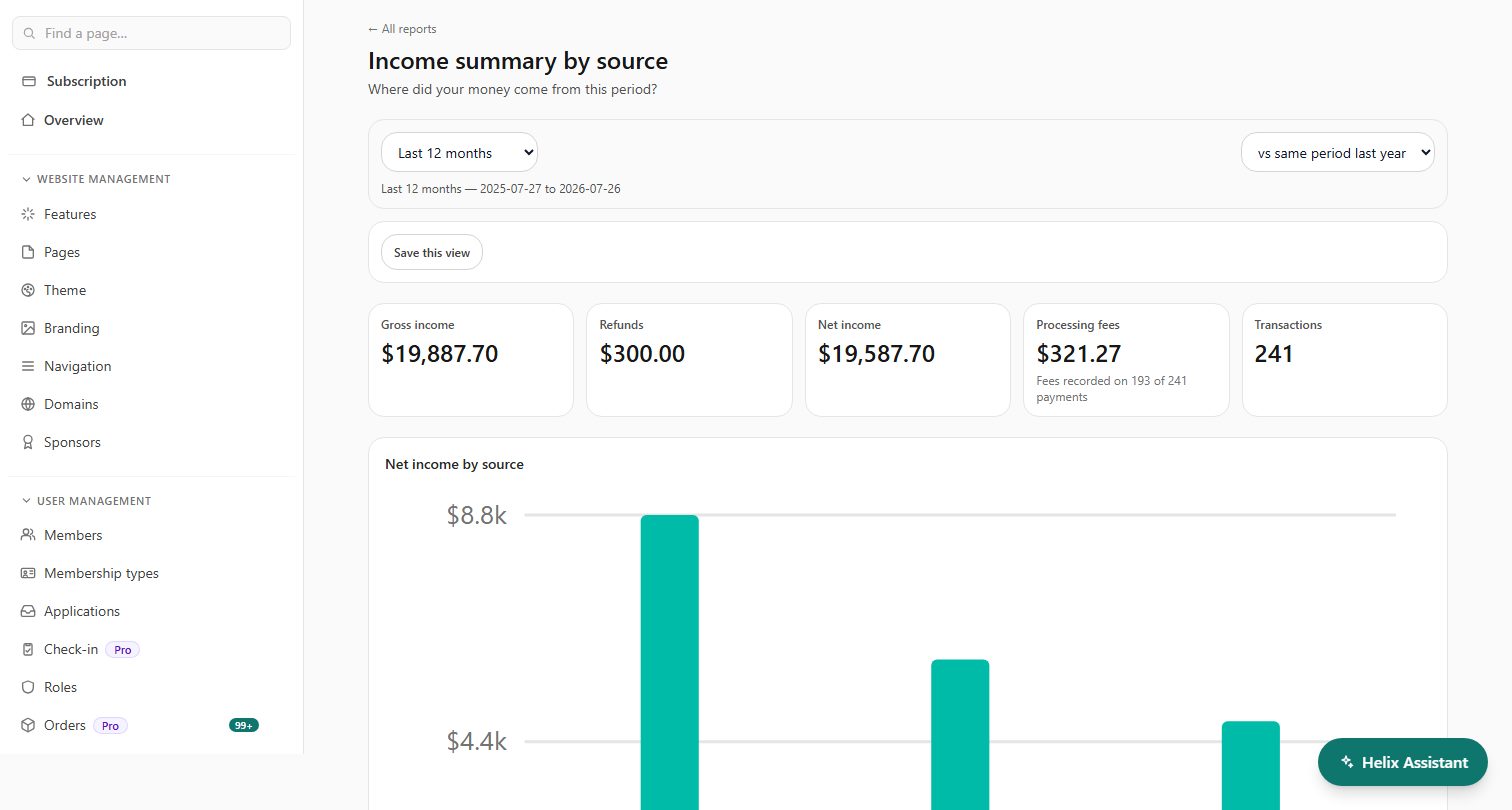
2. Income for the period, by source. Membership and registration fees, canteen or bar, merchandise, events, fundraising, grants, sponsorship, facility hire. Broken down by source, because "we took $14,000" tells the committee nothing about what to do next, and "$9,000 of it was rego and $400 was the canteen" tells them a great deal.
3. Expenditure for the period, by category. Grouped the same way every month so the comparison is meaningful.
4. Money owed to the club. Outstanding fees, unpaid invoices, sponsorship committed but not received — with an age against each. A club that is $8,000 up on paper and $6,000 of that is ninety days overdue is not $8,000 up.
5. Money the club owes. Approved but unpaid invoices, upcoming commitments, and anything the committee has voted to spend that has not yet left the account.
Report those five consistently and you have covered ninety per cent of what a committee needs. Add a comparison — the same period last year, or the same period last season — and you have covered the rest.
The template
Copy this into your meeting document. Replace the bracketed prompts.
Treasurer's report — [period], presented [date]
Position as at [date]
- Operating account: $[x]
- Savings / term deposit: $[x]
- Cash on hand (float, canteen tin): $[x]
- Total funds: $[x] — [up/down] $[x] on last month
Income this period — $[total]
| Source | This period | Same period last year |
|---|---|---|
| Membership & registration | $[x] | $[x] |
| Canteen / bar | $[x] | $[x] |
| Merchandise | $[x] | $[x] |
| Events & ticketing | $[x] | $[x] |
| Fundraising & donations | $[x] | $[x] |
| Grants | $[x] | $[x] |
| Sponsorship | $[x] | $[x] |
| Facility hire | $[x] | $[x] |
Expenditure this period — $[total]
Grouped as: competition and affiliation fees, ground and facility costs, equipment, insurance, utilities, coaching, administration, catering stock, other.
Owed to the club — $[total]
- Current (under 30 days): $[x]
- 30–60 days: $[x]
- 60–90 days: $[x]
- Over 90 days: $[x] — [number] members, [names withheld / listed in the confidential annexure]
Committed but not yet paid — $[total]
Matters for the committee
Two or three sentences, maximum. The one thing the committee needs to decide, notice or worry about. If there is nothing, say so — "no matters arising" is a legitimate and reassuring line.
Recommendation
"That the treasurer's report be accepted." Then it is minuted, and the position is on the record.
The wording that stops arguments
Three phrases save more meeting time than any spreadsheet formula.
"As at [date]" — every figure carries the date it was true. Half of all treasurer's-report disputes are two people quoting correct numbers from different days.
"On a cash basis" — say whether you are reporting money that has actually arrived, or money that has been invoiced. Community clubs almost always report cash received, because that is what is in the account. State it once at the top and the ambiguity disappears.
"This excludes…" — name what is deliberately not in the number. Grant money held for a specific purpose, a bond, a float. A committee that discovers an exclusion mid-meeting stops trusting the rest of the report.
Producing it in ten minutes
The reason treasurers dread this job is not arithmetic — it is collection. Fees in one system, canteen takings in a tin, merchandise on a card reader, event tickets on a third-party site, sponsorship in an email thread. Reconciling five sources is a weekend. Reading one is a coffee.
The fix is structural: take the money in one place, so the report is a query rather than a reconstruction. When registrations, shop orders, event tickets, donations and facility hire all land in the same ledger, income by source is a report you open, not a table you build. Add the comparison to the same period last year and the "are we better off?" question answers itself.
The other half is repetition. Use the same categories every month, in the same order. A committee reads a familiar report quickly and an unfamiliar one slowly, and the club gets a real trend line instead of twelve differently shaped snapshots. A monthly committee pack formalises this — the same reports, in the same order, arriving before the meeting rather than during it.

Reporting periods and the year-end
Most clubs run a financial year that suits their season and report to members at an annual general meeting after it closes. Quarterly reporting in a consistent shape keeps the treasurer producing one set of numbers rather than several.
If your club is a registered non-profit organisation or holds public benefit organisation status, annual reporting obligations attach to that registration. Your constitution and your registration decide what has to be presented, and by when.
Whatever the year-end, the discipline is the same: report the same figures in the same shape all year, and the annual report becomes a summary of twelve documents you already wrote.
Frequently asked questions
How long should a treasurer's report be?
One page for a monthly meeting. Two for a quarterly one. If it is longer, the detail belongs in an annexure the committee can read separately — the report itself should be short enough that people actually read it before the meeting.
Should the report name members who owe money?
Not in the general report. Report the total and the ageing, and if the committee needs names — to authorise a hardship arrangement, or to suspend a membership — put them in a confidential annexure. There is rarely a good reason for an individual's debt to appear in minutes that circulate widely.
Do we need an accountant?
For most small clubs, no — but the threshold at which a review or audit becomes required or expected is set by your legal structure and your revenue, not by preference. Read your constitution, then check your registration status. If either is unclear, an hour with an accountant is cheaper than getting it wrong at the annual general meeting.
What if the numbers do not reconcile?
Report it. "The canteen float is $180 short and I am reconciling it" is a fine sentence in a treasurer's report and a terrible thing to discover has been hidden. Committees forgive discrepancies; they do not forgive being told late.
How do we hand over to the next treasurer?
Not by handing over a laptop. If the club's finances live in a system the club owns rather than a spreadsheet on one person's machine, handover is a permission change. That single fact does more for continuity than any handover document, and it is worth fixing before the position turns over rather than after.


