
What this guide answers
- What is succession planning for a sports club?
It's the ongoing work of making sure every key role — committee positions especially — can change hands without the club losing knowledge, money or momentum: written role descriptions, an understudy doing part of each…
- How far in advance should we start looking for new committee members?
Twelve months — meaning immediately after each AGM, when understudies are named — with the direct recruiting conversations starting three to four months before the next AGM.
- How do we do a committee handover properly?
Four moves inside a fortnight of the AGM: deliver the handover pack (role description, deadline calendar, contacts, state of play); switch systems access from the old holders to the new in the club's own platform…
- What do we do if the same people have run the club for years?
Treat it as a risk, not a blessing, however excellent they are — long incumbencies concentrate knowledge and quietly convince everyone else the job is beyond them.
Ireland edition. This guide is written for volunteer-run clubs in Ireland. Where rules differ — grants, tax, incorporation, safeguarding — follow the Ireland-specific pointers below or check with your national body.
Ask any long-serving club president what keeps them up at night and it's rarely the finances or the fixtures. It's this: "If I stop, does the club stop?" Every season, good community clubs shrink, merge or fold — not for lack of players or money, but because a committee of tired volunteers reached an AGM where nobody would take the keys.
The uncomfortable truth is that succession crises are never really caused by the AGM where no one nominates. They're caused by the three years beforehand, when the club made its key roles bigger, lonelier and more mysterious until only a hero would take them — and heroes are in short supply. The good news: succession planning is not a dark art. It's a set of habits any committee can start this month, and this guide walks through all of them.
Why nobody wants the job (an honest diagnosis)
When members decline a committee role, they're almost always declining one of four specific things — and each has a specific fix:
- The role looks enormous — because the incumbent quietly absorbed three other jobs into it over the years. Fix: shrink and split roles back to their written descriptions.
- The role looks unknowable — everything lives in the incumbent's head, inbox and laptop, so a successor faces a year of archaeology. Fix: club-owned systems and a living handover pack.
- The role looks endless — the last three treasurers served "until they burned out", so accepting reads as a life sentence. Fix: visible, normal exits — fixed intentions, celebrated departures.
- They were never actually asked. The committee muttered "we need someone" at meetings, but no respected person ever looked a candidate in the eye and said "I think you'd be good at this". Fix: the personal ask, exactly as with recruiting any volunteer.
Notice what isn't on the list: apathy. Members aren't apathetic; they're rationally declining badly designed, badly transferred jobs. Redesign the jobs and the transfer, and the same members say yes.
The understudy system: succession's engine room
The single most effective succession structure is also the simplest: every key role has an understudy — a named person doing a real slice of the job this season.
Not a "shadow" who watches. A person who owns a piece:
- The treasurer's understudy runs the canteen float and reconciliation, or the gear-order invoicing.
- The secretary's understudy takes minutes at every second meeting and manages the club inbox one month in two.
- The president's understudy (often the vice-president, if you make the title real) chairs one meeting a season and runs one event end-to-end.
- The registrar's understudy runs registration day for one age group.
The understudy system works on three levels at once. The role's bus-factor problem disappears — someone else can already do part of the job. The understudy discovers the role is learnable, which demolishes objection #2. And the eventual AGM ask becomes tiny: "you already do half of this — will you take the title?" is a fundamentally different question from "will you become treasurer, whatever that involves?"
Put "every office holder names an understudy" on the first committee agenda after the AGM. It is the highest-leverage motion your club will pass all year.
The twelve-month succession timeline
Succession isn't an event before the AGM; it's a calendar. Here's the cycle, anchored to an AGM in month 12:
| Months | Succession activity |
|---|---|
| 1–2 (post-AGM) | New committee confirms role descriptions and hour estimates; every office holder names an understudy; access and permissions updated for all roles |
| 3–5 | Understudies take on their slice; committee starts a simple talent list — members with skills, new parents with energy, retiring players who love the club |
| 6–8 | Mid-season check: who intends to continue next year, who's stepping down? No pressure, just honesty — 6 months of runway beats 6 weeks |
| 9–10 | Personal asks begin for known vacancies; incumbents recruit their own successors; role descriptions refreshed to match reality |
| 11 | Nominations formally open with the AGM notice; every likely candidate has already been asked personally |
| 12 | AGM elects; outgoing office holders commit to 3 months of on-call support |
| 12+ | Handover pack delivered, systems access switched, bank signatories changed within a fortnight |
The mid-season intention check (months 6–8) is the step clubs skip and regret. It converts the AGM from a cliff-edge surprise into a managed transition — and it gives a tired office holder a legitimate, guilt-free way to signal the end, which paradoxically keeps people longer: volunteers who can see the exit stop planning their escape.
The handover pack: make the job takeable
A role is only as transferable as its documentation. Every office holder maintains a living handover pack — updated in month 11, not written at midnight before the AGM:
- The role, one page: duties, hours, season rhythm (what the pre-season looks like versus mid-season).
- The calendar: every deadline the role owns — regulator filings, insurance renewal, association affiliations, grant reporting — with dates.
- The contacts: the association contact, the ground or facility owner's officer, the bank, the auditor, key sponsors — names, emails, context ("Sue handles ground bookings; email, don't call").
- The systems: where everything lives and how access is granted. Not passwords in a document — accounts and roles in club-owned systems.
- The state of play: what's in flight, what's stuck, what the successor should tackle first.
One calendar item deserves a highlight: if the club is a company, officer changes are filed with the CRO, and clubs holding sports-body tax exemption keep their Revenue records current. Record the deadlines and logins in the pack, alongside the governing body and local sports partnership contacts.
Then the part most clubs get wrong: the club must own the infrastructure the pack points at. If the records live in a personal inbox, the website login belongs to someone's son, and the member list is a spreadsheet on a laptop, no document can transfer the role — the club has institutionalised dependence on individuals. Move the club onto systems where roles, not people, hold access: committee positions with scoped admin permissions that transfer in one click at handover, and the club's whole paper trail — minutes, resolutions and action items — in the club's own account, searchable by every future committee.
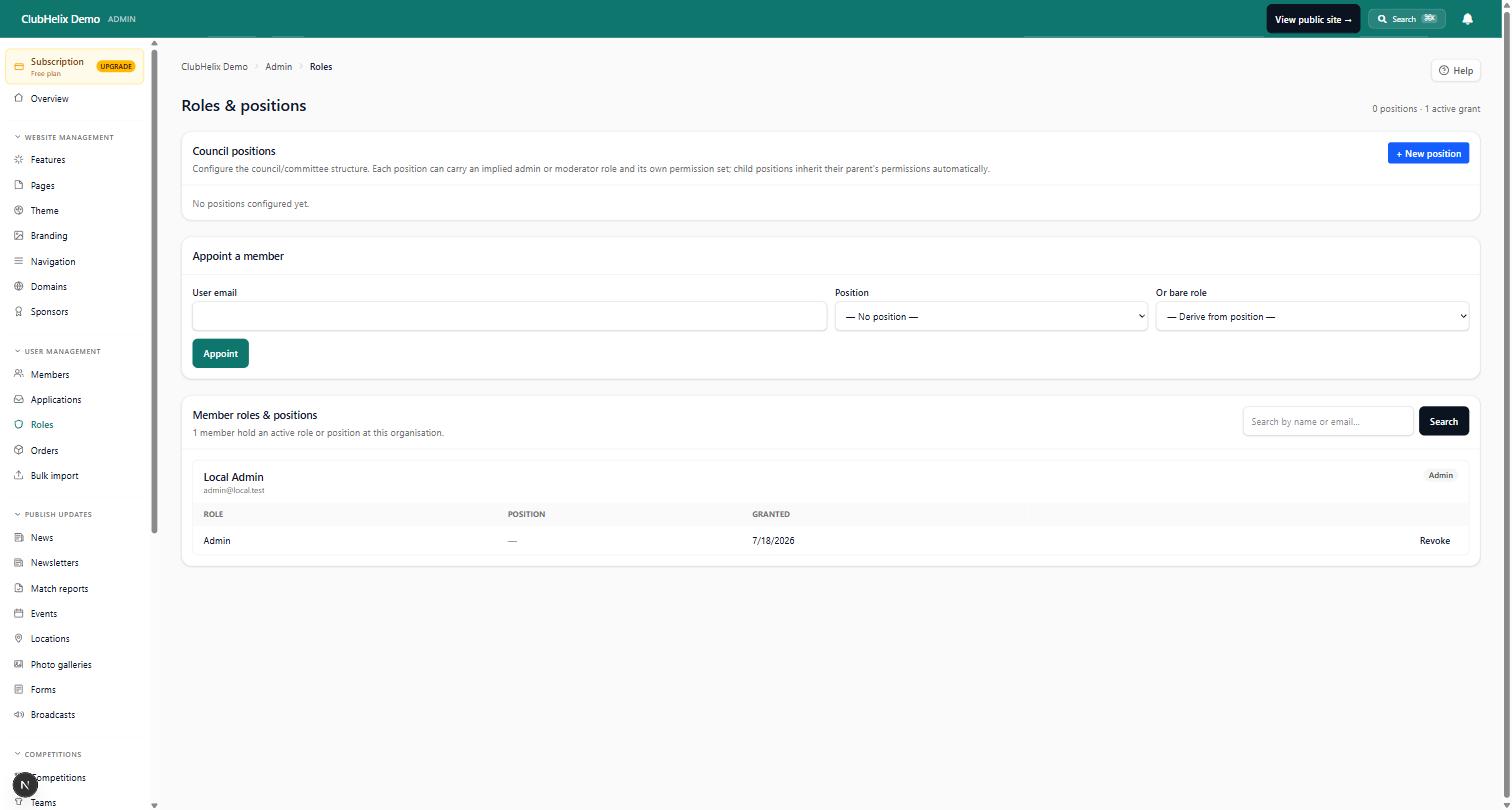
Done this way, handover is an afternoon: change the role holders, switch the permissions, update the bank. The new secretary reads five years of minutes in the same system the old one used. Nothing is lost, and — just as importantly — nothing looks mysterious to the next candidate deciding whether to nominate.
When nobody will be president
Sometimes the timeline wasn't run and the AGM is six weeks away with zero nominees. Triage options, in order:
- Split the role. Two co-presidents, or a president plus an operations lead. Half a big job gets yeses a whole one doesn't. Check your constitution allows it (many do; some need the second person titled vice-president).
- Term-limit the ask. "One year, and we'll run the succession plan properly behind you" is a genuinely different proposition from an open-ended reign. Put it in writing to the candidate.
- Shrink the job first, then re-ask. List everything the outgoing president actually did, hand the non-presidential parts to named others (events to a coordinator, sponsors to a sponsorship lead), and present the trimmed role.
- Look outside the usual suspects. Recently retired players, grandparents, past members whose kids have moved on — people with club love and newly free weekends. The talent list from month 3 is exactly for this.
- If truly nobody: the constitution's casual vacancy and caretaker provisions, and an honest general meeting about the club's future. Painful — and precisely the meeting the twelve-month timeline exists to prevent.

Frequently asked questions
What is succession planning for a sports club?
It's the ongoing work of making sure every key role — committee positions especially — can change hands without the club losing knowledge, money or momentum: written role descriptions, an understudy doing part of each key job, club-owned systems and records, a living handover pack, and personal recruitment of successors months before the AGM. The test is brutal and simple: if your president and treasurer both moved away tomorrow, would the club run next season? If not, succession planning is your most urgent project.
How far in advance should we start looking for new committee members?
Twelve months — meaning immediately after each AGM, when understudies are named — with the direct recruiting conversations starting three to four months before the next AGM. Six weeks out is too late for a considered yes; people need time to watch the role, ask questions and arrange their lives. The clubs that never have an AGM crisis are the ones where the outgoing treasurer has been quietly training and courting their successor since spring.
How do we do a committee handover properly?
Four moves inside a fortnight of the AGM: deliver the handover pack (role description, deadline calendar, contacts, state of play); switch systems access from the old holders to the new in the club's own platform rather than sharing passwords; change bank signatories and regulator records; and have each outgoing office holder commit to three months of on-call support for their successor. If handover takes longer than an afternoon of admin, the real problem is that the club's records live in personal accounts — fix that once and every future handover is easy.
What do we do if the same people have run the club for years?
Treat it as a risk, not a blessing, however excellent they are — long incumbencies concentrate knowledge and quietly convince everyone else the job is beyond them. Start gently: understudies for each long-held role, one meeting a season chaired by someone else, one event run end-to-end by a newcomer, and public celebration of partial stepping-back so exits look normal. Long-serving volunteers usually aren't clinging to power; they're staying because they can't see who else would do it. Show them.
ClubHelix makes clubs transferable: role-based admin access that switches in one click at handover, and every minute, motion and action item kept in the club's own account for the next committee. Start free and make your club bigger than any one volunteer.


